
Introduction: The Most Competitive Era in Tennis History
The debate over the greatest tennis player of all time — commonly known as the GOAT debate — has defined modern tennis for more than a decade. Unlike past generations where dominance was clear-cut, the 21st century has produced three players whose achievements overlap, intersect, and challenge traditional metrics of greatness.
Roger Federer. Rafael Nadal. Novak Djokovic.
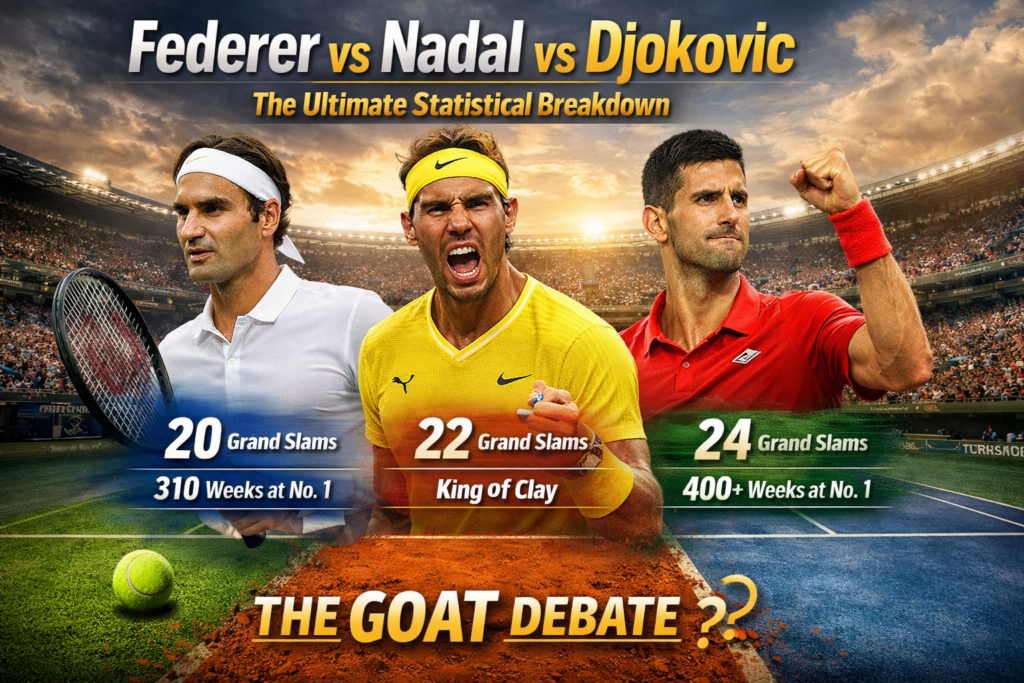
Each has redefined excellence in his own way. Each has broken records once thought untouchable. And each has built a legacy that transcends statistics.
But when we step away from emotion and fan loyalty, what does the data actually tell us?
This article provides a comprehensive statistical breakdown of the Big Three, analyzing Grand Slams, world rankings, head-to-head battles, surface performance, longevity, and overall impact on the sport.
1. Grand Slam Titles: The Foundation of Greatness
Grand Slam titles remain the most cited metric in the GOAT conversation.
Current totals:
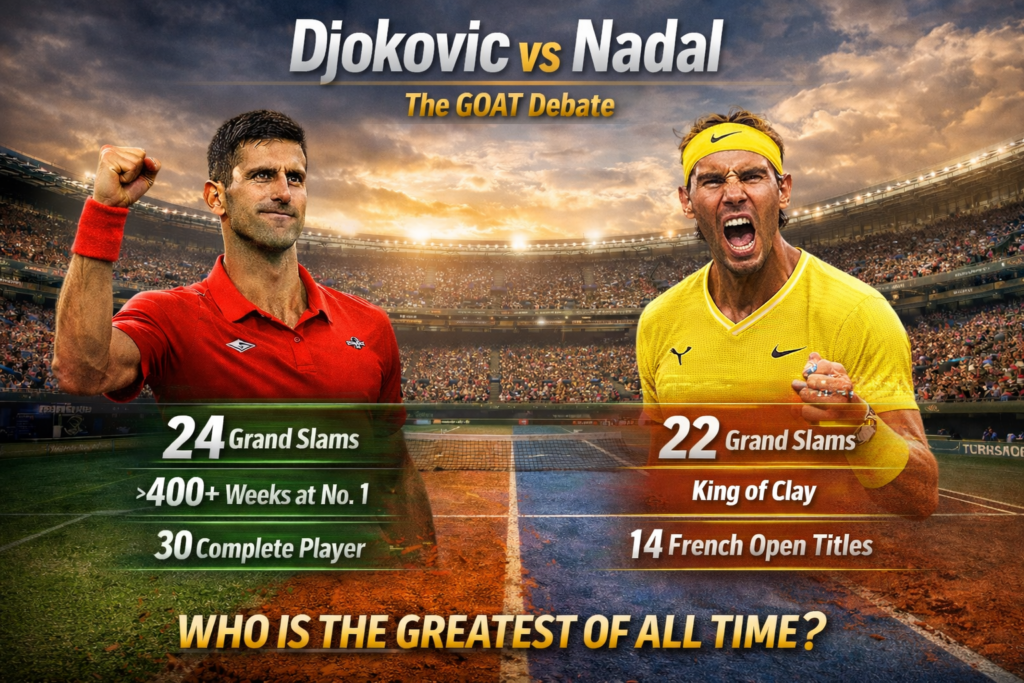
- Novak Djokovic – 24
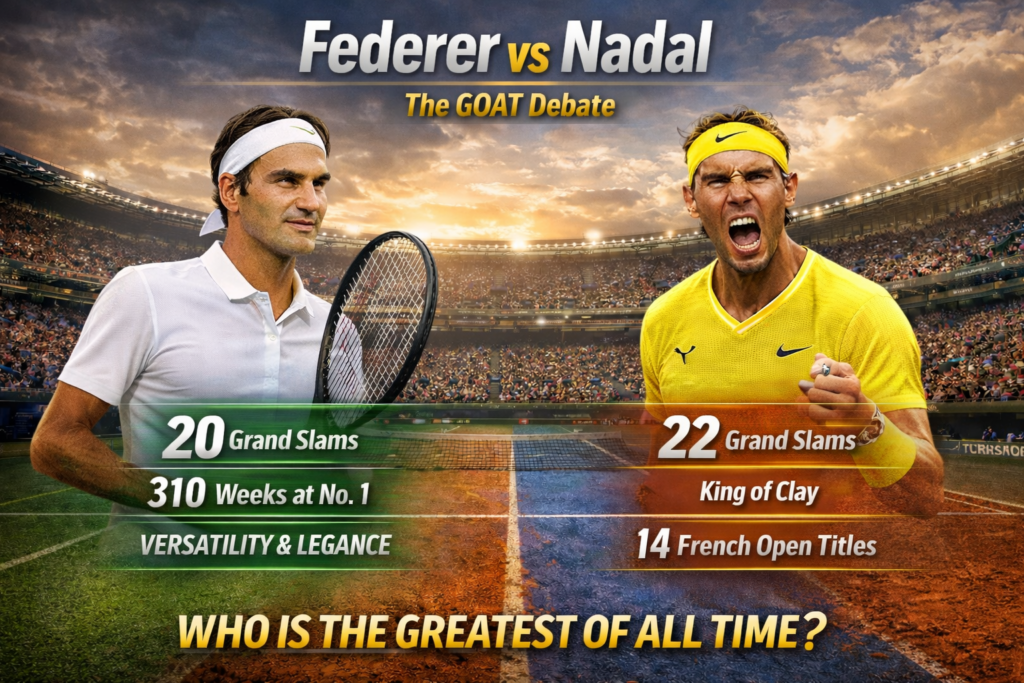
- Rafael Nadal – 22
- Roger Federer – 20
Grand Slams matter because they represent peak performance under maximum pressure — best-of-five matches, global attention, and the highest stakes in tennis.
However, context is critical.
Distribution of Slam Titles by Surface
Clay (French Open)
- Nadal: 14 titles
- Djokovic: 3
- Federer: 1
Nadal’s clay dominance is unprecedented in professional sports. Winning Roland Garros 14 times represents one of the most dominant single-tournament records in history.
Grass (Wimbledon)
- Federer: 8
- Djokovic: 7
- Nadal: 2
Federer’s early dominance on grass established his legacy. Djokovic later challenged that supremacy.
Hard Court (Australian Open + US Open)
Djokovic dominates this category with the most hard-court major titles overall, particularly at the Australian Open.
When evaluating surface balance, Djokovic holds the most evenly distributed success across all three surfaces.
2. Weeks at World No. 1: Sustained Excellence
Holding the No. 1 ranking requires year-round consistency — not just tournament peaks.
All-time weeks at No. 1:
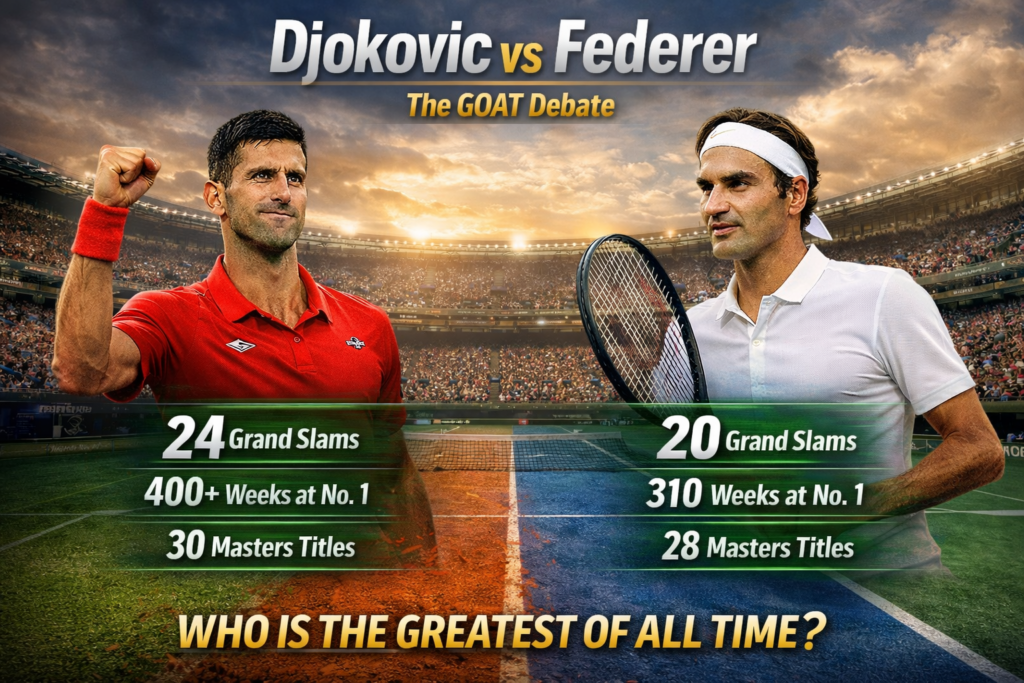
- Novak Djokovic – 400+ (record holder)
- Roger Federer – 310
- Rafael Nadal – 209
Djokovic not only surpassed Federer’s long-standing record, he extended it significantly. This metric reflects durability, scheduling intelligence, and consistent high-level performance across seasons.
Year-End No. 1 Finishes
Finishing a season ranked No. 1 is arguably more meaningful than total weeks, as it reflects dominance over an entire calendar year.
Djokovic leads this category as well.
This strengthens the argument that he sustained peak performance longer than his rivals.
3. Masters 1000 Titles and Tour-Level Dominance
Grand Slams are critical — but they occur only four times per year. Masters 1000 events test consistency at the highest level throughout the season.
Djokovic leads in Masters 1000 titles and is the only player to complete the Career Golden Masters (winning all nine Masters events) — and he has completed it twice.
This achievement reflects adaptability across surfaces and tournament conditions.
4. Head-to-Head Rivalries: Direct Competition Matters
Statistics gain even more meaning when players face each other directly.
Overall Head-to-Head:
- Djokovic leads both Federer and Nadal.
- Nadal leads Federer.
- Djokovic and Nadal have played the most matches in Open Era history.
This is crucial.
Unlike previous generations where dominance occurred without elite rivals at the same level, these three players repeatedly defeated each other in Grand Slam finals.
Djokovic’s positive head-to-head record against both rivals strengthens his statistical claim.
However, Nadal’s dominance over Federer — especially on clay — played a key role in shaping Federer’s legacy.
5. Surface Versatility and Adaptability
True greatness in tennis requires adaptability.
Clay
Nadal’s 14 French Open titles define clay-court excellence. His topspin-heavy forehand, defensive recovery, and physical endurance are perfectly suited for slower courts.
Grass
Federer’s serve-and-precision game thrived on grass. His movement and net play were unmatched during his prime years.
Hard Courts
Djokovic’s return game and defensive elasticity dominate on hard courts. His Australian Open record alone may define hard-court mastery in the Open Era.
When evaluating surface balance rather than specialization, Djokovic demonstrates the most complete cross-surface success.
6. Longevity and Late-Career Success
Longevity separates great players from legends.
Federer won Grand Slams into his late 30s, including a remarkable 2017 Australian Open comeback.
Nadal repeatedly returned from injury to win additional majors, showing extraordinary resilience.
Djokovic extended his peak into his mid-30s while maintaining elite physical conditioning and tactical evolution.
In terms of sustained dominance at the highest level beyond age 30, Djokovic holds the statistical advantage.
7. Mental Strength and Clutch Performance
High-pressure situations often determine greatness.
Djokovic holds one of the best records in five-set matches among the three. His performance in decisive sets and tiebreaks reflects exceptional mental composure.
Federer was often praised for elegance but occasionally struggled in extended baseline battles during his later years.
Nadal’s fighting spirit remains legendary — particularly in long clay-court matches.
However, statistically, Djokovic has converted more critical moments against elite opponents.
8. Era Strength and Competitive Depth
One of the strongest arguments in favor of the Big Three is the era in which they competed.
Unlike earlier decades where one player dominated weaker fields, Federer, Nadal, and Djokovic competed against:
- Each other
- Multiple Top 10 all-time talents
- Increased global depth in rankings
- Advanced sports science and analytics
Winning in this era arguably carries greater weight than raw numbers from previous generations.
9. Cultural Impact and Legacy Beyond Statistics
Numbers tell one story. Cultural influence tells another.
Federer
Expanded tennis into new global markets. Became a symbol of elegance and sportsmanship.
Nadal
Embodied resilience and humility. Inspired a generation through work ethic and perseverance.
Djokovic
Redefined modern preparation, flexibility training, and mental conditioning. Pushed the boundaries of professional longevity.
Each contributed differently to tennis history.
Final Analysis: Who Leads the GOAT Debate?
If evaluating purely by numbers:
- Most Grand Slams → Djokovic
- Most weeks at No. 1 → Djokovic
- Positive head-to-head vs rivals → Djokovic
- Masters titles → Djokovic
If evaluating dominance on a single surface → Nadal stands unmatched.
If evaluating elegance, influence, and early-era dominance → Federer remains iconic.
Statistically speaking, Novak Djokovic currently holds the strongest overall case. But greatness in sport is rarely determined by numbers alone.
You can check it:
Federer’s defeats to Djokovic at Wimbledon
Djokovic VS Sinner Head To Head
Djokovic vs Alcaraz Head-to-Head
The GOAT debate remains open — and perhaps that’s what makes this era unforgettable.
References:
- ATP Big Three Career Stats — Wikipedia
- Head-to-head records — ATP official

Tags: ATP rankings history, best tennis player ever, Big Three tennis, clay court dominance, Federer vs Nadal vs Djokovic, GOAT of tennis, grass court champions, greatest tennis player of all time, hard court tennis records, Masters 1000 titles, Novak Djokovic records, Rafael Nadal French Open, Roger Federer Wimbledon, tennis era comparison, tennis GOAT, tennis Grand Slam comparison, tennis head to head records, tennis legacy debate, tennis rivalry analysis, tennis statistics analysis
 Loading ...


