
Last Updated: August 2026
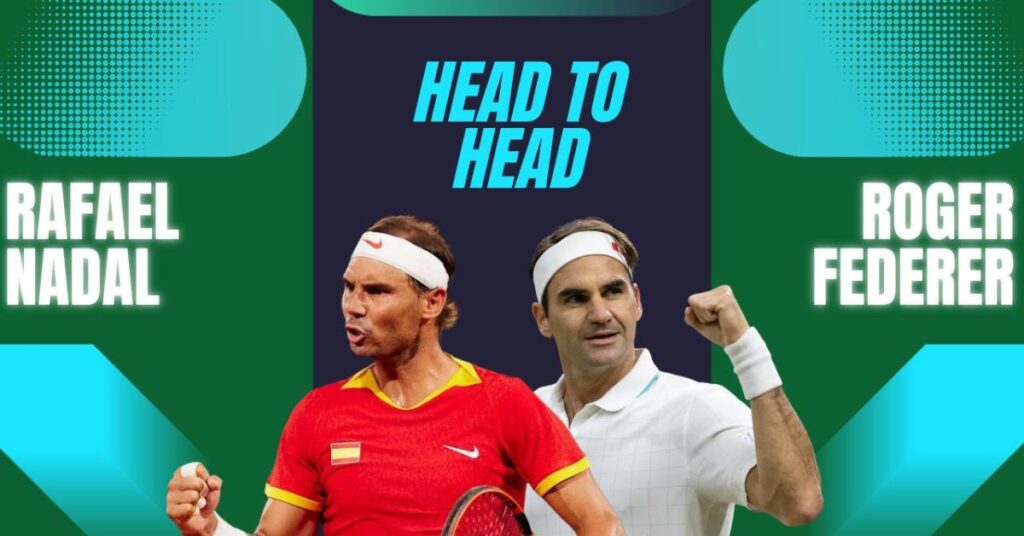
Rafael Nadal vs Roger Federer is one of the greatest rivalries in tennis history.
Two completely different playing styles. Two extraordinary champions. Forty professional matches. Fourteen Grand Slam meetings. Nine Grand Slam finals. And a rivalry that helped transform men’s tennis into a global sporting spectacle.
The final head-to-head record:
Rafael Nadal 24–16 Roger Federer
But that number alone does not explain the rivalry.
Federer held the advantage on hard courts and grass.
Nadal dominated on clay.
Federer controlled significant periods of their later rivalry.
Nadal won many of their biggest early matches, including the legendary 2008 Wimbledon final and 2009 Australian Open final.
Their careers became so interconnected that discussing one without the other is almost impossible.
This page provides the complete Nadal vs Federer head-to-head analysis: overall record, surface breakdown, Grand Slam meetings, finals, greatest matches, tactical matchup, career statistics and what their rivalry means to the tennis GOAT debate.
For complete individual career records, visit our Rafael Nadal career profile and Roger Federer career profile.
You can also compare both players within our Greatest Tennis Player of All Time analysis and see where fans currently place them in the Live Tennis GOAT Ranking.
Nadal vs Federer Head-to-Head: Quick Answer
Rafael Nadal and Roger Federer played 40 official tour-level matches.
Nadal won 24.
Federer won 16.
Final Nadal vs Federer Head-to-Head
| Category | Rafael Nadal | Roger Federer |
|---|---|---|
| Overall | 24 | 16 |
| Hard Court | 9 | 11 |
| Clay | 14 | 2 |
| Grass | 1 | 3 |
| Grand Slam Matches | 10 | 4 |
| Grand Slam Finals | 6 | 3 |
| Total Meetings | 40 | 40 |
The surface breakdown immediately reveals one of the most important truths about the rivalry:
Nadal’s overall head-to-head advantage was driven heavily by his extraordinary dominance on clay.
Outside clay, Federer led their rivalry.
On hard courts and grass combined, Federer held a 14–10 advantage.
That distinction matters when interpreting the final 24–16 record.
Nadal vs Federer Head-to-Head by Surface
The Nadal–Federer rivalry changed dramatically depending on the court beneath their feet.
Nadal vs Federer on Clay
Nadal leads 14–2.
Clay was overwhelmingly Nadal’s territory.
Federer was himself an elite clay-court player. He won Roland Garros, completed the Career Grand Slam and reached multiple French Open finals.
Against Nadal, however, the matchup became exceptionally difficult.
Nadal’s heavy left-handed forehand repeatedly attacked Federer’s one-handed backhand at shoulder height.
Clay increased the height of the bounce and gave Nadal additional time to defend.
Those conditions magnified Nadal’s greatest strengths while making Federer’s preferred attacking patterns more difficult to execute.
The result:
14 wins for Nadal.
2 for Federer.
This clay-court advantage accounts for a large portion of Nadal’s overall head-to-head lead.
Nadal vs Federer on Hard Courts
Federer leads 11–9.
Hard courts produced a much more balanced rivalry.
Federer’s serve became more effective.
His aggressive first-strike tennis was easier to impose.
The lower and faster conditions on many hard courts made Nadal’s topspin less overwhelming than on clay.
Federer’s 11–9 advantage demonstrates why describing the rivalry simply as “Nadal dominated Federer” is incomplete.
Away from clay, the matchup looked very different.
Nadal vs Federer on Grass
Federer leads 3–1.
They played only four official grass-court matches.
All four came at Wimbledon.
Federer won:
2006 Wimbledon Final
2007 Wimbledon Final
2019 Wimbledon Semifinal
Nadal won:
2008 Wimbledon Final
That one Nadal victory, however, became perhaps the most famous match the two ever played.
Nadal vs Federer Grand Slam Head-to-Head
The two champions met 14 times at Grand Slam tournaments.
Nadal led those meetings:
10–4.
Grand Slam Head-to-Head by Tournament
| Grand Slam | Nadal | Federer |
|---|---|---|
| Australian Open | 3 | 1 |
| Roland Garros | 6 | 0 |
| Wimbledon | 1 | 3 |
| US Open | 0 | 0 |
| Total | 10 | 4 |
One remarkable fact:
Rafael Nadal and Roger Federer never played each other at the US Open.
Despite combining for nine US Open singles championships, the draw never produced a Federer–Nadal meeting in New York.
Nadal vs Federer at the Australian Open
Nadal led their Australian Open rivalry 3–1.
Their four meetings included some enormously important matches.
2009 Australian Open Final
Nadal defeated Federer: 7–5, 3–6, 7–6, 3–6, 6–2
Nadal entered the final after surviving an exhausting five-set semifinal against Fernando Verdasco.
Federer was attempting to equal Pete Sampras’ then-record of 14 Grand Slam singles titles.
Instead, Nadal won another five-set battle.
It was Nadal’s first Australian Open championship.
The emotional trophy ceremony became one of the defining images of their rivalry.
2012 Australian Open Semifinal
Nadal defeated Federer in four sets.
Federer won the opening set before Nadal took control and advanced to the final.
Nadal would then face Novak Djokovic in one of the longest and most physically demanding Grand Slam finals ever played.
2014 Australian Open Semifinal
Nadal defeated Federer in straight sets.
At that point, the matchup had become increasingly difficult for Federer, particularly in major tournaments.
2017 Australian Open Final
Federer defeated Nadal: 6–4, 3–6, 6–1, 3–6, 6–3
This became one of the most important victories of Federer’s career.
Federer was 35.
He had missed six months of competition.
Neither man had won a Grand Slam title for several years.
Yet somehow they met again in a major final.
Nadal led by a break in the fifth set.
Federer came back.
The victory gave Federer his 18th Grand Slam championship and ended his long run of major defeats against Nadal.
For Federer supporters, it remains one of the defining matches of his career.
Nadal vs Federer at Roland Garros
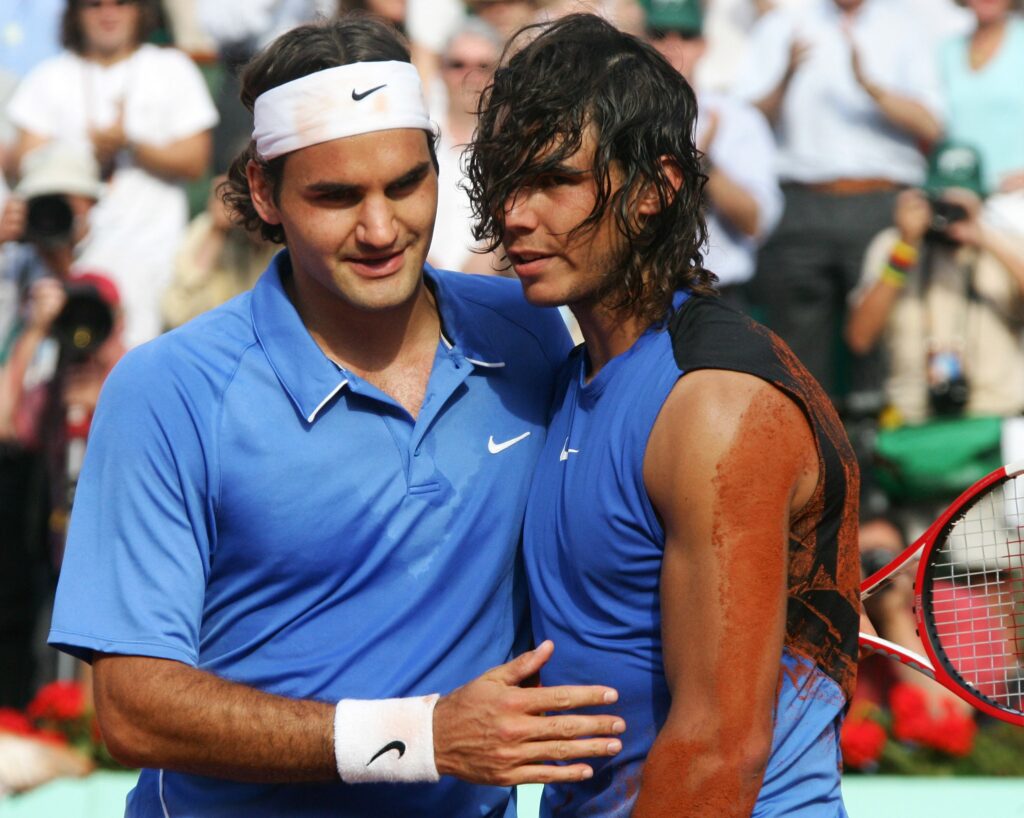
At Roland Garros, the rivalry was completely one-sided.
Nadal 6–0 Federer.
They met in Paris six times:
- 2005 semifinal
- 2006 final
- 2007 final
- 2008 final
- 2011 final
- 2019 semifinal
Nadal won every match.
Federer never defeated Nadal at Roland Garros.
That fact is particularly striking because Federer was one of the best clay-court players of his generation.
Against almost anyone else, his clay résumé would have been extraordinary.
Against Nadal in Paris, it was not enough.
2005 Roland Garros Semifinal
Their first Grand Slam meeting came on Nadal’s 19th birthday.
Federer entered as World No. 1.
Nadal was playing Roland Garros for the first time.
Nadal won in four sets.
Two days later, he captured his first Grand Slam championship.
The result foreshadowed the rivalry that would define the next several years.
2006 Roland Garros Final
This was the first Grand Slam final between Nadal and Federer.
Federer won the opening set 6–1.
Nadal responded and won the next three.
It became the beginning of a recurring story:
Federer chasing Roland Garros.
Nadal standing in the way.
2007 Roland Garros Final
Federer reached the final again.
Nadal defeated him again.
Federer’s pursuit of the Career Grand Slam would have to wait.
2008 Roland Garros Final
This was their most one-sided Grand Slam final.
Nadal defeated Federer:
6–1, 6–3, 6–0.
It remains one of the clearest demonstrations of Nadal’s peak clay-court dominance.
Only weeks later, however, Federer and Nadal would produce a dramatically different match at Wimbledon.
2011 Roland Garros Final
Federer entered the final after defeating Novak Djokovic in the semifinals.
Nadal once again proved too strong.
The Spaniard won in four sets.
2019 Roland Garros Semifinal
Eight years after their previous meeting in Paris, Federer and Nadal faced each other at Roland Garros for the final time.
Nadal won:
6–3, 6–4, 6–2.
His final Roland Garros record against Federer:
6–0.
Nadal vs Federer at Wimbledon
Their Wimbledon rivalry produced four matches.
Federer led:
3–1.
But those four encounters contain one of the most important chapters in modern tennis history.
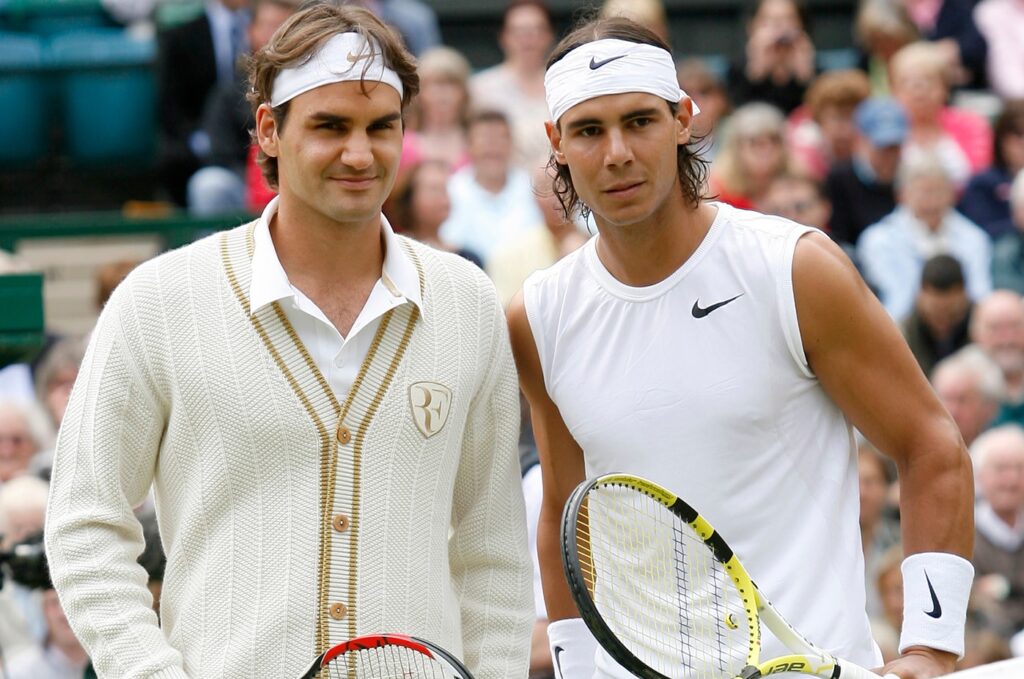
2006 Wimbledon Final
Federer defeated Nadal in four sets.
Nadal’s appearance in the final itself was significant.
The player already dominating clay had demonstrated that he could compete at the highest level on grass.
2007 Wimbledon Final
This time Nadal pushed Federer to five sets.
Federer eventually won:
7–6, 4–6, 7–6, 2–6, 6–2.
Federer captured his fifth consecutive Wimbledon championship.
But Nadal was getting closer.
One year later, everything changed.
2008 Wimbledon Final: Their Greatest Match?
Nadal defeated Federer: 6–4, 6–4, 6–7, 6–7, 9–7
For many tennis fans, this is the defining Nadal–Federer match.
Federer entered the final as the five-time defending Wimbledon champion.
Nadal had lost to him in the previous two finals.
Nadal won the first two sets.
Federer fought back.
He survived championship points.
He won consecutive tie-breaks.
Darkness approached.
And after nearly five hours of tennis interrupted by rain, Nadal finally broke through.
The victory ended Federer’s five-year Wimbledon reign and gave Nadal his first Grand Slam championship away from Roland Garros.
It also changed the rivalry.
Nadal was no longer merely the man who could stop Federer on clay.
He had beaten him on Federer’s greatest court.
2019 Wimbledon Semifinal
Eleven years passed before they played each other again on grass.
Federer was nearly 38.
Nadal was 33.
They were still competing for Grand Slam championships.
Federer won:
7–6, 1–6, 6–3, 6–4.
It became their final Wimbledon meeting and one of Federer’s most impressive late-career victories.
He advanced to the final against Djokovic.
Why Did Nadal Trouble Federer So Much?
The Nadal–Federer rivalry was fascinating because it was not simply a contest between two great players.
It was a tactical matchup.
And for much of their careers, Nadal possessed tools that directly challenged Federer’s preferred style.
Nadal’s Forehand vs Federer’s Backhand
This was the central tactical pattern.
Nadal is left-handed.
Federer is right-handed and used a one-handed backhand.
Nadal’s crosscourt forehand therefore naturally traveled toward Federer’s backhand.
But it wasn’t an ordinary forehand.
Nadal generated enormous topspin.
On clay, the ball could rise aggressively above Federer’s preferred contact zone.
Federer was forced to strike repeated high one-handed backhands.
That made it difficult for him to attack.
Nadal could repeat the pattern again and again.
Nadal’s Defense Extended Rallies
Federer’s greatest tennis frequently came when he controlled points quickly.
Nadal made that difficult.
Shots that would end points against other players often came back.
Federer therefore had to hit additional attacking shots.
That increased risk.
And when Federer became impatient, errors followed.
Nadal Attacked Federer’s Rhythm
Federer often played with extraordinary speed between shots.
Nadal’s looping trajectories, defensive court position and heavy spin changed that rhythm.
Federer could not simply play the same patterns he used successfully against much of the tour.
He had to solve a different problem.
How Federer Eventually Changed the Matchup
The rivalry did not remain static.
Federer adapted.
The clearest evidence came late in their careers.
From Basel 2015 through Wimbledon 2019, Federer won six of their final seven meetings.
A major reason was his willingness to become more aggressive with his backhand.
Federer Took the Backhand Earlier
Rather than allowing Nadal’s topspin forehand to climb high, Federer increasingly stepped forward.
He took the ball earlier.
That reduced Nadal’s time.
It also turned a historically defensive wing into an attacking weapon.
The adjustment became particularly visible during Federer’s extraordinary 2017 season.
Federer Shortened Points
Federer also looked to prevent Nadal from turning matches into extended physical battles.
He served aggressively.
He attacked earlier.
He moved forward.
He attempted to dictate rather than react.
The strategy carried greater risk.
But it also gave Federer a better opportunity to control the matchup.
The 2017 Turning Point
Federer’s 2017 results against Nadal deserve special attention.
He defeated Nadal four times that year:
Australian Open
Indian Wells
Miami
Shanghai
For a rivalry Nadal had controlled for so long, this was extraordinary.
The Australian Open final was the most important.
But collectively, those victories demonstrated that Federer had finally found a more effective tactical solution.
The rivalry was evolving even in its final years.
Nadal vs Federer in Finals
Federer and Nadal met repeatedly with championships at stake.
According to ATP records, they played 24 tour-level finals against each other.
Nadal led those finals:
14–10.
Their championship matches included:
- Grand Slam finals
- Masters 1000 finals
- ATP-level finals
Most importantly, they played nine Grand Slam finals.
Nadal won six.
Federer won three.
Few rivalries in tennis history have been contested so frequently with the sport’s biggest trophies directly on the line.
Nadal vs Federer Grand Slam Finals
| Tournament | Year | Winner |
|---|---|---|
| Roland Garros | 2006 | Nadal |
| Wimbledon | 2006 | Federer |
| Roland Garros | 2007 | Nadal |
| Wimbledon | 2007 | Federer |
| Roland Garros | 2008 | Nadal |
| Wimbledon | 2008 | Nadal |
| Australian Open | 2009 | Nadal |
| Roland Garros | 2011 | Nadal |
| Australian Open | 2017 | Federer |
Grand Slam final record: Nadal 6–3 Federer.
This is one of the strongest components of Nadal’s head-to-head case.
But again, surface matters.
Four of Nadal’s six Grand Slam final victories came at Roland Garros.
Federer’s three victories came at Wimbledon twice and the Australian Open once.
The Greatest Nadal vs Federer Matches
Ranking matches is subjective.
But several encounters are essential to understanding the rivalry.
1. Wimbledon Final – 2008
Winner: Nadal
The defining match.
Five sets.
Rain delays.
Championship points saved.
Near darkness.
The end of Federer’s Wimbledon reign.
Nadal’s arrival as an all-surface Grand Slam champion.
2. Australian Open Final – 2017
Winner: Federer
Perhaps the defining late-career match.
Two legends returning from difficult periods.
Five sets.
Nadal ahead in the fifth.
Federer fighting back.
Grand Slam No. 18.
3. Rome Final – 2006
Winner: Nadal
One of their greatest non-Grand Slam encounters.
The match lasted more than five hours.
Federer held match points.
Nadal survived.
The match became another early demonstration of the extraordinary mental and physical challenge Nadal presented on clay.
4. Wimbledon Final – 2007
Winner: Federer
Nadal pushed Federer to five sets.
Federer survived and won his fifth consecutive Wimbledon title.
The match set the stage for what happened one year later.
5. Australian Open Final – 2009
Winner: Nadal
Another five-set Grand Slam final.
Nadal proved that his success against Federer could translate from clay and grass to a hard-court major.
6. Miami Final – 2005
Winner: Federer
Nadal led by two sets.
Federer came back to win in five.
It was one of the earliest signs that their rivalry could become something special.
7. Wimbledon Semifinal – 2019
Winner: Federer
Their final grass-court meeting.
Federer defeated Nadal for the first time at Wimbledon since 2007.
Nadal vs Federer: Career Statistics Comparison
Head-to-head results tell us what happened when the two players faced each other.
Career statistics answer a different question:
What did each player accomplish against the entire tour?
| Career Achievement | Rafael Nadal | Roger Federer |
|---|---|---|
| Grand Slam Titles | 22 | 20 |
| Australian Open | 2 | 6 |
| Roland Garros | 14 | 1 |
| Wimbledon | 2 | 8 |
| US Open | 4 | 5 |
| Weeks at World No. 1 | 209 | 310 |
| Year-End No. 1 Finishes | 5 | 5 |
| Tour-Level Singles Titles | 92 | 103 |
| Career Singles Wins | 1,075 | 1,251 |
| Masters 1000 Titles | 36 | 28 |
| ATP Finals Titles | 0 | 6 |
| Career Grand Slam | Yes | Yes |
| Olympic Singles Gold | Yes | No |
| Olympic Doubles Gold | Yes | Yes |
This comparison demonstrates why there is no single statistic capable of settling their historical ranking.
Nadal finished with more Grand Slam titles and Masters 1000 championships.
Federer accumulated more weeks at No. 1, more overall titles, more career victories and six ATP Finals championships.
Nadal won Olympic singles gold.
Federer achieved greater Wimbledon success.
Nadal achieved unprecedented Roland Garros dominance.
Different criteria produce different arguments.
Nadal vs Federer Grand Slam Comparison
Rafael Nadal
22 Grand Slam titles
- Australian Open: 2
- Roland Garros: 14
- Wimbledon: 2
- US Open: 4
Roger Federer
20 Grand Slam titles
- Australian Open: 6
- Roland Garros: 1
- Wimbledon: 8
- US Open: 5
Nadal leads the overall Grand Slam count:
22–20.
But their distributions are dramatically different.
Nadal’s résumé is dominated by Roland Garros.
Federer’s titles are more heavily distributed between Wimbledon, the Australian Open and US Open.
Both completed the Career Grand Slam.
That makes the comparison more interesting than simply 22 versus 20.
Nadal vs Federer: Who Was Better on Clay?
This is the easiest surface question to answer.
Rafael Nadal.
The head-to-head:
Nadal 14–2 Federer.
At Roland Garros:
Nadal 6–0 Federer.
Nadal also finished his career with 14 Roland Garros titles.
Federer won one.
Federer was an outstanding clay-court player.
Nadal was the greatest clay-court player of his era and possesses perhaps the strongest statistical case as the greatest clay-court player ever.
There is no serious statistical argument for Federer over Nadal on clay.
Nadal vs Federer: Who Was Better on Grass?
Roger Federer.
Federer won a men’s record eight Wimbledon singles championships.
Nadal won two.
Federer also led their grass head-to-head:
3–1.
Nadal’s 2008 Wimbledon victory remains one of the greatest wins of his career, but across their complete careers, Federer achieved significantly more on grass.
Nadal vs Federer: Who Was Better on Hard Courts?
This comparison is closer.
In their direct rivalry:
Federer led 11–9.
In Grand Slam hard-court titles:
Federer won 11.
Nadal won 6.
Federer therefore has the stronger overall statistical case on hard courts.
Nadal, however, defeated Federer in the 2009 Australian Open final and won major hard-court titles across a long period.
Both belong among the great hard-court players of the Open Era.
Nadal vs Federer: Who Had the Better Peak?
This question depends heavily on how peak performance is defined.
Federer’s strongest period came from roughly 2004 through 2007.
During those four seasons, he won 11 Grand Slam titles and remained World No. 1 for an extraordinary uninterrupted period.
Nadal’s greatest dominance was more surface-specific.
At his peak on clay, he reached a level Federer—or anyone else—could not solve consistently.
Nadal’s 2008 and 2010 seasons also demonstrated extraordinary all-surface performance.
If peak means sustained dominance across the entire tour, Federer has a powerful argument.
If peak means the highest level of dominance on a particular surface, Nadal’s clay résumé is almost impossible to challenge.
Nadal vs Federer: Who Had Greater Longevity?
Both had extraordinary longevity.
Federer won his first Grand Slam in 2003 and his final one in 2018.
Nadal won his first in 2005 and his final one in 2022.
Federer remained a major contender into his late 30s.
Nadal repeatedly returned from significant physical problems and continued winning Grand Slam tournaments well into his 30s.
There is no simple winner here.
They demonstrated longevity in different ways.
Nadal vs Federer: Playing Style Comparison
Their contrasting styles helped make the rivalry so compelling.
| Attribute | Rafael Nadal | Roger Federer |
|---|---|---|
| Dominant Hand | Left | Right |
| Backhand | Two-handed | One-handed |
| Primary Strength | Heavy topspin & physical pressure | Attacking variety & early ball striking |
| Best Surface | Clay | Grass |
| Movement Style | Explosive defensive coverage | Efficient attacking movement |
| Forehand | Extreme topspin | Aggressive variety |
| Net Game | Strong | Exceptional |
| Defensive Strength | Exceptional | Strong |
| Serve | Effective | Major weapon |
| Point Construction | Physical pressure | Tempo & variety |
Neither style was inherently “better.”
Their greatness came from how successfully each player maximized his own strengths.
And their differences made every matchup tactically fascinating.
How the Rivalry Changed Tennis
The Nadal–Federer rivalry mattered beyond trophies.
During the mid-2000s, Federer had established himself as the dominant force in men’s tennis.
Then Nadal arrived.
He presented Federer with a genuine rival whose game was almost perfectly designed to challenge him.
The contrast captured public attention.
Swiss vs Spanish.
Right-handed vs left-handed.
One-handed backhand vs two-handed backhand.
Attacking elegance vs relentless physical pressure.
Wimbledon king vs Roland Garros king.
Their matches attracted viewers who did not normally follow every week of professional tennis.
Then Novak Djokovic emerged and transformed the Federer–Nadal era into the Big Three era.
The result became one of the most celebrated periods in men’s tennis history.
From Rivals to Friends
One of the most remarkable elements of Federer and Nadal’s relationship was what happened away from competition.
They fought for Grand Slam championships.
They competed for World No. 1.
They challenged each other’s records.
Yet their relationship developed into genuine mutual respect.
That became particularly visible during Federer’s farewell at the 2022 Laver Cup.
Federer chose to play doubles with Nadal in the final professional match of his career.
After the match, both men sat beside each other in tears.
The image became one of the most memorable moments of Federer’s farewell.
It also represented the transformation of their relationship:
from rivals competing for history to friends who had created history together.
Who Won the Nadal vs Federer Rivalry?
If the question is purely:
Who won more of their matches?
The answer is Rafael Nadal.
Nadal 24–16 Federer.
If the question becomes more specific, however, the answer changes.
Clay: Nadal.
Grass: Federer.
Hard court: Federer.
Grand Slam meetings: Nadal.
Grand Slam finals: Nadal.
Overall career titles: Federer.
Grand Slam titles: Nadal.
Weeks at World No. 1: Federer.
Masters 1000 titles: Nadal.
ATP Finals titles: Federer.
This is precisely why great rivalries cannot always be reduced to one number.
Did Nadal’s Clay Advantage Distort the Head-to-Head?
“Distort” is probably the wrong word.
Clay matches were legitimate professional tennis matches, and Nadal deserves full credit for winning them.
But surface distribution is important context.
Of their 40 meetings:
16 were on clay.
Nadal won 14 of them.
Outside clay, Federer led Nadal 14–10.
Therefore two statements can simultaneously be true:
Rafael Nadal clearly won the overall head-to-head rivalry.
and
Roger Federer won more of their matches outside clay.
A fair historical analysis should acknowledge both.
Why Did They Never Play at the US Open?
It is one of the strangest facts of their rivalry.
Federer and Nadal played 40 times.
They met at the Australian Open.
They met repeatedly at Roland Garros.
They produced three consecutive Wimbledon finals.
Yet they never faced each other at the US Open.
There were years when the draw placed them one match away from meeting.
But one of them was eliminated before the matchup could happen.
The missing Federer–Nadal US Open match remains one of the great “what ifs” of their rivalry.
Nadal vs Federer and the Tennis GOAT Debate
Head-to-head results matter in GOAT discussions.
But how much should they matter?
Nadal supporters can point directly to:
24–16 overall.
10–4 in Grand Slam matches.
6–3 in Grand Slam finals.
Those are significant advantages.
Federer supporters can respond with important context:
Federer led 14–10 outside clay.
He spent more weeks at World No. 1.
He won more career titles.
He won six ATP Finals championships to Nadal’s zero.
And Federer achieved greater success at Wimbledon and on hard courts overall.
Neither argument should be ignored.
The GOAT debate requires combining direct competition with complete career achievement.
For a broader framework, read How Is the Greatest Tennis Player of All Time Determined?.
Nadal vs Federer vs Djokovic
The rivalry eventually became part of something even larger.
Novak Djokovic emerged and challenged both men.
By the end of the Big Three era:
- Djokovic finished with 24 Grand Slam titles.
- Nadal finished with 22.
- Federer finished with 20.
Djokovic also finished with winning career head-to-head records against both Nadal and Federer.
But Federer and Nadal had already transformed men’s tennis before Djokovic reached his dominant peak.
Understanding the GOAT debate therefore requires examining all three careers—not simply counting one category.
Explore our full Greatest Tennis Player of All Time analysis for the wider comparison.
Nadal vs Federer Frequently Asked Questions
What was the final Nadal vs Federer head-to-head record?
Rafael Nadal led Roger Federer 24–16 in their 40 official tour-level meetings.
How many times did Federer and Nadal play?
They played 40 times.
Who won more matches between Nadal and Federer?
Rafael Nadal.
He won 24 matches compared with Federer’s 16.
What was Nadal vs Federer on clay?
Nadal led Federer 14–2 on clay.
What was Nadal vs Federer on hard courts?
Federer led Nadal 11–9 on hard courts.
What was Nadal vs Federer on grass?
Federer led Nadal 3–1 on grass.
What was Nadal vs Federer in Grand Slam matches?
Nadal led their Grand Slam head-to-head 10–4.
What was Nadal vs Federer in Grand Slam finals?
Nadal led their Grand Slam final record 6–3.
How many Grand Slam finals did Nadal and Federer play?
They played nine Grand Slam finals against each other.
Did Federer ever beat Nadal at Roland Garros?
No.
Nadal won all six of their Roland Garros meetings.
Did Nadal ever beat Federer at Wimbledon?
Yes.
Nadal defeated Federer in the legendary 2008 Wimbledon final.
Federer won their other three Wimbledon meetings.
Did Nadal and Federer ever play at the US Open?
No.
Despite playing 40 times during their careers, Federer and Nadal never faced each other at the US Open.
Who won the 2008 Wimbledon final?
Rafael Nadal defeated Roger Federer in five sets:
6–4, 6–4, 6–7, 6–7, 9–7.
Who won the 2017 Australian Open final?
Roger Federer defeated Rafael Nadal in five sets:
6–4, 3–6, 6–1, 3–6, 6–3.
Who had more Grand Slam titles: Nadal or Federer?
Nadal finished with 22 Grand Slam singles titles.
Federer finished with 20.
Who spent more weeks at World No. 1?
Federer.
Federer spent 310 weeks at World No. 1 compared with Nadal’s 209.
Who won more Masters 1000 titles?
Nadal.
Nadal won 36 Masters 1000 titles compared with Federer’s 28.
Who won more career singles titles?
Federer.
Federer won 103 tour-level singles titles compared with Nadal’s 92.
Who was better, Nadal or Federer?
There is no objective answer to the broader question.
Nadal won their direct head-to-head and finished with more Grand Slam and Masters 1000 titles.
Federer spent more weeks at World No. 1, won more overall titles and achieved greater success at Wimbledon and the ATP Finals.
The answer depends on which measures of greatness a fan considers most important.
To see how both players compare with Novak Djokovic across Grand Slams, rankings, surfaces and other major achievements, explore our complete Nadal vs Federer vs Djokovic comparison.
Vote: Nadal or Federer?
Forty matches gave us the competitive answer:
Nadal 24–16 Federer.
But the historical question remains open.
Who do you rank higher?
Rafael Nadal?
Roger Federer?
Or does another player belong above both?
VIEW THE LIVE TENNIS GOAT RANKING
The GOATofTennis.net ranking is determined by tennis fans—not by our editorial team.
Explore the Complete Player Profiles
Want to go deeper than the head-to-head?
Rafael Nadal: Career Statistics, Records, Achievements & Biography
Explore Nadal’s 22 Grand Slam championships, 14 Roland Garros titles, clay-court dominance, rankings and complete career.
Roger Federer: Career Statistics, Records, Achievements & Biography
Explore Federer’s 20 Grand Slam championships, eight Wimbledon titles, World No. 1 records and complete career.
Novak Djokovic: Career Statistics, Records, Achievements & Biography
Explore the career of the player who transformed the Federer–Nadal rivalry into the Big Three era.
Continue Exploring the Tennis GOAT Debate
The Greatest Tennis Player of All Time
Compare the leading GOAT candidates across championships, rankings, surfaces, longevity and historical influence.
Tennis GOAT Ranking – Live Fan Vote
See how tennis fans currently rank Nadal, Federer, Djokovic and other legends.
How Is the Greatest Tennis Player of All Time Determined?
Explore the criteria that should be considered when comparing players from different careers and eras.
Editorial Methodology
GOATofTennis.net separates statistical fact, historical analysis and fan opinion.
Head-to-head statistics on this page refer to official tour-level meetings between Rafael Nadal and Roger Federer.
Surface records, Grand Slam meetings and career statistics are checked against established tennis records.
Our analysis does not assume that one statistic automatically determines which player had the greater career.
A head-to-head record measures direct competition.
Grand Slam totals measure performance at tennis’s biggest tournaments.
Rankings measure sustained performance across the tour.
Surface records reveal adaptability and specialization.
Longevity measures the ability to remain competitive across generations.
All of these factors contribute to historical evaluation.
Editorial Conclusion
Rafael Nadal won the direct rivalry.
24–16.
That fact is clear.
But the story behind those 40 matches is far richer.
Nadal dominated Federer on clay.
Federer held the advantage on hard courts and grass.
Nadal won more of their Grand Slam encounters.
Federer accumulated more weeks at World No. 1 and more career titles.
They defeated each other on the biggest stages.
They forced each other to adapt.
They produced matches that changed careers.
And eventually, one of tennis’s fiercest rivalries became one of its most famous friendships.
Statistics tell us who won more matches.
They cannot completely measure what Federer and Nadal created together.
Their rivalry helped define an era of tennis.
Tags: Clay, Federer, Grass, Hard, Head 2 Head, Matches, Nadal, Rafael, Roger, Wins