
Last Updated: August 2026
Novak Djokovic vs Rafael Nadal became the most-played rivalry of the modern men’s game.
They faced each other 60 times across nearly two decades.
The final head-to-head record could hardly have been closer:
Novak Djokovic 31–29 Rafael Nadal
Sixty matches.
A difference of only two victories.
But the overall score tells only a fraction of the story.
Djokovic dominated their hard-court meetings.
Nadal held a commanding advantage on clay.
They split their grass-court encounters.
They played some of the longest, most physical and most historically significant matches of their generation.
They competed at every Grand Slam.
They fought for the World No. 1 ranking.
They met in nine Grand Slam finals.
And their rivalry eventually reached the Olympic Games for a second time, where Djokovic won their 60th and final official meeting on Court Philippe-Chatrier in Paris in 2024.
This page examines the complete Djokovic vs Nadal rivalry: head-to-head statistics, surface records, Grand Slam meetings, finals, greatest matches, tactical evolution, career achievements and what their rivalry means in the debate over the greatest tennis player of all time.
For their complete individual records, visit our Novak Djokovic career profile and Rafael Nadal career profile.
You can also compare both players in our Greatest Tennis Player of All Time analysis or see where tennis fans currently rank them in the Live Tennis GOAT Ranking.
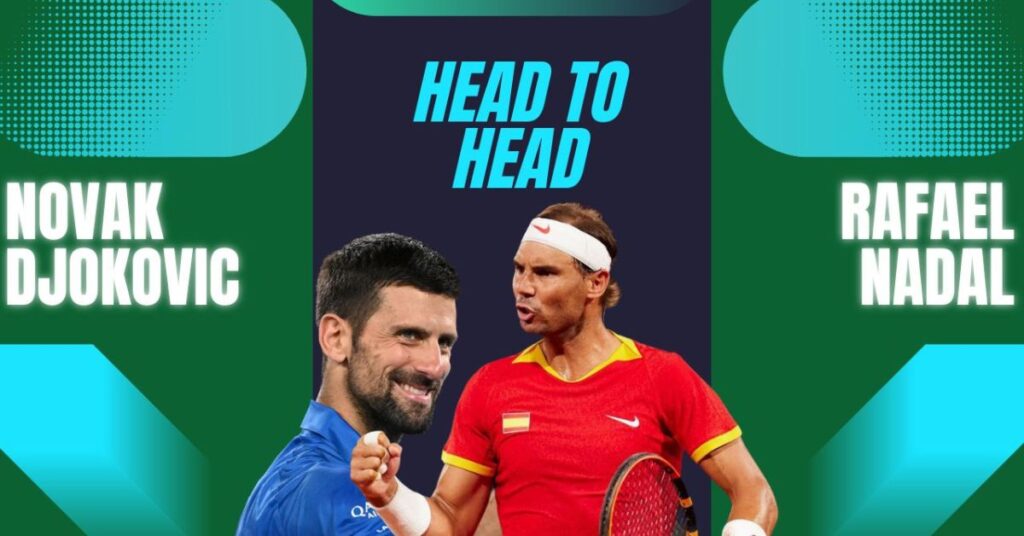
Djokovic vs Nadal Head-to-Head: Quick Answer
Novak Djokovic and Rafael Nadal played 60 official matches.
Djokovic won 31.
Nadal won 29.
Final Djokovic vs Nadal Head-to-Head
| Category | Novak Djokovic | Rafael Nadal |
|---|---|---|
| Overall | 31 | 29 |
| Hard Court | 20 | 7 |
| Clay | 9 | 20 |
| Grass | 2 | 2 |
| Grand Slam Matches | 7 | 12 |
| Grand Slam Finals | 4 | 5 |
| Total Meetings | 60 | 60 |
The numbers reveal the defining feature of this rivalry:
surface mattered enormously.
Djokovic controlled the hard-court rivalry.
Nadal dominated on clay.
Grass was completely even.
And when all 60 matches were combined, only two victories separated them.
Djokovic vs Nadal Head-to-Head by Surface
Few great rivalries demonstrate surface differences as clearly as Djokovic vs Nadal.
Djokovic vs Nadal on Hard Courts
Djokovic leads 20–7.
Hard courts produced Djokovic’s largest advantage.
His return of serve, ability to redirect pace, extraordinary movement and exceptional backhand allowed him to neutralize many of Nadal’s traditional patterns.
Djokovic could absorb Nadal’s heavy forehand and redirect the ball with depth.
His two-handed backhand was particularly important.
Unlike many one-handed backhand players, Djokovic could handle Nadal’s high, spinning forehand without being pushed as easily into a defensive position.
The result was a decisive hard-court advantage:
Djokovic 20
Nadal 7
This is one of the strongest components of Djokovic’s head-to-head case against Nadal.
Djokovic vs Nadal on Clay
Nadal leads 20–9.
Clay completely changes the picture.
This was Nadal’s kingdom.
The slower surface amplified his topspin, movement, defensive ability and physical endurance.
Yet Djokovic’s nine clay victories are significant precisely because defeating Nadal on clay was so difficult.
Djokovic became one of the few players capable of consistently challenging Nadal on the surface.
Most importantly, he defeated Nadal at Roland Garros twice.
That achievement places Djokovic in a tiny group.
Still, the complete clay record is clear:
Nadal 20
Djokovic 9
Nadal was the superior clay-court player.
Djokovic vs Nadal on Grass
2–2.
Their grass-court rivalry was perfectly balanced.
They played four times on grass.
The most important encounters came at Wimbledon, including the 2011 final and extraordinary 2018 semifinal.
Their equal grass record adds another fascinating layer to a rivalry dominated by dramatic surface differences elsewhere.
Djokovic vs Nadal Grand Slam Head-to-Head
Djokovic and Nadal played 19 times at Grand Slam tournaments.
Nadal led:
12–7.
That is more Grand Slam meetings than Federer and Nadal had against each other.
Grand Slam Head-to-Head by Tournament
| Grand Slam | Djokovic | Nadal |
|---|---|---|
| Australian Open | 2 | 0 |
| Roland Garros | 2 | 8 |
| Wimbledon | 2 | 2 |
| US Open | 1 | 2 |
| Total | 7 | 12 |
Again, surface distribution is critical.
Ten of their 19 Grand Slam matches took place at Roland Garros.
Nadal won eight of those.
Outside Roland Garros, their major rivalry was considerably closer.
Djokovic vs Nadal at the Australian Open
Djokovic and Nadal met twice at the Australian Open.
Djokovic won both.
Djokovic leads 2–0.
And both meetings came in finals.
2012 Australian Open Final
Djokovic defeated Nadal: 5–7, 6–4, 6–2, 6–7, 7–5
This was not simply one of the greatest Djokovic–Nadal matches.
It was one of the most extraordinary Grand Slam finals ever played.
The match lasted:
5 hours and 53 minutes.
It remains the longest Grand Slam singles final in the Open Era.
Nadal led 4–2 in the fifth set.
Djokovic came back.
After almost six hours of punishing baseline tennis, Djokovic finally won.
Both players were so exhausted during the trophy ceremony that chairs were brought onto the court.
The match became the ultimate representation of their rivalry:
Physical.
Tactical.
Mental.
Relentless.
Neither player willing to surrender.
2019 Australian Open Final
Seven years later, they met again for the championship in Melbourne.
This time there was almost no drama.
Djokovic produced one of the most dominant major-final performances of his career.
He defeated Nadal:
6–3, 6–2, 6–3.
The match lasted just over two hours.
It demonstrated the other side of the rivalry.
Not every Djokovic–Nadal classic required five sets.
Sometimes one of them reached a level the other simply could not match.
On this night, that player was Djokovic.
Djokovic vs Nadal at Roland Garros
No tournament better explains the complexity of their rivalry.
They played 10 times at Roland Garros.
Nadal led:
8–2.
That sounds one-sided.
But Djokovic’s two victories carry enormous historical significance because Nadal finished his Roland Garros career with an extraordinary 112–4 record.
Two of those four defeats came against Djokovic.
2006 Roland Garros Quarterfinal
This was where the rivalry began.
Djokovic was 19.
Nadal had just turned 20.
Nadal won the first two sets 6–4, 6–4 before Djokovic retired.
Nobody watching that day could have known they were witnessing the beginning of a rivalry that would eventually reach 60 matches.
2007 Roland Garros Semifinal
Nadal defeated Djokovic in straight sets.
Nadal then defeated Federer in the final to win his third consecutive Roland Garros championship.
2008 Roland Garros Semifinal
Nadal again defeated Djokovic in straight sets.
This was Nadal near the height of his clay-court powers.
He would go on to destroy Federer in the final and win Roland Garros without dropping a set.
2012 Roland Garros Final
For the first time, Djokovic and Nadal met in the Roland Garros final.
The historical stakes were enormous.
Djokovic had won the previous three Grand Slam tournaments.
Winning Roland Garros would have given him four consecutive majors simultaneously.
Nadal stopped him.
The Spaniard won:
6–4, 6–3, 2–6, 7–5.
The victory gave Nadal his seventh Roland Garros championship.
2013 Roland Garros Semifinal: One of Their Greatest Matches
This may have been the most important clay-court match of their rivalry.
Nadal won:
6–4, 3–6, 6–1, 6–7, 9–7.
The fifth set became legendary.
Djokovic broke first.
Nadal fought back.
Djokovic famously touched the net after putting away an overhead, costing him a crucial point.
The match lasted more than four and a half hours.
Nadal eventually survived 9–7 in the fifth.
He then defeated David Ferrer in the final.
For Djokovic, this was one of his closest opportunities to defeat Nadal at Roland Garros during Nadal’s prime.
For Nadal, it became another demonstration of his extraordinary ability to survive on Court Philippe-Chatrier.
2014 Roland Garros Final
Djokovic had another opportunity to complete the Career Grand Slam.
Again, Nadal stopped him.
Nadal won:
3–6, 7–5, 6–2, 6–4.
It gave Nadal his ninth Roland Garros championship.
For Djokovic, Paris remained the major title missing from his collection.
That would change eventually.
But first he had to do something very few players had ever accomplished.
Beat Nadal at Roland Garros.
2015 Roland Garros Quarterfinal: Djokovic Finally Beats Nadal
Djokovic defeated Nadal:
7–5, 6–3, 6–1.
It was Nadal’s first Roland Garros defeat since 2009.
And only the second defeat of his career at the tournament.
Djokovic had finally defeated Nadal in Paris.
Ironically, Djokovic still did not win the tournament.
Stan Wawrinka defeated him in the final.
Djokovic would have to wait another year to complete his Career Grand Slam.
2020 Roland Garros Final: Nadal’s Revenge
Five years after Djokovic defeated Nadal in Paris, the two met again in the Roland Garros final.
Djokovic entered the match having lost only once all season.
Nadal produced one of the greatest major-final performances of his career.
He won:
6–0, 6–2, 7–5.
The opening set was a statement.
Nadal handed Djokovic a 6–0 set on the biggest clay-court stage in tennis.
The victory gave Nadal his 13th Roland Garros title and 20th Grand Slam championship.
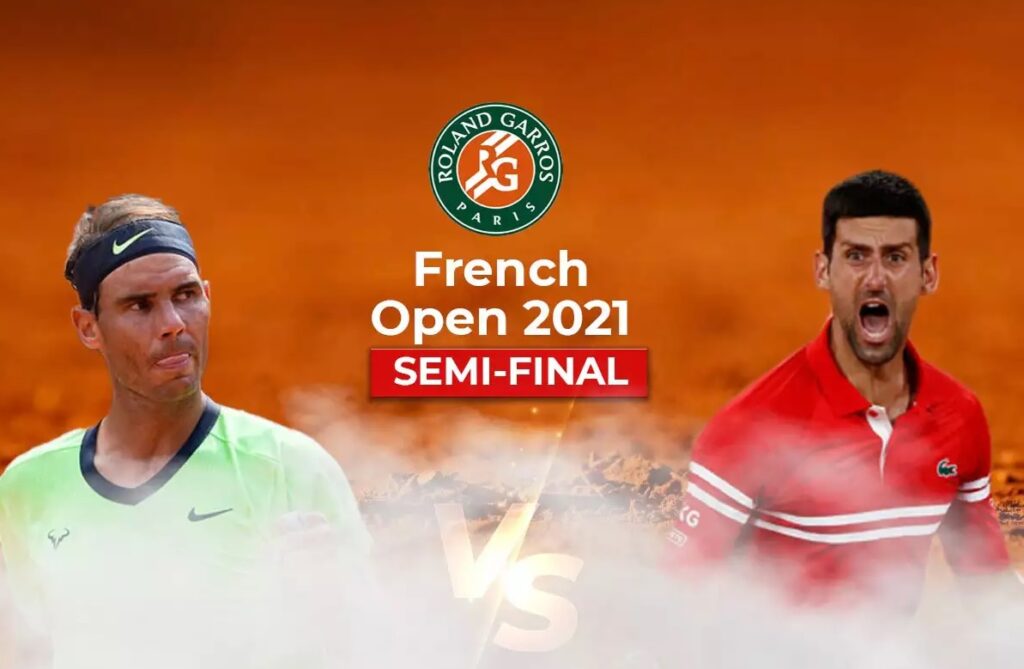
2021 Roland Garros Semifinal: Djokovic Makes History
One year later came one of Djokovic’s greatest victories.
Djokovic defeated Nadal:
3–6, 6–3, 7–6, 6–2.
Nadal had never lost a Roland Garros match after winning the first set.
Djokovic changed that.
The third set was extraordinary.
Long rallies.
Brutal physical exchanges.
Constant changes of momentum.
Djokovic eventually took control and became the first player to defeat Nadal twice at Roland Garros.
He then defeated Stefanos Tsitsipas in the final to win the title.
This victory is one of the strongest individual achievements in Djokovic’s GOAT résumé.
2022 Roland Garros Quarterfinal: Nadal Answers Again
Their next Roland Garros meeting came one year later.
Nadal won:
6–2, 4–6, 6–2, 7–6.
Djokovic served for the fourth set.
Nadal broke back.
He then dominated much of the tie-break and closed out the match.
Nadal went on to win Roland Garros for the 14th and final time.
It became their final Grand Slam meeting.
Djokovic vs Nadal at Wimbledon
Djokovic and Nadal finished 2–2 in their Wimbledon meetings.
Their grass rivalry contained two especially important matches.
2011 Wimbledon Final
Djokovic defeated Nadal:
6–4, 6–1, 1–6, 6–3.
Nadal was the defending Wimbledon champion.
Djokovic was in the middle of one of the greatest seasons in tennis history.
The victory gave Djokovic his first Wimbledon championship.
It also reinforced a dramatic shift in their rivalry.
Nadal had historically controlled the matchup.
In 2011, Djokovic suddenly became the player Nadal could not solve.
2018 Wimbledon Semifinal: A Two-Day Epic
Djokovic defeated Nadal:
6–4, 3–6, 7–6, 3–6, 10–8.
The match lasted 5 hours and 15 minutes and stretched across two days.
It was one of the defining matches of Djokovic’s career comeback.
Djokovic had struggled with injury and form before Wimbledon.
Defeating Nadal in a match of this intensity demonstrated that he was again capable of winning the biggest tournaments.
He defeated Kevin Anderson in the final.
The championship began another extraordinary period of Djokovic dominance.
Djokovic vs Nadal at the US Open
Djokovic and Nadal met three times at the US Open.
All three were finals.
Nadal led:
2–1.
2010 US Open Final
Nadal defeated Djokovic:
6–4, 5–7, 6–4, 6–2.
The victory gave Nadal his first US Open championship.
More importantly, it completed his Career Grand Slam.
Nadal had now won:
Australian Open.
Roland Garros.
Wimbledon.
US Open.
At only 24 years old, he had conquered every major.
2011 US Open Final
One year later, Djokovic turned the tables.
He defeated Nadal:
6–2, 6–4, 6–7, 6–1.
The victory completed Djokovic’s extraordinary 2011 Grand Slam season with titles at the Australian Open, Wimbledon and US Open.
It was also Djokovic’s sixth consecutive victory over Nadal that season—all six coming in finals.
2013 US Open Final
Nadal won their third US Open final:
6–2, 3–6, 6–4, 6–1.
The match was much more competitive than the final score suggests.
The third set became crucial.
Djokovic threatened to take control.
Nadal survived.
Then he pulled away.
It gave Nadal his second US Open championship and became one of the defining victories of his extraordinary 2013 comeback season.
Djokovic vs Nadal Grand Slam Finals
Djokovic and Nadal played nine Grand Slam finals against each other.
Nadal led:
5–4.
| Grand Slam Final | Winner |
|---|---|
| 2010 US Open | Nadal |
| 2011 Wimbledon | Djokovic |
| 2011 US Open | Djokovic |
| 2012 Australian Open | Djokovic |
| 2012 Roland Garros | Nadal |
| 2013 US Open | Nadal |
| 2014 Roland Garros | Nadal |
| 2019 Australian Open | Djokovic |
| 2020 Roland Garros | Nadal |
Think about how close that is.
Across nine Grand Slam championship matches:
Nadal 5
Djokovic 4
And the distribution once again reflects their surface strengths.
The 2011 Season Changed the Rivalry
One year deserves special attention.
2011.
Before that season, Nadal led Djokovic 16–7 in their rivalry.
Nadal was World No. 1.
He was the reigning champion at Roland Garros, Wimbledon and the US Open.
Then Djokovic transformed.
He defeated Nadal in the Indian Wells final.
Then Miami.
Then Madrid.
Then Rome.
Then Wimbledon.
Then the US Open.
Six meetings.
Six finals.
Six Djokovic victories.
For the first time, Nadal faced an opponent who could repeatedly absorb his best patterns and defeat him across different surfaces.
Djokovic’s return neutralized Nadal’s serve.
His backhand handled Nadal’s crosscourt forehand.
His movement allowed him to defend without surrendering court position.
His ability to redirect the ball changed rallies instantly.
The rivalry had changed forever.
Djokovic’s Seven-Match Winning Streak Against Nadal
Djokovic eventually won seven consecutive matches against Nadal during the 2011–2012 period.
Every one of those victories came in a final.
The streak culminated in the 2012 Australian Open epic.
Djokovic later produced another seven-match winning streak against Nadal between 2015 and 2016.
These stretches demonstrate something remarkable.
Nadal could dominate Djokovic.
Djokovic could then completely reverse the matchup.
Few rivalries between all-time greats have experienced such dramatic shifts.
Nadal’s Response
Nadal did not allow the rivalry to become permanently one-sided.
After losing the 2012 Australian Open final, he defeated Djokovic at Monte-Carlo, Rome and Roland Garros.
In 2013, Nadal defeated Djokovic in the Roland Garros semifinal and US Open final.
The rivalry repeatedly changed direction.
That constant adjustment is one reason it became so compelling.
Neither player found a permanent solution.
Why Djokovic Troubled Nadal More Than Almost Anyone
Nadal’s game created severe tactical problems for most opponents.
Djokovic possessed unusual answers.
Djokovic’s Backhand
This may have been the single most important shot in the rivalry.
Nadal’s left-handed crosscourt forehand traditionally attacks a right-handed player’s backhand.
Against many opponents, that pattern produced short balls or defensive replies.
Djokovic’s two-handed backhand was different.
He could absorb the topspin.
He could take the ball early.
He could redirect it down the line.
He could attack crosscourt.
Nadal therefore could not rely on his most natural pattern as safely as he could against many other opponents.
Djokovic’s Return of Serve
Djokovic is widely regarded as one of the greatest returners in tennis history.
Nadal’s serve was effective but was rarely his greatest weapon.
Djokovic repeatedly placed Nadal under immediate pressure in service games.
That forced Nadal to begin rallies from neutral or defensive positions more often than he preferred.
Djokovic Could Match Nadal’s Movement
Many players attacked Nadal successfully for a period.
The problem was finishing points.
Nadal retrieved seemingly impossible shots.
Djokovic was one of the few opponents capable of doing the same thing back to him.
That transformed their matches into extraordinary tests of movement, endurance and shot tolerance.
Djokovic Could Change Direction
Djokovic’s ability to redirect Nadal’s crosscourt forehand with his backhand was critical.
Instead of simply surviving Nadal’s spin, Djokovic could turn defense into attack.
That prevented Nadal from controlling rallies with the same patterns he used against much of the tour.
Why Nadal Troubled Djokovic
The tactical challenge worked both ways.
Nadal’s Forehand
Nadal’s forehand remained his greatest weapon.
Even Djokovic’s exceptional backhand could be pushed backward by repeated heavy topspin.
On clay, that effect became significantly stronger.
Nadal’s Court Coverage
Djokovic often wins points by gradually creating openings.
Against Nadal, those openings could disappear.
Nadal’s speed and defensive instincts forced Djokovic to play additional shots.
Nadal’s Physical Pressure
Matches against Nadal frequently became endurance tests.
Even when Djokovic was controlling rallies, he had to maintain extraordinary precision for long periods.
That pressure contributed to some of the longest and most physical matches either player ever contested.
Nadal on Clay
Ultimately, Nadal’s greatest tactical advantage was the surface itself.
On clay, he had more time.
His forehand bounced higher.
His defense became even more effective.
Djokovic challenged him better than almost anyone.
But Nadal still finished their clay rivalry ahead:
20–9.
Djokovic vs Nadal at the Olympics
Their rivalry had an unusual final chapter.
They met twice at the Olympic Games.
2008 Beijing Olympics Semifinal
Nadal defeated Djokovic:
6–4, 1–6, 6–4.
Nadal advanced to the gold-medal match.
He defeated Fernando González to become Olympic singles champion.
Djokovic won bronze.
2024 Paris Olympics: The Final Meeting
Sixteen years later, they met at the Olympics again.
The location made it even more symbolic.
Court Philippe-Chatrier.
The same stadium where Nadal had won Roland Garros 14 times.
Djokovic defeated Nadal:
6–1, 6–4.
It was their 60th official meeting.
It was also their last.
Djokovic moved ahead:
31–29.
He later went on to win the Olympic singles gold medal in Paris.
The rivalry that had begun at Roland Garros in 2006 had effectively ended on the same court 18 years later.
There could hardly have been a more fitting setting.
Djokovic vs Nadal: Their Greatest Matches
Choosing the greatest matches from 60 encounters is difficult.
But several stand above the rest.
1. 2012 Australian Open Final
Winner: Djokovic
5 hours, 53 minutes.
Five sets.
The longest Grand Slam singles final of the Open Era.
The ultimate physical battle.
2. 2013 Roland Garros Semifinal
Winner: Nadal
A 9–7 fifth set.
More than four and a half hours.
Djokovic came extraordinarily close to defeating Nadal in Paris.
Nadal survived.
3. 2018 Wimbledon Semifinal
Winner: Djokovic
Five hours and 15 minutes.
Two days.
A 10–8 deciding set.
A pivotal victory in Djokovic’s return to the top of men’s tennis.
4. 2021 Roland Garros Semifinal
Winner: Djokovic
Djokovic became the first man to defeat Nadal twice at Roland Garros.
The third set alone became one of the finest sets of their rivalry.
5. 2009 Madrid Semifinal
Winner: Nadal
A marathon three-set match lasting more than four hours.
Djokovic repeatedly came close.
Nadal repeatedly survived.
It was an early preview of the physical extremes their rivalry would later reach.
6. 2011 US Open Final
Winner: Djokovic
A defining victory during one of the greatest seasons in tennis history.
7. 2010 US Open Final
Winner: Nadal
Nadal completed his Career Grand Slam.
8. 2020 Roland Garros Final
Winner: Nadal
One of Nadal’s most dominant performances against Djokovic.
9. 2015 Roland Garros Quarterfinal
Winner: Djokovic
Djokovic became only the second man to defeat Nadal at Roland Garros.
10. 2022 Roland Garros Quarterfinal
Winner: Nadal
Their final Grand Slam battle.
Nadal defeated the defending champion and eventually won his 14th Roland Garros title.
Djokovic vs Nadal Career Statistics
Direct competition is only one part of comparing two careers.
The broader numbers provide additional context.
| Career Achievement | Novak Djokovic | Rafael Nadal |
|---|---|---|
| Grand Slam Singles Titles | 24 | 22 |
| Australian Open Titles | 10 | 2 |
| Roland Garros Titles | 3 | 14 |
| Wimbledon Titles | 7 | 2 |
| US Open Titles | 4 | 4 |
| Weeks at World No. 1 | 428 | 209 |
| Year-End No. 1 Finishes | 8 | 5 |
| Masters 1000 Titles | 40 | 36 |
| ATP Finals Titles | 7 | 0 |
| Career Grand Slam | Yes | Yes |
| Career Golden Masters | Yes | No |
| Olympic Singles Gold | Yes | Yes |
| Davis Cup Champion | Yes | Yes |
These numbers help explain why Djokovic and Nadal remain central to the GOAT debate.
Djokovic leads many of the major career totals.
Nadal possesses the most dominant single-major record in men’s tennis history at Roland Garros.
Both completed the Career Grand Slam.
Both became Olympic singles champions.
And they pushed each other throughout much of their careers.
Djokovic vs Nadal Grand Slam Comparison
Novak Djokovic
24 Grand Slam titles
- Australian Open: 10
- Roland Garros: 3
- Wimbledon: 7
- US Open: 4
Rafael Nadal
22 Grand Slam titles
- Australian Open: 2
- Roland Garros: 14
- Wimbledon: 2
- US Open: 4
Djokovic leads:
24–22.
But the distribution tells two very different stories.
Djokovic achieved extraordinary success across all four majors.
Nadal achieved unprecedented dominance at one tournament while still winning every other Grand Slam at least twice.
Both completed the Career Grand Slam.
Djokovic vs Nadal: Who Was Better on Hard Courts?
Novak Djokovic.
The direct head-to-head:
Djokovic 20–7.
Djokovic also won significantly more hard-court Grand Slam titles.
His Australian Open record in particular is historic.
Nadal was an outstanding hard-court champion.
Djokovic was better.
Djokovic vs Nadal: Who Was Better on Clay?
Rafael Nadal.
The direct head-to-head:
Nadal 20–9.
At Roland Garros:
Nadal 8–2.
Career Roland Garros titles:
Nadal 14
Djokovic 3
Djokovic may have been Nadal’s greatest clay-court challenger.
But Nadal’s overall superiority on the surface is overwhelming.
Djokovic vs Nadal: Who Was Better on Grass?
Their direct grass head-to-head finished:
2–2.
But Djokovic achieved substantially more across his complete grass-court career.
Djokovic won Wimbledon seven times.
Nadal won it twice.
Therefore the direct rivalry was even, but Djokovic has the stronger overall grass-court résumé.
Djokovic vs Nadal: Who Was Better at the Grand Slams?
Djokovic finished with more Grand Slam titles:
24–22.
But Nadal won more of their direct Grand Slam meetings:
12–7.
That distinction is extremely important.
The question:
Who achieved more at the majors overall?
points toward Djokovic.
The question:
Who won more when Djokovic and Nadal played each other at majors?
points toward Nadal.
Both statistics are legitimate.
They measure different things.
Djokovic vs Nadal: Who Was Better at World No. 1?
This category strongly favors Djokovic.
Djokovic spent 428 weeks at World No. 1.
Nadal spent 209.
Djokovic also finished more seasons as year-end No. 1.
This is one of the largest statistical advantages in their career comparison.
Djokovic vs Nadal: Who Had the Better Peak?
This is harder.
Djokovic’s 2011 season is one of the strongest individual seasons in modern tennis.
He defeated Nadal six times that year—all in finals.
His 2015 and early 2016 period was also extraordinary.
Nadal’s peak on clay, however, reached a level of surface-specific dominance unmatched in men’s tennis.
His 2008 and 2010 seasons demonstrated that his peak extended beyond clay.
If peak means dominance across the entire tour, Djokovic has a compelling argument.
If peak means the highest sustained level on a particular surface, Nadal’s clay peak stands alone.
Djokovic vs Nadal: Who Had Greater Longevity?
Both players demonstrated extraordinary longevity.
Nadal won his first Grand Slam title in 2005 and his final one in 2022.
Djokovic won his first Grand Slam in 2008 and continued winning major championships deep into his 30s.
Their first meeting occurred in 2006.
Their final meeting occurred in 2024.
Eighteen years separated them.
Few rivalries in professional sport have remained relevant across such a long period.
Djokovic vs Nadal Playing Style Comparison
| Attribute | Novak Djokovic | Rafael Nadal |
|---|---|---|
| Dominant Hand | Right | Left |
| Backhand | Two-handed | Two-handed |
| Primary Strength | Return, precision & movement | Topspin, physical pressure & movement |
| Best Surface | Hard | Clay |
| Return of Serve | Historic strength | Strong |
| Forehand | Elite | Signature weapon |
| Backhand | Signature weapon | Elite |
| Defense | Exceptional | Exceptional |
| Flexibility | Exceptional | Strong |
| Physical Endurance | Exceptional | Exceptional |
| Court Coverage | Exceptional | Exceptional |
| Tactical Adaptability | Exceptional | Exceptional |
The similarities are almost as interesting as the differences.
Both were extraordinary defenders.
Both possessed elite movement.
Both could survive physical matches.
Both competed with exceptional intensity.
But the geometry of their games was different.
That difference created one of tennis’s greatest tactical battles.
The Rivalry in Three Numbers
If someone wanted to understand Djokovic vs Nadal using only three numbers, these would be a good starting point:
31–29
The final overall head-to-head in Djokovic’s favor.
20–7
Djokovic’s hard-court advantage.
20–9
Nadal’s clay-court advantage.
Those three numbers explain why the overall rivalry remained so close.
Each player possessed territory where he was extraordinarily difficult for the other to defeat.
Who Won the Djokovic vs Nadal Rivalry?
If the question is simply:
Who won more matches?
The answer is:
Novak Djokovic.
31–29.
But other questions produce different answers.
Overall head-to-head: Djokovic
Hard courts: Djokovic
Clay: Nadal
Grass: Tie
Grand Slam head-to-head: Nadal
Grand Slam finals: Nadal
Total Grand Slam titles: Djokovic
World No. 1: Djokovic
Masters 1000 titles: Djokovic
Roland Garros: Nadal
That is why this rivalry is so useful when discussing tennis greatness.
There is no need to manipulate statistics.
The real numbers are already fascinating.
Djokovic vs Nadal and the GOAT Debate
The Djokovic–Nadal rivalry occupies a unique place in the GOAT discussion because the two men competed directly so many times.
Sixty meetings provide an enormous sample.
Djokovic’s case includes:
- 31–29 overall head-to-head advantage
- More Grand Slam titles
- More weeks at World No. 1
- More year-end No. 1 finishes
- More Masters 1000 titles
- More ATP Finals titles
- Winning hard-court head-to-head
- Victories over Nadal at Roland Garros
- Olympic singles gold
Nadal’s case includes:
- 12–7 Grand Slam head-to-head advantage
- 5–4 Grand Slam finals advantage
- 20–9 clay head-to-head
- 14 Roland Garros championships
- 22 Grand Slam titles
- Career Golden Slam
- Olympic singles gold
- Unprecedented clay-court dominance
To see how both players compare with Roger Federer across Grand Slams, rankings, surfaces and other major achievements, explore our complete Djokovic vs Nadal vs Federer comparison.
Djokovic leads many of the broad career totals.
Nadal leads their direct competition at the Grand Slam level.
How much should each category matter?
There is no official formula.
That’s why GOATofTennis.net evaluates multiple dimensions rather than declaring that one statistic automatically settles the debate.
Read our complete guide to how the greatest tennis player of all time is determined for the methodology behind these comparisons.
Djokovic, Nadal and Federer: The Big Three
The Djokovic–Nadal rivalry cannot be completely separated from Roger Federer.
Federer became the dominant champion first.
Nadal emerged as his greatest challenger.
Then Djokovic rose and challenged both.
Together, the three created the defining era of modern men’s tennis.
Their final Grand Slam totals:
Djokovic — 24
Nadal — 22
Federer — 20
But their influence cannot be understood through Grand Slam totals alone.
They competed for World No. 1.
They challenged each other’s records.
They adapted tactically because of one another.
And they forced the standard of elite men’s tennis higher.
For the broader comparison, visit our Greatest Tennis Player of All Time analysis.
Djokovic vs Nadal Frequently Asked Questions
What was the final Djokovic vs Nadal head-to-head record?
Novak Djokovic finished with a 31–29 advantage over Rafael Nadal.
How many times did Djokovic and Nadal play?
They played 60 official matches.
That made their rivalry the most-played in ATP Head2Head history.
Who won more matches, Djokovic or Nadal?
Djokovic won 31.
Nadal won 29.
What was Djokovic vs Nadal on hard courts?
Djokovic led Nadal 20–7 on hard courts.
What was Djokovic vs Nadal on clay?
Nadal led Djokovic 20–9 on clay.
What was Djokovic vs Nadal on grass?
Their grass-court head-to-head finished 2–2.
What was Djokovic vs Nadal in Grand Slam matches?
Nadal led their Grand Slam head-to-head 12–7.
How many Grand Slam finals did Djokovic and Nadal play?
They played nine Grand Slam finals.
Nadal led those finals 5–4.
What was Djokovic vs Nadal at the Australian Open?
Djokovic led 2–0.
Both matches were finals.
What was Djokovic vs Nadal at Roland Garros?
Nadal led their Roland Garros head-to-head 8–2.
What was Djokovic vs Nadal at Wimbledon?
Their Wimbledon head-to-head finished 2–2.
What was Djokovic vs Nadal at the US Open?
Nadal led 2–1.
All three meetings were US Open finals.
How many times did Djokovic beat Nadal at Roland Garros?
Djokovic defeated Nadal twice at Roland Garros.
Those victories came in 2015 and 2021.
How many times did Nadal beat Djokovic at Roland Garros?
Nadal defeated Djokovic eight times at Roland Garros.
What was the longest Djokovic vs Nadal match?
The 2012 Australian Open final lasted 5 hours and 53 minutes.
Djokovic won in five sets.
It remains the longest Grand Slam singles final of the Open Era.
What was the last Djokovic vs Nadal match?
Their final official meeting came in the second round of the 2024 Paris Olympics.
Djokovic defeated Nadal 6–1, 6–4.
What was their first match?
Their first official meeting came in the 2006 Roland Garros quarterfinal.
Nadal won after Djokovic retired following the first two sets.
Did Djokovic and Nadal play at every Grand Slam?
Yes.
They faced each other at the Australian Open, Roland Garros, Wimbledon and US Open.
Who won more Grand Slam titles?
Djokovic won 24 Grand Slam singles titles.
Nadal won 22.
Who spent more weeks at World No. 1?
Djokovic.
He spent 428 weeks at World No. 1 compared with Nadal’s 209.
Who won more Masters 1000 titles?
Djokovic won 40 Masters 1000 titles.
Nadal won 36.
Who won more ATP Finals titles?
Djokovic won seven ATP Finals championships.
Nadal never won the tournament.
Who won Olympic singles gold?
Both.
Nadal won singles gold at Beijing 2008.
Djokovic won singles gold at Paris 2024.
Who was better, Djokovic or Nadal?
There is no universally accepted answer.
Djokovic leads many major career statistics and finished ahead in their overall head-to-head.
Nadal leads their Grand Slam head-to-head and achieved unprecedented dominance at Roland Garros and on clay.
How those achievements should be weighted is ultimately part of the larger tennis GOAT debate.
Vote: Djokovic or Nadal?
Sixty matches gave us one answer:
Djokovic 31–29 Nadal.
But head-to-head competition is only one way to measure greatness.
Who had the greater career?
Novak Djokovic?
Rafael Nadal?
Roger Federer?
Or another champion entirely?
VIEW THE LIVE TENNIS GOAT RANKING
The GOATofTennis.net ranking is determined by tennis fans—not by our editorial team.
Explore the Complete Player Profiles
Novak Djokovic: Career Statistics, Records, Achievements & Biography
Explore Djokovic’s Grand Slam titles, World No. 1 records, Masters achievements, Olympic gold and complete career.
Rafael Nadal: Career Statistics, Records, Achievements & Biography
Explore Nadal’s 22 Grand Slam titles, record 14 Roland Garros championships, clay-court dominance and complete career.
Roger Federer: Career Statistics, Records, Achievements & Biography
Explore the career of the third member of the Big Three and one of the central figures in the modern GOAT debate.
Continue Exploring the Tennis GOAT Debate
The Greatest Tennis Player of All Time
Compare Djokovic, Nadal, Federer and other legends across championships, rankings, surfaces, longevity and historical impact.
Tennis GOAT Ranking – Live Fan Vote
See how tennis fans currently rank the greatest players and cast your own vote.
How Is the Greatest Tennis Player of All Time Determined?
Explore the criteria behind serious GOAT comparisons, including Grand Slams, rankings, longevity, versatility, head-to-head competition and historical influence.
Rafael Nadal vs Roger Federer: Head-to-Head, Stats, Records & Complete Rivalry
Explore the complete Nadal–Federer rivalry and see how its surface-by-surface story compares with Djokovic–Nadal.
Editorial Methodology
GOATofTennis.net separates statistical fact, historical analysis and fan opinion.
The Djokovic–Nadal rivalry is now complete because Rafael Nadal retired from professional tennis in 2024.
Their final official head-to-head record is:
Djokovic 31–29 Nadal.
Head-to-head statistics measure direct competition.
Grand Slam statistics measure performance at tennis’s most important tournaments.
Rankings measure sustained performance across the tour.
Surface records reveal specialization and adaptability.
Longevity measures the ability to remain competitive across generations.
No single statistic is automatically treated as proof that one player is greater than another.
Context matters.
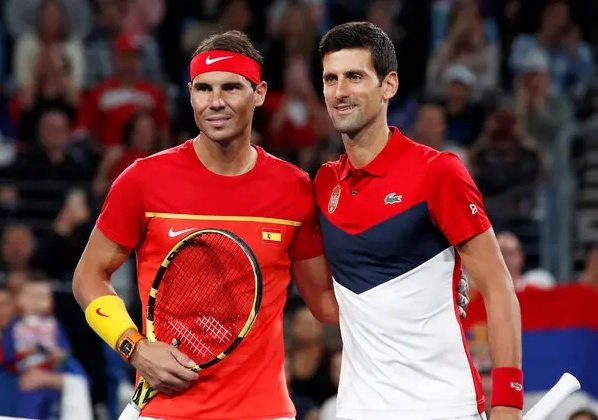
Editorial Conclusion
It began at Roland Garros in 2006.
It ended on Court Philippe-Chatrier at the Paris Olympics in 2024.
Between those two matches came nearly two decades of competition.
60 matches.
31 Djokovic victories.
29 Nadal victories.
Djokovic dominated their hard-court rivalry.
Nadal dominated their clay-court rivalry.
Grass finished even.
Nadal won more of their Grand Slam meetings.
Djokovic finished ahead overall.
They played the longest Grand Slam final in Open Era history.
They fought for Grand Slam championships.
They fought for World No. 1.
They pushed each other physically, tactically and mentally.
And each forced the other to become a better player.
The final score says:
31–29.
The history behind those numbers says much more.
Novak Djokovic vs Rafael Nadal was one of the defining rivalries in tennis history.
Tags: Clay, Djokovic, Grass, Hard, Head 2 Head, Matches, Nadal, Novak, Rafael, Wins
Pingback: Djokovic vs Nadal vs Federer Head-to-Head: Who Has the Best Record?
Pingback: What Is the Longest Tennis Match Ever? Tennis Marathon Records
Pingback: Who Has Won the Most Five-Set Matches in Tennis History?