
Last Updated: August 2026
Winning a Grand Slam singles title is one of the greatest achievements in tennis.
Winning 10 is extraordinary.
Winning 20 once seemed almost unimaginable.
Today, the highest total in tennis singles history is 24 Grand Slam titles.
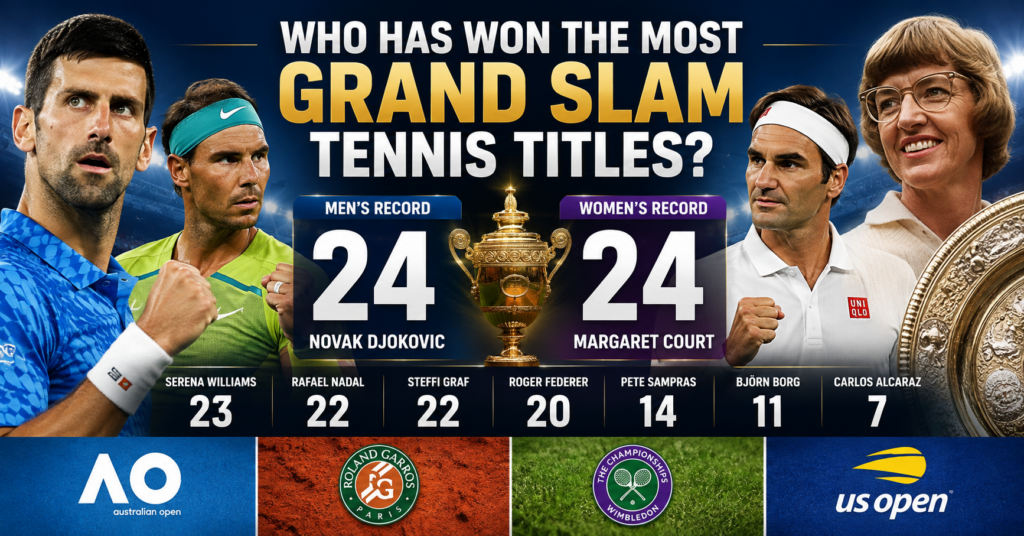
Novak Djokovic holds the men’s singles record with 24 Grand Slam titles, while Margaret Court holds the women’s singles record with 24.
Immediately behind them are Serena Williams with 23, Rafael Nadal and Steffi Graf with 22, and Roger Federer with 20.
But simply counting titles does not tell the complete story.
The Grand Slam record spans different generations, different surfaces and dramatically different eras of tennis. It also contains some remarkable individual records: Nadal’s 14 Roland Garros titles, Djokovic’s 10 Australian Opens, Federer’s eight Wimbledons and Serena Williams’ 23 Open Era majors.
This guide breaks down the all-time Grand Slam singles records, the men’s and women’s leaders, records at each of the four majors, Career Grand Slams, Calendar Grand Slams and why major championships matter so much in the debate over the greatest tennis player of all time.
Who Has the Most Grand Slam Titles? Quick Answer
The record for the most Grand Slam singles titles is 24.
Novak Djokovic — 24
Men’s singles record.
Margaret Court — 24
Women’s singles record.
The leading all-time totals are:
| Player | Grand Slam Singles Titles |
|---|---|
| Novak Djokovic | 24 |
| Margaret Court | 24 |
| Serena Williams | 23 |
| Rafael Nadal | 22 |
| Steffi Graf | 22 |
| Roger Federer | 20 |
| Helen Wills Moody | 19 |
| Martina Navratilova | 18 |
| Chris Evert | 18 |
The four Grand Slam tournaments are the Australian Open, Roland Garros, Wimbledon and US Open.
Winning all four at least once during a career is called the Career Grand Slam.
Winning all four during the same calendar year is the much rarer Calendar Grand Slam.
Who Has Won the Most Men’s Grand Slam Titles?
Novak Djokovic — 24 Grand Slam Titles
Novak Djokovic holds the men’s singles record with 24 Grand Slam championships.
His titles are distributed across all four majors:
| Tournament | Djokovic Titles |
|---|---|
| Australian Open | 10 |
| Roland Garros | 3 |
| Wimbledon | 7 |
| US Open | 4 |
| Total | 24 |
Djokovic won his first major at the 2008 Australian Open.
His 24th came at the 2023 US Open.
What makes Djokovic’s record particularly powerful in the GOAT debate is not only the total of 24. It is the distribution of those championships.
He won repeatedly on hard courts, clay and grass.
He won every Grand Slam tournament at least three times, becoming the first man in the Open Era to complete the Career Grand Slam three times.
For a complete breakdown of his records, achievements and career, visit our Novak Djokovic profile.
Men’s Grand Slam Singles Title Leaders
The leading men’s Grand Slam champions of the Open Era include:
| Rank | Player | Grand Slam Titles |
|---|---|---|
| 1 | Novak Djokovic | 24 |
| 2 | Rafael Nadal | 22 |
| 3 | Roger Federer | 20 |
| 4 | Pete Sampras | 14 |
| 5 | Björn Borg | 11 |
| T-6 | Andre Agassi | 8 |
| T-6 | Jimmy Connors | 8 |
| T-6 | Ivan Lendl | 8 |
| T-9 | Carlos Alcaraz | 7 |
| T-9 | John McEnroe | 7 |
| T-9 | Mats Wilander | 7 |
The gap between the Big Three and the previous generation illustrates how dramatically Djokovic, Nadal and Federer changed the men’s record book.
Pete Sampras retired with 14 major championships.
Federer eventually reached 20.
Nadal reached 22.
Djokovic reached 24.
Novak Djokovic’s 24 Grand Slam Titles
Djokovic’s Grand Slam résumé combines overall volume with extraordinary success across different surfaces.
Australian Open — 10 Titles
The Australian Open became Djokovic’s most successful Grand Slam.
His 10 men’s singles championships are the tournament record.
Melbourne’s hard courts produced some of Djokovic’s greatest performances and became a central part of his historical résumé.
Roland Garros — 3 Titles
Roland Garros presented a very different challenge.
Djokovic competed during the same era as Rafael Nadal, the most successful Roland Garros player in history.
Despite that competition, Djokovic won the tournament three times.
Those championships were crucial to his achievement of completing the Career Grand Slam three times.
Wimbledon — 7 Titles
Djokovic won Wimbledon seven times.
He sits one title behind Roger Federer’s men’s record of eight.
Among Djokovic’s Wimbledon championships were three final victories over Federer:
2014
2015
2019
The 2019 final became one of the defining matches of their rivalry.
You can explore their complete rivalry in our Novak Djokovic vs Roger Federer head-to-head analysis.
US Open — 4 Titles
Djokovic won four US Open championships.
His 2023 victory in New York brought his career total to 24 Grand Slam titles.
The combination of 10 Australian Opens, three Roland Garros titles, seven Wimbledons and four US Opens gives Djokovic one of the most balanced major résumés in tennis history.
Rafael Nadal — 22 Grand Slam Titles
Rafael Nadal finished his career with 22 Grand Slam singles titles.
His distribution was extraordinary:
| Tournament | Nadal Titles |
|---|---|
| Australian Open | 2 |
| Roland Garros | 14 |
| Wimbledon | 2 |
| US Open | 4 |
| Total | 22 |
One number dominates Nadal’s Grand Slam résumé:
14 Roland Garros titles.
No man has won one Grand Slam tournament more times.
Nadal’s 14 Roland Garros Titles
Nadal won Roland Garros in:
2005
2006
2007
2008
2010
2011
2012
2013
2014
2017
2018
2019
2020
2022
That is 14 championships at a single Grand Slam.
It is one of the most remarkable records in tennis history and perhaps one of the hardest major records for a future player to break.
But Nadal was far more than a clay-court specialist.
He won two Australian Opens, two Wimbledons and four US Opens.
He therefore won every Grand Slam tournament and completed the Career Grand Slam.
For the complete story behind his career and records, visit our Rafael Nadal profile.
Roger Federer — 20 Grand Slam Titles
Roger Federer won 20 Grand Slam singles championships and became the first man to reach that milestone.
His final distribution was:
| Tournament | Federer Titles |
|---|---|
| Australian Open | 6 |
| Roland Garros | 1 |
| Wimbledon | 8 |
| US Open | 5 |
| Total | 20 |
Federer was the player who first pushed the modern men’s Grand Slam record far beyond Pete Sampras’s previous benchmark of 14.
Federer’s 8 Wimbledon Titles
Federer won Wimbledon eight times:
2003
2004
2005
2006
2007
2009
2012
2017
His eight men’s singles championships remain the Wimbledon record.
Federer also reached 12 Wimbledon finals, demonstrating remarkable longevity at the tournament most closely associated with his career.
Federer’s 5 US Open Titles
Federer won five consecutive US Open championships from 2004 through 2008.
His five titles are tied for the men’s Open Era record.
Federer’s dominance at Wimbledon and the US Open was a major reason he became the first man to reach 20 majors.
Explore his full career in our Roger Federer profile.
Djokovic vs Nadal vs Federer: Grand Slam Comparison
The defining modern Grand Slam comparison is:
Novak Djokovic — 24
Rafael Nadal — 22
Roger Federer — 20
Together, the Big Three won an extraordinary:
66 Grand Slam singles titles.
But their individual tournament records reveal three very different careers.
| Grand Slam | Djokovic | Nadal | Federer |
|---|---|---|---|
| Australian Open | 10 | 2 | 6 |
| Roland Garros | 3 | 14 | 1 |
| Wimbledon | 7 | 2 | 8 |
| US Open | 4 | 4 | 5 |
| Total | 24 | 22 | 20 |
Djokovic leads the overall Grand Slam race and dominates the Australian Open comparison.
Nadal has an enormous advantage at Roland Garros.
Federer leads the three at Wimbledon and has the highest US Open title total among them.
Grand Slam totals, however, are only one part of their historical comparison.
For weeks at No. 1, Masters 1000 titles, ATP Finals, Olympics, head-to-head records, surfaces and longevity, visit our complete Djokovic vs Nadal vs Federer comparison.
Pete Sampras — 14 Grand Slam Titles
Before the Big Three transformed the record book, Pete Sampras represented the modern standard for men’s Grand Slam success.
Sampras won:
14 Grand Slam singles titles.
His distribution:
Australian Open — 2
Roland Garros — 0
Wimbledon — 7
US Open — 5
When Sampras retired, 14 majors looked like an extraordinary record.
Federer eventually surpassed him.
Nadal then surpassed Federer.
Djokovic ultimately surpassed both.
The progression from Sampras’s 14 to Djokovic’s 24 demonstrates just how much the Big Three changed expectations about longevity and major-tournament success.
Björn Borg — 11 Grand Slam Titles
Björn Borg won 11 Grand Slam singles titles despite having a much shorter elite career than the Big Three.
His championships came at two majors:
Roland Garros — 6
Wimbledon — 5
That combination is remarkable because clay and grass traditionally demand very different styles of tennis.
Borg was capable of dominating both.
He won five consecutive Wimbledon titles from 1976 through 1980 while simultaneously establishing himself as one of the greatest clay-court players ever.
His early departure from full-time tennis remains one of the great “what if?” stories in tennis history.
Carlos Alcaraz — 7 Grand Slam Titles and Counting
Carlos Alcaraz represents a new generation attempting to follow the Big Three.
As of August 2026, Alcaraz has won seven Grand Slam singles titles.
His 2026 Australian Open championship also allowed him to complete the Career Grand Slam at just 22 years old.
That makes his start historically significant.
But there is an enormous difference between reaching seven majors and reaching Djokovic’s record of 24.
Maintaining Grand Slam-winning form for a decade or longer requires talent, health, adaptability, consistency and extraordinary longevity.
Whether Alcaraz—or another future champion—can eventually challenge 24 will be one of the biggest stories in tennis over the coming years.
Who Has Won the Most Women’s Grand Slam Titles?
Margaret Court — 24 Grand Slam Titles
Margaret Court holds the women’s singles record with 24 Grand Slam championships.
Her title distribution:
| Tournament | Court Titles |
|---|---|
| Australian Championships/Open | 11 |
| Roland Garros | 5 |
| Wimbledon | 3 |
| US Championships/Open | 5 |
| Total | 24 |
Court’s career crossed the transition between the Amateur Era and Open Era.
That historical context is important when comparing her record with modern champions.
The official total remains 24.
But not all 24 were won during the Open Era.
Serena Williams — 23 Grand Slam Titles
Serena Williams won 23 Grand Slam singles championships, the women’s record for the Open Era.
Her distribution:
| Tournament | Serena Titles |
|---|---|
| Australian Open | 7 |
| Roland Garros | 3 |
| Wimbledon | 7 |
| US Open | 6 |
| Total | 23 |
Serena’s record is particularly impressive because of its balance.
She won at least three championships at every Grand Slam.
She dominated on hard courts.
She won seven Wimbledons on grass.
And she won Roland Garros three times on clay.
She finished just one major behind Court’s all-time total.
Steffi Graf — 22 Grand Slam Titles
Steffi Graf won 22 Grand Slam singles championships.
Her distribution:
| Tournament | Graf Titles |
|---|---|
| Australian Open | 4 |
| Roland Garros | 6 |
| Wimbledon | 7 |
| US Open | 5 |
| Total | 22 |
But one achievement separates Graf from every other modern singles champion.
Steffi Graf’s 1988 Golden Slam
In 1988, Graf won:
Australian Open
Roland Garros
Wimbledon
US Open
and
Olympic singles gold
She therefore captured all four majors and the Olympic singles title during the same calendar year.
The achievement became known as the Golden Slam.
It remains one of the most extraordinary seasons in tennis history.
Women’s Grand Slam Singles Leaders
The leading women’s totals include:
| Rank | Player | Grand Slam Titles |
|---|---|---|
| 1 | Margaret Court | 24 |
| 2 | Serena Williams | 23 |
| 3 | Steffi Graf | 22 |
| 4 | Helen Wills Moody | 19 |
| T-5 | Martina Navratilova | 18 |
| T-5 | Chris Evert | 18 |
These players competed across very different periods of tennis history.
That is why raw Grand Slam totals are important but should always be interpreted alongside historical context.
Who Has the Most Grand Slam Titles: Men and Women Combined?
If men’s and women’s singles totals are placed together, the leaders are:
1. Novak Djokovic — 24
1. Margaret Court — 24
3. Serena Williams — 23
4. Rafael Nadal — 22
4. Steffi Graf — 22
6. Roger Federer — 20
Therefore, the highest Grand Slam singles total in tennis history is:
24.
Djokovic and Court reached that number in very different eras and competitive environments.
It is accurate to say they are tied on total Grand Slam singles championships.
It is much more complicated to say those careers are directly equivalent.
What Are the Four Grand Slam Tournaments?
The four Grand Slam tournaments are the most prestigious recurring events in tennis.
Each has its own history, conditions and identity.
Australian Open
Location: Melbourne, Australia
Current surface: Hard court
The Australian Open is traditionally the first Grand Slam of the calendar year.
The men’s singles record belongs to:
Novak Djokovic — 10 titles
The women’s all-time singles record belongs to:
Margaret Court — 11 titles
Roland Garros
Location: Paris, France
Surface: Clay
Roland Garros is the only Grand Slam played on clay.
The slower surface produces long rallies and places enormous demands on movement, endurance and point construction.
The men’s record belongs to:
Rafael Nadal — 14 titles
The women’s record belongs to:
Chris Evert — 7 titles
Nadal’s 14 championships represent one of the greatest single-tournament records in tennis.
Wimbledon
Location: London, United Kingdom
Surface: Grass
Wimbledon is the oldest Grand Slam tournament and the only major still played on grass.
The men’s singles record belongs to:
Roger Federer — 8 titles
The women’s singles record belongs to:
Martina Navratilova — 9 titles
Wimbledon has played a particularly important role in the legacies of Federer, Djokovic, Borg, Sampras and many other all-time greats.
US Open
Location: New York, United States
Current surface: Hard court
The US Open is traditionally the final Grand Slam tournament of the season.
In the men’s Open Era, the record is shared by:
Jimmy Connors — 5
Pete Sampras — 5
Roger Federer — 5
In women’s Open Era singles:
Chris Evert — 6
Serena Williams — 6
Who Holds the Men’s Record at Each Grand Slam?
| Tournament | Record Holder | Titles |
|---|---|---|
| Australian Open | Novak Djokovic | 10 |
| Roland Garros | Rafael Nadal | 14 |
| Wimbledon | Roger Federer | 8 |
| US Open — Open Era | Connors / Sampras / Federer | 5 |
There is something remarkable about this table.
Each member of the Big Three owns the men’s singles record at a different Grand Slam.
Djokovic — Australian Open
Nadal — Roland Garros
Federer — Wimbledon
It is another illustration of how differently the three players built their historical résumés.
What Is a Career Grand Slam?
A player completes the Career Grand Slam by winning all four Grand Slam tournaments at least once during their career.
In men’s Open Era tennis, players who have achieved it include:
Rod Laver
Andre Agassi
Roger Federer
Rafael Nadal
Novak Djokovic
Carlos Alcaraz
Alcaraz joined the group after winning the 2026 Australian Open.
Djokovic has gone even further by winning each of the four majors at least three times.
The Career Grand Slam is important because it demonstrates success across different tournaments, conditions and surfaces.
What Is a Calendar Grand Slam?
A Calendar Grand Slam means winning all four Grand Slam singles tournaments during the same calendar year.
It is one of the rarest accomplishments in tennis.
Rod Laver achieved it twice in men’s singles:
1962
1969
The 1969 achievement came during the Open Era.
On the women’s side, players to achieve a Calendar Grand Slam include:
Maureen Connolly — 1953
Margaret Court — 1970
Steffi Graf — 1988
Graf’s 1988 season was even more remarkable because she also won Olympic singles gold, completing the Golden Slam.
Why Are Grand Slam Titles So Important in the GOAT Debate?
Grand Slam titles carry enormous weight because the four majors are the biggest recurring tournaments in tennis.
They require players to succeed under different conditions:
Australian Open — hard court
Roland Garros — clay
Wimbledon — grass
US Open — hard court
Winning majors repeatedly tests far more than talent.
It tests adaptability.
Physical durability.
Mental strength.
Consistency.
Tactical flexibility.
And the ability to perform when the pressure is greatest.
That is why:
24 — 22 — 20
became such an important part of the Djokovic, Nadal and Federer debate.
But Grand Slam titles should not be the only criterion.
Weeks at World No. 1 matter.
Year-end No. 1 finishes matter.
Masters titles matter.
Head-to-head records matter.
Surface versatility matters.
Peak dominance matters.
Longevity matters.
Historical context matters.
For a deeper explanation of how these factors can be evaluated, read How Is the Greatest Tennis Player of All Time Determined?.
Does Having the Most Grand Slam Titles Automatically Make You the GOAT?
Not necessarily.
If the GOAT question were determined only by Grand Slam totals, there would be little reason for a debate.
We would simply look at the leaderboard.
But tennis history is more complicated.
Different generations competed under different conditions.
Tournament participation changed.
Travel changed.
Equipment changed.
Court surfaces changed.
Training changed.
Professional eligibility changed.
Even the importance players placed on individual tournaments changed over time.
Grand Slam titles are therefore one of the strongest pieces of evidence in a GOAT argument.
But they are not the entire argument.
That’s why our Greatest Tennis Player of All Time analysis considers much more than majors.
Why Comparing Grand Slam Titles Across Eras Is Difficult
A Grand Slam title is an extraordinary achievement in any era.
But comparing totals separated by decades requires context.
Before the Open Era began in 1968, professional players were not always eligible to compete at the traditional major championships.
International travel was far more difficult.
The Australian Championships did not always attract the same international fields that the Australian Open attracts today.
Equipment evolved.
Surfaces evolved.
Sports science evolved.
The professional calendar evolved.
Modern players compete in a globalized professional sport in which the four Grand Slams are universally treated as the most important tournaments.
None of this means achievements from earlier eras should be dismissed.
It means they should be understood within the conditions under which they occurred.
The Big Three Changed the Grand Slam Record Forever
Pete Sampras retired with 14 Grand Slam titles.
At the time, that looked like an extraordinary benchmark.
Then Roger Federer reached 15.
And 16.
And 17.
Eventually:
20.
Rafael Nadal then reached:
22.
Novak Djokovic ultimately reached:
24.
The Big Three did not simply break the previous men’s Grand Slam record.
They moved the benchmark 10 titles beyond Sampras’s 14.
And they did much of it while competing directly against one another.
Their rivalries are therefore an essential part of understanding the record.
Djokovic vs Nadal
They played 60 times.
Djokovic finished ahead 31–29.
Read the complete Djokovic vs Nadal head-to-head.
Djokovic vs Federer
They played 50 times.
Djokovic finished ahead 27–23.
Read the complete Djokovic vs Federer head-to-head.
Nadal vs Federer
They played 40 times.
Nadal finished ahead 24–16.
Read the complete Nadal vs Federer head-to-head.
Could Anyone Break Djokovic’s 24 Grand Slam Record?
Yes.
Records can be broken.
But reaching 24 requires much more than producing several brilliant seasons.
It requires an extraordinary combination of:
talent
health
longevity
consistency
adaptability
motivation
and the ability to repeatedly defeat the best players in the world on the biggest stages.
Carlos Alcaraz is naturally part of this conversation because of what he has already accomplished at a young age.
As of August 2026, he has seven Grand Slam titles and has completed the Career Grand Slam.
But projecting seven titles into 24 is extremely difficult.
Many things can happen across a decade of professional tennis.
Djokovic’s record is not simply evidence of an extraordinary peak.
It is evidence of an extraordinary career.
Grand Slam Titles vs Weeks at World No. 1
Grand Slam titles and weeks at No. 1 measure different things.
Grand Slam titles measure success at the four biggest tournaments.
Weeks at World No. 1 measure sustained performance across the tour.
A player may produce extraordinary results at majors without maintaining the No. 1 ranking for the same amount of time.
Another player may demonstrate incredible week-to-week consistency without accumulating the highest number of majors.
That’s why both achievements belong in a serious GOAT discussion.
For the Big Three specifically, our Djokovic vs Nadal vs Federer comparison examines Grand Slam totals alongside rankings, Masters 1000 titles, ATP Finals, Olympics, surfaces and direct competition.
Most Grand Slam Titles FAQ
Who has won the most Grand Slam singles titles in tennis history?
Novak Djokovic and Margaret Court are tied at 24 Grand Slam singles titles.
Djokovic holds the men’s singles record.
Court holds the women’s singles record.
Who has won the most men’s Grand Slam titles?
Novak Djokovic, with 24.
Who has won the most women’s Grand Slam titles?
Margaret Court, with 24.
Who has won the most women’s Grand Slam titles in the Open Era?
Serena Williams, with 23.
How many Grand Slams has Novak Djokovic won?
Novak Djokovic has won 24 Grand Slam singles titles.
How many Grand Slams did Rafael Nadal win?
Rafael Nadal won 22 Grand Slam singles titles.
How many Grand Slams did Roger Federer win?
Roger Federer won 20 Grand Slam singles titles.
How many Grand Slams did Serena Williams win?
Serena Williams won 23 Grand Slam singles titles.
How many Grand Slams did Steffi Graf win?
Steffi Graf won 22 Grand Slam singles titles.
How many Grand Slams did Pete Sampras win?
Pete Sampras won 14 Grand Slam singles titles.
How many Grand Slams has Carlos Alcaraz won?
As of August 2026, Carlos Alcaraz has won seven Grand Slam singles titles.
Who has won the most Australian Open men’s titles?
Novak Djokovic holds the men’s record with 10 Australian Open championships.
Who has won the most Roland Garros men’s titles?
Rafael Nadal holds the men’s record with 14 Roland Garros championships.
Who has won the most Wimbledon men’s singles titles?
Roger Federer holds the men’s record with eight Wimbledon singles championships.
Who has won the most US Open men’s titles?
The all-time men’s record is seven, achieved before the Open Era.
In the Open Era, Jimmy Connors, Pete Sampras and Roger Federer share the record with five US Open titles each.
What are the four Grand Slam tournaments?
The four Grand Slam tournaments are the Australian Open, Roland Garros, Wimbledon and US Open.
Did Djokovic, Nadal and Federer all complete the Career Grand Slam?
Yes.
All three won each of the four Grand Slam tournaments at least once.
Has anyone won all four Grand Slams in the same year?
Yes.
The achievement is known as the Calendar Grand Slam.
Rod Laver accomplished it twice in men’s singles, including in 1969 during the Open Era.
Margaret Court achieved it in 1970.
Steffi Graf achieved it in 1988 and also won Olympic singles gold that year.
Does Novak Djokovic having 24 majors make him automatically the GOAT?
No official formula determines the tennis GOAT.
Djokovic’s 24 Grand Slam titles give him one of the strongest statistical arguments, but rankings, head-to-head records, longevity, peak dominance, surfaces and historical context can also be considered.
Who Is the Greatest Grand Slam Player Ever?
There is no single way to answer this question.
If we use men’s total Grand Slam singles titles:
Novak Djokovic — 24.
If we use women’s total Grand Slam singles titles:
Margaret Court — 24.
If we restrict the women’s comparison to the Open Era:
Serena Williams — 23.
If we ask who dominated one Grand Slam more than any other man:
Rafael Nadal — 14 Roland Garros titles.
If we ask who won the most men’s Wimbledon singles championships:
Roger Federer — 8.
Different definitions of greatness produce different answers.
And that is precisely why the tennis GOAT debate cannot be completely reduced to one number.
Grand Slam Titles and the Tennis GOAT Debate
Grand Slam titles give us one of the clearest starting points in modern men’s tennis:
Djokovic — 24
Nadal — 22
Federer — 20
But the debate extends much further.
Djokovic owns extraordinary ranking, Masters and all-surface records.
Nadal produced unmatched clay-court dominance.
Federer owns the men’s Wimbledon title record and established many of the benchmarks the other two eventually chased.
Earlier champions competed under very different conditions.
Women’s champions have their own extraordinary records across multiple generations.
A strong GOAT argument should therefore use Grand Slam titles as evidence—not as the only evidence.
For the complete Big Three statistical comparison, read Djokovic vs Nadal vs Federer: Who Is the Greatest?.
For the broader historical question, continue to The Greatest Tennis Player of All Time.
Vote for the Greatest Tennis Player of All Time
Statistics give us the evidence.
But fans can disagree about what matters most.
Should Djokovic’s 24 Grand Slam titles settle the debate?
Should Nadal’s 14 Roland Garros championships receive special weight?
Should Federer’s Wimbledon record, peak dominance and influence matter?
Should Serena Williams’ 23 Open Era majors place her above champions from earlier eras?
Or does another player have the strongest case?
VIEW THE LIVE TENNIS GOAT RANKING AND CAST YOUR VOTE
The GOATofTennis.net ranking reflects fan voting rather than an editorial selection.
Final Answer: Who Has Won the Most Grand Slam Tennis Titles?
The record is:
24 Grand Slam singles titles.
Novak Djokovic — 24
The men’s singles record holder.
Margaret Court — 24
The women’s singles record holder.
Immediately behind them:
Serena Williams — 23
Rafael Nadal — 22
Steffi Graf — 22
Roger Federer — 20
But the numbers represent much more than a leaderboard.
Different generations.
Different surfaces.
Different opponents.
Different equipment.
Different competitive environments.
Different eras of tennis.
Grand Slam championships are not the only measure of greatness.
But they remain one of the most important.
And for now:
24 is the number at the top.
Tags: Australian Open records, Big Three tennis, Bjorn Borg, Calendar Grand Slam, Career Grand Slam, Carlos Alcaraz, Golden Slam, Grand Slam Titles, greatest tennis player of all time, Margaret Court, most Grand Slam titles, Novak Djokovic, Pete Sampras, Rafael Nadal, Roger Federer, Roland Garros records, Serena Williams, Steffi Graf, tennis GOAT, tennis records, US Open records, Wimbledon records
Pingback: Who Has Won the Most US Open Titles? All-Time Records.
Pingback: Who Has Won the Most Tennis Titles? ATP Career Records
Pingback: Most Year-End World No. 1 Finishes in Tennis History