
Last Updated: August 2026
Rafael Nadal built one of the greatest careers in tennis history—and achieved a level of dominance on clay that may never be repeated.
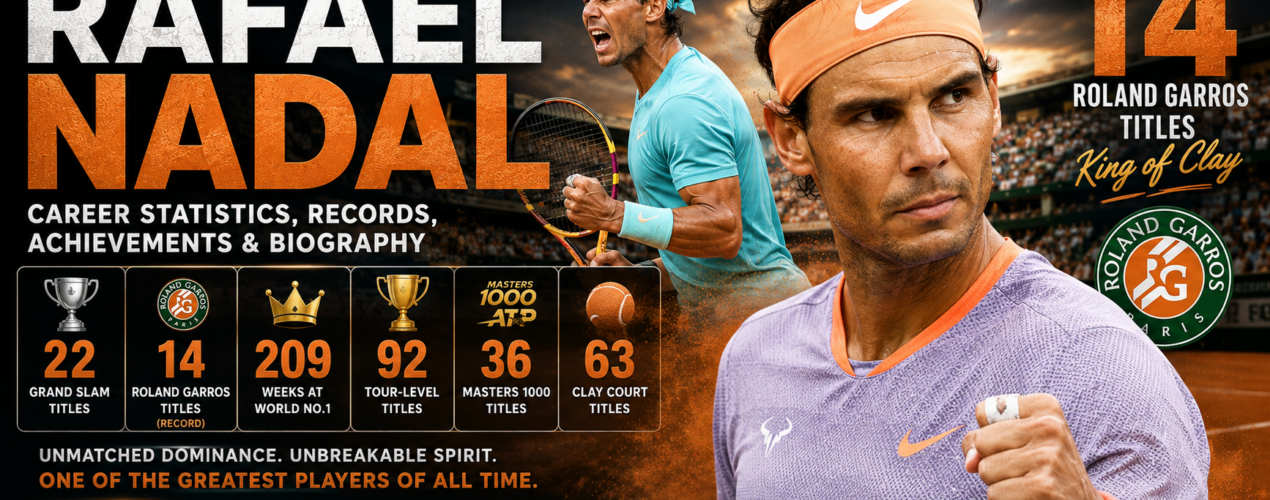
The Spanish legend won 22 Grand Slam singles titles, including an unprecedented 14 Roland Garros championships, spent 209 weeks as ATP World No. 1, captured 36 Masters 1000 titles, won 92 tour-level singles titles, and earned Olympic gold medals in both singles and doubles.
At Roland Garros alone, Nadal finished with an extraordinary 112–4 record.
Those numbers explain part of his greatness.
They do not explain all of it.
Nadal became famous for relentless competitiveness, extraordinary movement, devastating topspin, physical endurance and an ability to fight for points and matches that appeared lost.
His rivalries with Roger Federer and Novak Djokovic helped define one of the greatest eras in men’s tennis history.
Together, the three champions became the central figures in the modern debate over the greatest tennis player of all time.
This page explores Rafael Nadal’s complete career, statistics, Grand Slam championships, records, rivalries, playing style, achievements and historical legacy.
You can also see where tennis fans currently place Nadal in the Live Tennis GOAT Ranking or explore how the greatest tennis player of all time is determined.
Rafael Nadal Quick Facts
| Fact | Rafael Nadal |
|---|---|
| Full Name | Rafael Nadal Parera |
| Country | Spain |
| Born | June 3, 1986 |
| Birthplace | Manacor, Mallorca, Spain |
| Height | 1.85 m / 6 ft 1 in |
| Plays | Left-handed, two-handed backhand |
| Turned Professional | 2001 |
| Retired | 2024 |
| Highest ATP Ranking | No. 1 |
| Weeks at World No. 1 | 209 |
| Year-End No. 1 Finishes | 5 |
| Grand Slam Singles Titles | 22 |
| Australian Open Titles | 2 |
| Roland Garros Titles | 14 |
| Wimbledon Titles | 2 |
| US Open Titles | 4 |
| Tour-Level Singles Titles | 92 |
| Career Singles Wins | 1,075 |
| Masters 1000 Titles | 36 |
| Clay-Court Titles | 63 |
| Olympic Singles Gold | Beijing 2008 |
| Olympic Doubles Gold | Rio 2016 |
| Career Grand Slam | Yes |
| Davis Cup Champion | Yes |
GOATofTennis.net Status: One of the leading candidates for the title of Greatest Tennis Player of All Time.
Rafael Nadal Career Overview
Rafael Nadal’s professional career became a story of dominance, adaptation, resilience and repeated comebacks.
He turned professional as a teenager and quickly established himself as one of tennis’s most dangerous young players.
By 2005, the tennis world understood that something extraordinary was happening.
Nadal arrived at Roland Garros for the first time at age 19.
He won the tournament.
That championship was not the beginning of a normal Grand Slam career.
It was the beginning of one of the most dominant relationships between an athlete and a sporting venue ever seen.
Nadal would eventually win Roland Garros 14 times.
But reducing his career to clay would be a serious mistake.
He won Wimbledon twice.
He won the Australian Open twice.
He won the US Open four times.
He reached World No. 1.
He completed the Career Grand Slam.
He won Olympic singles gold.
He defeated Federer in one of the greatest Wimbledon finals ever played.
And he competed successfully across multiple generations despite suffering numerous injuries throughout his career.
By the time Nadal retired from professional tennis in 2024, his résumé had secured his place among the sport’s greatest champions.
Rafael Nadal Career Statistics
Nadal’s career combines extraordinary Grand Slam success with longevity, surface dominance and championship success across the tour.
| Achievement | Nadal |
|---|---|
| Grand Slam Singles Titles | 22 |
| Australian Open Titles | 2 |
| Roland Garros Titles | 14 |
| Wimbledon Titles | 2 |
| US Open Titles | 4 |
| Tour-Level Singles Titles | 92 |
| Career Singles Wins | 1,075 |
| Weeks at ATP No. 1 | 209 |
| Year-End No. 1 Finishes | 5 |
| Masters 1000 Titles | 36 |
| Clay-Court Titles | 63 |
| Olympic Singles Gold Medals | 1 |
| Olympic Doubles Gold Medals | 1 |
| Career Grand Slam | Completed |
These numbers establish Nadal as much more than the greatest clay-court specialist in tennis history.
He was an all-surface champion who happened to achieve unprecedented dominance on one surface.
Rafael Nadal Grand Slam Record
Nadal won 22 Grand Slam men’s singles championships.
Grand Slam Title Breakdown
| Grand Slam | Titles |
|---|---|
| Australian Open | 2 |
| Roland Garros | 14 |
| Wimbledon | 2 |
| US Open | 4 |
| Total | 22 |
Nadal won every Grand Slam tournament at least twice.
That fact is important.
His 14 Roland Garros championships naturally dominate discussions about his career, but Nadal’s major résumé demonstrates that he could win under every Grand Slam condition.
Hard court.
Clay.
Grass.
Outdoor heat.
Long physical battles.
Fast rallies.
Slow rallies.
Nadal adapted and won everywhere.
Roland Garros: The Greatest Dominance of Nadal’s Career
No discussion of Rafael Nadal can begin anywhere else.
14 Roland Garros titles.
Nadal won the French major in:
2005, 2006, 2007, 2008, 2010, 2011, 2012, 2013, 2014, 2017, 2018, 2019, 2020 and 2022.
He reached 14 finals.
He won all 14.
His final career record at Roland Garros was:
112 wins – 4 losses.
That translates to a winning percentage above 96%.
Across 19 appearances in Paris, only three players defeated Nadal:
Robin Söderling
Novak Djokovic
and
Alexander Zverev.
Djokovic defeated him twice.
That means Nadal lost only four matches at Roland Garros across an entire professional career.
Why Nadal Was Almost Unbeatable at Roland Garros
Clay amplified nearly every strength in Nadal’s game.
His heavy left-handed forehand generated extreme topspin.
The slower surface gave him additional time to defend.
His movement allowed him to turn defensive positions into attacking ones.
His physical conditioning made long rallies extremely difficult for opponents.
And his mentality made winning three sets against him on clay an enormous challenge.
The result was something tennis had never seen before.
A player did not simply dominate a tournament for several seasons.
Nadal dominated Roland Garros across generations.
His first championship came in 2005.
His final championship came in 2022.
Seventeen years separated them.
Why Rafael Nadal Is Called the King of Clay
The nickname King of Clay is not marketing exaggeration.
It is supported by one of the most extraordinary collections of surface-specific statistics in tennis history.
Nadal won 63 tour-level clay-court titles.
His career clay-court record was approximately 484–51.
He won 81 consecutive matches on clay from 2005 to 2007.
That remains an Open Era record winning streak on a single surface.
He also won 50 consecutive sets on clay during another extraordinary run in 2017 and 2018.
And then there is Roland Garros:
14 titles.
112 wins.
4 losses.
There have been extraordinary clay-court champions throughout tennis history.
Nadal exists in a category of his own.
Australian Open: Two Championships and Years of Persistence
The Australian Open produced both heartbreak and triumph for Nadal.
He won the tournament twice:
2009 and 2022.
His first championship came in 2009.
Nadal defeated Fernando Verdasco in an exhausting five-set semifinal before facing Roger Federer in the final.
Nadal defeated Federer in another five-set battle to win his first Australian Open championship.
Thirteen years later came one of the greatest comeback victories of Nadal’s career.
In the 2022 Australian Open final, Nadal faced Daniil Medvedev.
He lost the first two sets.
Medvedev appeared to be in control.
Nadal fought back.
He won the match in five sets and captured his second Australian Open championship.
The victory gave Nadal his 21st Grand Slam singles title and demonstrated one of the defining characteristics of his career:
he was extraordinarily difficult to finish off.
Wimbledon: Nadal Conquers Grass
Nadal’s Wimbledon success is one of the strongest arguments against describing him as only a clay-court champion.
He won Wimbledon twice:
2008 and 2010.
The 2008 championship became one of the defining moments of his career.
Nadal faced Federer in the final.
Federer had won Wimbledon five consecutive times.
Nadal had lost to him in the previous two Wimbledon finals.
Their 2008 match stretched across five sets and was repeatedly interrupted by rain.
Nadal eventually won:
6–4, 6–4, 6–7, 6–7, 9–7.
The match became one of the most celebrated finals in tennis history.
More importantly for Nadal’s career, it proved that his game could conquer tennis’s most famous grass-court championship.
Two years later, he won Wimbledon again.
US Open: Four Championships in New York
Nadal won the US Open four times:
2010, 2013, 2017 and 2019.
His first US Open championship in 2010 was historically significant.
By winning in New York, Nadal completed the Career Grand Slam.
At age 24, he had now won all four major championships.
His US Open success also demonstrates how effectively his game adapted to hard courts.
The 2019 championship provided another memorable example of Nadal’s resilience.
He defeated Daniil Medvedev in a five-set final that lasted nearly five hours.
By then, Nadal was no longer the teenage phenomenon who had arrived at Roland Garros in 2005.
He was a veteran champion still capable of surviving some of the most physically demanding matches in tennis.
The Historic 22 Grand Slam Titles
Nadal finished his career with 22 Grand Slam singles championships.
For a period, he held the men’s record.
His 2022 Australian Open victory moved him to 21 majors.
Later that year, another Roland Garros championship brought him to 22.
Novak Djokovic eventually surpassed that total.
But historical evaluation requires context.
Nadal’s 22 majors include:
14 Roland Garros titles
4 US Opens
2 Wimbledons
and
2 Australian Opens.
He also completed the Career Grand Slam.
The result is a résumé combining unmatched surface dominance with championship success everywhere else.
Rafael Nadal and World No. 1
Nadal spent 209 weeks as ATP World No. 1.
He first reached the top ranking on August 18, 2008.
The achievement was particularly significant because Nadal spent years competing directly against Federer during one of the strongest periods of Federer’s career.
Before finally reaching No. 1, Nadal spent a record 160 consecutive weeks at No. 2.
He eventually finished five seasons as the year-end World No. 1:
2008
2010
2013
2017
2019
The years are revealing.
Nadal’s first year-end No. 1 season and his final one were separated by more than a decade.
That demonstrates remarkable longevity.
Rafael Nadal’s Record Top-10 Longevity
One of Nadal’s less famous records may be one of the clearest demonstrations of his consistency.
He spent 912 consecutive weeks inside the ATP Top 10.
His streak lasted from 2005 until 2023.
That means an entire generation of tennis fans essentially grew up without seeing Rafael Nadal outside the world’s Top 10.
Injuries interrupted individual seasons.
They did not remove him from elite tennis for nearly two decades.
That consistency is a major part of his historical résumé.
Rafael Nadal Masters 1000 Record
Nadal won 36 ATP Masters 1000 titles.
A large portion came on clay, where he dominated tournaments such as Monte-Carlo, Rome and Madrid.
But his Masters résumé was not limited to one surface.
Nadal also won major hard-court Masters events.
His 410 Masters 1000 match victories demonstrate the consistency he maintained at the highest level below the Grand Slams.
Masters tournaments matter in GOAT comparisons because they measure performance throughout the regular tour—not only during four major events each year.
Rafael Nadal at Monte-Carlo
Monte-Carlo became another symbol of Nadal’s clay-court dominance.
He won the tournament 11 times.
Even more remarkably, Nadal won eight consecutive Monte-Carlo championships from 2005 through 2012.
Dominating the same elite tournament across so many seasons demonstrates how difficult it was for opponents to solve Nadal’s clay-court game.
Rafael Nadal at the Olympics
Nadal’s Olympic career strengthens his all-around résumé.
He won two Olympic gold medals.
Beijing 2008 Singles Gold
Nadal won the men’s singles gold medal at the 2008 Beijing Olympics.
Only days later, he officially became ATP World No. 1 for the first time.
The summer of 2008 therefore became one of the defining periods of his career:
Wimbledon champion.
Olympic champion.
World No. 1.
Rio 2016 Doubles Gold
Eight years later, Nadal won another Olympic gold medal.
This time he partnered with Marc López to win the men’s doubles championship at Rio 2016.
That gave Nadal Olympic gold in both singles and doubles.
Rafael Nadal and the Career Golden Slam
By winning Olympic singles gold in Beijing and all four Grand Slam tournaments during his career, Nadal completed the Career Golden Slam.
His collection includes:
- Australian Open
- Roland Garros
- Wimbledon
- US Open
- Olympic singles gold
This achievement reinforces an important point about Nadal’s legacy.
His career cannot be reduced to clay.
He won the biggest prizes available across different surfaces and formats.
Rafael Nadal and the Davis Cup
Representing Spain was an important part of Nadal’s career.
He contributed to multiple Spanish Davis Cup championship teams.
His connection to the competition was so significant that his final professional appearance came at the 2024 Davis Cup Finals in Málaga.
That created a fitting conclusion.
One of Nadal’s early major achievements had come while representing Spain in Davis Cup competition.
Two decades later, he chose the same competition as the setting for his farewell to professional tennis.
Rafael Nadal on Every Surface
Nadal will always be associated most strongly with clay.
But his results demonstrate elite performance on every major surface.
Clay Courts
This is where Nadal produced his greatest dominance.
His résumé includes:
- 14 Roland Garros titles
- 63 clay-court titles
- 81 consecutive clay-court match wins
- 112–4 Roland Garros record
No surface-player relationship in modern men’s tennis is more iconic.
Hard Courts
Nadal won six hard-court Grand Slam championships:
Two Australian Opens
and
Four US Opens.
He also won Masters titles on hard courts and Olympic singles gold on a hard court in Beijing.
His success demonstrates that Nadal’s heavy topspin and defensive skills could be adapted well beyond clay.
Grass Courts
Nadal won Wimbledon twice.
He also reached multiple Wimbledon finals.
His 2008 victory over Federer remains one of the defining achievements of his career.
Grass required Nadal to adjust his court position, serve and attacking patterns.
He did so successfully enough to become a multiple Wimbledon champion.
What Made Rafael Nadal’s Game So Effective?
Nadal’s game was immediately recognizable.
Few players in tennis history have possessed such a distinctive combination of technique, athleticism and competitive mentality.
The Left-Handed Forehand
Nadal’s forehand became his signature weapon.
He generated enormous topspin, causing the ball to jump aggressively after the bounce.
Against right-handed players, his crosscourt forehand naturally attacked the opponent’s backhand.
That pattern became particularly important in his rivalry with Federer.
Movement and Defense
At his physical peak, Nadal’s court coverage was extraordinary.
Shots that appeared to be winners often came back.
But his defense was not passive.
Nadal frequently used extraordinary retrievals to change the momentum of rallies before turning defense into attack.
Physical Endurance
Long matches rarely discouraged Nadal.
His conditioning and willingness to engage in physically demanding rallies created pressure on opponents.
Winning against him often required maintaining an extremely high level for hours.
Heavy Topspin
Nadal’s topspin was particularly devastating on clay.
The higher bounce pushed opponents away from the baseline and created space for Nadal to attack.
But the same spin also gave him margin and control on other surfaces.
Competitive Mentality
Perhaps no characteristic is more closely associated with Nadal than his willingness to compete for every point.
He rarely behaved as if a match were lost before the final point.
That mentality produced countless comebacks and made opponents understand that beating Nadal required actually finishing the match.
Rafael Nadal’s Greatest Rivalries
Nadal competed during an extraordinary period of men’s tennis.
His rivalries with Federer and Djokovic became central to his career and to the popularity of the sport itself.
Nadal vs Roger Federer
Nadal’s rivalry with Roger Federer became one of tennis’s defining sporting relationships.
The contrast was compelling.
Federer’s tennis was built around attacking variety, early ball-striking, serving and fluid movement.
Nadal’s game featured heavy topspin, physical defense, relentless pressure and extraordinary court coverage.
Their tactical matchup was particularly interesting because Nadal’s left-handed forehand naturally attacked Federer’s one-handed backhand.
Nadal finished with a winning career head-to-head record against Federer.
But the rivalry became much larger than statistics.
The 2008 Wimbledon final became one of the most celebrated matches in tennis history.
The 2017 Australian Open final provided Federer with one of his greatest late-career victories.
Over time, the rivalry also developed into a highly visible friendship and mutual respect.
Nadal vs Novak Djokovic
Nadal’s rivalry with Novak Djokovic was even more extensive.
They played 60 professional matches.
Djokovic finished with a narrow 31–29 head-to-head advantage.
But the overall number hides enormous surface differences.
Nadal held the advantage at Roland Garros.
Djokovic proved capable of defeating Nadal on clay in ways almost no other player could.
Their matches frequently became physical endurance contests built around defense, baseline precision and tactical adjustments.
The rivalry included Grand Slam finals, Masters finals, Olympic competition and some of the longest elite matches of their era.
Djokovic, Nadal and Federer GOAT comparison!
Their 2012 Australian Open final became particularly famous for its extraordinary length and physical intensity.
Nadal vs the Next Generation
Nadal’s longevity meant that he also competed against players who grew up watching the Big Three.
By the later stages of his career, younger champions such as Carlos Alcaraz and Jannik Sinner had emerged.
Alcaraz was particularly significant because he represented Spain’s next generation of men’s tennis.
Nadal’s career therefore became a bridge between different eras—from Federer and Djokovic to the champions who followed them.
The 2008 Season: Nadal Reaches the Summit
The 2008 season was one of the defining years of Nadal’s career.
He won Roland Garros without dropping a set.
Then he defeated Federer in the Wimbledon final.
Then he won Olympic singles gold in Beijing.
And then he became World No. 1.
Within a matter of months, Nadal had demonstrated championship success on clay, grass and hard courts.
That season permanently changed the perception that he was primarily a clay-court specialist.
He had become the world’s best player.
The 2010 Season: Three Majors on Three Surfaces
Nadal produced another historic season in 2010.
He won:
Roland Garros on clay
Wimbledon on grass
and
the US Open on hard court.
Winning three Grand Slam tournaments on three different surfaces in the same season demonstrated extraordinary versatility.
The US Open championship also completed his Career Grand Slam.
At age 24, Nadal had won every major tournament.
The 2013 Comeback
Injuries repeatedly interrupted Nadal’s career.
His response to those injuries became part of his legacy.
After missing significant competition because of a knee problem, Nadal returned in 2013 and produced one of the greatest comeback seasons in tennis history.
He won Roland Garros.
He won the US Open.
He returned to World No. 1.
The season reinforced a pattern that would repeat throughout his career:
Nadal could disappear because his body would not allow him to compete—and then return to championship level.
The 2022 Australian Open Comeback
Few matches summarize Nadal’s competitive identity better than the 2022 Australian Open final.
He faced Daniil Medvedev.
He lost the first two sets.
He was a break point away from falling further behind in the third.
The situation appeared close to hopeless.
Nadal won.
The five-set comeback delivered his second Australian Open title and 21st Grand Slam championship.
Only months later, he won Roland Garros again to reach 22 majors.
At age 36, Nadal was still rewriting his career.
Rafael Nadal Career Timeline
| Year | Career Milestone |
|---|---|
| 2001 | Turns professional |
| 2004 | Helps Spain win Davis Cup |
| 2005 | Wins first Roland Garros title |
| 2006 | Successfully defends Roland Garros |
| 2007 | Wins third consecutive Roland Garros title |
| 2008 | Wins Roland Garros, Wimbledon and Olympic singles gold; becomes World No. 1 |
| 2009 | Wins first Australian Open |
| 2010 | Wins Roland Garros, Wimbledon and US Open; completes Career Grand Slam |
| 2012 | Wins seventh Roland Garros title |
| 2013 | Returns from injury to win Roland Garros and US Open |
| 2014 | Wins ninth Roland Garros championship |
| 2016 | Wins Olympic doubles gold |
| 2017 | Wins Roland Garros and US Open; returns to No. 1 |
| 2019 | Wins Roland Garros and US Open; finishes year No. 1 |
| 2020 | Wins 13th Roland Garros title |
| 2022 | Wins Australian Open and record-extending 14th Roland Garros |
| 2024 | Plays final professional event at Davis Cup Finals and retires |
Rafael Nadal’s Greatest Records and Achievements
Nadal’s record book contains achievements that may remain unmatched for generations.
14 Roland Garros Titles
This is the defining record.
Nadal won the same Grand Slam tournament 14 times.
No man has won another Grand Slam singles tournament as many times.
112–4 Roland Garros Record
Nadal won 112 of his 116 matches at Roland Garros.
The statistic captures how difficult defeating him in Paris truly was.
22 Grand Slam Singles Titles
Nadal finished his career with 22 major championships.
63 Clay-Court Titles
The number reinforces his status as the most successful clay-court champion of the Open Era.
81 Consecutive Clay-Court Victories
Nadal won 81 straight matches on clay from 2005 to 2007.
That is an Open Era record winning streak on a single surface.
209 Weeks at World No. 1
Nadal spent more than four years in total at the top of the ATP rankings.
Five Year-End No. 1 Finishes
He finished No. 1 in 2008, 2010, 2013, 2017 and 2019.
912 Consecutive Weeks in the Top 10
Nadal remained inside the ATP Top 10 continuously for almost 18 years.
36 Masters 1000 Titles
His Masters success demonstrates dominance beyond Grand Slam tournaments.
Career Grand Slam
Nadal won all four major championships.
Career Golden Slam
Nadal added Olympic singles gold to victories at all four Grand Slam tournaments.
Two Olympic Gold Medals
He won singles gold in Beijing 2008 and doubles gold in Rio 2016.
Rafael Nadal’s GOAT Case
Nadal’s argument for being the greatest men’s tennis player of all time is powerful because it combines historic dominance with all-surface achievement.
Supporters can point to:
- 22 Grand Slam singles titles
- 14 Roland Garros championships
- 112–4 career record at Roland Garros
- 209 weeks at World No. 1
- Five year-end No. 1 finishes
- 36 Masters 1000 titles
- 92 tour-level singles titles
- 1,075 career singles victories
- 63 clay-court titles
- 81-match clay winning streak
- Career Grand Slam
- Career Golden Slam
- Olympic singles gold
- Olympic doubles gold
- Multiple Wimbledon championships
- Multiple Australian Open championships
- Four US Open titles
- Winning career head-to-head record against Federer
- Extraordinary longevity
- Repeated successful returns from injury
But Nadal’s GOAT case contains another argument that raw totals do not capture:
peak dominance.
When discussing the greatest player ever, should it matter that one player achieved a level of superiority on a surface that nobody else in tennis history has approached?
For Nadal supporters, the answer is yes.
The Counterarguments to Nadal as the GOAT
A balanced comparison must also acknowledge the strongest arguments against Nadal.
Djokovic Leads Several Major Career Categories
Novak Djokovic finished with more Grand Slam titles than Nadal.
He also spent significantly more weeks at World No. 1 and won more Masters 1000 and ATP Finals titles.
For fans who prioritize the broadest statistical résumé, Djokovic therefore has a powerful advantage.
Nadal’s Results Were More Concentrated on Clay
Fourteen of Nadal’s 22 Grand Slam championships came at Roland Garros.
A majority of his tour-level titles also came on clay.
Critics may argue that Djokovic and Federer had more evenly distributed success across surfaces.
Nadal supporters respond that dominance should not be penalized simply because one player became historically superior on a particular surface.
No ATP Finals Championship
Nadal never won the season-ending ATP Finals.
It is one of the most significant titles missing from his résumé.
Fewer Weeks at No. 1 Than Federer and Djokovic
Nadal’s 209 weeks at World No. 1 are extraordinary.
But they trail both Federer and Djokovic.
For fans who place heavy emphasis on sustained ranking dominance, this weakens Nadal’s statistical case relative to those rivals.
Is Rafael Nadal the Greatest Tennis Player of All Time?
There is no official answer.
Statistically, Djokovic leads Nadal in several major career categories.
Federer’s influence and sustained dominance created a different type of GOAT argument.
But Nadal possesses something neither rival can match:
14 Roland Garros titles and perhaps the greatest single-surface dominance tennis has ever witnessed.
And Nadal was not merely the King of Clay.
He won all four majors.
He won Wimbledon twice.
He won the Australian Open twice.
He won four US Opens.
He became World No. 1.
He won Olympic singles gold.
He completed the Career Golden Slam.
His career therefore combines unmatched specialization with genuine all-surface greatness.
Whether that combination makes Rafael Nadal the GOAT depends on how you define greatness.
And that is why the debate remains open.
Nadal vs Djokovic vs Federer: Career Snapshot
| Achievement | Rafael Nadal | Novak Djokovic | Roger Federer |
|---|---|---|---|
| Grand Slam Titles | 22 | 24 | 20 |
| Australian Open | 2 | 10 | 6 |
| Roland Garros | 14 | 3 | 1 |
| Wimbledon | 2 | 7 | 8 |
| US Open | 4 | 4 | 5 |
| Weeks at World No. 1 | 209 | 428 | 310 |
| Masters 1000 Titles | 36 | 40 | 28 |
| ATP Finals Titles | 0 | 7 | 6 |
| Career Grand Slam | Yes | Yes | Yes |
| Olympic Singles Gold | Yes | Yes | No |
No table can settle the GOAT debate by itself.
But it reveals why the debate is so compelling.
Djokovic owns the strongest position in several major career totals.
Federer holds the men’s Wimbledon record and had extraordinary uninterrupted dominance at No. 1.
Nadal possesses a Roland Garros record unlike anything else in men’s tennis.
For the broader analysis, visit our Greatest Tennis Player of All Time guide.
Vote: Is Rafael Nadal the Tennis GOAT?
What matters most when defining greatness?
Total championships?
Peak dominance?
Longevity?
Versatility?
Head-to-head competition?
Mental strength?
Historical influence?
Rafael Nadal’s career provides one of the strongest arguments in every serious GOAT discussion.
Now the decision belongs to tennis fans.
VIEW THE LIVE TENNIS GOAT RANKING
The GOATofTennis.net ranking is determined by fan votes—not by our editorial team.
Rafael Nadal Frequently Asked Questions
How many Grand Slam titles did Rafael Nadal win?
Rafael Nadal won 22 Grand Slam men’s singles championships.
How many French Open titles did Rafael Nadal win?
Nadal won Roland Garros 14 times, the men’s singles record at the tournament.
His championships came in 2005, 2006, 2007, 2008, 2010, 2011, 2012, 2013, 2014, 2017, 2018, 2019, 2020 and 2022.
What was Rafael Nadal’s record at Roland Garros?
Nadal finished his Roland Garros career with 112 wins and four losses.
Who defeated Rafael Nadal at Roland Garros?
Only three players defeated Nadal at Roland Garros:
Robin Söderling, Novak Djokovic and Alexander Zverev.
Djokovic defeated Nadal twice at the tournament.
Why is Rafael Nadal called the King of Clay?
Nadal won 14 Roland Garros titles, 63 tour-level clay-court championships and 81 consecutive matches on clay.
His combination of titles, winning percentage and longevity on the surface is unmatched in modern men’s tennis.
How many Australian Open titles did Nadal win?
Nadal won the Australian Open twice, in 2009 and 2022.
How many Wimbledon titles did Nadal win?
Nadal won Wimbledon twice, in 2008 and 2010.
How many US Open titles did Nadal win?
Nadal won the US Open four times:
2010, 2013, 2017 and 2019.
How many career titles did Rafael Nadal win?
Nadal finished his career with 92 tour-level singles titles.
How many career matches did Nadal win?
Nadal recorded 1,075 tour-level singles victories.
How many weeks was Rafael Nadal World No. 1?
Nadal spent 209 weeks at ATP World No. 1.
How many times did Nadal finish the year No. 1?
Nadal finished five seasons as year-end World No. 1:
2008, 2010, 2013, 2017 and 2019.
How many Masters 1000 titles did Nadal win?
Nadal won 36 Masters 1000 championships.
Did Rafael Nadal win the ATP Finals?
No.
Nadal never won the season-ending ATP Finals.
It is one of the major titles missing from his career résumé.
Did Rafael Nadal win Olympic gold?
Yes.
Nadal won two Olympic gold medals.
He won men’s singles gold at Beijing 2008 and men’s doubles gold with Marc López at Rio 2016.
Did Nadal complete the Career Grand Slam?
Yes.
Nadal won all four Grand Slam tournaments.
He completed the Career Grand Slam by winning the US Open in 2010.
Did Nadal complete the Career Golden Slam?
Yes.
His four Grand Slam championships combined with Olympic singles gold gave Nadal a Career Golden Slam.
What was Nadal’s longest clay-court winning streak?
Nadal won 81 consecutive matches on clay between 2005 and 2007.
When did Rafael Nadal retire?
Nadal retired from professional tennis in November 2024 after his final appearance at the Davis Cup Finals in Málaga, Spain.
Is Rafael Nadal the greatest clay-court player ever?
Nadal’s 14 Roland Garros titles, 63 clay-court championships and extraordinary career winning record on the surface give him an unmatched statistical case as the greatest clay-court player in men’s tennis history.
Is Rafael Nadal officially the tennis GOAT?
No organization officially awards the title of Greatest Tennis Player of All Time.
Nadal remains one of the leading candidates because of his 22 Grand Slam championships, unprecedented clay-court dominance, Career Golden Slam, longevity and success against the greatest players of his generation.
Explore More Rafael Nadal Statistics and Comparisons
This page is designed to become the central Rafael Nadal profile within the GOATofTennis.net player database.
As our database expands, continue exploring:
Rafael Nadal vs Novak Djokovic – Complete Comparison
Rafael Nadal vs Roger Federer – Complete Comparison
Rafael Nadal Grand Slam Record
Rafael Nadal Roland Garros Record
Rafael Nadal Australian Open Record
Rafael Nadal Wimbledon Record
Rafael Nadal US Open Record
Rafael Nadal Masters 1000 Record
Rafael Nadal Clay-Court Records
Rafael Nadal Career Timeline
Rafael Nadal Greatest Matches
Rafael Nadal Records That May Never Be Broken
These resources will form a complete information network around this central profile as they are published.
Continue the Tennis GOAT Debate
Rafael Nadal’s career is one part of the larger question at the heart of GOATofTennis.net.
The Greatest Tennis Player of All Time
Compare Nadal, Djokovic, Federer and other tennis legends across records, achievements, surfaces, eras and historical context.
Tennis GOAT Ranking – Live Fan Vote
See where Nadal currently ranks among tennis fans and cast your vote.
How Is the Greatest Tennis Player of All Time Determined?
Learn how Grand Slam championships, rankings, longevity, versatility, head-to-head competition and historical influence contribute to the GOAT debate.
Novak Djokovic: Career Statistics, Records, Achievements & Biography
Explore the complete career and records of Nadal’s most frequently played major rival.
Roger Federer: Career Statistics, Records, Achievements & Biography
Explore the career of the rival with whom Nadal created one of tennis’s most famous sporting relationships.
Editorial Methodology
GOATofTennis.net aims to separate measurable career statistics from historical interpretation and fan opinion.
Because Rafael Nadal’s professional career ended in 2024, his career statistics are now fixed.
However, the historical context surrounding those achievements will continue to evolve as new generations challenge existing records.
Our player profiles therefore distinguish between:
Fact — measurable career statistics and historical results.
Analysis — interpretation of what those achievements mean within tennis history.
Fan Opinion — voting results submitted by the GOATofTennis.net community.
We do not believe historical greatness should be decided by selectively choosing one statistic.
Grand Slam championships matter.
World No. 1 rankings matter.
Peak dominance matters.
Longevity matters.
Versatility matters.
Direct competition matters.
Olympic achievements matter.
And historical impact matters.
Our goal is to present those factors clearly enough for readers to reach their own conclusions.
Editorial Promise
GOATofTennis.net is committed to building an accurate, transparent and continually improving resource for tennis history, statistics, records and comparisons.
Player statistics are checked against established tennis records.
Errors are corrected when identified.
Historical comparisons acknowledge differences between eras rather than pretending every generation competed under identical conditions.
The GOAT debate deserves more than opinions.
It deserves statistics, context, history and the voice of tennis fans.
Rafael Nadal’s professional career is complete.
His records are now part of tennis history.
His place among the greatest players of all time will be debated for generations.