
Last Updated: September 2026
Reaching World No. 1 is one of the greatest achievements in professional tennis.
Staying there is even harder.
But there is another ranking accomplishment that carries enormous historical importance:
finishing the season as the year-end World No. 1.
A player can reach No. 1 during the year without finishing there.
A player can also spend many weeks at the top across a career without leading the rankings when a particular season ends.
That is what makes the year-end No. 1 record different.
In men’s tennis, one player stands alone.
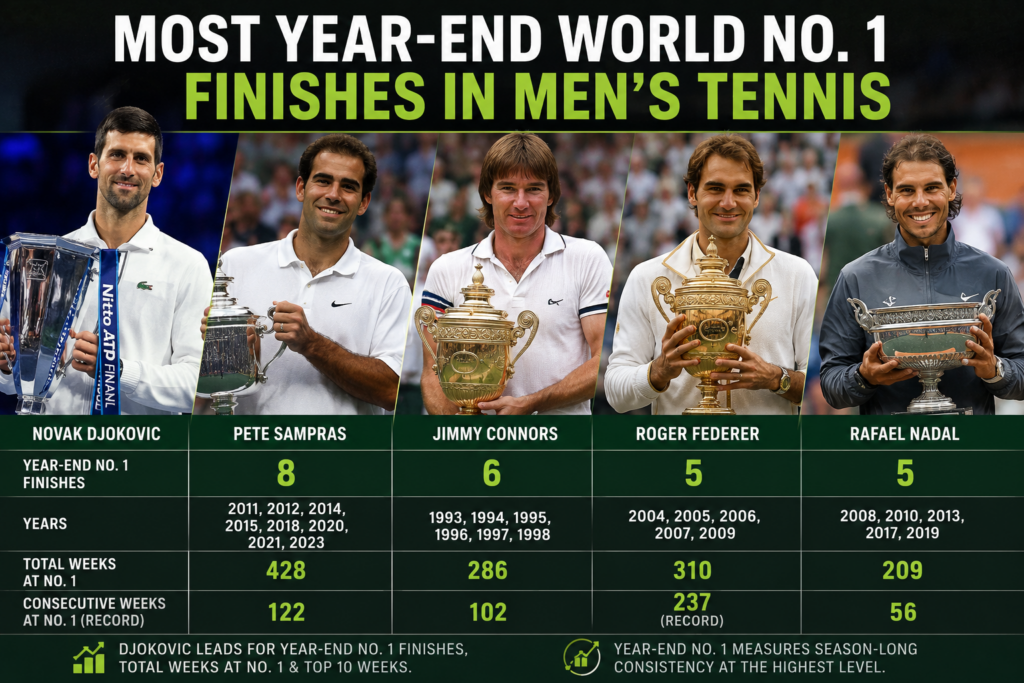
Novak Djokovic has finished as ATP year-end World No. 1 eight times — the men’s record.
Behind him are Pete Sampras with six and Jimmy Connors, Roger Federer and Rafael Nadal with five each.
Those numbers provide another important piece of evidence when comparing the greatest players in tennis history.
Let’s look at the complete record, how year-end No. 1 is determined, and why this achievement matters so much.
Who Has the Most Year-End No. 1 Finishes? Quick Answer
Novak Djokovic holds the men’s record for the most ATP year-end World No. 1 finishes.
He has achieved it:
8 times
Djokovic finished No. 1 in:
2011
2012
2014
2015
2018
2020
2021
2023
The leading men’s totals are:
| Rank | Player | Year-End No. 1 Finishes |
|---|---|---|
| 1 | Novak Djokovic | 8 |
| 2 | Pete Sampras | 6 |
| 3 | Jimmy Connors | 5 |
| 3 | Roger Federer | 5 |
| 3 | Rafael Nadal | 5 |
| 6 | John McEnroe | 4 |
| 6 | Ivan Lendl | 4 |
Djokovic therefore owns a two-season advantage over Sampras and a three-season advantage over Federer and Nadal.
What Does Year-End World No. 1 Mean?
Year-end World No. 1 is the player who finishes the tennis season at the top of the official rankings.
This is different from simply reaching No. 1.
A player might become World No. 1 in March, lose the position in June and finish the season ranked second.
That player was:
World No. 1
but was not:
year-end World No. 1.
The year-end distinction rewards performance across the season.
Why Is Year-End No. 1 So Important?
Finishing No. 1 means a player has successfully accumulated enough ranking results across the season to end ahead of every rival.
That normally requires excellence at several levels of competition.
Grand Slams matter enormously.
Masters-level events matter.
Other tour results matter.
Consistency matters.
And maintaining performance throughout the season matters.
That makes year-end No. 1 an important measure of seasonal dominance.
Novak Djokovic — 8 Year-End No. 1 Finishes
Novak Djokovic holds the men’s record.
His eight year-end No. 1 seasons are:
| Year | Year-End Ranking |
|---|---|
| 2011 | No. 1 |
| 2012 | No. 1 |
| 2014 | No. 1 |
| 2015 | No. 1 |
| 2018 | No. 1 |
| 2020 | No. 1 |
| 2021 | No. 1 |
| 2023 | No. 1 |
What makes this record particularly impressive is the span.
His first year-end No. 1 came in:
2011
His eighth came in:
2023
That is a 12-year gap between his first and most recent year-end No. 1 season.
It demonstrates not just dominance, but longevity.
Djokovic’s First Year-End No. 1 — 2011
The 2011 season transformed Djokovic’s career.
He began the year with an extraordinary winning run.
He won the Australian Open.
He won Wimbledon.
He won the US Open.
And he rose to World No. 1.
Djokovic finished the season as the top-ranked player for the first time.
It was the beginning of a record-breaking period.
Djokovic Repeats in 2012
Djokovic finished No. 1 again in 2012.
This was important because maintaining the top ranking after a breakthrough season can be extremely difficult.
Rivals adjust.
Points must be defended.
Expectations increase.
Djokovic demonstrated that 2011 was not an isolated peak.
He had become the player to beat.
Djokovic’s 2014 and 2015 No. 1 Seasons
Djokovic returned to the year-end top position in:
2014
Then again in:
2015
His 2015 season was particularly dominant.
He won three Grand Slam titles and reached the final of the fourth.
It remains one of the strongest seasons of the modern era.
By the end of 2015, Djokovic had already accumulated four year-end No. 1 finishes.
But he was only halfway to his eventual record.
Djokovic Returns to No. 1 in 2018
The 2018 season demonstrated another side of Djokovic’s greatness.
After struggling with injury and form, he returned to championship level.
He won Wimbledon.
He won the US Open.
And he climbed back to No. 1.
Djokovic finished 2018 as year-end No. 1 for the fifth time.
That tied the totals of Connors and Federer.
Djokovic Finishes No. 1 in 2020 and 2021
Djokovic added another year-end No. 1 finish in:
2020
That moved him to six.
Then came:
2021
Djokovic won the Australian Open.
He won Roland-Garros.
He won Wimbledon.
He reached the US Open final.
By finishing the season No. 1 for a seventh time, Djokovic broke the men’s record previously held by Pete Sampras.
Djokovic Extends the Record in 2023
Djokovic wasn’t finished.
At age 36, he produced another remarkable season in 2023.
He won:
Australian Open
Roland-Garros
US Open
and reached the:
Wimbledon final
He also won the ATP Finals.
Djokovic finished the season ranked No. 1 for the eighth time.
That extended his men’s record.
Eight seasons.
More than a decade separating the first and last.
It is one of the strongest longevity records in men’s tennis.
For the wider career picture, visit our Novak Djokovic profile.
Pete Sampras — 6 Year-End No. 1 Finishes
Before Djokovic broke the record, it belonged to:
Pete Sampras
Sampras finished year-end No. 1:
six times
And he did something particularly impressive.
He achieved all six consecutively.
His No. 1 seasons were:
1993
1994
1995
1996
1997
1998
Six straight seasons.
That remains one of the greatest sustained periods of ranking dominance in tennis history.
Why Sampras’s Six Consecutive No. 1 Seasons Matter
Djokovic owns the overall record.
But Sampras’s achievement has its own unique quality.
From 1993 through 1998, every ATP season ended with the same player at No. 1.
Pete Sampras.
That level of uninterrupted control over the rankings is extraordinary.
It also helps explain why Sampras was widely regarded as the greatest men’s player of his era.
Jimmy Connors — 5 Year-End No. 1 Finishes
Jimmy Connors finished year-end No. 1 five times.
His seasons were:
1974
1975
1976
1977
1978
Like Sampras, Connors produced an extraordinary consecutive run.
Five seasons.
Five year-end No. 1 finishes.
Connors also holds another major longevity record:
the men’s Open Era record for career match victories.
That combination demonstrates how long he remained among the sport’s elite.
Roger Federer — 5 Year-End No. 1 Finishes
Roger Federer also finished No. 1 five times.
His year-end No. 1 seasons were:
2004
2005
2006
2007
2009
Federer’s first four came consecutively.
That period represents one of the most dominant stretches of his career.
From 2004 through 2007, Federer controlled men’s tennis at an extraordinary level.
Federer’s 2004–2007 Ranking Dominance
Federer became World No. 1 in 2004 and then held the position for:
237 consecutive weeks
That remains the men’s record for the longest uninterrupted stay at No. 1.
He finished:
2004 — No. 1
2005 — No. 1
2006 — No. 1
2007 — No. 1
His run ended when Rafael Nadal eventually displaced him from the top position in 2008.
Federer later returned and finished 2009 as No. 1 for a fifth time.
For his broader achievements, visit our Roger Federer profile.
Rafael Nadal — 5 Year-End No. 1 Finishes
Rafael Nadal also finished year-end World No. 1 five times.
His seasons were:
2008
2010
2013
2017
2019
Nadal’s pattern is very different from Federer, Connors and Sampras.
His five finishes were spread across more than a decade.
That makes Nadal’s record particularly interesting as a measure of longevity.
Nadal’s First and Last No. 1 Seasons
Nadal first finished year-end No. 1 in:
2008
His fifth and final year-end No. 1 finish came in:
2019
That demonstrates his ability to return to the top after injuries, difficult seasons and changing generations of competition.
For the complete career picture, visit our Rafael Nadal profile.
John McEnroe — 4 Year-End No. 1 Finishes
John McEnroe finished No. 1 four times:
1981
1982
1983
1984
Four consecutive seasons.
His final season in that run, 1984, is frequently remembered as one of the greatest individual seasons in men’s tennis history.
McEnroe combined elite singles results with extraordinary doubles success during his peak.
Ivan Lendl — 4 Year-End No. 1 Finishes
Ivan Lendl also finished year-end No. 1 four times.
His seasons were:
1985
1986
1987
1989
Lendl’s dominance followed McEnroe’s.
This transition helps illustrate the evolution of men’s tennis during the 1980s.
McEnroe controlled the early part of the decade.
Lendl then became the dominant ranking force.
Most Men’s Year-End No. 1 Finishes
Here is the leading historical group:
| Player | Year-End No. 1 Finishes | Years |
|---|---|---|
| Novak Djokovic | 8 | 2011, 2012, 2014, 2015, 2018, 2020, 2021, 2023 |
| Pete Sampras | 6 | 1993–1998 |
| Jimmy Connors | 5 | 1974–1978 |
| Roger Federer | 5 | 2004–2007, 2009 |
| Rafael Nadal | 5 | 2008, 2010, 2013, 2017, 2019 |
| John McEnroe | 4 | 1981–1984 |
| Ivan Lendl | 4 | 1985–1987, 1989 |
These numbers show several different types of dominance.
Djokovic owns the overall total.
Sampras owns an extraordinary six-season consecutive streak.
Connors produced five consecutive finishes.
Federer produced four consecutive finishes during his peak.
Nadal’s five were spread across an unusually long period.
Different careers reached the same achievement in different ways.
Djokovic vs Federer vs Nadal: Year-End No. 1
The Big Three comparison is straightforward:
| Player | Year-End No. 1 Finishes |
|---|---|
| Novak Djokovic | 8 |
| Roger Federer | 5 |
| Rafael Nadal | 5 |
Djokovic leads both rivals by:
3 year-end No. 1 finishes
This is a significant advantage in one of the major ranking categories used in GOAT comparisons.
But year-end No. 1 is only one ranking measurement.
Another important one is total weeks at No. 1.
Year-End No. 1 vs Most Weeks at No. 1
These statistics measure different things.
Weeks at World No. 1
Measures the total amount of time a player occupies the top ranking.
Year-End World No. 1
Measures how many seasons a player finishes in the top position.
A player can lead one category without having the same advantage in another.
That is why the two statistics deserve separate analysis.
For the complete weeks record, read Who Has Spent the Most Weeks at World No. 1?.
Djokovic vs Federer vs Nadal: Weeks at No. 1
The Big Three totals are:
| Player | Weeks at No. 1 | Year-End No. 1 Finishes |
|---|---|---|
| Novak Djokovic | 428 | 8 |
| Roger Federer | 310 | 5 |
| Rafael Nadal | 209 | 5 |
Djokovic leads both ranking categories.
Federer holds another important ranking record:
237 consecutive weeks at No. 1.
Nadal’s five year-end No. 1 finishes are particularly impressive considering that his total number of weeks at No. 1 is substantially lower than Federer’s.
Each statistic reveals something different.
Who Has the Most Consecutive Year-End No. 1 Finishes?
Pete Sampras holds the men’s record with:
6 consecutive year-end No. 1 finishes
from:
1993 through 1998
Behind him:
Jimmy Connors — 5 consecutive
from 1974 through 1978.
Roger Federer and John McEnroe each produced four consecutive year-end No. 1 seasons.
This is an important distinction.
Djokovic owns the most total year-end No. 1 finishes.
Sampras owns the longest consecutive streak.
Most Consecutive Year-End No. 1 Seasons
| Player | Consecutive Finishes |
|---|---|
| Pete Sampras | 6 |
| Jimmy Connors | 5 |
| Roger Federer | 4 |
| John McEnroe | 4 |
This illustrates why tennis records should be examined from more than one angle.
Total dominance and uninterrupted dominance are related, but they are not identical.
Who Was the Oldest Men’s Year-End World No. 1?
Novak Djokovic became the oldest man to finish a season ranked World No. 1 in:
2023
He was:
36 years old
That added another longevity dimension to his record.
His first year-end No. 1 came in 2011.
His record eighth came 12 years later.
Very few athletes in any sport remain capable of finishing as the world’s best so far apart in their careers.
Why Finishing No. 1 Is Harder Than Reaching No. 1
Reaching World No. 1 is extraordinarily difficult.
But a player can reach the top because of an exceptional stretch of results.
Finishing the season there requires something slightly different.
The ranking must survive the entire competitive cycle.
A player may need to defend major titles.
Perform consistently at Masters events.
Stay healthy.
Manage fatigue.
And respond when rivals accumulate points.
Year-end No. 1 therefore reflects a full-season body of work.
Can a Player Be World No. 1 Without Finishing the Year No. 1?
Absolutely.
This happens frequently.
Several players may occupy the No. 1 ranking during the same season.
But only one player can finish the year at the top.
That is why the list of players who have reached No. 1 is much larger than the list of players with multiple year-end No. 1 finishes.
Does Year-End No. 1 Mean a Player Was the Best Player That Year?
Usually, it is one of the strongest objective indicators.
But debates can still occur.
Ranking systems measure results according to established point structures.
Fans and analysts may place different emphasis on:
Grand Slam titles,
head-to-head results,
Olympic results,
or peak performance.
Still, finishing the official season ranked No. 1 is one of the clearest objective measures of sustained annual performance.
Year-End No. 1 and Grand Slam Success
Year-end No. 1 seasons frequently coincide with major success.
That makes sense.
Grand Slams award enormous ranking value and represent four of the biggest opportunities to build a dominant season.
Djokovic’s 2011, 2015, 2021 and 2023 seasons all included multiple major championships.
Federer’s dominant 2004–2007 period featured extraordinary Grand Slam success.
Nadal’s year-end No. 1 seasons often coincided with some of the strongest all-surface performances of his career.
Grand Slam titles and ranking dominance therefore frequently reinforce each other.
For the major-title leaderboard, visit Who Has Won the Most Grand Slam Tennis Titles?.
Does Year-End No. 1 Matter in the GOAT Debate?
Yes.
Finishing a season No. 1 is one of the strongest measures of seasonal dominance.
Doing it repeatedly demonstrates that a player was not simply great for a few months.
The player repeatedly accumulated the strongest ranking résumé across entire seasons.
Djokovic’s eight finishes therefore strengthen his GOAT case.
Sampras’s six consecutive seasons demonstrate the scale of his 1990s dominance.
Federer’s five show the extraordinary consistency of his peak.
Nadal’s five demonstrate his ability to return to the top across more than a decade.
Connors, McEnroe and Lendl also show why ranking dominance matters when comparing generations.
Is Year-End No. 1 More Important Than Grand Slam Titles?
There is no universally accepted formula.
Grand Slam titles generally receive more attention.
But year-end No. 1 measures something that a major title cannot:
season-long ranking dominance.
A player can win one Grand Slam while performing inconsistently elsewhere.
Finishing No. 1 usually requires a much broader collection of results.
That is why both statistics belong in a serious GOAT comparison.
Ranking Records in the GOAT Debate
When comparing all-time greats, we should distinguish several ranking accomplishments.
Total Weeks at No. 1
Measures accumulated time at the top.
Consecutive Weeks at No. 1
Measures uninterrupted dominance.
Year-End No. 1 Finishes
Measures how often a player ends an entire season on top.
Each tells a different story.
Using only one can hide important parts of a player’s career.
That is why our methodology for determining the greatest tennis player of all time evaluates multiple categories.
Year-End No. 1 FAQ
Who has finished year-end World No. 1 the most times in men’s tennis?
Novak Djokovic holds the men’s record with eight year-end No. 1 finishes.
How many times did Djokovic finish year-end No. 1?
Eight.
Which years did Djokovic finish No. 1?
2011, 2012, 2014, 2015, 2018, 2020, 2021 and 2023.
Who had the record before Djokovic?
Pete Sampras, with six year-end No. 1 finishes.
How many times did Pete Sampras finish No. 1?
Six.
How many times did Federer finish year-end No. 1?
Five.
How many times did Nadal finish year-end No. 1?
Five.
How many times did Jimmy Connors finish year-end No. 1?
Five.
Who has the most consecutive year-end No. 1 finishes?
Pete Sampras, with six consecutive seasons from 1993 through 1998.
How many consecutive year-end No. 1 finishes did Federer have?
Four, from 2004 through 2007.
How many consecutive year-end No. 1 finishes did Connors have?
Five, from 1974 through 1978.
What is the difference between World No. 1 and year-end World No. 1?
World No. 1 refers to occupying the top ranking at any point.
Year-end No. 1 means finishing the season ranked first.
Is year-end No. 1 the same as most weeks at No. 1?
No.
Weeks at No. 1 measure total time at the top.
Year-end No. 1 measures the number of seasons a player finishes first.
Who has spent the most weeks at men’s World No. 1?
Novak Djokovic holds the record with 428 weeks.
Who holds the record for consecutive weeks at men’s No. 1?
Roger Federer, with 237 consecutive weeks.
Who was the oldest men’s year-end No. 1?
Novak Djokovic, who finished 2023 at No. 1 at age 36.
Does year-end No. 1 matter in the GOAT debate?
Yes.
It is an important measure of season-long dominance and consistency.
Final Answer: Who Has Finished Year-End No. 1 the Most Times?
The men’s record belongs to:
Novak Djokovic — 8 year-end No. 1 finishes
He finished at the top in:
2011
2012
2014
2015
2018
2020
2021
2023
Behind him:
Pete Sampras — 6
Jimmy Connors — 5
Roger Federer — 5
Rafael Nadal — 5
John McEnroe — 4
Ivan Lendl — 4
Djokovic owns the overall record.
Sampras owns the record for consecutive year-end No. 1 finishes with six.
Connors achieved five consecutively.
Federer achieved four consecutively and also holds the men’s record for consecutive weeks at No. 1.
Nadal finished No. 1 five times across more than a decade.
These differences matter.
Year-end No. 1 isn’t simply another ranking statistic.
It answers a very specific question:
Who finished an entire tennis season on top of everyone else?
Doing it once is exceptional.
Doing it repeatedly defines an era.
And doing it eight times is one of the strongest ranking achievements in men’s tennis history.
How Much Should No. 1 Dominance Matter in the GOAT Debate?
Djokovic leads the men’s records for both total weeks at No. 1 and year-end No. 1 finishes.
Federer owns the longest consecutive stay at No. 1.
Sampras owns the most consecutive year-end No. 1 seasons.
Nadal repeatedly returned to No. 1 across different stages of his career.
So which ranking achievement matters most?
And how should rankings compare with Grand Slam titles, Masters championships, head-to-head results and longevity?
VIEW THE LIVE TENNIS GOAT RANKING AND CAST YOUR VOTE
Compare the greatest players in tennis history and make your choice.
Tags: ATP Rankings, Novak Djokovic, Pete Sampras, Rafael Nadal, Roger Federer, tennis GOAT, tennis records, Year-End World No. 1