
Last Updated: August 2026
Roger Federer is one of the most accomplished, influential and recognizable players in tennis history.
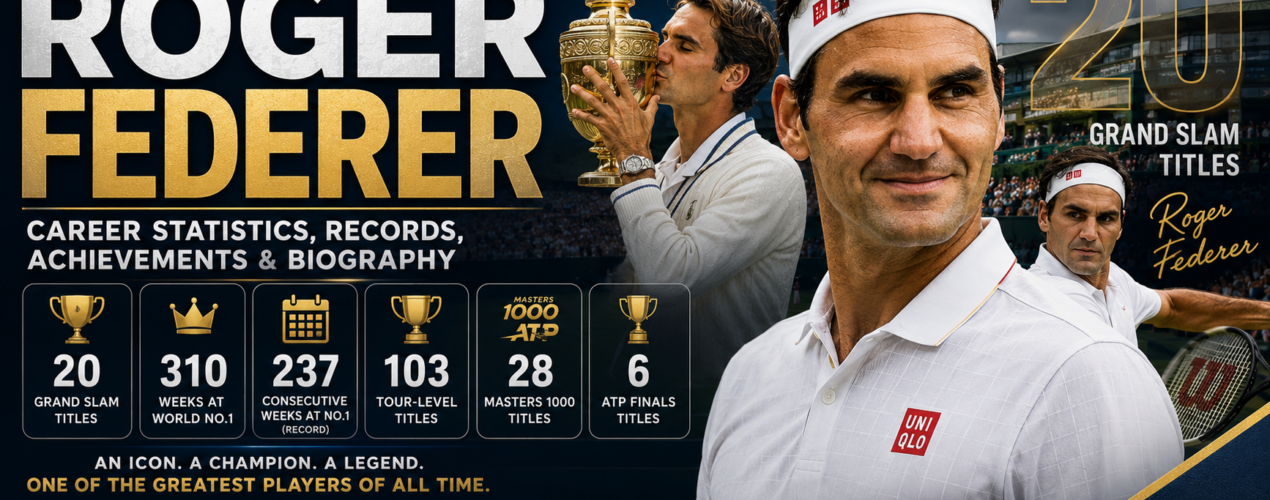
The Swiss champion won 20 Grand Slam singles titles, a record eight Wimbledon men’s singles championships, 103 tour-level singles titles, six ATP Finals titles and 28 Masters 1000 championships.
He spent 310 weeks as ATP World No. 1, including an extraordinary 237 consecutive weeks at the top—a record that still stands.
But Federer’s legacy cannot be understood through numbers alone.
His attacking tennis, movement, one-handed backhand, longevity and enormous international popularity helped define an era and introduced millions of people around the world to professional tennis.
Alongside Novak Djokovic and Rafael Nadal, Federer became one of the central figures in the modern debate over the greatest tennis player of all time.
This page explores Roger Federer’s complete career, statistics, Grand Slam championships, records, rivalries, playing style, achievements and legacy.
You can also see where tennis fans currently place Federer in the Live Tennis GOAT Ranking or explore how the greatest tennis player of all time is determined.
Roger Federer Quick Facts
| Fact | Roger Federer |
|---|---|
| Full Name | Roger Federer |
| Country | Switzerland |
| Born | August 8, 1981 |
| Birthplace | Basel, Switzerland |
| Height | 1.85 m / 6 ft 1 in |
| Plays | Right-handed, one-handed backhand |
| Turned Professional | 1998 |
| Retired | 2022 |
| Highest ATP Ranking | No. 1 |
| Weeks at World No. 1 | 310 |
| Consecutive Weeks at No. 1 | 237 |
| Year-End No. 1 Finishes | 5 |
| Grand Slam Singles Titles | 20 |
| Australian Open Titles | 6 |
| Roland Garros Titles | 1 |
| Wimbledon Titles | 8 |
| US Open Titles | 5 |
| Tour-Level Singles Titles | 103 |
| Masters 1000 Titles | 28 |
| ATP Finals Titles | 6 |
| Career Singles Wins | 1,251 |
| Olympic Gold Medal | Doubles – Beijing 2008 |
| Olympic Singles Silver | London 2012 |
| Davis Cup Champion | 2014 |
| Career Grand Slam | Yes |
| International Tennis Hall of Fame | Class of 2026 |
GOATofTennis.net Status: One of the leading candidates for the title of Greatest Tennis Player of All Time.
Roger Federer Career Overview
Roger Federer’s journey from talented Swiss junior to global sporting icon lasted more than two decades.
Early in his career, his enormous potential was obvious.
So was his inconsistency.
Federer possessed extraordinary shot-making ability, but transforming that talent into sustained championship success required time.
One of the first major signals came at Wimbledon in 2001.
Federer defeated seven-time Wimbledon champion Pete Sampras in five sets in the fourth round.
Sampras had dominated Wimbledon throughout the previous decade.
Federer’s victory did not immediately make him a Grand Slam champion, but in retrospect it became a symbolic moment:
one era meeting the next.
Two years later, Federer returned to Wimbledon and won his first Grand Slam singles championship.
The 2003 Wimbledon title changed his career.
By February 2004, Federer had reached World No. 1.
What followed was one of the most dominant periods men’s tennis had ever seen.
Between 2004 and 2007, Federer controlled much of the men’s tour, accumulated Grand Slam championships at an extraordinary rate and remained No. 1 for a record 237 consecutive weeks.
Then came another challenge.
Rafael Nadal emerged as his greatest rival.
Novak Djokovic followed.
Instead of dominating a transitional era indefinitely, Federer found himself competing against two players who would eventually construct GOAT résumés of their own.
His ability to continue winning against younger generations—and to return to Grand Slam-winning form in his mid-30s—became an important part of his legacy.
Roger Federer Career Statistics
Federer’s historical importance becomes clearer when his major achievements are viewed together.
| Achievement | Federer |
|---|---|
| Grand Slam Singles Titles | 20 |
| Australian Open Titles | 6 |
| Roland Garros Titles | 1 |
| Wimbledon Titles | 8 |
| US Open Titles | 5 |
| Tour-Level Singles Titles | 103 |
| Career Singles Wins | 1,251 |
| Weeks at ATP No. 1 | 310 |
| Consecutive Weeks at No. 1 | 237 |
| Year-End No. 1 Finishes | 5 |
| Masters 1000 Titles | 28 |
| ATP Finals Titles | 6 |
| Olympic Doubles Gold | 1 |
| Olympic Singles Silver | 1 |
| Davis Cup Titles | 1 |
| Career Grand Slam | Completed |
Federer’s numbers would represent an extraordinary career in any generation.
Their historical importance is even greater because many of them became standards that later champions had to chase.
For years, 20 Grand Slam titles represented the summit of men’s tennis.
For years, 310 weeks at No. 1 represented the record.
His 237 consecutive weeks at No. 1 remain a remarkable symbol of uninterrupted dominance.
Roger Federer Grand Slam Record
Federer won 20 Grand Slam men’s singles championships.
Grand Slam Title Breakdown
| Grand Slam | Titles |
|---|---|
| Australian Open | 6 |
| Roland Garros | 1 |
| Wimbledon | 8 |
| US Open | 5 |
| Total | 20 |
The distribution demonstrates Federer’s versatility.
He won majors on hard courts, grass and clay and completed the Career Grand Slam.
But one tournament became particularly associated with his career.
Wimbledon.
Wimbledon: Roger Federer’s Greatest Stage
If one tournament symbolizes Roger Federer, it is Wimbledon.
Federer won the men’s singles championship a record eight times:
2003, 2004, 2005, 2006, 2007, 2009, 2012 and 2017.
His first Wimbledon championship in 2003 was also his first Grand Slam title.
He then won five consecutive Wimbledon championships from 2003 through 2007.
The grass courts rewarded many of Federer’s greatest strengths:
- Precise serving
- First-strike tennis
- Variety
- Movement
- Slice backhand
- Net skills
- Ability to take the ball early
His attacking style seemed naturally suited to the tournament.
Federer’s Wimbledon story, however, also includes some of the most painful defeats of his career.
The 2008 final against Rafael Nadal became one of the most celebrated matches in tennis history.
The 2019 final against Novak Djokovic became another unforgettable chapter when Federer held championship points but ultimately lost.
Those defeats are part of his story because Federer’s greatest rivalries often reached their highest level on tennis’s biggest stages.
Australian Open: Six Championships in Melbourne
Federer won the Australian Open six times:
2004, 2006, 2007, 2010, 2017 and 2018.
His success in Melbourne spans an extraordinary period.
His first Australian Open championship came in 2004.
His sixth came 14 years later in 2018.
But the most famous may be 2017.
Federer entered the tournament after spending months away from competition because of injury.
At age 35, he was no longer expected to dominate men’s tennis in the way he had a decade earlier.
He reached the final.
Waiting for him was Rafael Nadal.
Federer recovered from a break down in the fifth set to defeat his longtime rival and claim his 18th Grand Slam championship.
The victory became one of the defining moments of the later stage of his career.
One year later, Federer defended his Australian Open title and became the first man to reach 20 Grand Slam singles championships.
Roland Garros and the Career Grand Slam
Clay was Federer’s most difficult major surface.
The biggest reason had a name:
Rafael Nadal.
Federer repeatedly reached the final stages of Roland Garros during his prime, only to encounter the greatest clay-court player the sport had seen.
He finished runner-up to Nadal in the 2006, 2007 and 2008 finals.
Then came 2009.
Nadal was eliminated earlier in the tournament by Robin Söderling.
Federer reached the final and defeated Söderling to win his first Roland Garros championship.
The victory completed Federer’s Career Grand Slam.
He had now won:
- Australian Open
- Roland Garros
- Wimbledon
- US Open
The emotional significance of the victory was enormous.
For years, Roland Garros had been the missing piece in Federer’s résumé.
In 2009, he finally completed the set.
US Open: Five Consecutive Championships
Federer won the US Open five times:
2004, 2005, 2006, 2007 and 2008.
All five championships came consecutively.
That streak demonstrates the level of dominance Federer maintained during his prime.
From 2004 through 2008, nobody could remove him from the throne in New York.
His combination of serving, aggressive baseline play and ability to control points early made him exceptionally difficult to defeat on the US Open hard courts.
Federer reached another US Open final in 2009 but lost to Juan Martín del Potro in five sets.
He never won the tournament again.
Yet five consecutive US Open championships remain one of the defining achievements of his career.
The Historic 20 Grand Slam Titles
Today, tennis fans know that Djokovic and Nadal eventually moved beyond Federer’s Grand Slam total.
That can make it easy to forget how significant Federer’s achievement was when it happened.
When Federer began his career, Pete Sampras’ 14 major championships represented the Open Era men’s benchmark.
Federer passed it.
Then he kept going.
At the 2018 Australian Open, Federer became the first man in tennis history to win 20 Grand Slam singles titles.
The number became the new standard.
Nadal and Djokovic would eventually surpass it, but Federer’s role in moving the benchmark from 14 to 20 remains historically important.
GOAT debates should not evaluate only where a record stands today.
They should also consider how dramatically a player changed expectations during his own era.
Federer did exactly that.
The Federer Dominance Era: 2004–2007
Federer’s peak dominance is central to his GOAT case.
From 2004 through 2007, he produced one of the greatest four-year stretches in men’s tennis history.
During those four seasons, Federer won 11 Grand Slam singles titles.
Federer at the Majors, 2004–2007
| Year | Australian Open | Roland Garros | Wimbledon | US Open |
|---|---|---|---|---|
| 2004 | Champion | Third Round | Champion | Champion |
| 2005 | Semifinal | Semifinal | Champion | Champion |
| 2006 | Champion | Final | Champion | Champion |
| 2007 | Champion | Final | Champion | Champion |
The table shows something extraordinary.
During the final two years of that stretch—2006 and 2007—Federer reached the final of every Grand Slam tournament.
Only Nadal at Roland Garros prevented him from completing the calendar-year Grand Slam.
This period established Federer as the dominant force in men’s tennis.
Roger Federer and World No. 1
Federer first reached ATP World No. 1 on February 2, 2004.
Then he stayed there.
And stayed there.
And stayed there.
Federer remained No. 1 for 237 consecutive weeks.
That remains the record for the longest uninterrupted reign at the top of the ATP rankings.
In total, Federer spent 310 weeks as World No. 1.
He also finished five seasons as the year-end No. 1:
2004, 2005, 2006, 2007 and 2009.
Djokovic later surpassed Federer’s total weeks at No. 1.
But the consecutive-weeks record illustrates something slightly different:
uninterrupted dominance.
For more than four and a half years, nobody displaced Federer from the top ranking.
Roger Federer ATP Titles
Federer finished his career with 103 tour-level singles championships.
Only a tiny number of players in the Open Era have reached the 100-title milestone.
Federer’s championships were won across different surfaces, continents and generations.
His trophy collection included:
- 20 Grand Slam titles
- 28 Masters 1000 titles
- 6 ATP Finals titles
- Numerous ATP 500 and ATP 250 championships
He won his 100th career title in Dubai in 2019.
By the end of his career, the total stood at 103.
That combination of major championships and overall tournament success illustrates both peak excellence and longevity.
Roger Federer Masters 1000 Record
Federer won 28 ATP Masters 1000 championships.
His Masters success came across hard courts and clay.
Among the tournaments most closely associated with him was Cincinnati, where Federer won seven times.
Masters events provide important context in GOAT comparisons because they require sustained excellence outside the four Grand Slam tournaments.
Federer’s 28 championships therefore represent another significant part of his career résumé.
Roger Federer at the ATP Finals
Federer won the season-ending ATP Finals six times.
He also reached the championship match 10 times.
The event brings together the best-performing players of the season, making repeated success particularly meaningful.
Federer won the tournament across different stages of his career and under different conditions.
His record at the ATP Finals further demonstrates his ability to defeat elite opposition consistently.
Roger Federer at the Olympics
Federer never won Olympic men’s singles gold.
That is sometimes mentioned as one of the few major achievements missing from his singles résumé.
However, Federer did become an Olympic champion.
At the 2008 Beijing Olympics, Federer partnered with fellow Swiss player Stan Wawrinka to win the men’s doubles gold medal.
Four years later, Federer reached the men’s singles final at the 2012 London Olympics, played at Wimbledon.
Andy Murray defeated him in the gold-medal match.
Federer therefore finished his Olympic career with:
1 doubles gold medal
and
1 singles silver medal.
Roger Federer and the Davis Cup
Another important achievement came in 2014.
Switzerland won the Davis Cup, with Federer playing a central role alongside Stan Wawrinka.
The championship added one of the major international team trophies missing from Federer’s résumé.
For a player whose career was primarily defined by individual achievement, winning the Davis Cup for Switzerland carried particular significance.
Roger Federer on Every Surface
Federer’s reputation is often connected most strongly with grass.
But his career demonstrates far greater versatility.
Grass Courts
Grass was Federer’s signature surface.
His record eight Wimbledon titles represent the clearest evidence.
His serve, footwork, variety and ability to attack early made him ideally suited to the surface.
At one point, Federer won 65 consecutive matches on grass.
Hard Courts
Hard courts produced the majority of Federer’s career titles.
He won:
Six Australian Opens
and
Five US Opens.
His aggressive baseline game, serve and ability to take time away from opponents made him one of the greatest hard-court players of his generation.
Clay Courts
Clay was Federer’s least successful surface relative to his extraordinary standards.
But describing him as a weak clay-court player would be misleading.
Federer reached multiple Roland Garros finals and won the tournament in 2009.
His difficulty in Paris largely reflected the presence of Nadal, whose clay-court achievements are unprecedented.
Federer’s Roland Garros championship and multiple deep runs demonstrate that he remained an elite clay-court competitor.
What Made Roger Federer’s Game So Special?
Statistics explain what Federer achieved.
They do not completely explain why millions of tennis fans were drawn to him.
His game had a distinctive visual quality.
The Serve
Federer’s serve was not necessarily the fastest on tour.
Its effectiveness came from disguise, placement and variation.
Opponents often struggled to read where the ball was going until very late.
That allowed Federer to win free points and begin rallies in attacking positions.
The Forehand
At his peak, Federer’s forehand was one of the most destructive shots in tennis.
He could attack from almost any position and create extreme angles without appearing to use excessive effort.
The inside-out forehand became one of his signature patterns.
The One-Handed Backhand
Few shots are more closely associated with Federer than his one-handed backhand.
It could be used aggressively, defensively or with slice.
Later in his career, Federer became increasingly willing to take the backhand earlier and attack the ball—an adjustment that played an important role in his 2017 resurgence.
Movement
Federer’s movement often appeared effortless.
He used efficient footwork to arrive early and maintain attacking court position.
Rather than relying only on spectacular defensive retrievals, Federer frequently used movement to prevent himself from becoming defensive in the first place.
Net Play
Federer came from a generation in which attacking the net remained an important component of elite tennis.
His volleys and transition game gave him options that many baseline-focused opponents lacked.
Variety
Perhaps the defining quality of Federer’s tennis was variety.
He could:
- Attack from the baseline
- Serve and volley
- Use drop shots
- Slice the backhand
- Change pace
- Take the ball early
- Defend
- Finish points at the net
That versatility made his game difficult to predict.
Roger Federer’s Greatest Rivalries
Federer’s career became inseparable from two of the greatest rivalries in tennis history.
Federer vs Rafael Nadal
Federer was already the dominant player in men’s tennis when Rafael Nadal emerged.
Nadal presented a unique tactical problem.
His heavy left-handed topspin forehand repeatedly attacked Federer’s one-handed backhand, particularly on clay.
Their rivalry produced some of the most famous matches in tennis history.
The 2008 Wimbledon final is often placed among the greatest matches ever played.
Nadal won that match in five sets.
Nine years later, Federer defeated Nadal in another five-set classic in the 2017 Australian Open final.
The rivalry became much more than a collection of matches.
Their contrasting personalities, playing styles and strengths helped expand tennis’s global audience.
Federer vs Novak Djokovic
Federer’s rivalry with Novak Djokovic represented a different challenge.
Djokovic’s return of serve, defensive skills and ability to absorb pace made it increasingly difficult for Federer to control rallies.
Their rivalry produced dramatic matches at Wimbledon and the US Open.
The 2019 Wimbledon final became the most painful example for Federer supporters.
Federer held championship points but Djokovic survived and eventually won.
Djokovic ultimately finished with the winning career head-to-head record.
But the rivalry remains one of the defining competitive relationships of the modern era.
Federer vs Djokovic vs Nadal comparison!
Federer vs Andy Murray
Andy Murray also played an important role in the later years of Federer’s career.
The two met in major finals and Olympic competition.
Federer defeated Murray in the finals of the 2008 US Open and 2012 Wimbledon.
Only weeks after that Wimbledon final, Murray defeated Federer on the same court to win Olympic singles gold.
Their matches added another dimension to an era filled with elite competitors.
Roger Federer Career Timeline
| Year | Career Milestone |
|---|---|
| 1998 | Turns professional |
| 2001 | Defeats Pete Sampras at Wimbledon |
| 2003 | Wins first Grand Slam title at Wimbledon |
| 2004 | Reaches World No. 1 and wins three majors |
| 2005 | Wins Wimbledon and US Open |
| 2006 | Wins three majors and reaches all four major finals |
| 2007 | Wins three majors for the third time |
| 2008 | Wins fifth consecutive US Open and Olympic doubles gold |
| 2009 | Wins Roland Garros, completes Career Grand Slam and regains Wimbledon |
| 2010 | Wins Australian Open |
| 2012 | Wins seventh Wimbledon and returns to World No. 1 |
| 2014 | Helps Switzerland win Davis Cup |
| 2017 | Returns from injury to win Australian Open and Wimbledon |
| 2018 | Wins 20th Grand Slam title at Australian Open |
| 2019 | Reaches Wimbledon final and wins 100th career title |
| 2021 | Plays final professional singles season |
| 2022 | Announces retirement and says farewell at Laver Cup |
| 2026 | International Tennis Hall of Fame Class of 2026 |
The Extraordinary 2017 Federer Comeback
Federer’s 2017 season deserves its own place in his career story.
He had missed the second half of 2016 because of a knee injury.
He entered 2017 at age 35 with questions surrounding his future.
Then he produced one of the greatest late-career seasons in tennis history.
At the Australian Open, Federer defeated Nadal in a five-set final to win his first major championship since Wimbledon 2012.
Later that year, he won Wimbledon without dropping a set.
The season changed how many fans viewed athletic longevity in tennis.
Federer was no longer merely extending his career.
He was again winning the sport’s biggest tournaments.
Roger Federer’s Greatest Records and Achievements
Federer’s record book is extensive.
These are among the achievements most important to his historical legacy.
20 Grand Slam Singles Titles
Federer became the first man in tennis history to reach 20 major singles championships.
Eight Wimbledon Titles
Federer holds the men’s singles record with eight Wimbledon championships.
237 Consecutive Weeks at World No. 1
Federer’s uninterrupted run from 2004 to 2008 remains the ATP record.
310 Total Weeks at World No. 1
Federer accumulated 310 weeks at the top of the ATP rankings.
103 Tour-Level Singles Titles
Federer finished his career with more than 100 professional singles championships.
1,251 Career Singles Wins
His extraordinary match-win total demonstrates both excellence and longevity.
36 Consecutive Grand Slam Quarterfinals
Federer’s consistency at the majors produced remarkable streaks.
He reached 36 consecutive Grand Slam quarterfinals.
23 Consecutive Grand Slam Semifinals
Even more extraordinary, Federer reached 23 consecutive major semifinals.
Five Consecutive Wimbledon Titles
Federer won Wimbledon every year from 2003 through 2007.
Five Consecutive US Open Titles
He then produced another five-year championship streak in New York from 2004 through 2008.
Career Grand Slam
Federer’s 2009 Roland Garros championship completed victories at all four majors.
Six ATP Finals Titles
His success at the season-ending championship further strengthened his résumé against elite competition.
Roger Federer’s Impact Beyond Statistics
Any evaluation of Federer that looks only at numbers misses a significant part of his legacy.
Federer became one of the most recognizable athletes in the world.
His influence crossed national and sporting boundaries.
For many casual sports fans, Federer became synonymous with tennis itself.
His playing style contributed enormously to that appeal.
The game looked fluid.
Points looked creative.
His movement appeared effortless.
That aesthetic dimension is difficult to measure statistically, but it matters when discussing historical impact.
Federer also received the ATP Fans’ Favourite award for a record 19 consecutive years.
He became an ambassador for the sport long before his playing career ended.
His influence also continued through the creation of the Laver Cup, a team competition that brought together leading players from Europe and the rest of the world.
Roger Federer and the International Tennis Hall of Fame
Federer’s place in tennis history received another formal recognition when he was elected to the International Tennis Hall of Fame’s Class of 2026.
The honor recognizes a career that extended far beyond championships.
Federer’s influence helped shape modern men’s tennis, and his rivalries with Nadal and Djokovic became central stories in one of the sport’s most celebrated eras.
His Hall of Fame recognition reinforces something tennis fans had understood for years:
Roger Federer is not simply a former champion.
He is part of the history of the sport.
Roger Federer’s GOAT Case
Federer’s GOAT argument has changed over time.
During much of his career, the case was heavily statistical.
He held the men’s Grand Slam record.
He held the total-weeks-at-No. 1 record.
He held numerous other major benchmarks.
Djokovic and Nadal later surpassed some of those totals.
Yet Federer’s GOAT case did not disappear.
Instead, it became broader.
Supporters can point to:
- 20 Grand Slam singles titles
- Eight Wimbledon championships
- 310 weeks at World No. 1
- 237 consecutive weeks at No. 1
- 103 tour-level singles titles
- 1,251 career singles wins
- Six ATP Finals championships
- 28 Masters 1000 titles
- Career Grand Slam
- Olympic doubles gold
- Extraordinary success on grass and hard courts
- Deep success on clay
- Dominance during his peak years
- Exceptional longevity
- Historic rivalries
- Global influence on tennis
- One of the most admired playing styles in the sport’s history
Federer’s strongest GOAT argument therefore combines achievement and influence.
He did not simply win.
He helped change what global tennis stardom looked like.
The Counterarguments to Federer as the GOAT
A serious GOAT analysis should also acknowledge the statistical arguments against Federer.
Djokovic Surpassed Several Major Records
Novak Djokovic eventually surpassed Federer in Grand Slam titles and total weeks at World No. 1.
Djokovic also finished with more Masters 1000 titles and built winning career head-to-head records against both Federer and Nadal.
For fans who prioritize statistical accumulation above other criteria, that strengthens Djokovic’s case.
Nadal Led Their Head-to-Head Rivalry
Rafael Nadal finished with a winning career head-to-head record against Federer.
Nadal’s dominance on clay was particularly important to the rivalry.
For fans who place substantial weight on direct competition, this is an important consideration.
Federer Never Won Olympic Singles Gold
Federer won Olympic doubles gold and singles silver but never captured the men’s singles gold medal.
Djokovic and Nadal both achieved Olympic singles gold.
Era and Competition Questions
GOAT debates frequently examine the strength of competition during different periods of a player’s career.
Federer accumulated many of his biggest titles before Djokovic reached his prime and while Nadal’s greatest early dominance was concentrated on clay.
Federer supporters counter that he later continued competing successfully deep into the era of both rivals.
Both perspectives deserve consideration.
Is Roger Federer the Greatest Tennis Player of All Time?
There is no official answer.
If greatness is determined only by several major career totals, Djokovic now leads Federer in important categories.
Nadal also surpassed Federer’s Grand Slam total.
But the GOAT debate has never been only one spreadsheet.
Federer’s case includes something more difficult to quantify:
how profoundly he influenced tennis.
He established records that reshaped expectations.
He dominated the sport for years.
He won on every surface.
He completed the Career Grand Slam.
He remained a champion into his mid-30s.
He participated in some of the most important rivalries and matches in modern tennis history.
And he inspired an enormous global following.
Whether that combination makes Federer the GOAT depends on how each fan defines greatness.
That is exactly why the debate continues.
Federer vs Djokovic vs Nadal: Career Snapshot
| Achievement | Roger Federer | Novak Djokovic | Rafael Nadal |
|---|---|---|---|
| Grand Slam Titles | 20 | 24 | 22 |
| Australian Open | 6 | 10 | 2 |
| Roland Garros | 1 | 3 | 14 |
| Wimbledon | 8 | 7 | 2 |
| US Open | 5 | 4 | 4 |
| Weeks at World No. 1 | 310 | 428 | 209 |
| Masters 1000 Titles | 28 | 40 | 36 |
| ATP Finals Titles | 6 | 7 | 0 |
| Career Grand Slam | Yes | Yes | Yes |
| Olympic Singles Gold | No | Yes | Yes |
This table illustrates why the GOAT debate is complicated.
Djokovic leads several major statistical categories.
Nadal owns unmatched Roland Garros dominance.
Federer remains the record holder at Wimbledon and possesses a historical and cultural legacy that statistics alone cannot fully represent.
For a much deeper comparison, visit our Greatest Tennis Player of All Time guide.
Vote: Is Roger Federer the Tennis GOAT?
Statistics can measure championships.
Rankings can measure sustained performance.
Head-to-head records can measure direct competition.
But none of those statistics can decide what you value most when defining greatness.
Do you believe Roger Federer’s combination of championships, dominance, longevity, style and global impact makes him the greatest tennis player of all time?
VIEW THE LIVE TENNIS GOAT RANKING
The GOATofTennis.net ranking is determined by fan votes—not by our editorial team.
Roger Federer Frequently Asked Questions
How many Grand Slam titles did Roger Federer win?
Roger Federer won 20 Grand Slam men’s singles championships.
How many Wimbledon titles did Roger Federer win?
Federer won Wimbledon eight times, the men’s singles record.
His championship years were 2003, 2004, 2005, 2006, 2007, 2009, 2012 and 2017.
How many Australian Open titles did Federer win?
Federer won the Australian Open six times:
2004, 2006, 2007, 2010, 2017 and 2018.
How many French Open titles did Federer win?
Federer won Roland Garros once, in 2009.
That victory completed his Career Grand Slam.
How many US Open titles did Federer win?
Federer won the US Open five times, capturing five consecutive championships from 2004 through 2008.
How many career titles did Roger Federer win?
Federer finished his career with 103 tour-level singles titles.
How many matches did Roger Federer win?
Federer recorded 1,251 tour-level singles victories during his career.
How many weeks was Federer World No. 1?
Federer spent 310 total weeks as ATP World No. 1.
What is Federer’s consecutive weeks at No. 1 record?
Federer remained World No. 1 for 237 consecutive weeks from February 2004 until August 2008.
That remains the ATP record for consecutive weeks at No. 1.
How many ATP Finals titles did Federer win?
Federer won the ATP Finals six times.
How many Masters 1000 titles did Federer win?
Federer won 28 Masters 1000 championships.
Did Roger Federer win Olympic gold?
Yes.
Federer and Stan Wawrinka won the men’s doubles gold medal for Switzerland at the 2008 Beijing Olympics.
Federer did not win Olympic singles gold.
He won the men’s singles silver medal at London 2012.
Did Federer complete the Career Grand Slam?
Yes.
Federer completed the Career Grand Slam by winning Roland Garros in 2009.
When did Roger Federer win his first Grand Slam?
Federer won his first major championship at Wimbledon in 2003.
What was Roger Federer’s final Grand Slam title?
Federer’s 20th and final Grand Slam singles championship came at the 2018 Australian Open.
When did Roger Federer retire?
Federer announced his retirement in 2022 and played his farewell competitive event at the Laver Cup.
Is Roger Federer in the Tennis Hall of Fame?
Yes.
Federer was elected to the International Tennis Hall of Fame’s Class of 2026.
Why is Roger Federer considered one of the greatest tennis players ever?
Federer’s GOAT case combines 20 Grand Slam titles, eight Wimbledon championships, 310 weeks at World No. 1, 103 tour-level titles, exceptional longevity, all-surface success and enormous influence on the global popularity of tennis.
Is Roger Federer officially the GOAT?
No organization officially awards the title of Greatest Tennis Player of All Time.
Federer remains one of the leading candidates, but the answer depends on how much weight an individual places on statistics, peak dominance, longevity, playing style, influence and other factors.
Explore More Roger Federer Statistics and Comparisons
This page is designed to become the central Roger Federer profile within the GOATofTennis.net player database.
As our database expands, continue exploring:
Roger Federer vs Novak Djokovic – Complete Comparison
Roger Federer vs Rafael Nadal – Complete Comparison
Roger Federer Grand Slam Record
Roger Federer Wimbledon Record
Roger Federer Australian Open Record
Roger Federer US Open Record
Roger Federer Roland Garros Record
Roger Federer Career Timeline
Roger Federer Greatest Matches
Roger Federer Records That May Never Be Broken
Roger Federer’s 2004–2007 Dominance Explained
As these pages are published, they will form a complete information network around this central profile.
Continue the Tennis GOAT Debate
Roger Federer’s career is one chapter in a much larger discussion.
The Greatest Tennis Player of All Time
Compare Federer, Djokovic, Nadal and other legends across statistics, achievements, eras and historical context.
Tennis GOAT Ranking – Live Fan Vote
See where Federer currently ranks among tennis fans and cast your vote.
How Is the Greatest Tennis Player of All Time Determined?
Learn how Grand Slam championships, No. 1 rankings, longevity, versatility, rivalries and historical influence contribute to the GOAT debate.
Novak Djokovic: Career Statistics, Records, Achievements & Biography
Explore the complete career of one of Federer’s greatest rivals.
Editorial Methodology
GOATofTennis.net aims to separate measurable career statistics from historical interpretation and fan opinion.
Roger Federer’s career statistics are no longer changing because his professional playing career has ended.
However, historical context continues to evolve as new players challenge records and change the way previous achievements are viewed.
Our player profiles therefore distinguish between:
Fact — measurable statistics and historical results.
Analysis — interpretation of those achievements in the context of tennis history.
Fan Opinion — voting results submitted by the GOATofTennis.net community.
We do not believe historical greatness should be decided by selectively choosing one statistic.
Grand Slam titles matter.
Rankings matter.
Peak dominance matters.
Longevity matters.
Competition matters.
Versatility matters.
And historical influence matters.
Our goal is to present those factors clearly enough for readers to form their own conclusions.
Editorial Promise
GOATofTennis.net is committed to building an accurate, transparent and continually improving resource for tennis history, records and comparisons.
Player statistics are checked against established tennis records.
Errors are corrected when identified.
Historical comparisons acknowledge differences between eras rather than assuming every generation competed under identical conditions.
The GOAT debate deserves more than a list of trophies.
It deserves statistics, context, history and the voice of tennis fans.
Roger Federer’s professional career is complete.
His place in tennis history will continue to be debated for generations.