
Last Updated: August 2026
Novak Djokovic has built one of the most accomplished careers in the history of professional tennis.
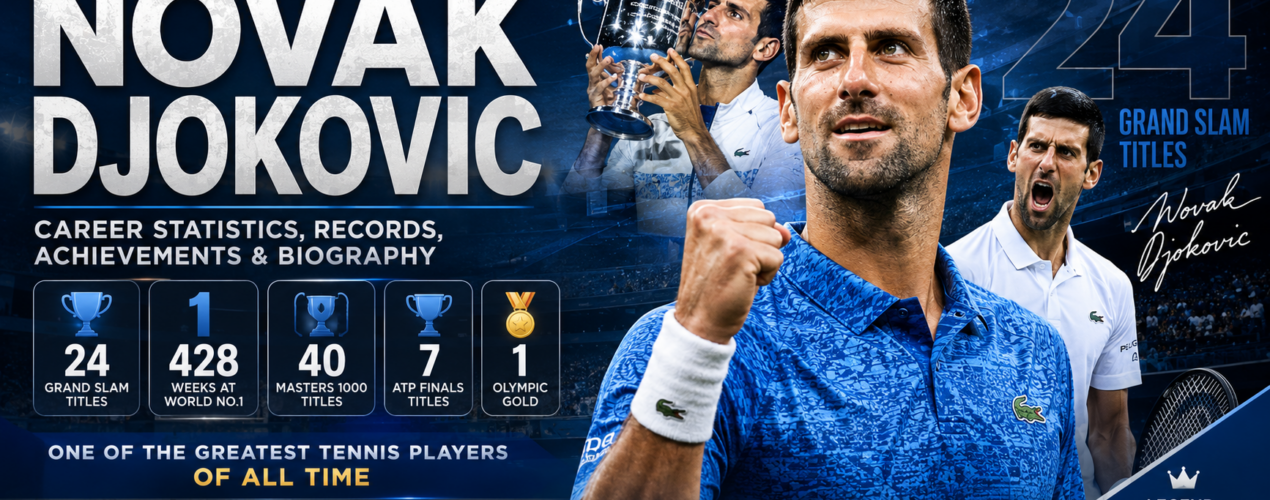
The Serbian champion has won 24 Grand Slam singles titles, spent a record 428 weeks as ATP World No. 1, captured 40 Masters 1000 titles, won the ATP Finals seven times, and completed the Career Golden Slam by winning Olympic singles gold at Paris 2024.
But Djokovic’s place in tennis history is about much more than the size of his trophy collection.
His longevity, ability to win on every surface, success against the greatest players of his generation, return of serve, defensive skills, mental resilience and extraordinary record in the sport’s biggest tournaments have made him one of the central figures in the debate over the greatest tennis player of all time.
This page tracks Novak Djokovic’s career, statistics, Grand Slam championships, records, achievements and legacy—and will be updated as his career continues.
Novak Djokovic Quick Facts
| Fact | Novak Djokovic |
|---|---|
| Full Name | Novak Djokovic |
| Country | Serbia |
| Born | May 22, 1987 |
| Birthplace | Belgrade |
| Height | 1.88 m / 6 ft 2 in |
| Plays | Right-handed |
| Turned Professional | 2003 |
| Highest ATP Ranking | No. 1 |
| Grand Slam Singles Titles | 24 |
| Australian Open Titles | 10 |
| Roland Garros Titles | 3 |
| Wimbledon Titles | 7 |
| US Open Titles | 4 |
| Masters 1000 Titles | 40 |
| ATP Finals Titles | 7 |
| Weeks at World No. 1 | 428 |
| Olympic Singles Gold | 1 – Paris 2024 |
| Career Grand Slam | Yes |
| Career Golden Slam | Yes |
GOATofTennis.net Status: One of the leading candidates for the title of Greatest Tennis Player of All Time.
Novak Djokovic Career Overview
Djokovic’s journey from Belgrade to the summit of world tennis spans more than two decades.
He emerged during an era already dominated by Roger Federer and Rafael Nadal, yet ultimately built a career that surpassed many of the statistical standards established during their extraordinary period at the top of men’s tennis.
His first Grand Slam championship came at the 2008 Australian Open, where he defeated Jo-Wilfried Tsonga in the final.
That victory established Djokovic as a major champion.
What followed transformed him into a tennis legend.
The defining breakthrough came in 2011.
Djokovic began that season with an extraordinary winning streak and finished the year with three Grand Slam titles—the Australian Open, Wimbledon and US Open.
He also reached World No. 1 for the first time.
From that point onward, Djokovic became one of the dominant forces of his generation.
His career would eventually include multiple periods of dominance, remarkable comebacks, victories over several generations of elite opponents, and records that once appeared almost unreachable.
Tennis GOAT Ranking / View the Live Tennis GOAT Ranking
Novak Djokovic Career Statistics
Djokovic’s career is remarkable not because of one isolated record but because he ranks at or near the top of so many major categories.
| Achievement | Djokovic |
|---|---|
| Grand Slam Singles Titles | 24 |
| Australian Open Titles | 10 |
| Roland Garros Titles | 3 |
| Wimbledon Titles | 7 |
| US Open Titles | 4 |
| Masters 1000 Titles | 40 |
| ATP Finals Titles | 7 |
| Weeks at ATP No. 1 | 428 |
| Olympic Singles Gold Medals | 1 |
| Career Grand Slam | Completed |
| Career Golden Slam | Completed |
These achievements explain why Djokovic’s GOAT case extends far beyond Grand Slam totals.
He has combined success at the majors with longevity at World No. 1, dominance at Masters level, year-end championship success, Olympic gold and victories on every major surface.
Novak Djokovic Grand Slam Record
Grand Slam tournaments are the most prestigious championships in tennis, and Djokovic has won 24 men’s singles majors.
Grand Slam Title Breakdown
| Grand Slam | Titles |
|---|---|
| Australian Open | 10 |
| Roland Garros | 3 |
| Wimbledon | 7 |
| US Open | 4 |
| Total | 24 |
The distribution is particularly important when evaluating his career.
Djokovic did not build his Grand Slam total through overwhelming success at only one tournament.
He has won every Grand Slam tournament at least three times.
That makes his major résumé one of the clearest demonstrations of all-surface versatility in men’s tennis history.
Australian Open: Djokovic’s Most Successful Grand Slam
Melbourne occupies a special place in Djokovic’s career.
He has won the Australian Open men’s singles championship 10 times.
His championship years are:
2008, 2011, 2012, 2013, 2015, 2016, 2019, 2020, 2021 and 2023.
The Australian Open was where Djokovic became a Grand Slam champion for the first time.
It later became the tournament most closely associated with his hard-court dominance.
His combination of movement, returning, flexibility, baseline control and ability to perform under pressure has repeatedly made him exceptionally difficult to defeat in Melbourne.
More than a decade after his first Australian Open victory, Djokovic remained one of the tournament’s leading contenders—an extraordinary demonstration of longevity at the highest level.
Roland Garros: Conquering the Greatest Clay-Court Challenge
Roland Garros presented one of the greatest challenges of Djokovic’s career.
Much of his prime overlapped with Rafael Nadal, whose success in Paris established one of the most extraordinary records in tennis history.
Despite that obstacle, Djokovic won Roland Garros three times:
2016, 2021 and 2023.
His first victory in 2016 was historically significant because it completed his Career Grand Slam.
The 2021 championship was another defining achievement.
Djokovic defeated Nadal in the semifinal before coming back from two sets down against Stefanos Tsitsipas in the final.
By winning Roland Garros again in 2023, Djokovic became the first man to win each of the four Grand Slam tournaments at least three times.
That achievement significantly strengthened his case as one of the most versatile champions in tennis history.
Wimbledon: Seven Championships on Grass
Djokovic has won seven Wimbledon men’s singles titles:
2011, 2014, 2015, 2018, 2019, 2021 and 2022.
His Wimbledon success demonstrates how effectively his game adapted to grass.
His return of serve allows him to neutralize powerful servers, while his movement, balance and ability to redirect pace make him extremely difficult to attack consistently.
One of the defining matches of his career came in the 2019 Wimbledon final against Roger Federer.
Djokovic survived championship points before winning one of the most dramatic Wimbledon finals ever played.
His seven Wimbledon championships place him among the greatest grass-court players in men’s tennis history.
US Open: Four Championships in New York
Djokovic has won the US Open four times:
2011, 2015, 2018 and 2023.
New York has also produced some of the most dramatic moments of his career.
In 2021, Djokovic entered the US Open having won the first three Grand Slam tournaments of the season.
Victory in New York would have completed the calendar-year Grand Slam.
He reached the final but lost to Daniil Medvedev.
Two years later, Djokovic returned to the final and defeated Medvedev to claim his 24th Grand Slam singles championship.
The Historic 24 Grand Slam Titles
Djokovic’s 24 major singles championships place him at the top of the men’s Grand Slam title list.
But the number alone does not fully describe the achievement.
His major championships span from the 2008 Australian Open to the 2023 US Open—more than 15 years between his first and 24th Grand Slam titles.
That longevity required Djokovic to succeed against different generations of opponents and repeatedly adapt his game.
He won majors during the Federer-Nadal era.
He won majors while Andy Murray and Stan Wawrinka were major champions and leading competitors.
And he remained a major contender as younger champions emerged.
That ability to remain relevant across different generations is an important part of Djokovic’s historical legacy.
The 2011 Season: Djokovic Becomes World No. 1
The 2011 season transformed Djokovic’s career.
He won:
- Australian Open
- Wimbledon
- US Open
and reached ATP World No. 1 for the first time.
More importantly, he repeatedly defeated Federer and Nadal during a period when both remained elite competitors.
The season established Djokovic not merely as another member of tennis’s emerging Big Three, but as a player capable of dominating the sport himself.
2011 remains one of the defining seasons of his career.
The Historic 2015–2016 Run
Djokovic reached another extraordinary peak during 2015 and the first half of 2016.
He won three majors in 2015:
- Australian Open
- Wimbledon
- US Open
He then won the 2016 Australian Open and 2016 Roland Garros.
By winning in Paris, Djokovic became the reigning champion of all four Grand Slam tournaments simultaneously.
This achievement became widely known as the Nole Slam.
It was not a calendar-year Grand Slam because the championships were won across two seasons.
Nevertheless, holding all four major singles titles at the same time remains one of the defining accomplishments of Djokovic’s career.
The 2021 Grand Slam Pursuit
Djokovic came remarkably close to completing one of tennis’s rarest achievements in 2021.
He won the:
Australian Open
then:
Roland Garros
then:
Wimbledon
That left only the US Open.
Djokovic reached the final in New York with an opportunity to become the first man since Rod Laver in 1969 to complete the calendar-year Grand Slam.
Daniil Medvedev defeated him in the final.
Djokovic fell one victory short.
Even without completing the sweep, winning the first three majors of the year and reaching the final of the fourth demonstrated the extraordinary level he maintained at age 34.
Novak Djokovic and World No. 1
Grand Slam championships measure success at tennis’s biggest individual tournaments.
The ATP ranking measures something different:
sustained performance across the season.
Djokovic has spent 428 weeks at World No. 1, a men’s record.
Remaining No. 1 requires more than performing well at one tournament.
Players must accumulate results throughout the season against changing opponents, conditions and surfaces.
Djokovic’s record therefore provides another important dimension to his GOAT case.
His success was not limited to isolated championship runs.
For years, he accumulated enough results across the tour to remain the world’s highest-ranked player.
Novak Djokovic Masters 1000 Record
Djokovic has won 40 ATP Masters 1000 titles.
Masters tournaments represent the highest regular level of ATP competition below the Grand Slams and ATP Finals.
But Djokovic achieved something particularly remarkable at this level.
He won all nine Masters 1000 tournaments.
Then he won all nine again.
The Double Career Golden Masters
This achievement is commonly described as the Double Career Golden Masters.
It demonstrates Djokovic’s ability to win across dramatically different tournament conditions and surfaces.
Success at all nine events requires far more versatility than dominating one particular type of court.
It is one of the most distinctive achievements on Djokovic’s résumé.
Novak Djokovic at the ATP Finals
Djokovic has won the ATP Finals seven times.
The tournament is particularly demanding because qualification is restricted to the leading players of the season.
Unlike a standard tour event, there are no traditional early rounds against much lower-ranked opponents.
Repeated success at the ATP Finals therefore provides another measure of Djokovic’s ability to defeat elite competition.
His seven championships are an important part of his historical record.
Olympic Gold and the Career Golden Slam
For years, Olympic singles gold was one of the most significant achievements missing from Djokovic’s résumé.
That changed at the Paris 2024 Olympic Games.
Djokovic defeated Carlos Alcaraz in the men’s singles gold-medal match at Roland Garros.
The victory completed his Career Golden Slam.
That means Djokovic has won:
- Australian Open
- Roland Garros
- Wimbledon
- US Open
- Olympic singles gold
The Olympic championship filled one of the few remaining gaps in his trophy collection and became one of the most emotional victories of his career.
Novak Djokovic on Every Surface
One of Djokovic’s defining qualities is versatility.
He has won major championships on hard courts, grass and clay.
Hard Courts
Hard courts have produced many of Djokovic’s greatest achievements.
His 10 Australian Open championships represent the clearest example.
His movement, return of serve, defensive ability and precision from the baseline make him exceptionally difficult to defeat on hard courts.
Grass Courts
Seven Wimbledon titles demonstrate that Djokovic’s game adapted extraordinarily well to grass.
His return allows him to neutralize powerful serves, while his balance and ability to redirect pace make him dangerous in faster conditions.
Clay Courts
Clay presented a unique challenge because Djokovic’s career overlapped with Rafael Nadal’s unprecedented Roland Garros dominance.
Even so, Djokovic became a three-time Roland Garros champion.
Winning Paris three times during an era defined by Nadal’s clay-court success significantly strengthens Djokovic’s claim as one of tennis’s greatest all-surface players.
What Makes Novak Djokovic’s Game So Effective?
Djokovic does not depend on one overwhelming weapon.
His greatness comes from how many elite skills work together.
Return of Serve
Djokovic is widely regarded as one of the greatest returners in tennis history.
His ability to neutralize powerful serves frequently transforms an opponent’s advantage into a neutral baseline exchange.
That ability has been particularly valuable against aggressive players and elite servers.
Movement
Djokovic’s flexibility, balance and court coverage are central to his game.
He can defend areas of the court that would produce winners against many opponents while still maintaining enough control to prepare for the next shot.
Two-Handed Backhand
Djokovic’s two-handed backhand is one of the defining shots of his career.
It is exceptionally stable under pressure and effective both crosscourt and down the line.
It also allows him to redirect pace and defend aggressively from difficult positions.
Defense to Offense
Djokovic’s defense is not simply about returning one additional ball.
He frequently turns defensive positions into attacking opportunities within only a few shots.
That forces opponents to attempt increasingly difficult winners and often creates additional pressure.
Mental Strength
Many of Djokovic’s most famous victories came after he appeared close to defeat.
His ability to maintain concentration during deciding sets, tie-breaks, Grand Slam finals and high-pressure moments has become a defining part of his reputation.
Novak Djokovic’s Greatest Rivalries
Djokovic’s career cannot be understood without examining the extraordinary opponents he faced.
Djokovic vs Roger Federer
Novak Djokovic and Roger Federer produced one of tennis’s defining rivalries.
Their matches represented a fascinating stylistic contrast.
Federer often attempted to shorten points through serving, attacking tennis and early ball-striking.
Djokovic attempted to neutralize those advantages through returning, movement and baseline control.
Their 2019 Wimbledon final remains one of the most famous matches of the rivalry.
Djokovic ultimately finished with a winning career head-to-head record against Federer.
Explore: Novak Djokovic vs Roger Federer – Complete Head-to-Head Comparison
Djokovic vs Rafael Nadal
The Djokovic-Nadal rivalry became one of the defining rivalries of modern tennis.
Their matches covered every major surface and included Grand Slam finals, Masters championships and Olympic competition.
Nadal’s greatest advantage came on clay.
Djokovic enjoyed greater success in many hard-court conditions.
Their matches frequently became physical and tactical battles built around extraordinary defense, movement, endurance and mental resilience.
Explore: Novak Djokovic vs Rafael Nadal – Complete Head-to-Head Comparison
Djokovic vs Andy Murray
Andy Murray was another defining opponent of Djokovic’s generation.
Born only days apart in May 1987, the two progressed from junior tennis to the highest level of the professional game.
They met in multiple Grand Slam finals, particularly at the Australian Open.
Djokovic ultimately enjoyed the stronger overall rivalry record, but Murray’s defensive ability, movement and tactical intelligence produced many difficult encounters.
Djokovic vs the Next Generation
Djokovic’s longevity created another chapter in his career.
Instead of competing only against Federer, Nadal and Murray, he eventually faced champions more than a decade younger.
Carlos Alcaraz and Jannik Sinner became particularly important late-career opponents.
Djokovic defeated Alcaraz for Olympic singles gold at Paris 2024.
The emergence of younger champions created a new challenge:
Could Djokovic continue competing for the sport’s biggest championships against players who grew up watching his generation dominate tennis?
His ability to remain competitive deep into his late 30s became another remarkable element of his career.
Novak Djokovic Career Timeline
| Year | Career Milestone |
|---|---|
| 2003 | Turns professional |
| 2007 | Establishes himself among the world’s elite |
| 2008 | Wins first Grand Slam at Australian Open |
| 2011 | Wins three majors and becomes World No. 1 |
| 2015 | Wins three majors during another dominant season |
| 2016 | Wins Roland Garros and completes Career Grand Slam |
| 2018 | Returns to major-winning form at Wimbledon and US Open |
| 2021 | Wins first three majors of season and reaches US Open final |
| 2023 | Reaches 24 career Grand Slam singles titles |
| 2024 | Wins Olympic singles gold and completes Career Golden Slam |
| 2025 | Reaches 100 tour-level singles titles |
| 2026 | Continues competing among the world’s elite |
Djokovic Reaches 100 Career Titles
In May 2025, Djokovic won the Geneva Open to claim his 100th tour-level singles championship.
Reaching 100 titles placed him in extremely rare company in men’s professional tennis.
The milestone also demonstrated one of the most remarkable features of Djokovic’s career:
longevity.
His first tour-level title came nearly two decades earlier.
Remaining capable of winning professional tournaments across such a long period required continuous adaptation as opponents, playing styles and generations changed.
Novak Djokovic’s Greatest Records
Some records carry more historical significance than others.
These are among the achievements most frequently cited when discussing Djokovic’s place in tennis history.
24 Men’s Grand Slam Singles Titles
Djokovic has won 24 Grand Slam men’s singles championships.
That total stands at the top of the men’s major-title list.
428 Weeks at World No. 1
Djokovic spent 428 weeks as ATP World No. 1.
Longevity at the top of the rankings is one of the strongest measures of sustained excellence.
40 Masters 1000 Titles
Djokovic has won 40 Masters 1000 championships.
His success across the entire Masters calendar makes the record particularly significant.
Seven ATP Finals Titles
Djokovic has won the ATP Finals seven times.
Repeated success against fields composed of the season’s best players strengthens the achievement.
10 Australian Open Titles
Djokovic has won the Australian Open men’s singles championship 10 times.
Melbourne has become the Grand Slam tournament most closely associated with his dominance.
Triple Career Grand Slam
Djokovic became the first man to win every Grand Slam tournament at least three times.
This is one of the strongest indicators of his success across different surfaces and conditions.
Double Career Golden Masters
Djokovic became the first player to win all nine Masters 1000 tournaments at least twice.
Career Golden Slam
His Paris 2024 Olympic singles gold added the Olympic championship to victories at all four Grand Slam tournaments.
100+ Tour-Level Titles
Djokovic joined the extremely small group of men’s players in the Open Era to reach at least 100 tour-level singles championships.
Novak Djokovic’s GOAT Case
The argument for Djokovic as the greatest men’s tennis player ever is unusually broad.
It does not depend on one statistic.
Supporters can point to:
- 24 Grand Slam singles titles
- 428 weeks at World No. 1
- 40 Masters 1000 championships
- Seven ATP Finals titles
- 10 Australian Open championships
- Winning all four majors at least three times
- Winning all nine Masters events at least twice
- Olympic singles gold
- Career Golden Slam
- Championship success on hard courts, clay and grass
- Winning career head-to-head records against Federer and Nadal
- Extraordinary longevity
- Success against multiple generations of opponents
Taken together, these achievements create one of the strongest statistical cases for GOAT status in tennis history.
But statistics are not the only way fans define greatness.
The Counterarguments to Djokovic as the GOAT
A balanced GOAT discussion should acknowledge why some tennis fans choose another player.
Roger Federer and Cultural Impact
Roger Federer played an enormous role in expanding tennis’s global popularity.
His attacking style, movement, one-handed backhand and public image made him one of the most recognizable athletes of his generation.
Some fans believe influence, aesthetics and cultural impact should carry greater weight when defining greatness.
Rafael Nadal and Unmatched Clay-Court Dominance
Rafael Nadal’s 14 Roland Garros championships represent a level of dominance at one Grand Slam tournament that Djokovic did not match at any individual major.
Nadal supporters may therefore place greater emphasis on peak dominance and achievements on clay.
Djokovic vs Nadal vs Federer comparison!
Comparing Different Tennis Eras
Players such as Rod Laver competed under dramatically different conditions.
Modern rankings, Masters 1000 tournaments, equipment, sports medicine and tour structures did not exist in the same form.
Comparing raw totals across eras therefore has important limitations.
Greatness Is Not a Formula
There is no official mathematical weighting for:
- Grand Slam titles
- Weeks at No. 1
- Masters championships
- ATP Finals
- Olympic medals
- Head-to-head records
- Peak performance
- Longevity
- Surface versatility
- Cultural influence
Different definitions of greatness can produce different answers.
That is why GOATofTennis.net separates statistics, editorial analysis and fan opinion.
Is Novak Djokovic the Greatest Tennis Player of All Time?
Statistically, Djokovic has an exceptionally strong argument.
He leads men’s tennis in several of the categories most commonly used in GOAT discussions, including Grand Slam singles titles, weeks at World No. 1, Masters 1000 championships and ATP Finals titles.
He has also completed the Career Golden Slam and demonstrated championship-level success on every major surface.
His career combines:
Peak dominance.
Longevity.
Versatility.
Major championships.
Ranking dominance.
Elite rivalry success.
Few players in tennis history can match that combination.
But GOAT status is not an official title.
Tennis fans can reasonably value different criteria.
That is why the final decision belongs to the tennis community.
Vote: Is Novak Djokovic the Tennis GOAT?
Where does Novak Djokovic belong in tennis history?
Before making your decision, compare his achievements with Roger Federer, Rafael Nadal and the greatest champions from previous generations.
View the Live Tennis GOAT Ranking
Cast Your GOAT Vote
The GOATofTennis.net ranking is determined by fan votes—not by our editorial team.
Novak Djokovic Frequently Asked Questions
How many Grand Slam titles has Novak Djokovic won?
Novak Djokovic has won 24 Grand Slam men’s singles titles.
How many Australian Open titles has Djokovic won?
Djokovic has won the Australian Open 10 times.
How many Wimbledon titles has Djokovic won?
Djokovic has won seven Wimbledon men’s singles championships.
How many Roland Garros titles has Djokovic won?
Djokovic has won Roland Garros three times, in 2016, 2021 and 2023.
How many US Open titles has Djokovic won?
Djokovic has won the US Open four times, in 2011, 2015, 2018 and 2023.
How many weeks was Djokovic World No. 1?
Djokovic spent 428 weeks at ATP World No. 1.
How many Masters 1000 titles has Djokovic won?
Djokovic has won 40 Masters 1000 titles.
How many ATP Finals titles has Djokovic won?
Djokovic has won the ATP Finals seven times.
Did Novak Djokovic win an Olympic gold medal?
Yes.
Djokovic won the men’s singles gold medal at the Paris 2024 Olympic Games, defeating Carlos Alcaraz in the final.
Has Djokovic completed the Career Grand Slam?
Yes.
Djokovic has won all four Grand Slam tournaments.
He also became the first man to win each of them at least three times.
Has Djokovic completed the Career Golden Slam?
Yes.
His Olympic singles gold medal in Paris completed the Career Golden Slam:
Australian Open, Roland Garros, Wimbledon, US Open and Olympic singles gold.
What is Djokovic’s most successful Grand Slam?
The Australian Open.
Djokovic has won the tournament 10 times.
When did Djokovic win his first Grand Slam?
Djokovic won his first major championship at the 2008 Australian Open, defeating Jo-Wilfried Tsonga in the final.
When did Djokovic win his 100th career title?
Djokovic reached 100 tour-level singles titles by winning the 2025 Geneva Open.
Why is Novak Djokovic considered one of the greatest tennis players ever?
His GOAT case is based on an unusually broad collection of achievements, including 24 Grand Slam singles titles, 428 weeks at World No. 1, 40 Masters 1000 titles, seven ATP Finals championships, Olympic gold and major titles on every surface.
Is Novak Djokovic officially the GOAT?
No organization officially awards the title of “Greatest Tennis Player of All Time.”
Djokovic has one of the strongest statistical cases in men’s tennis history, but GOAT status ultimately depends on which achievements and qualities an individual considers most important.
Explore More Novak Djokovic Statistics and Comparisons
This profile is designed to become the central Novak Djokovic page within the GOATofTennis.net player database.
As our database expands, continue exploring:
Novak Djokovic vs Roger Federer – Complete Comparison
Novak Djokovic vs Rafael Nadal – Complete Comparison
Novak Djokovic vs Carlos Alcaraz – Head-to-Head
Novak Djokovic vs Jannik Sinner – Head-to-Head
Novak Djokovic Grand Slam Record
Novak Djokovic Australian Open Record
Novak Djokovic Wimbledon Record
Novak Djokovic Roland Garros Record
Novak Djokovic US Open Record
Novak Djokovic Masters 1000 Record
Novak Djokovic Career Timeline
Novak Djokovic Records That May Never Be Broken
These resources will form a complete information network around this central player profile.
Continue the Tennis GOAT Debate
Novak Djokovic’s statistics tell only one part of the larger GOAT story.
Continue exploring GOATofTennis.net:
The Greatest Tennis Player of All Time
Compare the strongest GOAT candidates across records, achievements, surfaces, eras and historical context.
Tennis GOAT Ranking – Live Fan Vote
See who tennis fans currently rank as the greatest player of all time and cast your vote.
How Is the Greatest Tennis Player of All Time Determined?
Explore the criteria that should—and should not—be used when comparing tennis legends.
Editorial Methodology
GOATofTennis.net aims to distinguish clearly between measurable statistics, historical interpretation and fan opinion.
Because Novak Djokovic remains an active professional player, some career statistics can change.
This page should therefore be reviewed periodically as his career develops.
Our player profiles distinguish between:
Fact — measurable career statistics and historical results.
Analysis — interpretation of what those achievements mean in the context of tennis history.
Fan Opinion — voting results submitted by the GOATofTennis.net community.
Our goal is not to tell readers which player they must choose.
Our goal is to provide enough reliable information for tennis fans to make their own informed decision.
Editorial Promise
GOATofTennis.net is committed to building an accurate, transparent and continually improving resource for tennis history, records and comparisons.
Player profiles are reviewed as records change.
Statistical errors are corrected when identified.
Historical comparisons acknowledge differences between eras rather than assuming every generation competed under identical conditions.
The tennis GOAT debate deserves more than opinions.
It deserves statistics, context, history and the voice of tennis fans.
Novak Djokovic’s career remains part of tennis history in progress.
This page will evolve with it.