
Last Updated: August 2026
Winning one Grand Slam title can define a tennis career.
Winning all four is something else entirely.
A Career Grand Slam in tennis means winning each of the four major singles tournaments at least once during a player’s career:
- Australian Open
- Roland-Garros (French Open)
- Wimbledon
- US Open
The four titles do not have to be won in the same year.
That distinction is important.
Winning all four during a career is called a Career Grand Slam.
Winning all four in the same calendar year is called the Grand Slam or Calendar Grand Slam.
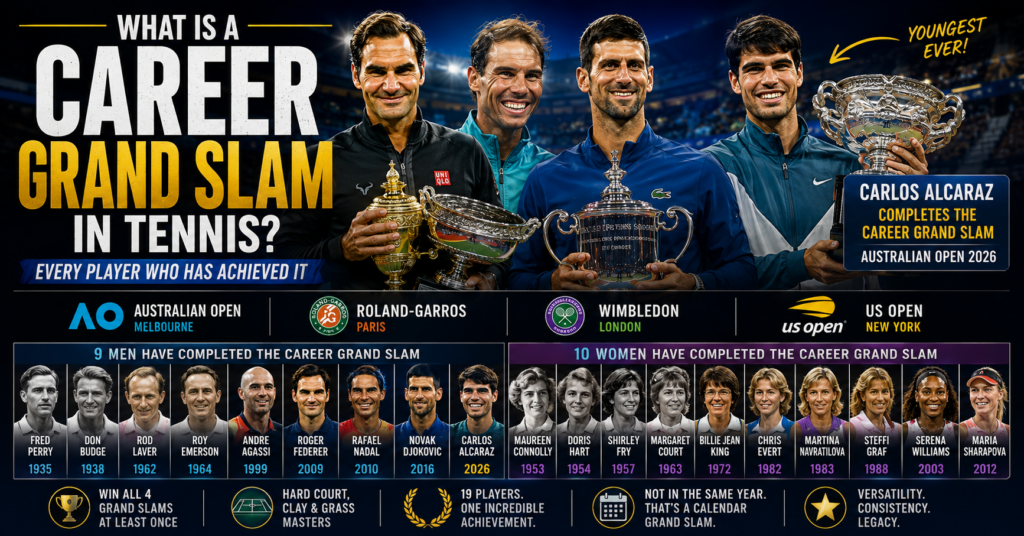
As of August 2026, only nine men and ten women have completed a Career Grand Slam in singles.
The newest member of the club is Carlos Alcaraz, who won the 2026 Australian Open to complete his collection at just 22 years old.
He joined legends including Don Budge, Rod Laver, Andre Agassi, Roger Federer, Rafael Nadal and Novak Djokovic.
On the women’s side, the list includes Margaret Court, Billie Jean King, Chris Evert, Martina Navratilova, Steffi Graf, Serena Williams and Maria Sharapova.
Completing the Career Grand Slam is therefore one of the clearest demonstrations of versatility in tennis.
A player must prove that he or she can win the biggest tournaments on hard courts, clay and grass.
That is one reason the achievement carries significant weight when discussing the greatest tennis player of all time.
Let’s look at exactly what a Career Grand Slam means, every singles player who has achieved it, and why the accomplishment is so rare.
What Is a Career Grand Slam in Tennis?
A player completes the Career Grand Slam by winning all four Grand Slam singles tournaments at least once during his or her career.
Those tournaments are:
Australian Open
Played on hard courts in Melbourne.
Roland-Garros
Also known as the French Open, played on clay in Paris.
Wimbledon
Played on grass in London.
US Open
Played on hard courts in New York.
A player does not need to win them consecutively.
The titles can be separated by several years.
For example, Roger Federer had already won the Australian Open, Wimbledon and US Open before finally winning Roland-Garros in 2009.
That French Open victory completed his Career Grand Slam.
Career Grand Slam vs Calendar Grand Slam
These terms are often confused.
But they describe different achievements.
Career Grand Slam
Win all four majors at least once at any point during a career.
Calendar Grand Slam
Win all four majors during the same calendar year.
The Calendar Grand Slam is considerably rarer.
A player must win:
Australian Open + French Open + Wimbledon + US Open
in one season.
Completing a Career Grand Slam may take many years.
Completing a Calendar Grand Slam requires perfection across all four majors within a single year.
What Are the Four Grand Slam Tournaments?
The four majors are the most prestigious tournaments in tennis.
Each presents a different challenge.
| Grand Slam | Location | Current Surface |
|---|---|---|
| Australian Open | Melbourne, Australia | Hard |
| Roland-Garros | Paris, France | Clay |
| Wimbledon | London, England | Grass |
| US Open | New York, United States | Hard |
Winning all four therefore demonstrates something beyond simple tournament success.
It demonstrates surface versatility.
A player must be able to adapt to very different conditions.
We’ve built individual record guides for each tournament:
Together, those four tournaments define the Career Grand Slam.
Every Man to Complete the Career Grand Slam
Only nine men in tennis history have won all four major singles championships.
They are:
| Player | Tournament That Completed Career Grand Slam | Year |
|---|---|---|
| Fred Perry | French Championships | 1935 |
| Don Budge | French Championships | 1938 |
| Rod Laver | U.S. Championships | 1962 |
| Roy Emerson | Wimbledon | 1964 |
| Andre Agassi | Roland-Garros | 1999 |
| Roger Federer | Roland-Garros | 2009 |
| Rafael Nadal | US Open | 2010 |
| Novak Djokovic | Roland-Garros | 2016 |
| Carlos Alcaraz | Australian Open | 2026 |
That is an extraordinarily short list considering the long history of men’s tennis.
Let’s examine the modern champions in greater detail.
Andre Agassi Completes the Career Grand Slam in 1999
Andre Agassi completed his Career Grand Slam at Roland-Garros in 1999.
His path was unusual because his four major victories came on very different surfaces and during different stages of his career.
Agassi had already won:
Wimbledon — 1992
US Open — 1994
Australian Open — 1995
One tournament remained.
Roland-Garros.
Agassi finally won it in 1999.
He came back from two sets down against Andriy Medvedev in the final to win the championship.
With that victory, Agassi became the first man of the Open Era to complete the Career Grand Slam.
It also demonstrated the extraordinary versatility of his game.
Roger Federer Completes the Career Grand Slam in 2009
For Roger Federer, one tournament repeatedly stood in the way:
Roland-Garros
Federer was already one of the greatest players in tennis history.
He had dominated Wimbledon.
He had dominated the US Open.
He had won multiple Australian Opens.
But in Paris, he repeatedly ran into Rafael Nadal.
Nadal defeated Federer in the Roland-Garros final in:
2006
2007
2008
Then came 2009.
Nadal suffered a surprise fourth-round defeat to Robin Söderling.
Federer reached the final.
His opponent was Söderling.
Federer won in straight sets.
The victory gave Federer his first Roland-Garros championship and completed his Career Grand Slam.
It was one of the most important victories of his career.
For a complete look at Federer’s records, see our Roger Federer profile.
Why Federer’s 2009 French Open Was So Important
Federer’s victory did more than complete the Career Grand Slam.
It answered one of the biggest questions surrounding his career.
Could Federer win the biggest title on clay?
The answer became:
Yes.
His problem had not necessarily been clay itself.
His problem was that he competed during the same era as the most successful Roland-Garros player in history.
Nadal eventually won the French Open 14 times.
Federer’s 2009 championship therefore became essential to his claim as one of the most complete players ever.
Rafael Nadal Completes the Career Grand Slam in 2010
Rafael Nadal completed his Career Grand Slam at the 2010 US Open.
Before New York, Nadal had already won:
Roland-Garros
Wimbledon
Australian Open
The US Open was the missing title.
Nadal reached the final against Novak Djokovic.
He won in four sets.
At just 24 years old, Nadal had completed the Career Grand Slam.
At the time, he became the youngest man of the Open Era to accomplish the feat.
That record would stand for more than 15 years.
For Nadal, the achievement was particularly important because his career was so strongly associated with clay.
Winning all four majors proved that Nadal was much more than the King of Clay.
His full career résumé is covered in our Rafael Nadal profile.
Novak Djokovic Completes the Career Grand Slam in 2016
Like Federer, Novak Djokovic had one major missing from his collection:
Roland-Garros
Before 2016, Djokovic had already won:
Australian Open
Wimbledon
US Open
But the French Open remained unfinished business.
Djokovic reached the Roland-Garros final several times before finally breaking through.
In 2016, he defeated Andy Murray in the final:
3-6, 6-1, 6-2, 6-4
Djokovic had completed the Career Grand Slam.
But he had actually accomplished something even more unusual.
The Nole Slam: Djokovic Held All Four Majors at Once
When Djokovic won Roland-Garros in 2016, he became the reigning champion at all four Grand Slam tournaments simultaneously.
His run was:
Wimbledon 2015 — Champion
US Open 2015 — Champion
Australian Open 2016 — Champion
Roland-Garros 2016 — Champion
He had won four consecutive majors.
But because the titles were spread across two calendar years, it was not technically a Calendar Grand Slam.
The achievement became widely known as the:
Nole Slam
It remains one of the defining achievements of Djokovic’s career.
For the full statistical picture, see our Novak Djokovic profile.
Djokovic’s Triple Career Grand Slam
Djokovic did not stop after winning each major once.
He eventually won every Grand Slam tournament at least three times.
His major distribution is:
| Tournament | Djokovic Titles |
|---|---|
| Australian Open | 10 |
| Roland-Garros | 3 |
| Wimbledon | 7 |
| US Open | 4 |
| Total | 24 |
That means Djokovic completed what is sometimes described as a:
Triple Career Grand Slam
He has won every major at least three times.
No other man in tennis history has accomplished that.
This is one of the strongest statistics in Djokovic’s GOAT résumé.
Rafael Nadal’s Double Career Grand Slam
Nadal also went beyond winning each tournament once.
His major distribution is:
| Tournament | Nadal Titles |
|---|---|
| Australian Open | 2 |
| Roland-Garros | 14 |
| Wimbledon | 2 |
| US Open | 4 |
| Total | 22 |
By winning his second Australian Open in 2022, Nadal had won every major at least twice.
That gave him a:
Double Career Grand Slam
It is another important example of Nadal’s versatility.
His 14 Roland-Garros titles dominate his résumé, but he also won every other major multiple times.
Roger Federer’s Career Grand Slam Distribution
Federer’s 20 Grand Slam titles were distributed as follows:
| Tournament | Federer Titles |
|---|---|
| Australian Open | 6 |
| Roland-Garros | 1 |
| Wimbledon | 8 |
| US Open | 5 |
| Total | 20 |
Federer won three of the four majors at least five times.
Roland-Garros was the exception.
His one championship there was enough to complete the Career Grand Slam.
It is also a reminder of how much Nadal’s dominance affected the major totals of other players.
Carlos Alcaraz Completes the Career Grand Slam in 2026
The Career Grand Slam club gained its newest member at the 2026 Australian Open.
Carlos Alcaraz
Alcaraz entered Melbourne with titles at:
Roland-Garros
Wimbledon
US Open
There was only one missing trophy:
Australian Open
He changed that in 2026.
And he did it against one of the greatest Australian Open champions ever.
Alcaraz Defeats Djokovic in the 2026 Australian Open Final
Carlos Alcaraz faced Novak Djokovic in the 2026 Australian Open final.
Djokovic entered the match with a perfect record in his previous 10 Australian Open finals.
He won the opening set.
But Alcaraz responded.
The final score was:
Carlos Alcaraz def. Novak Djokovic
2-6, 6-2, 6-3, 7-5
Alcaraz had won the Australian Open for the first time.
And with that victory, he had now won all four Grand Slam tournaments.
Carlos Alcaraz Becomes the Youngest Man to Complete the Career Grand Slam
Alcaraz was only 22 years old.
That made him the youngest man in tennis history to complete the Career Grand Slam.
The previous Open Era benchmark belonged to Rafael Nadal.
Nadal completed his set at the 2010 US Open at age 24.
Alcaraz beat that mark by completing the achievement in Melbourne in 2026.
This immediately became one of the most important milestones of his young career.
Alcaraz’s Grand Slam Collection
After the 2026 Australian Open, Alcaraz owned titles at every major:
Australian Open
2026
Roland-Garros
2024, 2025
Wimbledon
2023, 2024
US Open
2022, 2025
That gave Alcaraz seven Grand Slam titles at the time he completed the Career Grand Slam.
And he had achieved the complete set before turning 23.
That puts his career trajectory into extraordinary historical territory.
Youngest Men to Complete the Career Grand Slam
Alcaraz’s 2026 victory changed the record book.
Among Open Era men’s players, the leading ages are:
| Player | Completed At | Age |
|---|---|---|
| Carlos Alcaraz | Australian Open 2026 | 22 |
| Rafael Nadal | US Open 2010 | 24 |
| Roger Federer | Roland-Garros 2009 | 27 |
| Novak Djokovic | Roland-Garros 2016 | 29 |
| Andre Agassi | Roland-Garros 1999 | 29 |
| Rod Laver | US Open 1969* | 31 |
*Laver had already completed a Career Grand Slam before the Open Era and then completed the set again during his historic 1969 season.
Alcaraz’s age is what makes his achievement especially remarkable.
He potentially has many years to add additional titles to each part of the collection.
Every Woman to Complete the Career Grand Slam
Ten women have won all four major singles championships during their careers.
They are:
| Player | Tournament That Completed Career Grand Slam | Year |
|---|---|---|
| Maureen Connolly | French Championships | 1953 |
| Doris Hart | U.S. Championships | 1954 |
| Shirley Fry | Australian Championships | 1957 |
| Margaret Court | Wimbledon | 1963 |
| Billie Jean King | Roland-Garros | 1972 |
| Chris Evert | Australian Open | 1982 |
| Martina Navratilova | US Open | 1983 |
| Steffi Graf | US Open | 1988 |
| Serena Williams | Australian Open | 2003 |
| Maria Sharapova | Roland-Garros | 2012 |
Several of these players went far beyond completing the Career Grand Slam once.
Maureen Connolly — The First Woman to Complete It
Maureen Connolly completed the Career Grand Slam at the French Championships in 1953.
But 1953 became even more historic.
Connolly won all four major championships that year.
That meant she completed both:
Career Grand Slam
and
Calendar Grand Slam
She became the first woman to win all four majors in a single calendar year.
Margaret Court and the Career Grand Slam
Margaret Court completed her Career Grand Slam at Wimbledon in 1963.
Her overall Grand Slam résumé eventually became extraordinary.
She won:
Australian Open — 11
Roland-Garros — 5
Wimbledon — 3
US Open — 5
Total — 24
Court also completed the Calendar Grand Slam in 1970.
Her 24 singles majors remain one of the largest totals in tennis history.
Billie Jean King Completes the Career Grand Slam
Billie Jean King completed her Career Grand Slam by winning Roland-Garros in 1972.
King became particularly famous for her success at Wimbledon, where she won six singles championships.
But her French Open victory demonstrated her ability to win on clay as well.
That versatility placed her among the small group of women to conquer all four majors.
Chris Evert Completes the Career Grand Slam
Chris Evert completed her Career Grand Slam at the Australian Open in 1982.
Her career included extraordinary success at both Roland-Garros and the US Open.
Evert won:
7 French Opens
and
6 US Opens
Her consistency across surfaces made her one of the defining champions of women’s tennis.
Martina Navratilova Completes the Career Grand Slam
Martina Navratilova completed the Career Grand Slam at the 1983 US Open.
Her major résumé ultimately reached:
18 singles titles
Her signature tournament was Wimbledon.
Navratilova won the Wimbledon singles championship nine times, an extraordinary tournament record.
But winning all four majors showed that her greatness extended far beyond grass.
Steffi Graf Completes the Career Grand Slam — and Much More
Steffi Graf completed her Career Grand Slam at the 1988 US Open.
But describing what she did that year simply as a Career Grand Slam does not come close to capturing the achievement.
Graf won:
Australian Open
Roland-Garros
Wimbledon
US Open
All in 1988.
That completed the Calendar Grand Slam.
Then she won Olympic singles gold in Seoul.
The result was something even rarer:
The Golden Slam
Graf won all four majors and Olympic singles gold in the same calendar year.
No other singles player has replicated that exact achievement.
Serena Williams Completes the Career Grand Slam
Serena Williams completed her first Career Grand Slam at the 2003 Australian Open.
She had won four consecutive majors:
Roland-Garros 2002
Wimbledon 2002
US Open 2002
Australian Open 2003
Like Djokovic’s later achievement, Serena held all four Grand Slam titles simultaneously without winning them in one calendar year.
The achievement became known as the:
Serena Slam
And remarkably, Serena later did something similar again.
The Second Serena Slam
More than a decade later, Serena again won four consecutive majors:
US Open 2014
Australian Open 2015
Roland-Garros 2015
Wimbledon 2015
She once again held all four major titles simultaneously.
That level of dominance across two very different stages of her career demonstrates why Serena is central to any discussion of the greatest women’s tennis player ever.
Maria Sharapova Completes the Career Grand Slam
Maria Sharapova completed her Career Grand Slam at Roland-Garros in 2012.
Her major journey began at Wimbledon.
She won there in 2004 as a teenager.
She later won:
US Open — 2006
Australian Open — 2008
The French Open remained.
Sharapova eventually transformed herself into an elite clay-court player and won Roland-Garros in 2012.
She then won the tournament again in 2014.
Her ability to adapt her game to clay was one of the most impressive developments of her career.
Career Grand Slam Winners: Men vs Women
As of August 2026:
Men
9 players
Women
10 players
Total
19 singles players
That illustrates just how rare the achievement is.
Thousands of players have competed in Grand Slam tournaments.
Only a tiny group have won all four.
Why Is the Career Grand Slam So Difficult?
The biggest challenge is versatility.
Winning one major repeatedly is incredibly difficult.
Winning all four requires adapting to very different conditions.
Winning on Hard Courts
The Australian Open and US Open are currently played on hard courts.
Hard courts generally reward complete players who can:
- Serve effectively
- Return aggressively
- Defend
- Attack
- Move efficiently
- Control baseline rallies
But even the two hard-court majors do not play identically.
Conditions, climate, balls and tournament timing can create different challenges.
Winning on Clay
Roland-Garros presents a completely different test.
Clay produces:
- Higher bounces
- Longer rallies
- More sliding
- Slower conditions
- Greater physical demands
Some outstanding players have struggled to translate their games to clay.
Federer and Djokovic both had to wait years before completing their Career Grand Slams in Paris.
And both competed against Rafael Nadal — the winner of a record 14 Roland-Garros titles.
Winning on Grass
Wimbledon presents another challenge.
Grass traditionally produces:
- Lower bounces
- Faster points
- Greater rewards for strong serving
- Different movement
- Different return patterns
A player who dominates on clay may not automatically succeed on grass.
That is why Nadal winning both Roland-Garros and Wimbledon multiple times is so impressive.
It is also why Björn Borg’s historical ability to dominate both tournaments remains remarkable.
Which Grand Slam Most Often Prevented the Big Three From Completing It?
For Federer:
Roland-Garros
For Djokovic:
Roland-Garros
For Nadal:
US Open
Federer and Djokovic both had to solve the clay-court challenge.
Nadal had to win in New York.
Their paths demonstrate that even all-time great players can have one major that proves significantly more difficult than the others.
Federer vs Nadal vs Djokovic: Career Grand Slam Comparison
All three members of the Big Three completed the Career Grand Slam.
But they did it in different ways.
| Player | Australian Open | French Open | Wimbledon | US Open | Total |
|---|---|---|---|---|---|
| Novak Djokovic | 10 | 3 | 7 | 4 | 24 |
| Rafael Nadal | 2 | 14 | 2 | 4 | 22 |
| Roger Federer | 6 | 1 | 8 | 5 | 20 |
This table reveals their different strengths.
Djokovic built the most balanced overall major résumé.
Nadal produced unmatched dominance at Roland-Garros.
Federer dominated Wimbledon while also winning six Australian Opens and five US Opens.
For the broader comparison, read Djokovic vs Nadal vs Federer: Who Is the Greatest?.
Who Has Completed the Career Grand Slam More Than Once?
Winning every major once is extraordinary.
Winning every major multiple times is even rarer.
Among modern men’s players, two achievements stand out.
Novak Djokovic
Every Grand Slam at least three times.
Rafael Nadal
Every Grand Slam at least two times.
Djokovic’s Triple Career Grand Slam is particularly significant because it demonstrates exceptional balance across all four tournaments.
Nadal’s Double Career Grand Slam reinforces that his career was far more versatile than his clay-court reputation alone might suggest.
Career Grand Slam vs Double Career Grand Slam
The terminology is straightforward.
Career Grand Slam
Win each major at least once.
Double Career Grand Slam
Win each major at least twice.
Triple Career Grand Slam
Win each major at least three times.
This makes Djokovic’s résumé especially unusual.
He has won:
Australian Open — 10
French Open — 3
Wimbledon — 7
US Open — 4
His lowest total at any individual major is three.
What Is a Non-Calendar Grand Slam?
A player can also hold all four Grand Slam titles simultaneously without winning them during the same calendar year.
For example:
Novak Djokovic won four consecutive majors from Wimbledon 2015 through Roland-Garros 2016.
Serena Williams won four consecutive majors from Roland-Garros 2002 through the Australian Open 2003.
This is sometimes described as a:
Non-Calendar Grand Slam
It is different from the traditional Calendar Grand Slam because the four championships cross two seasons.
What Is the Golden Slam?
A Golden Slam adds Olympic singles gold to the four Grand Slam titles.
There are two versions of the concept.
Calendar Golden Slam
Win:
Australian Open
Roland-Garros
Wimbledon
US Open
and
Olympic singles gold
during the same calendar year.
Steffi Graf accomplished this in 1988.
Career Golden Slam
Win all four majors and Olympic singles gold at some point during a career.
This is another extremely exclusive achievement.
Djokovic and the Career Golden Slam
Djokovic completed the Career Golden Slam by winning Olympic singles gold at the Paris Games in 2024.
He already owned all four Grand Slam titles.
Olympic gold completed the collection.
That means Djokovic’s résumé includes:
Australian Open
Roland-Garros
Wimbledon
US Open
Olympic singles gold
This adds another important achievement to his GOAT case.
Nadal and the Career Golden Slam
Rafael Nadal also completed the Career Golden Slam.
Nadal won Olympic singles gold at the 2008 Beijing Olympics.
He later completed the Career Grand Slam at the 2010 US Open.
That gave him all four majors plus Olympic singles gold.
Career Grand Slam vs Grand Slam Title Record
Completing the Career Grand Slam and winning the most Grand Slam titles are different achievements.
A player could win many majors without winning all four tournaments.
Conversely, a player could complete the Career Grand Slam with relatively few total major titles.
For example:
Maria Sharapova — 5 majors
Yet she won every major at least once.
Meanwhile, some players with larger totals never completed the Career Grand Slam.
This demonstrates why versatility and total volume measure different aspects of greatness.
For the complete major leaderboard, read Who Has Won the Most Grand Slam Tennis Titles?.
Does a Career Grand Slam Make Someone the GOAT?
Not automatically.
Completing a Career Grand Slam is one of tennis’s greatest achievements.
But GOAT analysis requires more information.
Important factors include:
Grand Slam titles
Career Grand Slam achievements
Weeks at World No. 1
Year-end No. 1 finishes
Masters titles
Head-to-head results
Surface versatility
Peak dominance
Longevity
and
performance against elite competition
A Career Grand Slam provides strong evidence of versatility.
But it is one part of a much larger résumé.
Our guide to how the greatest tennis player of all time is determined examines those criteria in detail.
Who Could Complete the Career Grand Slam Next?
This is where the story becomes especially interesting.
Carlos Alcaraz completed his Career Grand Slam in 2026.
That removed one of the most obvious candidates from the list of players chasing the achievement.
But other active stars remain close.
Jannik Sinner Needs Roland-Garros
As of August 2026, Jannik Sinner has won major titles at:
Australian Open
Wimbledon
US Open
The missing piece is:
Roland-Garros
That means one French Open championship would complete Sinner’s Career Grand Slam.
His challenge is significant because clay requires different movement and point construction from the surfaces where he has already enjoyed his greatest success.
But he is now only one tournament away.
Iga Swiatek Needs the Australian Open
On the women’s side, Iga Swiatek has already won:
Roland-Garros
Wimbledon
US Open
The missing major is:
Australian Open
An Australian Open championship would therefore complete her Career Grand Slam.
Given her success across multiple surfaces, this will be one of the major historical storylines to watch during the next phase of her career.
Why Alcaraz’s 2026 Achievement Matters So Much
Alcaraz completing the Career Grand Slam at 22 changes the historical conversation surrounding his career.
He no longer needs to answer the question:
Can he win every Grand Slam?
He already has.
The questions now become much bigger:
Can he win every major twice?
Can he challenge the all-time Grand Slam record?
Can he build the longevity of Federer, Nadal and Djokovic?
Can he dominate multiple surfaces for a decade or more?
Those questions cannot yet be answered.
But completing the Career Grand Slam before turning 23 gives Alcaraz an extraordinary foundation.
Career Grand Slam FAQ
What is a Career Grand Slam in tennis?
A Career Grand Slam means winning all four major tournaments — the Australian Open, French Open, Wimbledon and US Open — at least once during a player’s career.
Do you have to win all four Grand Slams in the same year?
No.
If you win all four at any point during your career, you complete the Career Grand Slam.
Winning all four in the same calendar year is called the Calendar Grand Slam.
How many men have completed the Career Grand Slam?
As of August 2026, nine men have completed a singles Career Grand Slam.
How many women have completed the Career Grand Slam?
As of August 2026, ten women have completed a singles Career Grand Slam.
Who is the newest Career Grand Slam winner?
Carlos Alcaraz.
He completed the Career Grand Slam by winning the 2026 Australian Open.
Who is the youngest man to complete the Career Grand Slam?
Carlos Alcaraz.
He completed the achievement at age 22 at the 2026 Australian Open.
Did Roger Federer complete the Career Grand Slam?
Yes.
Federer completed it by winning Roland-Garros in 2009.
Did Rafael Nadal complete the Career Grand Slam?
Yes.
Nadal completed it by winning the 2010 US Open.
Did Novak Djokovic complete the Career Grand Slam?
Yes.
Djokovic completed it by winning Roland-Garros in 2016.
Did Carlos Alcaraz complete the Career Grand Slam?
Yes.
Alcaraz completed it at the 2026 Australian Open.
Did Serena Williams complete the Career Grand Slam?
Yes.
Serena completed her first Career Grand Slam at the 2003 Australian Open.
Did Steffi Graf complete the Career Grand Slam?
Yes.
Graf completed it as part of her historic 1988 Calendar Grand Slam.
Did Maria Sharapova complete the Career Grand Slam?
Yes.
Sharapova completed it by winning Roland-Garros in 2012.
Did Andre Agassi complete the Career Grand Slam?
Yes.
Agassi completed it by winning Roland-Garros in 1999.
Who has won every Grand Slam at least three times?
Among men, Novak Djokovic is the only player to have won each of the four Grand Slam tournaments at least three times.
Who has a Double Career Grand Slam?
Several players in tennis history have won each major multiple times.
Among the Big Three, Nadal completed the Double Career Grand Slam, while Djokovic went further and completed the Triple Career Grand Slam.
What was the Nole Slam?
The Nole Slam refers to Djokovic holding all four Grand Slam titles simultaneously after winning four consecutive majors from Wimbledon 2015 through Roland-Garros 2016.
What was the Serena Slam?
The Serena Slam refers to Serena Williams holding all four major titles simultaneously across two calendar years.
She accomplished the feat more than once during her career.
What is a Golden Slam?
A Golden Slam combines all four Grand Slam titles with Olympic singles gold.
Steffi Graf achieved the Calendar Golden Slam in 1988 by winning all four majors and Olympic singles gold in the same year.
Which major does Jannik Sinner need for a Career Grand Slam?
As of August 2026, Sinner needs Roland-Garros.
Which major does Iga Swiatek need for a Career Grand Slam?
As of August 2026, Swiatek needs the Australian Open.
Why the Career Grand Slam Is One of Tennis’s Greatest Achievements
Winning one Grand Slam requires two weeks of elite tennis.
Winning all four requires much more.
A player must succeed:
in different countries
in different climates
on different surfaces
against different generations
and often
across many years
That is why the Career Grand Slam list is so short.
It includes some of the greatest names tennis has ever produced.
Fred Perry.
Don Budge.
Rod Laver.
Andre Agassi.
Roger Federer.
Rafael Nadal.
Novak Djokovic.
Carlos Alcaraz.
Margaret Court.
Billie Jean King.
Chris Evert.
Martina Navratilova.
Steffi Graf.
Serena Williams.
Maria Sharapova.
These players did something most Grand Slam champions never accomplish.
They conquered every major.
Career Grand Slam and the Tennis GOAT Debate
The Career Grand Slam is particularly relevant when comparing the Big Three.
All three completed it.
But Djokovic went further.
Roger Federer
Career Grand Slam
20 total majors
Rafael Nadal
Double Career Grand Slam
22 total majors
Novak Djokovic
Triple Career Grand Slam
24 total majors
This gives Djokovic an especially strong versatility argument.
But Nadal owns the greatest single-major dominance with 14 Roland-Garros championships.
Federer owns the men’s Wimbledon singles record with eight.
And all three achieved extraordinary longevity.
Carlos Alcaraz has now joined the Career Grand Slam club at a younger age than any man before him.
That does not place his completed career alongside the Big Three yet.
But it gives him the opportunity to build a résumé that could eventually enter that discussion.
Vote for the Greatest Tennis Player of All Time
Winning all four Grand Slam tournaments proves versatility.
But is versatility the most important GOAT criterion?
Novak Djokovic won every major at least three times.
Rafael Nadal won every major at least twice and Roland-Garros 14 times.
Roger Federer completed the Career Grand Slam and won Wimbledon eight times.
Carlos Alcaraz completed the Career Grand Slam at only 22.
Other legends such as Rod Laver, Andre Agassi, Serena Williams and Steffi Graf built their own historic records.
So what matters most?
Total majors?
Career Grand Slams?
Peak dominance?
Longevity?
Rankings?
Surface versatility?
You decide.
VIEW THE LIVE TENNIS GOAT RANKING AND CAST YOUR VOTE
Compare the candidates, see the current ranking and cast your vote.
Final Answer: What Is a Career Grand Slam in Tennis?
A Career Grand Slam means winning all four major singles tournaments at least once during a player’s career:
Australian Open
Roland-Garros
Wimbledon
US Open
As of August 2026, nine men and ten women have accomplished it in singles.
The newest men’s member is:
Carlos Alcaraz
He completed the Career Grand Slam by defeating Novak Djokovic in the 2026 Australian Open final.
At 22, Alcaraz became the youngest man ever to achieve it.
Among the Big Three:
Federer completed the Career Grand Slam.
Nadal completed the Double Career Grand Slam.
Djokovic completed the Triple Career Grand Slam.
That last achievement remains particularly extraordinary.
Djokovic has won every Grand Slam tournament at least three times.
But regardless of how many times a player completes the set, winning all four requires mastering every major environment in tennis.
Hard court.
Clay.
Grass.
Melbourne.
Paris.
London.
New York.
That is why the Career Grand Slam remains one of the rarest and most prestigious achievements in the sport.
Tags: Andre Agassi, Australian Open, Calendar Grand Slam, Career Golden Slam, Career Grand Slam, Career Grand Slam tennis, Carlos Alcaraz, Double Career Grand Slam, French Open, Golden Slam, Grand Slam history, Grand Slam records, Grand Slam winners, greatest tennis player of all time, Jannik Sinner, Margaret Court, Maria Sharapova, Martina Navratilova, Nole Slam, Novak Djokovic, Rafael Nadal, Rod Laver, Roger Federer, Roland Garros, Serena Slam, Serena Williams, Steffi Graf, tennis GOAT, tennis Grand Slam, Tennis History, tennis records, Triple Career Grand Slam, US Open, Wimbledon