
Last Updated: August 2026
Novak Djokovic, Rafael Nadal and Roger Federer defined an era of men’s tennis that may never be repeated.
Together, the Big Three won 66 Grand Slam singles titles:
Novak Djokovic — 24
Rafael Nadal — 22
Roger Federer — 20
But Grand Slam totals are only the beginning of the comparison.
Djokovic holds the men’s record for weeks at World No. 1 and Masters 1000 titles.
Nadal produced the greatest single-surface and single-Grand-Slam dominance men’s tennis has seen, winning Roland Garros 14 times.
Federer won a record eight men’s Wimbledon singles titles and spent 237 consecutive weeks at World No. 1.
All three completed the Career Grand Slam.
All three dominated different surfaces.
All three defeated the other two repeatedly.
And all three have legitimate achievements that belong in any serious discussion about the greatest tennis player of all time.
So who was actually greater?
This page compares Djokovic vs Nadal vs Federer across the categories that matter most: Grand Slam titles, individual majors, World No. 1, ATP Masters 1000 titles, ATP Finals, Olympics, head-to-head records, surfaces, peak dominance, longevity and historical impact.
For deeper individual analysis, explore our complete Novak Djokovic profile, Rafael Nadal profile and Roger Federer profile.
For the broader debate beyond the Big Three, visit The Greatest Tennis Player of All Time.
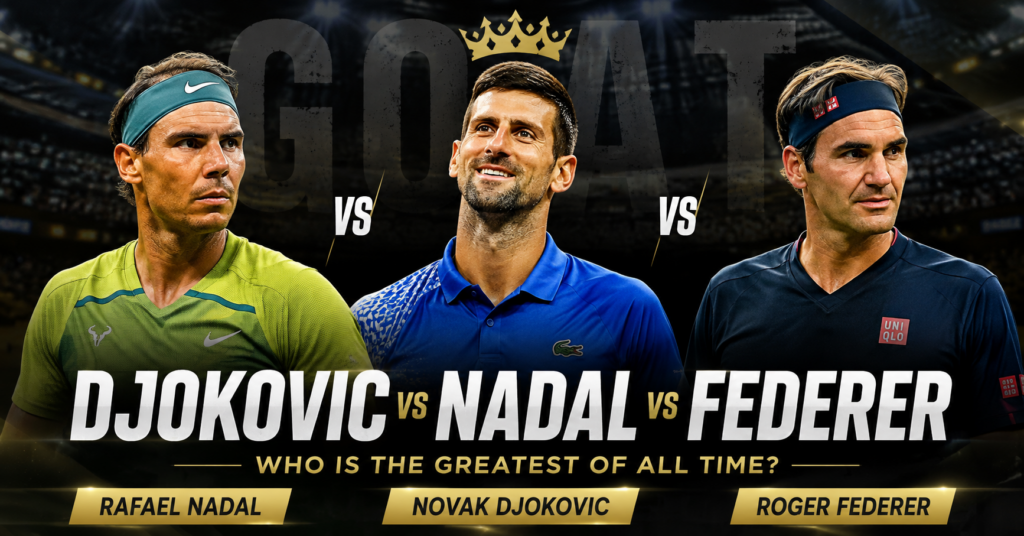
Djokovic vs Nadal vs Federer: Quick Comparison
Here is the Big Three comparison at a glance.
| Achievement | Novak Djokovic | Rafael Nadal | Roger Federer |
|---|---|---|---|
| Grand Slam Titles | 24 | 22 | 20 |
| Australian Open | 10 | 2 | 6 |
| Roland Garros | 3 | 14 | 1 |
| Wimbledon | 7 | 2 | 8 |
| US Open | 4 | 4 | 5 |
| Weeks at World No. 1 | 428 | 209 | 310 |
| Year-End No. 1 | 8 | 5 | 5 |
| Masters 1000 Titles | 40 | 36 | 28 |
| ATP Finals Titles | 7 | 0 | 6 |
| Career Grand Slam | Yes | Yes | Yes |
| Olympic Singles Gold | 1 | 1 | 0 |
| Olympic Doubles Gold | 0 | 1 | 1 |
| Head-to-Head vs Other Two | 58–52 | 53–47 | 39–51 |
The first impression is clear.
Djokovic leads more of the major statistical categories.
But that does not mean every category belongs to Djokovic.
Nadal’s clay records are extraordinary.
Federer’s Wimbledon achievements remain unmatched among the three.
And direct competition reveals a more complicated picture than career totals alone.
Who Has the Most Grand Slam Titles?
1. Novak Djokovic — 24
2. Rafael Nadal — 22
3. Roger Federer — 20
Djokovic leads the Big Three in men’s Grand Slam singles championships.
This is one of the strongest elements of his GOAT case.
But the way each man reached his total was very different.
Novak Djokovic’s 24 Grand Slams
Djokovic won:
- 10 Australian Opens
- 3 Roland Garros titles
- 7 Wimbledons
- 4 US Opens
His distribution demonstrates extraordinary success across all four majors.
He also became the first man in the Open Era to complete the Career Grand Slam three times.
Rafael Nadal’s 22 Grand Slams
Nadal won:
- 2 Australian Opens
- 14 Roland Garros titles
- 2 Wimbledons
- 4 US Opens
More than half of Nadal’s majors came at Roland Garros.
That might initially look like a lack of balance.
But another interpretation is more appropriate:
Nadal became so dominant at one Grand Slam that he created a record that may be among the hardest in tennis history to break.
Fourteen Roland Garros championships.
Roger Federer’s 20 Grand Slams
Federer won:
- 6 Australian Opens
- 1 Roland Garros
- 8 Wimbledons
- 5 US Opens
Federer became the first man to reach 20 major singles titles.
For years, he established the statistical benchmark Nadal and Djokovic were chasing.
His distribution also demonstrates exceptional versatility.
He won at least five championships at three of the four majors.
Who Was Best at the Australian Open?
Winner: Novak Djokovic
This category is decisive.
Djokovic — 10
Federer — 6
Nadal — 2
Djokovic turned Melbourne into one of the defining locations of his career.
His ten Australian Open championships are the men’s singles record.
Federer was also an extraordinary Australian Open player, winning six times.
Nadal won twice and completed one of his greatest career comebacks there in 2022.
But among the Big Three:
Australian Open advantage — Djokovic.
Who Was Best at Roland Garros?
Winner: Rafael Nadal
This is the least debatable category on the page.
Nadal — 14
Djokovic — 3
Federer — 1
Nadal did not merely outperform Djokovic and Federer at Roland Garros.
He produced the greatest record any men’s player has achieved at a single Grand Slam.
14 titles.
His career Roland Garros match record finished at an extraordinary 112–4.
Djokovic deserves special recognition because he defeated Nadal twice at Roland Garros.
Federer reached five finals and won the tournament in 2009.
But neither came close to Nadal’s overall dominance.
Roland Garros advantage — Nadal.
Who Was Best at Wimbledon?
Winner: Roger Federer — by titles
This comparison is much closer.
Federer — 8
Djokovic — 7
Nadal — 2
Federer’s eight men’s Wimbledon singles titles remain the tournament record.
Wimbledon became the tournament most closely associated with his career.
But there is an important complication.
Djokovic defeated Federer in three Wimbledon finals: 2014, 2015 and 2019.
So two statements can simultaneously be true:
Federer won more Wimbledon championships.
Djokovic had the better direct Wimbledon head-to-head against Federer.
Nadal also won Wimbledon twice and produced one of the tournament’s greatest finals when he defeated Federer in 2008.
By total championships:
Wimbledon advantage — Federer.
Who Was Best at the US Open?
Winner by titles: Roger Federer
The totals are:
Federer — 5
Djokovic — 4
Nadal — 4
Federer won five consecutive US Open championships from 2004 through 2008.
Djokovic reached a remarkable number of finals in New York and won four titles.
Nadal also won four, demonstrating that his success extended far beyond clay.
By championships alone:
US Open advantage — Federer.
But this is one of the closest major comparisons among the three.
Who Spent the Most Weeks at World No. 1?
Winner: Novak Djokovic
The final Big Three comparison:
Djokovic — 428 weeks
Federer — 310 weeks
Nadal — 209 weeks
This is one of Djokovic’s strongest statistical advantages.
Federer’s 310 weeks were once the men’s record.
He also spent an extraordinary 237 consecutive weeks at No. 1.
Djokovic eventually surpassed Federer’s total and extended the record to 428 weeks.
Nadal reached No. 1 across multiple stages of his career but spent significantly fewer total weeks there.
Combined, the Big Three spent:
947 weeks at World No. 1.
By total weeks:
World No. 1 advantage — Djokovic.
Who Finished the Most Seasons at No. 1?
Winner: Novak Djokovic
Djokovic — 8
Federer — 5
Nadal — 5
Year-end No. 1 measures something different from total weeks.
A player must perform across an entire season strongly enough to finish the year above everyone else.
Djokovic did that eight times.
Nadal and Federer each did it five times.
Year-end No. 1 advantage — Djokovic.
Who Won the Most Masters 1000 Titles?
Winner: Novak Djokovic
The Big Three dominate the Masters 1000 record book.
Djokovic — 40
Nadal — 36
Federer — 28
Djokovic holds the record.
But there is another important distinction.
Djokovic became the first player to win all nine Masters 1000 tournaments, completing what became known as the Career Golden Masters.
Then he did it again.
Nadal’s Masters record was heavily driven by extraordinary clay dominance.
Federer’s 28 titles remain one of the highest totals in history.
Still:
Masters 1000 advantage — Djokovic.
Who Won the Most ATP Finals Titles?
Winner: Novak Djokovic
The ATP Finals produced one of the largest differences between Nadal and the other two.
Djokovic — 7
Federer — 6
Nadal — 0
Djokovic holds the tournament record.
Federer sits directly behind him with six.
Nadal reached the final twice but never won the season-ending championship.
Because the event has historically been played on indoor hard courts, conditions were less favorable to Nadal’s greatest strengths.
Nevertheless, it remains a significant gap in his résumé.
ATP Finals advantage — Djokovic.
Who Won Olympic Gold?
This category requires context.
Singles Gold
Djokovic — 1
Nadal — 1
Federer — 0
Nadal won Olympic singles gold at Beijing 2008.
Djokovic completed one of the final major goals of his career by winning singles gold at Paris 2024.
Federer never won Olympic singles gold.
Doubles Gold
Federer won doubles gold with Stan Wawrinka at Beijing 2008.
Nadal won doubles gold with Marc López at Rio 2016.
Therefore:
Olympic singles — Djokovic and Nadal
Olympic doubles — Nadal and Federer
All three won Olympic medals, but only Djokovic and Nadal became Olympic singles champions.
Djokovic vs Nadal vs Federer Head-to-Head Records
Career statistics tell us how each player performed against the entire tour.
Head-to-head records tell us what happened when the legends played each other.
Novak Djokovic vs Rafael Nadal
Djokovic leads 31–29.
They played 60 times.
It became the most-played rivalry in ATP Head2Head history.
Explore all 60 matches in our complete Novak Djokovic vs Rafael Nadal head-to-head analysis.
Novak Djokovic vs Roger Federer
Djokovic leads 27–23.
They played 50 times.
Djokovic also finished ahead in their Grand Slam rivalry.
Explore the complete Novak Djokovic vs Roger Federer head-to-head analysis.
Rafael Nadal vs Roger Federer
Nadal leads 24–16.
They played 40 times.
Nadal’s clay-court advantage played a major role in the overall record, while Federer performed much better against Nadal away from clay.
Explore the complete Rafael Nadal vs Roger Federer head-to-head analysis.
Big Three Combined Head-to-Head Table
If we combine each player’s matches against the other two:
| Player | Wins | Losses | Win % |
|---|---|---|---|
| Novak Djokovic | 58 | 52 | 52.7% |
| Rafael Nadal | 53 | 47 | 53.0% |
| Roger Federer | 39 | 51 | 43.3% |
This produces an interesting result.
Djokovic recorded the most total victories against the other two.
But Nadal’s combined winning percentage is fractionally higher because he played fewer total matches against Federer and Djokovic.
This is an excellent example of why GOAT comparisons should not reduce complex careers to one number.
Who Was Best in Grand Slam Head-to-Head Matches?
This category becomes particularly interesting.
Djokovic vs Nadal at Grand Slams
Nadal leads 12–7.
Djokovic vs Federer at Grand Slams
Djokovic leads 11–6.
Nadal vs Federer at Grand Slams
Nadal leads 10–4.
Therefore, Nadal has particularly strong direct Grand Slam records against both of his Big Three rivals.
But context matters.
A large portion of Nadal’s major meetings with Djokovic and Federer occurred at Roland Garros, where Nadal was historically dominant.
That does not invalidate the results.
It explains them.
This is precisely why both results and context belong in a serious comparison.
Who Was the Best Hard-Court Player?
Advantage: Novak Djokovic
All three were exceptional hard-court players.
But Djokovic has the strongest overall case.
His record includes:
- 10 Australian Open championships
- 4 US Open championships
- Record Masters 1000 success
- Record ATP Finals success
- Winning hard-court head-to-head against Nadal
- Winning hard-court head-to-head against Federer
Federer is an extremely strong second candidate.
His peak hard-court dominance during the 2000s was extraordinary, including five consecutive US Open championships.
Nadal won six hard-court majors and numerous Masters titles.
But overall:
Hard-court advantage — Djokovic.
Who Was the Best Clay-Court Player?
Advantage: Rafael Nadal
There is little serious debate.
Nadal’s clay résumé includes:
14 Roland Garros titles
11 Monte-Carlo titles
10 Rome titles
and an extraordinary career winning percentage on the surface.
Djokovic was one of the greatest clay players of his generation and one of the few men capable of repeatedly challenging Nadal.
Federer was also an elite clay-court player.
But Nadal belongs in a separate category.
Clay-court advantage — Nadal.
Who Was the Best Grass-Court Player?
Federer vs Djokovic
This is one of the most interesting Big Three arguments.
Federer:
8 Wimbledon titles
Djokovic:
7 Wimbledon titles
Nadal:
2 Wimbledon titles
Federer holds the championship advantage.
Djokovic holds the direct Wimbledon advantage over Federer.
Federer reached 12 Wimbledon finals.
Djokovic won three Wimbledon finals directly against Federer.
If the question is:
Who won Wimbledon the most?
The answer is Federer.
If the question is:
Who performed better when Djokovic and Federer directly met at Wimbledon?
The answer is Djokovic.
Our category winner based on total Wimbledon championships is:
Grass-court advantage — Federer.
Who Was the Most Complete Across All Surfaces?
Advantage: Novak Djokovic
This category is necessarily more interpretive.
All three completed the Career Grand Slam.
But Djokovic’s distribution is exceptionally balanced:
Australian Open — 10
Roland Garros — 3
Wimbledon — 7
US Open — 4
He also completed the Career Grand Slam three times.
Nadal completed it twice.
Federer completed it once.
Djokovic additionally won every Masters 1000 event at least twice.
That gives Djokovic an exceptionally strong argument as the most accomplished all-surface player of the three.
Who Had the Greatest Single-Surface Dominance?
Winner: Rafael Nadal
If versatility favors Djokovic, specialization overwhelmingly favors Nadal.
Nadal’s clay dominance is unlike anything Federer or Djokovic achieved on another surface.
The centerpiece:
14 Roland Garros championships.
For perspective, Federer and Djokovic combined won four Roland Garros titles.
Nadal won fourteen.
This is not a criticism of the other two.
It demonstrates how extreme Nadal’s dominance became.
Single-surface dominance — Nadal.
Who Had the Greatest Peak?
There is no objective formula for peak performance.
But there are three periods that deserve special consideration.
Roger Federer: 2004–2007
Federer won 11 Grand Slam titles in four seasons.
He dominated the rankings.
He reached major final after major final.
And he spent 237 consecutive weeks at World No. 1.
At his peak, Federer made dominance look routine.
Rafael Nadal: 2008 and 2010
Nadal’s 2008 season included Roland Garros, Wimbledon and Olympic singles gold.
His 2010 season produced three consecutive Grand Slam championships:
Roland Garros.
Wimbledon.
US Open.
That US Open victory completed his Career Grand Slam.
And on clay, Nadal’s peak reached an even higher level of surface-specific dominance.
Novak Djokovic: 2011 and 2015–2016
Djokovic’s 2011 season changed the Big Three hierarchy.
He repeatedly defeated Nadal and Federer and won three majors.
His 2015 season was similarly extraordinary.
Then, by winning Roland Garros in 2016, Djokovic simultaneously held all four Grand Slam titles:
Wimbledon 2015.
US Open 2015.
Australian Open 2016.
Roland Garros 2016.
That achievement became known as the Nole Slam.
Peak Verdict
There is no clean statistical winner because “peak” can be defined differently.
Federer — extraordinary multi-year dominance
Nadal — unmatched peak on one surface
Djokovic — extraordinary all-surface peak against elite competition
This category should remain open to interpretation.
Who Had the Best Longevity?
All three changed expectations about how long elite tennis careers could last.
Roger Federer
Federer won his first Grand Slam in 2003.
He won his final Grand Slam in 2018.
At 36, he returned to World No. 1.
Rafael Nadal
Nadal won his first Roland Garros in 2005.
He won his final major at Roland Garros in 2022.
That created a 17-year span between his first and final Grand Slam championships.
Novak Djokovic
Djokovic won his first Grand Slam in 2008.
He remained a major contender deep into his late 30s and won Olympic singles gold at age 37 in Paris.
Djokovic’s late-career performance gives him an exceptionally strong longevity case.
But all three demonstrated remarkable durability across different eras of the sport.
Who Had the Toughest Competition?
This is one of the hardest questions to quantify.
Federer’s early period of dominance occurred before Nadal and Djokovic reached their peaks.
Nadal then emerged and challenged Federer.
Djokovic arrived later and eventually competed simultaneously against both.
But Federer also had to adapt to two younger all-time greats.
Nadal had to compete against Federer first and then Djokovic.
Djokovic had to overcome established champions Federer and Nadal before eventually becoming the dominant player himself.
This is why “competition” cannot be reduced to a simple count of opponents.
Their careers overlapped substantially, but their peaks did not occur at exactly the same time.
Big Three Playing Style Comparison
| Attribute | Novak Djokovic | Rafael Nadal | Roger Federer |
|---|---|---|---|
| Dominant Hand | Right | Left | Right |
| Backhand | Two-handed | Two-handed | One-handed |
| Signature Strength | Return & movement | Forehand & physical pressure | Serve, forehand & variety |
| Best Surface | Hard | Clay | Grass |
| Return | Exceptional | Excellent | Very good |
| Serve | Excellent | Strong | Exceptional |
| Forehand | Elite | Exceptional | Exceptional |
| Backhand | Exceptional | Elite | Iconic one-hander |
| Defense | Exceptional | Exceptional | Very good |
| Net Play | Excellent | Very good | Exceptional |
| Court Coverage | Exceptional | Exceptional | Exceptional |
| Tactical Adaptability | Exceptional | Exceptional | Exceptional |
The Big Three did not dominate by playing identical tennis.
That is part of what made the era so compelling.
Federer sought to take time away.
Nadal created physical and rotational pressure.
Djokovic neutralized attacks and redirected them.
Three different approaches reached historically great levels.
How Their Styles Matched Up
Federer vs Nadal
Nadal’s left-handed forehand repeatedly attacked Federer’s one-handed backhand.
On clay, that matchup became particularly difficult for Federer.
Federer adapted later in his career by taking his backhand earlier and playing more aggressively.
The final head-to-head:
Nadal 24–16 Federer.
Nadal vs Djokovic
Djokovic’s two-handed backhand handled Nadal’s heavy crosscourt forehand better than almost any other player’s backhand.
Djokovic could absorb the topspin and redirect it.
That helped him create a much more balanced rivalry with Nadal.
Final head-to-head:
Djokovic 31–29 Nadal.
Djokovic vs Federer
Federer’s serve and first-strike aggression attempted to prevent Djokovic from establishing baseline rhythm.
Djokovic’s return forced Federer to play additional shots.
Their contrasting styles produced an extremely close rivalry.
Final head-to-head:
Djokovic 27–23 Federer.
Who Was Mentally Strongest?
This category cannot be measured perfectly.
All three produced extraordinary performances under pressure.
Federer recovered from major defeats and remained competitive across multiple generations.
Nadal became famous for fighting for every point regardless of score.
Djokovic produced some of the most dramatic escapes in Grand Slam history.
Examples include saving match points against Federer at the US Open in both 2010 and 2011.
Then came the 2019 Wimbledon final.
Federer held two championship points.
Djokovic survived and won.
Nadal’s 2012 Australian Open final loss to Djokovic demonstrated another form of mental resilience: despite losing an almost six-hour battle, Nadal continued challenging Djokovic and later reversed momentum in their rivalry.
There is no objective statistic called “mental strength.”
It should therefore be discussed as analysis, not presented as mathematical fact.
Who Changed Tennis the Most?
Statistics become less useful here.
Roger Federer’s Influence
Federer’s style, popularity and international appeal helped bring enormous attention to men’s tennis.
His combination of attacking tennis, movement and apparent effortlessness made him one of the sport’s most recognizable athletes.
He also established many of the records Nadal and Djokovic later chased.
Rafael Nadal’s Influence
Nadal changed perceptions about topspin, physicality and defensive tennis.
His intensity became part of his identity.
His rivalry with Federer helped transform men’s tennis into a global sporting storyline.
And his clay dominance established a standard unlikely to be matched.
Novak Djokovic’s Influence
Djokovic helped redefine elite returning, flexibility, movement and baseline defense.
His rise also transformed the Federer–Nadal era into the Big Three era.
Instead of two players fighting for historical supremacy, there were three.
Eventually, Djokovic surpassed many of the statistical benchmarks both men had established.
Historical influence cannot be completely measured.
But all three permanently changed men’s tennis.
Big Three Career Advantages by Category
A useful way to summarize the comparison is to ask who owns the clearest advantage in each category.
| Category | Advantage |
|---|---|
| Grand Slam Titles | Djokovic |
| Australian Open | Djokovic |
| Roland Garros | Nadal |
| Wimbledon | Federer |
| US Open | Federer |
| Weeks at No. 1 | Djokovic |
| Year-End No. 1 | Djokovic |
| Masters 1000 | Djokovic |
| ATP Finals | Djokovic |
| Olympic Singles Gold | Djokovic / Nadal |
| Hard Courts | Djokovic |
| Clay Courts | Nadal |
| Grass Titles / Wimbledon | Federer |
| Combined Big Three Wins | Djokovic |
| Combined Big Three Win % | Nadal |
| All-Surface Résumé | Djokovic |
| Single-Surface Dominance | Nadal |
This table explains why Djokovic has such a powerful statistical GOAT argument.
He leads the largest number of measurable categories.
But Nadal and Federer retain categories in which their achievements are historically exceptional.
The Strongest Case for Novak Djokovic
If someone chooses Djokovic as the greatest of the Big Three, the statistical case is extensive.
His résumé includes:
- 24 Grand Slam titles
- 428 weeks at World No. 1
- 8 year-end No. 1 finishes
- 40 Masters 1000 titles
- 7 ATP Finals titles
- Olympic singles gold
- Three Career Grand Slams
- Career Golden Masters
- Winning head-to-head against Nadal
- Winning head-to-head against Federer
- Winning Grand Slam head-to-head against Federer
- Exceptional success on hard, clay and grass
Djokovic’s greatest argument is not one record.
It is the breadth of categories in which he leads.
For his complete record, see our Novak Djokovic career profile.
The Strongest Case for Rafael Nadal
Nadal’s case begins with the most dominant major-tournament record in men’s tennis.
14 Roland Garros titles.
But his résumé extends much further.
It includes:
- 22 Grand Slam titles
- 14 Roland Garros titles
- Olympic singles gold
- Olympic doubles gold
- Career Grand Slam
- Career Golden Slam
- 36 Masters 1000 titles
- Winning Grand Slam head-to-head against Djokovic
- Winning Grand Slam head-to-head against Federer
- Winning overall head-to-head against Federer
- Unmatched clay-court dominance
Nadal’s greatest argument is not simply that he was great on clay.
It is that his superiority on clay reached a level no other Big Three player achieved on his best surface, while Nadal simultaneously built an all-surface résumé worthy of an all-time great.
For his complete record, see our Rafael Nadal career profile.
The Strongest Case for Roger Federer
Federer’s case cannot be understood only by looking at categories later surpassed by Djokovic and Nadal.
Federer established many of the standards they chased.
His résumé includes:
- 20 Grand Slam titles
- 8 Wimbledon titles
- 5 consecutive US Open titles
- 310 weeks at World No. 1
- 237 consecutive weeks at No. 1
- 6 ATP Finals titles
- 28 Masters 1000 titles
- Career Grand Slam
- Olympic doubles gold
- 103 tour-level singles titles
- Extraordinary peak dominance
- Enormous influence on the popularity and global reach of tennis
Federer was the first of the three to establish a modern statistical case for being the greatest men’s player ever.
Nadal and Djokovic subsequently challenged and surpassed several of his records.
But Federer’s role in creating the benchmark remains central to the story of the Big Three.
For his complete record, see our Roger Federer career profile.
So Who Is Greater: Djokovic, Nadal or Federer?
If greatness is judged primarily by the broadest collection of major career statistics, Novak Djokovic currently has the strongest case among the Big Three.
He leads in Grand Slam titles.
He leads in weeks at No. 1.
He leads in year-end No. 1 finishes.
He leads in Masters 1000 titles.
He leads in ATP Finals titles.
And he finished with winning head-to-head records against both Nadal and Federer.
But that conclusion should not be confused with saying Djokovic won every meaningful comparison.
He did not.
Nadal owns the greatest clay-court résumé in tennis history and leads Djokovic in their Grand Slam head-to-head.
Federer owns the men’s Wimbledon singles-title record and produced one of the most dominant sustained peaks of the Open Era.
There is also a larger philosophical question:
Should the greatest player simply be the player who leads the most statistics?
Or should peak performance, surface dominance, influence, playing style, competition and historical importance also matter?
GOATofTennis.net does not need to pretend that those questions have an official answer.
Instead, we can present the evidence.
Then fans can decide.
Why the GOAT Debate Is More Complicated Than 24–22–20
The most famous Big Three numbers are:
Djokovic 24
Nadal 22
Federer 20
But if Grand Slam totals were the only criterion, there would be little reason for a GOAT debate.
Tennis careers are multidimensional.
Consider:
Djokovic: 428 weeks at No. 1.
Nadal: 14 Roland Garros titles.
Federer: 8 Wimbledon titles and 237 consecutive weeks at No. 1.
These achievements measure different forms of greatness.
Longevity.
Dominance.
Versatility.
Peak performance.
Surface mastery.
Direct competition.
Consistency.
Pressure performance.
Historical influence.
A serious GOAT discussion considers more than one column of a statistics table.
For a deeper explanation of the criteria, read How Is the Greatest Tennis Player of All Time Determined?.
Djokovic vs Nadal vs Federer FAQ
Who has the most Grand Slam titles: Djokovic, Nadal or Federer?
Novak Djokovic leads with 24 Grand Slam singles titles.
Rafael Nadal won 22.
Roger Federer won 20.
Who has the most weeks at World No. 1?
Djokovic holds the Big Three record with 428 weeks.
Federer spent 310 weeks at No. 1.
Nadal spent 209.
Who won the most Masters 1000 titles?
Djokovic won 40 Masters 1000 titles.
Nadal won 36.
Federer won 28.
Who won the most ATP Finals titles?
Djokovic won seven.
Federer won six.
Nadal did not win the ATP Finals.
Who won the most Australian Open titles?
Djokovic won 10, compared with Federer’s six and Nadal’s two.
Who won the most Roland Garros titles?
Nadal won an extraordinary 14 Roland Garros championships.
Djokovic won three.
Federer won one.
Who won the most Wimbledon titles?
Federer won eight Wimbledon men’s singles titles.
Djokovic won seven.
Nadal won two.
Who won the most US Open titles?
Among the Big Three, Federer leads with five.
Djokovic and Nadal each won four.
Did Djokovic, Nadal and Federer all win the Career Grand Slam?
Yes.
All three won each of the four Grand Slam tournaments at least once.
Djokovic completed the Career Grand Slam three times.
Nadal completed it twice.
Federer completed it once.
Who won Olympic singles gold?
Djokovic and Nadal.
Nadal won Beijing 2008.
Djokovic won Paris 2024.
Federer won Olympic doubles gold but never singles gold.
What was Djokovic’s head-to-head against Nadal?
Djokovic finished ahead 31–29.
What was Djokovic’s head-to-head against Federer?
Djokovic finished ahead 27–23.
What was Nadal’s head-to-head against Federer?
Nadal finished ahead 24–16.
Who won the most matches against the other Big Three players?
Djokovic recorded 58 victories against Nadal and Federer combined.
Nadal recorded 53 victories against Djokovic and Federer.
Federer recorded 39 victories against Djokovic and Nadal.
Who had the best combined winning percentage against the other two?
Nadal finished fractionally ahead at approximately 53.0%, compared with Djokovic’s approximately 52.7%.
Who was the best clay-court player?
Nadal.
His 14 Roland Garros titles and extraordinary clay-court records make his case overwhelming.
Who was the best hard-court player?
Djokovic has the strongest statistical case, particularly because of his Australian Open record, Masters success, ATP Finals titles and direct hard-court records against Nadal and Federer.
Who was the best grass-court player?
Federer won the most Wimbledon titles with eight.
Djokovic won seven and defeated Federer in three Wimbledon finals.
Who is statistically the greatest of the Big Three?
Across the broadest collection of major career statistics, Djokovic currently holds the strongest statistical case.
However, the GOAT debate depends on which achievements and criteria a person values most.
Vote: Djokovic, Nadal or Federer?
Now you have the numbers.
24–22–20 in Grand Slams.
428–310–209 in weeks at No. 1.
40–36–28 in Masters 1000 titles.
Djokovic leads many of the largest statistical categories.
Nadal owns unmatched clay-court dominance.
Federer owns the Big Three Wimbledon-title advantage and an extraordinary legacy of dominance and influence.
So now we want your answer:
Who is the greatest?
Novak Djokovic?
Rafael Nadal?
Roger Federer?
Or another player entirely?
VIEW THE LIVE TENNIS GOAT RANKING
The ranking reflects fan voting rather than an editorial selection by GOATofTennis.net.
Explore Every Big Three Rivalry
Want to go deeper than the career totals?
Novak Djokovic vs Rafael Nadal
60 meetings — Djokovic 31–29 Nadal
Explore the complete Djokovic vs Nadal rivalry.
Novak Djokovic vs Roger Federer
50 meetings — Djokovic 27–23 Federer
Explore the complete Djokovic vs Federer rivalry.
Rafael Nadal vs Roger Federer
40 meetings — Nadal 24–16 Federer
Explore the complete Nadal vs Federer rivalry.
Explore the Complete Big Three Profiles
Novak Djokovic
Novak Djokovic: Career Statistics, Records, Achievements & Biography
Explore Djokovic’s 24 Grand Slam championships, ranking records, Masters achievements, Olympic gold and complete career.
Rafael Nadal
Rafael Nadal: Career Statistics, Records, Achievements & Biography
Explore Nadal’s 22 majors, 14 Roland Garros championships, Olympic achievements and clay-court records.
Roger Federer
Roger Federer: Career Statistics, Records, Achievements & Biography
Explore Federer’s 20 Grand Slam championships, eight Wimbledon titles, ranking achievements and complete career.
Continue the GOAT Debate
The Big Three are central to the modern GOAT debate, but tennis history did not begin with Federer, Nadal and Djokovic.
Rod Laver.
Björn Borg.
Pete Sampras.
Jimmy Connors.
Ivan Lendl.
John McEnroe.
Andre Agassi.
And champions from earlier eras all belong in the larger historical conversation.
That’s why this page should be viewed as a Big Three comparison, not as the complete answer to the greatest-player question.
For the broader historical analysis, continue to:
The Greatest Tennis Player of All Time
And to understand how different achievements should be evaluated:
How Is the Greatest Tennis Player of All Time Determined?
Editorial Methodology
GOATofTennis.net separates verified statistics, historical analysis and fan opinion.
Grand Slam titles measure success at the four major championships.
Rankings measure sustained performance against the entire tour.
Masters 1000 and ATP Finals results measure elite performance beyond the majors.
Head-to-head records measure direct competition.
Surface records measure specialization and versatility.
Peak performance attempts to evaluate the highest level a player reached.
Longevity measures the ability to remain competitive across different stages of a career.
Historical influence involves factors that cannot be represented completely by statistics.
No single category automatically determines who is the greatest tennis player of all time.
For our complete approach, see How Is the Greatest Tennis Player of All Time Determined?.
Final Verdict: Djokovic vs Nadal vs Federer
The Big Three debate produced countless arguments.
But the fairest conclusion begins with acknowledging what each man did better than the others.
Roger Federer established the benchmark.
He reached 20 Grand Slam titles first.
He won Wimbledon eight times.
He spent 237 consecutive weeks at World No. 1.
And his success helped define a generation of men’s tennis.
Rafael Nadal created unmatched dominance.
Fourteen Roland Garros titles.
Twenty-two Grand Slam championships.
Olympic singles gold.
And a level of clay-court superiority that may never be repeated.
Novak Djokovic ultimately accumulated the broadest statistical résumé.
Twenty-four Grand Slam titles.
428 weeks at World No. 1.
Eight year-end No. 1 finishes.
Forty Masters 1000 championships.
Seven ATP Finals titles.
Olympic singles gold.
And winning career head-to-head records against both Nadal and Federer.
If the question is:
Who leads the most major statistical categories?
The answer is Novak Djokovic.
If the question is:
Who produced the greatest dominance on a single surface?
The answer is Rafael Nadal.
If the question is:
Who won the most Wimbledon titles and helped establish the benchmark the other two chased?
The answer is Roger Federer.
And if the question is:
Who is the greatest tennis player of all time?
Statistics can inform the answer.
History can provide context.
But ultimately, greatness depends on what you believe should matter most.
Three players.
66 Grand Slam titles.
947 combined weeks at World No. 1.
150 matches against one another.
One extraordinary era.
Now it’s your turn to decide.
SEE THE LIVE GOAT RANKING AND CAST YOUR VOTE