
Updated for 2026
Tennis matches have no fixed duration.
One match can last five hours.
Another can be over before many spectators have settled into their seats.
At the extreme end of the scale is one of the strangest records in professional tennis:
the shortest completed matches ever played.
In modern ATP Tour history, the benchmark belongs to:
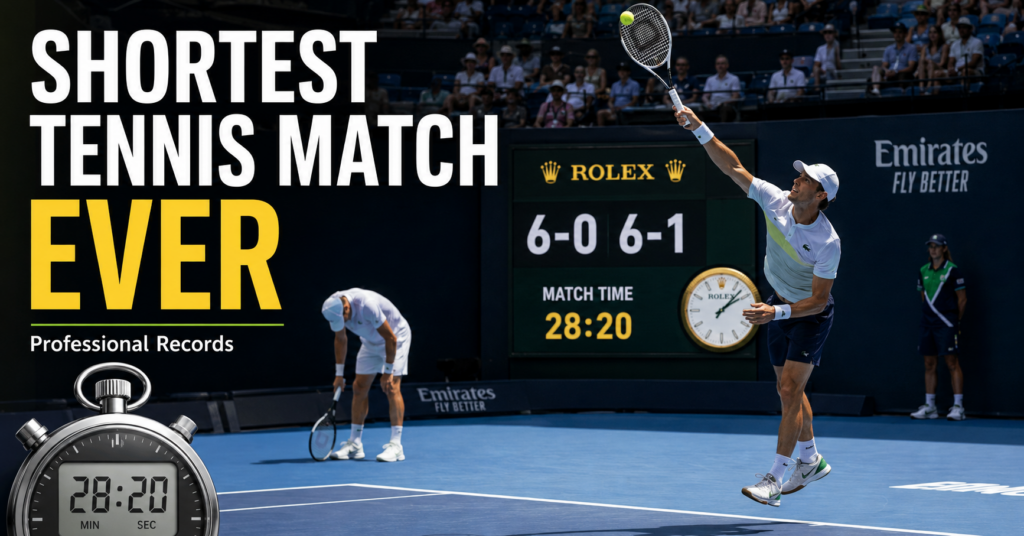
Jarkko Nieminen vs Bernard Tomic — 28 minutes and 20 seconds.
Nieminen won:
6–0, 6–1
at the Miami tournament in 2014.
But that isn’t necessarily the shortest documented professional match in tennis history.
At Wimbledon in 1969, British player Sue Tutt defeated Marion Boundy 6–2, 6–0 in only 20 minutes.
And when we narrow the question to Grand Slam finals, another remarkable match stands out:
Steffi Graf vs Natasha Zvereva — Roland-Garros 1988.
Graf won:
6–0, 6–0
in approximately:
32 minutes of actual playing time.
So what is the shortest tennis match ever?
The answer depends on what exactly we are measuring:
ATP Tour records,
historical professional matches,
Grand Slam matches,
or Grand Slam finals.
Let’s separate those categories properly.
What Is the Shortest ATP Tennis Match Ever?
The shortest completed match in the ATP’s official timing era is:
Jarkko Nieminen vs Bernard Tomic
at:
Miami 2014.
Duration:
28 minutes, 20 seconds
Score:
6–0, 6–1
Winner:
Jarkko Nieminen
The ATP began keeping this type of official match-time record in:
1991.
So Nieminen vs Tomic is best described as:
the shortest completed ATP Tour match since official timing records began.
Nieminen vs Tomic: 28 Minutes in Miami
The match took place on:
March 20, 2014
at the Miami tournament.
Bernard Tomic was returning to competition after undergoing surgery on both hips.
His opponent was Finnish veteran:
Jarkko Nieminen.
The contest quickly became extremely one-sided.
Nieminen won the opening set:
6–0.
The entire set lasted only:
13 minutes.
Tomic finally won a game in the second set.
But Nieminen continued controlling the match.
Final score:
6–0, 6–1.
Total duration:
28 minutes and 20 seconds.
Tomic Won Only 13 Points
One of the most striking statistics from the match is the total number of points won by Tomic.
He collected only:
13 points.
Nieminen, meanwhile, lost only three points across his seven service games.
There were:
few long rallies,
few extended games,
very little scoreboard pressure,
and virtually no opportunity for the match to develop into a real contest.
Everything that normally makes tennis last longer was missing.
Why Was the Match So Short?
A tennis match becomes extremely short when several things happen at once.
One Player Dominates Serve
Long service games add time.
Deuces add time.
Break points add time.
If a player holds quickly, entire games can disappear in only a few minutes.
The Returner Offers Little Resistance
Tomic struggled to create pressure in Nieminen’s service games.
That meant fewer extended exchanges.
There Were Almost No Competitive Games
A set can last a long time even when it finishes 6–2 if several games contain multiple deuces.
That did not happen often enough here.
Only Two Sets Were Required
A best-of-three match can end after:
12 games
with a 6–0, 6–0 result.
Nieminen needed only:
13 games
to win 6–0, 6–1.
The mathematical structure of the match allowed it to finish very quickly.
Is 28 Minutes the Shortest Tennis Match Ever?
Not across all recorded tennis history.
This is where the terminology matters.
Nieminen vs Tomic is the shortest completed match in the ATP’s modern official timing database.
But older tennis history contains shorter documented contests.
The most famous example comes from:
Wimbledon 1969.
Sue Tutt defeated:
Marion Boundy
in approximately:
20 minutes.
Score:
6–2, 6–0.
So if someone asks simply:
“What is the shortest tennis match ever?”
the responsible answer needs context rather than one misleading number.
Sue Tutt vs Marion Boundy — 20 Minutes
The Wimbledon match took place in:
1969.
Sue Tutt won:
6–2, 6–0.
Reported duration:
20 minutes.
That is extraordinary because the score wasn’t even:
6–0, 6–0.
Boundy won:
two games.
Yet the entire match still finished in about 20 minutes.
How Can a 6–2, 6–0 Match Last Only 20 Minutes?
Twelve games are required for a double bagel:
6–0, 6–0.
Tutt and Boundy played:
14 games.
For 14 games to finish in 20 minutes, the average game needed to be exceptionally short.
That suggests:
very short rallies,
few deuces,
rapid service games,
and almost no extended interruptions.
Historical match timing was not standardized as precisely as today’s electronic tournament systems, which is one reason older records should always be presented carefully.
The Shortest Grand Slam Final of the Open Era
If we narrow the record to:
Grand Slam singles finals in the Open Era
the answer becomes much clearer.
Steffi Graf defeated:
Natasha Zvereva
in the:
1988 Roland-Garros final.
Score:
6–0, 6–0.
Actual playing time:
32 minutes.
Roland-Garros records the final at around 34 minutes overall, while Guinness identifies 32 minutes of playing time because a rain interruption affected the elapsed match clock.
Steffi Graf vs Natasha Zvereva — 6–0, 6–0
A Grand Slam final is supposed to represent the closest thing tennis has to a championship showdown.
Two players survive an entire tournament.
They reach the final match.
One victory remains.
Yet the 1988 Roland-Garros women’s final became one of the most one-sided championship matches tennis has ever seen.
Graf did not lose:
a single game.
Final score:
6–0, 6–0.
What Is a Double Bagel in Tennis?
A score of:
6–0, 6–0
is commonly called a:
double bagel.
The losing player does not win a game.
In best-of-three tennis, it is the most dominant possible straight-sets score.
Graf produced that score:
in a Grand Slam final.
That is what makes the 1988 match so extraordinary.
Graf’s 1988 Roland-Garros Dominance
Graf wasn’t simply playing well in the final.
She dominated the entire tournament.
Guinness notes that she lost only:
20 games during the tournament.
The championship victory came while Graf was only:
18 years old.
That season would become one of the greatest in tennis history.
Graf went on to win:
Australian Open,
Roland-Garros,
Wimbledon,
US Open,
and Olympic singles gold.
That completed the unique:
Calendar Golden Slam.
You can read more about that achievement in our Golden Slam in tennis guide.
Why Do Some Sources Say 32 Minutes and Others Say 34?
This is an important detail.
The official match clock has often been reported at approximately:
34 minutes.
But actual playing time was:
32 minutes
because rain interrupted the contest.
That is why you’ll encounter both numbers.
The clean way to explain the record is:
32 minutes of playing time; approximately 34 minutes elapsed.
For an article about historical records, that distinction is better than pretending one number is universally used.
Iga Swiatek’s 40-Minute Roland-Garros Match
A much more recent example of extreme domination came at:
Roland-Garros 2024.
Iga Swiatek faced:
Anastasia Potapova
in the fourth round.
Swiatek won:
6–0, 6–0
in:
40 minutes.
It was the shortest tour-level match of Swiatek’s career at the time.
Swiatek Lost Only 10 Points
Potapova won only:
10 points
during the entire match.
Swiatek won:
48 of 58 points.
Even more remarkably, Potapova never took a Swiatek service game to deuce.
The result provides a modern example of how quickly an elite professional match can disappear when one player controls:
serve,
return,
rallies,
and scoreboard momentum.
Graf vs Swiatek: Two Roland-Garros Blowouts
The two matches make an interesting comparison.
| Match | Score | Duration |
|---|---|---|
| Steffi Graf vs Natasha Zvereva, 1988 final | 6–0, 6–0 | 32 min playing time |
| Iga Swiatek vs Anastasia Potapova, 2024 R4 | 6–0, 6–0 | 40 min |
Same score.
Different stages of the tournament.
Eight minutes apart.
Yet Graf’s performance remains more historically remarkable because it occurred:
in the championship match itself.
What Is the Shortest Wimbledon Match?
One of the best-known Wimbledon records is:
Sue Tutt vs Marion Boundy — 20 minutes
in:
1969.
Tutt won:
6–2, 6–0.
That gives Wimbledon an extraordinary pair of opposite duration records.
At one end:
20 minutes.
At the other:
John Isner vs Nicolas Mahut in 2010:
11 hours and 5 minutes.
From 20 Minutes to 11 Hours
Few sports can produce such an extreme range.
Tutt vs Boundy
20 minutes
Isner vs Mahut
11 hours, 5 minutes
The longest match lasted more than:
33 times longer
than the 20-minute Wimbledon contest.
For the full marathon story, read What Is the Longest Tennis Match Ever?.
What Is the Shortest Grand Slam Final Ever?
Historical tennis contains several extremely short finals.
Suzanne Lenglen defeated:
Molla Mallory
in the 1922 Wimbledon final:
6–2, 6–0
in approximately:
23 minutes.
That predates the Open Era by decades.
For the modern Open Era, Graf’s Roland-Garros final remains the benchmark at:
32 minutes of playing time.
Why Historical Records Need Context
A 1922 tennis match and a 2026 tennis match should not be treated as identical statistical environments.
Several things changed:
equipment,
court preparation,
changeover rules,
medical treatment,
broadcast timing,
serve clocks,
tournament organization,
and how match duration was officially recorded.
Older reports may use estimates or contemporary newspaper timings.
Modern matches are tracked much more precisely.
That is why this article separates:
historical documented records
from:
official modern tour records.
Why Aren’t Retirements Counted?
Suppose a player retires after:
three minutes.
Technically, the match has ended faster than Nieminen vs Tomic.
But it would be misleading to call that:
the shortest tennis match based on competitive play.
The player did not complete the normal match.
For meaningful duration records, we should focus on:
completed matches.
Otherwise the leaderboard would mostly measure injuries rather than tennis performance.
Walkovers Are Not Matches Either
A walkover happens when a player advances because the opponent cannot start the match.
Duration:
effectively zero.
But no match was played.
So a walkover should never be called:
the shortest tennis match ever.
There was no tennis match to time.
Completed Match vs Retirement vs Walkover
The difference is important.
Completed Match
One player wins the required number of sets.
Retirement
The match starts, but one player cannot finish.
Walkover
The match never begins.
Only the first category gives us a meaningful:
shortest completed match record.
What Makes a Tennis Match Extremely Short?
Several conditions usually need to combine.
Straight Sets
A three-set men’s Grand Slam match will almost always last longer than a two-set WTA or ATP best-of-three match.
Fewer sets create the opportunity for an unusually quick result.
Very Few Games
Compare:
6–0, 6–0
with:
7–6, 7–6.
Both are straight-set victories.
But the first contains:
12 games.
The second contains at least:
24 games plus two tiebreaks.
Scoreline structure dramatically affects duration.
Few Deuces
A game can contain:
four points
or:
twenty points.
At deuce, a player needs two consecutive points to finish the game.
Repeated deuces can make even one game last:
10 minutes
or more.
Quick matches contain few such games.
Short Rallies
Serve.
Return.
Winner.
Point ends.
Repeat.
Short points rapidly reduce match time.
Few Change-of-Momentum Moments
Long matches often contain:
comebacks,
tactical changes,
tight service games,
medical interruptions,
crowd drama,
and momentum shifts.
A dominant short match tends to have one direction from the beginning.
Does 6–0, 6–0 Always Mean a Very Short Match?
No.
This is an interesting tennis misconception.
A double bagel guarantees:
only 12 games.
It does not guarantee:
short games.
Imagine every game reaches:
deuce several times.
The final score could still be:
6–0, 6–0
while the match lasts much longer than expected.
Score tells us:
who won the games.
It does not tell us:
how difficult those games were.
Can a 6–0 Set Last Longer Than a 6–3 Set?
Absolutely.
Suppose the 6–0 set contains:
six long deuce games.
Now imagine the 6–3 set contains:
nine quick holds.
The 6–0 set could easily take longer.
This is why match duration is a separate statistical category from:
games won
and:
points won.
Why Modern Tennis Matches Often Last Longer
Modern tennis contains several factors that can produce long matches.
Players return serve exceptionally well.
Baseline defense is extraordinary.
Athletes cover the court with incredible speed.
Physical conditioning allows extended rallies to continue.
And at the Grand Slams, men’s singles still uses:
best-of-five sets.
That creates the conditions for:
three-hour,
four-hour,
and occasionally five-hour contests.
Why Fast Courts Can Produce Short Matches
On faster courts, serves become harder to return effectively.
Points may end quickly.
A player with a dominant first serve can race through service games.
But faster conditions can also produce:
tiebreaks.
If neither player breaks serve, sets can still become lengthy.
So surface speed alone does not guarantee a short match.
Shortest Match vs Most Dominant Match
These are not exactly the same question.
A player could win:
6–0, 6–0
in 45 minutes.
Another could win:
6–1, 6–1
in 35 minutes.
The first result is more dominant by games.
The second match is shorter by time.
So the shortest match record measures:
speed of completion
rather than purely:
scoreline dominance.
Why Nieminen vs Tomic Is Such an Important Record
The Miami match gives us something older historical results often cannot:
a modern, officially timed ATP benchmark.
Duration:
28 minutes and 20 seconds.
Score:
6–0, 6–1.
Thirteen games.
And only:
13 points won by Tomic.
Because the ATP timing database begins in 1991, this record has a clear statistical framework.
That makes it particularly useful for modern tennis comparisons.
Could an ATP Match Finish in Under 20 Minutes?
Theoretically:
yes.
A best-of-three match can end:
6–0, 6–0.
That is only:
12 games.
If each game averaged around:
90 seconds,
the tennis itself could move extremely quickly.
But professional match procedures include:
changeovers,
serve preparation,
ball retrieval,
and normal pauses between points.
Breaking the 20-minute barrier in a completed ATP match would therefore require an extraordinary combination of:
rapid points
and:
near-perfect dominance.
Could Nieminen’s ATP Record Be Broken?
Yes.
The record is not mathematically impossible to beat.
A future player could produce:
6–0, 6–0
with exceptionally short games.
But professional tennis is extremely competitive.
Even a heavily outmatched player can:
win a service game,
force deuce,
extend rallies,
or slow the pace of the contest.
That makes 28 minutes extraordinarily difficult to beat under normal professional conditions.
How Does the Shortest Match Compare With the Average Tennis Match?
There is no single fixed average for professional tennis because match length depends heavily on:
format,
surface,
players,
score,
number of sets,
and competition.
But a 28-minute ATP match is obviously an extreme outlier.
Most professional matches last far longer.
A single competitive set can sometimes approach or exceed:
one hour.
Nieminen completed:
the entire match
in less than half that time.
What About Men’s Grand Slam Matches?
Men’s Grand Slam singles uses:
best-of-five sets.
A player must win:
three sets.
The shortest possible normal score is:
6–0, 6–0, 6–0.
That already requires:
18 games
rather than the:
12 games
required for a double-bagel best-of-three victory.
So men’s Grand Slam matches have a structural disadvantage when competing for overall shortest-match records.
A Triple Bagel in Men’s Tennis
A men’s Grand Slam match finishing:
6–0, 6–0, 6–0
is sometimes called a:
triple bagel.
It is extremely rare.
But even a triple bagel may take longer than a quick women’s or ATP best-of-three match because:
another entire set must be completed.
That is why duration records need to consider match format.
Match Format Changes Everything
Compare the minimum number of games.
Best-of-three
6–0, 6–0:
12 games
Best-of-five
6–0, 6–0, 6–0:
18 games
The second requires:
50% more games.
Before considering:
rallies,
deuces,
changeovers,
or tiebreaks.
This is one reason men’s Grand Slam duration records should not be directly compared with ordinary ATP or WTA best-of-three records without context.
Short Matches and Tennis Greatness
Does winning very quickly make a player greater?
Not necessarily.
A short match usually means:
the winner played extremely well
or:
the opponent played very poorly.
Often both.
But career greatness is built through:
hundreds of matches,
many surfaces,
different opponents,
major championships,
ranking dominance,
and longevity.
One 28-minute destruction is memorable.
It does not define an entire career.
What Short Matches Reveal About Dominance
They do reveal something interesting:
how large the gap between two professionals can become on a particular day.
Both players may be world-class athletes.
Both may have trained for decades.
Yet professional tennis can still produce a match where one player barely wins any points.
That is part of what makes individual sports fascinating.
There is nowhere for a struggling player to hide.
Shortest Match and the GOAT Debate
Extreme match records should carry very little direct weight in determining tennis’s greatest player.
A player is not greater because he once won in:
30 minutes.
Similarly, a player is not automatically greater because he survived a six-hour match.
These records show specific forms of performance.
GOAT analysis requires a much broader view.
For the complete framework, read How Is the Greatest Tennis Player of All Time Determined?.
Shortest Tennis Match FAQ
What is the shortest ATP tennis match ever?
Jarkko Nieminen defeated Bernard Tomic in 28 minutes and 20 seconds at Miami in 2014, the shortest completed ATP Tour match since official timing records began in 1991.
What was the score?
Nieminen won:
6–0, 6–1.
How many points did Tomic win?
How long did the first set take?
Approximately 13 minutes.
Is 28 minutes the shortest documented tennis match ever?
Not necessarily. Historical women’s matches include Sue Tutt’s approximately 20-minute victory over Marion Boundy at Wimbledon in 1969.
What was the score in Tutt vs Boundy?
6–2, 6–0.
What is the shortest Grand Slam final in the Open Era?
Steffi Graf’s victory over Natasha Zvereva at Roland-Garros in 1988. Guinness records 32 minutes of playing time.
What was the score?
6–0, 6–0.
Why do some sources say the Graf final lasted 34 minutes?
The official elapsed time included a rain interruption, while approximately 32 minutes were actual playing time.
What is a double bagel?
A 6–0, 6–0 victory.
Did Iga Swiatek ever win a Grand Slam match in 40 minutes?
Yes. She defeated Anastasia Potapova 6–0, 6–0 in 40 minutes at Roland-Garros 2024.
What is the longest tennis match ever?
John Isner vs Nicolas Mahut at Wimbledon 2010 lasted:
11 hours and 5 minutes.
Do retirements count toward shortest-match records?
Normally they should be separated because the match was not completed naturally.
Does a walkover count as a tennis match?
No. No competitive match begins.
What is the shortest possible score in best-of-three tennis?
6–0, 6–0.
What is the shortest possible score in men’s best-of-five Grand Slam tennis?
6–0, 6–0, 6–0.
Does a double bagel guarantee a short match?
No. Individual games can still contain many deuces and long rallies.
Final Answer: What Is the Shortest Tennis Match Ever?
There is no perfectly standardized single record covering every level and every era of tennis.
But several benchmarks are clear.
For modern ATP Tour tennis:
Jarkko Nieminen vs Bernard Tomic — 28 minutes, 20 seconds
Miami 2014.
Score:
6–0, 6–1.
For a famous historical Wimbledon example:
Sue Tutt vs Marion Boundy — approximately 20 minutes
Wimbledon 1969.
Score:
6–2, 6–0.
For an Open Era Grand Slam final:
Steffi Graf vs Natasha Zvereva — 32 minutes of playing time
Roland-Garros 1988.
Score:
6–0, 6–0.
Those matches represent the complete opposite of tennis’s marathon contests.
One side of the sport produced:
Isner vs Mahut — 11 hours and 5 minutes.
The other produced professional matches completed in:
20–30 minutes.
That enormous range exists because tennis has no game clock deciding when competition ends.
The players decide it.
Sometimes neither can separate himself from the opponent for hours.
And sometimes one player takes control immediately and never gives it back.
Which Record Is More Incredible: 20 Minutes or 11 Hours?
One Wimbledon match was over in roughly 20 minutes.
Another lasted across three days.
Both belong to the same sport.
Which extreme is harder to imagine?
A professional opponent barely being given time to compete?
Or two players being unable to separate themselves for more than 11 hours?
VIEW THE LIVE TENNIS GOAT RANKING AND CAST YOUR VOTE
Explore tennis’s greatest players, matches and records and decide which achievements impress you most.
Tags: Bernard Tomic, Grand Slam records, Jarkko Nieminen, Match Duration, Shortest Tennis Match, Steffi Graf, Tennis History, tennis records