
Last Updated: September 2026
Tennis has no fixed match duration.
Some matches are finished in less than an hour.
Others become exhausting battles lasting four, five or even six hours.
And then there is one match that exists in a category of its own.
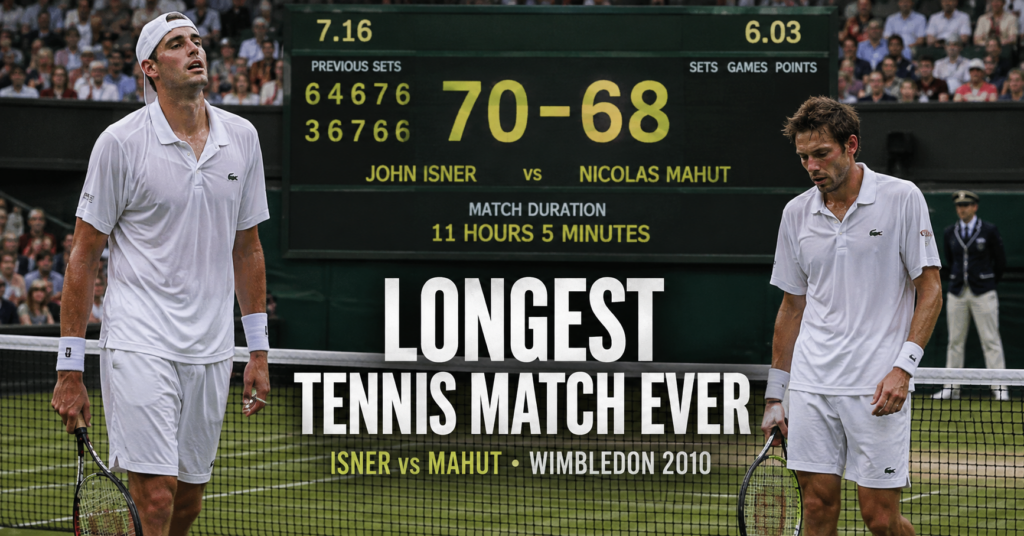
John Isner vs Nicolas Mahut at Wimbledon in 2010 lasted 11 hours and 5 minutes.
The match stretched across three days.
It contained 183 games.
The fifth set alone ended:
70–68.
John Isner finally won.
More than a decade later, it remains the longest professional tennis match ever played.
But Isner vs Mahut is only the beginning of the story.
Novak Djokovic and Rafael Nadal produced the longest Grand Slam singles final at the 2012 Australian Open.
Kevin Anderson and Isner played for more than six and a half hours at Wimbledon in 2018.
Roger Federer, Rafael Nadal and Novak Djokovic also produced several marathon matches that became defining moments of the Big Three era.
This guide looks at the longest tennis match ever, the records it produced, other legendary marathon matches and why modern rules make another 70–68 deciding set extraordinarily unlikely.
What Is the Longest Tennis Match Ever?
The longest professional tennis match ever played was:
John Isner vs Nicolas Mahut
Tournament: Wimbledon
Year: 2010
Round: First Round
Duration: 11 hours, 5 minutes
Winner: John Isner
Final score:
6–4, 3–6, 6–7, 7–6, 70–68
The match began on June 22, 2010.
It finally ended on June 24.
Three days after it started.
Isner vs Mahut: The 11-Hour Wimbledon Match
John Isner and Nicolas Mahut walked onto Court 18 at Wimbledon for what appeared to be an ordinary first-round match.
The opening four sets gave little indication of what was coming.
Isner won the first set.
Mahut won the second.
Mahut took the third in a tiebreak.
Isner answered by winning the fourth in another tiebreak.
The match was tied at:
two sets each.
Then came the fifth set.
And one of the most extraordinary events in tennis history began.
Why Did the Fifth Set Reach 70–68?
At the time, Wimbledon did not use a final-set tiebreak in the situation Isner and Mahut faced.
The deciding set had to be won by:
two clear games.
At 6–6, they continued.
Then:
10–10
20–20
30–30
40–40
50–50
Neither player could create and maintain the two-game advantage required to end the match.
The scoreboard eventually reached numbers almost unimaginable in professional tennis.
The Match Is Suspended for Darkness
The match could not be completed on its first day.
Darkness forced play to stop.
Isner and Mahut returned the next day.
They continued playing.
And continued.
And continued.
Still there was no winner.
Darkness eventually stopped the match again.
That meant both players had to return for:
a third day.
Isner Finally Wins 70–68
When the players returned on June 24, the deciding set continued.
Eventually the score reached:
69–68 Isner.
Mahut served to stay in the match once again.
This time, Isner finally broke serve.
The fifth set ended:
70–68.
After more than 11 hours of tennis, the longest match in professional tennis history was finally over.
Isner vs Mahut Records
The statistics from the match are extraordinary.
| Record | Isner vs Mahut |
|---|---|
| Total Match Time | 11 hours, 5 minutes |
| Total Games | 183 |
| Fifth-Set Score | 70–68 |
| Fifth-Set Games | 138 |
| Days of Competition | 3 |
| Isner Aces | 113 |
| Mahut Aces | 103 |
| Combined Aces | 216 |
These numbers explain why the match has become one of the most famous statistical anomalies in tennis history.
How Long Was the Fifth Set?
The fifth set alone lasted approximately:
8 hours and 11 minutes.
That means the deciding set by itself lasted longer than almost every complete professional tennis match ever played.
It contained:
138 games.
For comparison, a normal straight-sets match may contain only a fraction of that number.
How Many Aces Did Isner and Mahut Hit?
Serving played an enormous role in keeping the match alive.
John Isner hit:
113 aces
Nicolas Mahut hit:
103 aces
Combined:
216 aces.
Neither player could consistently break the other’s serve.
That is the primary reason the deciding set continued for so long.
Why the 11-Hour Record May Never Be Broken
The biggest reason is simple:
tennis rules have changed.
Grand Slam tournaments now use deciding-set tiebreak systems rather than allowing sets to continue indefinitely under the old advantage format.
That means a modern Grand Slam deciding set cannot simply continue:
20–20,
40–40,
60–60,
or eventually:
70–68.
Modern players can still play extremely long five-set matches.
But the specific conditions that allowed Isner and Mahut to reach 11 hours no longer exist at the Grand Slams.
That makes the record a serious candidate for one of tennis’s most difficult records to break.
What Is the Longest Grand Slam Final Ever?
The longest Grand Slam singles final belongs to:
Novak Djokovic vs Rafael Nadal
at the:
2012 Australian Open
Duration:
5 hours and 53 minutes
Djokovic won:
5–7, 6–4, 6–2, 6–7, 7–5
It became one of the defining matches of the Djokovic-Nadal rivalry.
For the complete history between them, read our Novak Djokovic vs Rafael Nadal head-to-head analysis.
Djokovic vs Nadal — Australian Open 2012
Unlike Isner-Mahut, the Australian Open final was not dominated by almost endless service holds.
It was an exhausting baseline battle.
Djokovic and Nadal repeatedly forced each other into long rallies.
Both possessed exceptional:
movement
defense
returning
endurance
and
mental strength.
The result was nearly six hours of championship-level tennis.
The Five-Set Battle
Nadal won the opening set.
Djokovic responded by winning the next two.
Nadal took the fourth set in a tiebreak.
Everything came down to the fifth.
Nadal moved ahead.
Djokovic fought back.
Eventually Djokovic secured the decisive break and completed the victory.
Final set:
7–5
Total duration:
5 hours, 53 minutes.
Why the 2012 Final Became Legendary
It wasn’t simply long.
It was a:
Grand Slam final
between two of the greatest players ever.
Both players were competing close to their physical limits.
Neither surrendered.
By the trophy ceremony, both men were visibly exhausted.
The match remains one of the clearest examples of the extraordinary physical demands of men’s Grand Slam tennis.
Kevin Anderson vs John Isner — Wimbledon 2018
John Isner appears in another famous marathon.
This time:
Kevin Anderson vs John Isner
Wimbledon 2018 semifinal
Duration:
6 hours and 36 minutes
Final score:
7–6, 6–7, 6–7, 6–4, 26–24
Anderson won.
It became one of the longest matches ever played at Wimbledon.
Why Anderson vs Isner Lasted So Long
The deciding set again used the traditional advantage format.
Neither player could consistently break the other’s powerful serve.
The fifth set continued far beyond 6–6.
Eventually Anderson won:
26–24.
The match demonstrated that the conditions behind Isner-Mahut could still create extraordinary marathon contests.
And this time it happened in a:
Wimbledon semifinal.
How Marathon Matches Helped Change Wimbledon
The 2018 Anderson-Isner semifinal raised an important problem.
A player could survive an exhausting six-hour semifinal and then be expected to return for the championship match.
That affects:
player recovery
scheduling
competitive balance
and
player welfare.
Matches like Isner-Mahut and Anderson-Isner contributed to the broader discussion around deciding-set formats.
Modern Grand Slam tiebreak rules have now reduced the likelihood of another extremely long advantage set.
Federer vs Djokovic — Wimbledon 2019
Another legendary marathon came in the:
2019 Wimbledon final
between:
Roger Federer and Novak Djokovic.
Duration:
4 hours and 57 minutes
Djokovic eventually won:
7–6, 1–6, 7–6, 4–6, 13–12
But the score alone does not explain why the match became unforgettable.
Federer Had Championship Points
Late in the fifth set, Federer reached:
two championship points
on his own serve.
One successful point would have given Federer his ninth Wimbledon title.
Djokovic saved both.
The match continued.
Eventually Djokovic won the deciding tiebreak.
It became one of the most dramatic Grand Slam finals of the Big Three era.
For their complete rivalry, read Novak Djokovic vs Roger Federer head-to-head.
Nadal vs Federer — Wimbledon 2008
Another match frequently mentioned among the greatest ever played is:
Rafael Nadal vs Roger Federer
2008 Wimbledon final
Duration:
4 hours and 48 minutes
Nadal won:
6–4, 6–4, 6–7, 6–7, 9–7
The match ended Federer’s run of:
five consecutive Wimbledon titles.
It also gave Nadal his first Wimbledon championship.
Why the 2008 Wimbledon Final Was Special
Federer had dominated Wimbledon for years.
Nadal had dominated Roland-Garros.
The 2008 final became the meeting point between those two forms of greatness.
Nadal won the first two sets.
Federer fought back to force a fifth.
Rain repeatedly interrupted the match.
Daylight began disappearing.
Finally, Nadal won:
9–7 in the fifth set.
The match became one of the defining moments of their rivalry.
For more, visit our Rafael Nadal vs Roger Federer head-to-head page.
Nadal vs Medvedev — Australian Open 2022
The 2022 Australian Open final produced another marathon with a completely different story.
Rafael Nadal faced:
Daniil Medvedev.
Medvedev won the first two sets.
Nadal was one set away from defeat.
Instead, he produced an extraordinary comeback.
Nadal won:
2–6, 6–7, 6–4, 6–4, 7–5
The match lasted:
5 hours and 24 minutes.
Nadal Comes Back From Two Sets Down
Winning a best-of-five match from two sets down requires:
three consecutive set victories.
There is no margin for another lost set.
Nadal managed it in a Grand Slam final.
The victory gave him his second Australian Open championship.
It also meant he had won every major at least twice.
Why Five-Set Tennis Produces Marathon Matches
Men’s Grand Slam singles traditionally use:
best-of-five sets.
A player must win three sets to win the match.
That creates much greater potential for dramatic comebacks and long contests than best-of-three tennis.
A match can move through:
five full sets,
multiple tiebreaks,
long deuce games,
and an extended deciding set.
Physical Challenges of a Marathon Tennis Match
Playing tennis for five or six hours is not simply an endurance exercise.
Tennis requires repeated explosive movement.
Players continuously:
sprint
stop
change direction
serve
rotate
jump
slide
and
recover.
And they must maintain technical precision while doing it.
Serving Under Extreme Fatigue
Serving involves repeated explosive movement through the:
legs,
core,
shoulder,
and arm.
A player in a marathon match may serve hundreds of times.
Maintaining:
speed,
accuracy,
spin,
and technique
becomes increasingly difficult as fatigue develops.
Concentration After Several Hours
Physical exhaustion is only half the problem.
Players must still make decisions on every point.
Where should I serve?
Should I attack?
Where is my opponent moving?
Should I change direction?
Is the opponent tiring?
A single poor decision after five hours can decide an entire match.
Recovering Between Points
Elite players constantly manage their energy.
Breathing.
Hydration.
Nutrition.
Tempo.
Movement.
Point construction.
In an exceptionally long match, those small decisions can become essential to survival.
Longest Match vs Greatest Match
The longest match is easy to identify:
Isner vs Mahut — 11 hours, 5 minutes.
The greatest match is subjective.
Some fans choose:
Federer vs Nadal — Wimbledon 2008
Others:
Djokovic vs Nadal — Australian Open 2012
Others:
Djokovic vs Federer — Wimbledon 2019
Length alone does not determine greatness.
Quality.
Importance.
Drama.
Rivalry.
Championship stakes.
Historical significance.
All matter.
Isner vs Mahut vs Djokovic vs Nadal
These two record matches represent very different types of tennis endurance.
| Match | Duration | Main Challenge |
|---|---|---|
| Isner vs Mahut 2010 | 11h 05m | Extreme serving endurance and endless deciding set |
| Djokovic vs Nadal 2012 | 5h 53m | Extreme baseline physicality in a Grand Slam final |
Isner-Mahut was almost twice as long.
But Djokovic-Nadal featured a completely different physical style.
There is no need to choose which was “harder.”
They tested different elements of professional tennis.
What Is the Longest Wimbledon Match?
The answer is:
John Isner vs Nicolas Mahut — 2010
Duration:
11 hours and 5 minutes.
It is also the longest professional tennis match overall.
What Is the Longest Australian Open Final?
The record belongs to:
Novak Djokovic vs Rafael Nadal — 2012
Duration:
5 hours, 53 minutes
Djokovic won.
The match is also the longest Grand Slam singles final.
What Is the Longest Wimbledon Final?
The 2019 final between:
Novak Djokovic and Roger Federer
lasted:
4 hours and 57 minutes.
It became the longest Wimbledon singles final at the time and one of the most dramatic championship matches ever played at the tournament.
What Was the Longest Set in Tennis History?
The deciding set of:
Isner vs Mahut
at Wimbledon 2010.
It lasted approximately:
8 hours and 11 minutes.
Score:
70–68.
That one set lasted longer than almost every complete match in tennis history.
Why Final-Set Tiebreaks Changed Tennis
Traditional advantage sets created extraordinary drama.
But they also produced practical problems.
Modern deciding-set tiebreaks provide a defined endpoint.
This helps with:
player health
tournament scheduling
competitive fairness
and
predictability.
The trade-off is that another score such as:
70–68
is effectively gone from modern Grand Slam tennis.
Could the Longest Tennis Match Record Be Broken?
Anything is theoretically possible.
But under modern Grand Slam rules:
it is extremely unlikely.
The Isner-Mahut record depended on a deciding set that could continue indefinitely.
Modern tiebreak systems eliminate that possibility.
Players can still produce matches lasting five or six hours.
Reaching:
11 hours and 5 minutes
is another matter.
That is why Isner-Mahut may remain the record for generations.
Marathon Matches and the Tennis GOAT Debate
Marathon matches also reveal qualities that ordinary statistics sometimes miss.
They test:
mental resilience
physical endurance
problem solving
pressure management
and
determination.
Djokovic’s victory over Nadal in Melbourne is part of his reputation for exceptional endurance and mental strength.
Nadal’s 2022 comeback against Medvedev demonstrates his refusal to surrender.
Federer’s five-set battles with Nadal and Djokovic form part of his Grand Slam legacy.
These performances do not replace title counts or ranking records.
But they help explain how the greatest players built those records.
For our broader approach, read How Is the Greatest Tennis Player of All Time Determined?.
Longest Tennis Match FAQ
What is the longest tennis match ever?
John Isner vs Nicolas Mahut at Wimbledon in 2010.
How long did the longest tennis match last?
11 hours and 5 minutes.
Who won the longest tennis match?
John Isner.
Who did Isner beat?
Nicolas Mahut.
What was the final score?
6–4, 3–6, 6–7, 7–6, 70–68.
How many days did Isner vs Mahut last?
Three days.
How many games were played?
How many games were in the fifth set?
How long was the fifth set?
Approximately 8 hours and 11 minutes.
How many aces did Isner hit?
How many aces did Mahut hit?
What is the longest Grand Slam final?
Novak Djokovic vs Rafael Nadal at the 2012 Australian Open.
How long did Djokovic vs Nadal last?
5 hours and 53 minutes.
Who won the 2012 Australian Open final?
Novak Djokovic.
What was the score?
Djokovic won:
5–7, 6–4, 6–2, 6–7, 7–5.
How long was Anderson vs Isner at Wimbledon?
6 hours and 36 minutes in the 2018 semifinal.
How long was Federer vs Djokovic at Wimbledon 2019?
4 hours and 57 minutes.
How long was Federer vs Nadal at Wimbledon 2008?
4 hours and 48 minutes.
Can a Wimbledon fifth set still reach 70–68?
Not under the current deciding-set tiebreak format.
Why are tennis matches sometimes so long?
There is no traditional running match clock. Players must win the required sets and games, and close matches can continue for hours.
Is Isner vs Mahut’s record likely to be broken?
Under modern deciding-set rules, it appears extremely difficult to break.
Final Answer: What Is the Longest Tennis Match Ever?
The longest professional tennis match ever played was:
John Isner vs Nicolas Mahut
at:
Wimbledon 2010.
It lasted:
11 hours and 5 minutes.
The match required:
three days
and:
183 games.
Isner finally won:
6–4, 3–6, 6–7, 7–6, 70–68.
The fifth set alone lasted approximately:
8 hours and 11 minutes.
Another extraordinary record belongs to:
Novak Djokovic and Rafael Nadal.
Their 2012 Australian Open final lasted:
5 hours and 53 minutes
and remains the longest Grand Slam singles final.
But modern tennis rules have changed.
Deciding-set tiebreaks now make another 70–68 set extraordinarily unlikely.
So Isner and Mahut’s record is more than simply the longest match tennis has ever seen.
It may be one of the sport’s most difficult records ever to break.
Which Tennis Record Is the Most Unbreakable?
Isner and Mahut played for more than 11 hours.
Nadal won Roland-Garros 14 times.
Djokovic won 24 Grand Slam titles.
Federer spent 237 consecutive weeks at World No. 1.
Different records represent different kinds of greatness.
Which achievement impresses you most?
VIEW THE LIVE TENNIS GOAT RANKING AND CAST YOUR VOTE
Compare the greatest players and records in tennis history and make your choice.
Tags: Grand Slam records, John Isner, Longest Tennis Match, Nicolas Mahut, Novak Djokovic, Rafael Nadal, tennis records, Wimbledon
Pingback: What Is the Fastest Tennis Serve Ever? Men's & Women's Records
Pingback: Who Has Hit the Most Aces in Tennis History? Career Records