
Updated for 2026
Most tennis players spend years trying to become ready for a Grand Slam championship.
Some legends barely waited until adulthood.
Michael Chang was only 17 when he survived one of the most remarkable Roland-Garros runs ever seen.
Boris Becker was also 17 when he exploded onto the Wimbledon lawns and became a champion before most players his age had established themselves on the professional tour.
Martina Hingis was just 16 when she dominated the 1997 Australian Open.
And long before the modern professional era, Britain’s Lottie Dod achieved something even more extraordinary:
she won Wimbledon at only 15 years old.
Age records tell a fascinating side of Grand Slam history.
Winning a major as a teenager demands more than exceptional talent. A young player must handle seven matches, unfamiliar pressure, experienced opponents, huge crowds and the expectation that arrives with every victory.
Some teenage champions went on to dominate an era.
Others never won another major.
That makes the list of youngest Grand Slam champions much more than a collection of numbers.
It is a history of tennis prodigies who became champions before almost anyone expected them to.
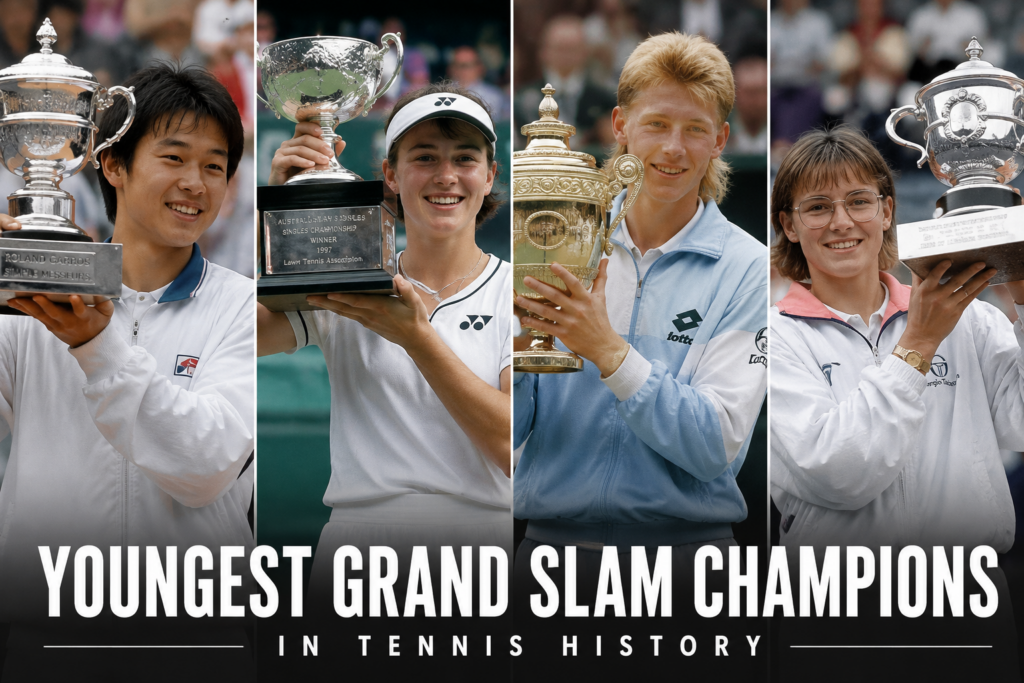
Who Is the Youngest Grand Slam Champion Ever?
The youngest singles champion in Grand Slam history is:
Lottie Dod
Dod won the Wimbledon women’s singles championship in:
1887
at the age of:
15 years and 285 days.
That record comes from a completely different period of tennis.
The sport was still in its early competitive history.
Professional tennis as we understand it today did not exist.
Tournament draws, equipment, training and competitive structures were radically different.
But historically, Dod’s achievement remains extraordinary.
More than a century later, nobody has won a Grand Slam singles title at a younger age.
Who Is the Youngest Grand Slam Champion of the Open Era?
For the modern Open Era, the record belongs to:
Martina Hingis.
Hingis won the:
1997 Australian Open
at:
16 years and 117 days.
She defeated Mary Pierce in the final:
6–2, 6–2.
Even more impressively, Hingis did not lose a set during the tournament.
At an age when most elite juniors are still preparing for full-time professional tennis, Hingis was already a Grand Slam singles champion.
If you want to understand why modern-era records are often separated from earlier tennis history, read our guide to what the Open Era means in tennis.
Who Is the Youngest Male Grand Slam Champion?
The men’s record belongs to:
Michael Chang.
Chang won:
Roland-Garros 1989
at the age of:
17 years and 110 days.
He remains the youngest man ever to win a Grand Slam singles championship.
His victory was remarkable not simply because of his age.
The path to the trophy became one of the most famous underdog runs in major tennis history.
Youngest Grand Slam Champions: The Key Records
| Record | Player | Tournament | Age |
|---|---|---|---|
| Youngest singles champion all-time | Lottie Dod | Wimbledon 1887 | 15 years, 285 days |
| Youngest Open Era singles champion | Martina Hingis | Australian Open 1997 | 16 years, 117 days |
| Youngest men’s Grand Slam champion | Michael Chang | Roland-Garros 1989 | 17 years, 110 days |
| Youngest Wimbledon men’s champion | Boris Becker | Wimbledon 1985 | 17 years, 227 days |
| Youngest Australian Open men’s champion | Ken Rosewall | Australian Championships 1953 | 18 years, 76 days |
| Youngest US Open men’s champion | Pete Sampras | US Open 1990 | 19 years, 28 days |
| Youngest US Open women’s champion | Tracy Austin | US Open 1979 | 16 years, 8 months, 28 days |
The table combines records from very different periods.
That historical context is essential.
A 15-year-old Wimbledon champion from the 1880s and a 17-year-old champion in the professional Open Era competed in almost different sporting worlds.
Yet both belong to Grand Slam history.
Lottie Dod — Wimbledon Champion at 15
Charlotte “Lottie” Dod is one of the most remarkable multi-sport athletes of the nineteenth century.
Her tennis record begins with a number that still looks almost impossible:
15 years, 285 days.
That was her age when she won Wimbledon in 1887.
A Record More Than a Century Old
Dod’s achievement has survived:
the amateur era,
the birth of professional tennis,
the beginning of the Open Era,
wooden rackets,
metal rackets,
graphite rackets,
and generations of champions.
Modern tennis makes such an achievement extremely unlikely.
Today’s pathway from junior tennis to the professional game is much more structured, and the physical demands of elite tennis are enormous.
That makes Dod’s record one of the great historical curiosities of the sport.
Martina Hingis — Australian Open Champion at 16
If we focus on modern Grand Slam tennis, Martina Hingis becomes the central figure.
Hingis won the:
1997 Australian Open
at:
16 years and 117 days.
She defeated Mary Pierce in the championship match without dropping a set.
The title announced that women’s tennis had a new superstar.
Hingis Wasn’t Simply an Early Champion
Winning one major extremely young can sometimes be an isolated breakthrough.
Hingis immediately proved that hers was not.
During 1997, she reached the final of:
Australian Open,
Roland-Garros,
Wimbledon,
and
US Open.
She won three of the four.
Only Roland-Garros prevented her from completing an extraordinary sweep.
Hingis eventually won:
5 Grand Slam singles titles.
Her teenage success remains one of the most precocious periods in modern tennis history.
Michael Chang — Roland-Garros Champion at 17
Michael Chang’s 1989 Roland-Garros run is legendary.
He entered the tournament as a talented young American.
He left Paris as:
the youngest male Grand Slam champion in history.
Chang was:
17 years and 110 days old.
The Match Against Ivan Lendl
The defining match of Chang’s run came before the final.
In the fourth round, he faced:
Ivan Lendl.
Lendl was World No. 1 and one of the dominant players of the era.
Chang fell two sets behind.
Then the match became unforgettable.
Exhausted and suffering from cramps, Chang altered his tactics dramatically.
At one point, he famously served underarm.
He also stood unusually close to the service line when Lendl served, attempting to disrupt the champion’s rhythm.
Chang somehow survived.
He won in five sets.
Chang Completes the Miracle Run
The tournament still wasn’t over.
Chang eventually reached the final against:
Stefan Edberg.
Again, he had to fight through a long match.
Chang won:
6–1, 3–6, 4–6, 6–4, 6–2.
At 17 years and 110 days, history belonged to him.
The title became Chang’s only Grand Slam singles championship, but his age record has survived every generation since.
Boris Becker — Wimbledon Champion at 17
Only weeks separated Michael Chang’s record age from one of Wimbledon’s most famous teenage champions.
In:
1985
Boris Becker won Wimbledon at:
17 years and 227 days.
Becker was unseeded.
Few spectators expected the German teenager to finish the tournament holding the trophy.
Becker Changed Wimbledon History
Becker’s athletic serve-and-volley game was perfectly suited to the grass.
He attacked.
He dived around the court.
He served with enormous power.
And he played with remarkably little fear for someone so young.
By the end of the tournament, Becker had become:
Wimbledon’s youngest men’s singles champion.
He was also the first German men’s champion at the tournament.
Becker Proved It Wasn’t a Fluke
The most impressive part came one year later.
Becker returned to Wimbledon in:
1986
and won again.
A teenage breakthrough had become a genuine championship era.
Becker eventually won:
6 Grand Slam singles titles
including:
3 Wimbledons.
Monica Seles — Roland-Garros Champion at 16
Women’s tennis has produced several champions even younger than the leading men’s record.
Monica Seles won her first Roland-Garros championship in:
1990
at only:
16 years old.
She defeated Steffi Graf in the final.
At that point, Graf was already the dominant force in women’s tennis.
Seles wasn’t intimidated.
Seles Quickly Became a Major-Tournament Power
Her first title was only the beginning.
Seles won Roland-Garros again in:
1991
and:
1992.
By the time she turned 20, she had already collected:
8 Grand Slam singles titles.
Few players in tennis history have accumulated major championships so rapidly.
Tracy Austin — US Open Champion at 16
The US Open’s youngest singles champion is:
Tracy Austin.
She won in:
1979
at:
16 years, 8 months and 28 days.
Her opponent in the final was:
Chris Evert.
Evert had dominated the US Open for years.
Austin defeated her:
6–4, 6–3.
Austin Ended Evert’s US Open Run
The championship carried even more significance because Evert had won the previous four US Open titles.
Austin’s victory ended that reign.
The teenager returned two years later and won the tournament again in:
1981.
Her career was later affected by injuries, but her youngest-US-Open-champion record remains intact.
Ken Rosewall — Australian Champion at 18
The youngest men’s Australian champion is:
Ken Rosewall.
He won the Australian Championships in:
1953
at:
18 years and 76 days.
Rosewall’s career later became famous for the opposite type of age record as well.
He remained competitive at the highest level for decades.
That makes his career unusual:
he was both an exceptionally young champion and an extraordinarily successful older player.
Pete Sampras — US Open Champion at 19
Pete Sampras was:
19 years and 28 days
when he won the:
1990 US Open.
He remains the youngest men’s singles champion in US Open history.
Sampras Beats Agassi in the Final
Sampras faced another young American star:
Andre Agassi.
The final seemed to announce the beginning of a new era in American men’s tennis.
Sampras won in straight sets.
It was his first Grand Slam championship.
He eventually finished his career with:
14 majors.
At the time of his retirement, that was the men’s all-time record.
His first championship therefore wasn’t simply a teenage surprise.
It was the opening chapter of one of tennis’s great careers.
Rafael Nadal — Roland-Garros Champion at 19
Rafael Nadal wasn’t quite young enough to take Michael Chang’s record.
But his first major carried even greater long-term consequences.
Nadal made his Roland-Garros debut in:
2005.
He was only:
19 years old.
He won the tournament immediately.
One Teenage Title Became Fourteen
That first championship began the greatest single-tournament dominance in men’s Grand Slam history.
Nadal eventually won Roland-Garros:
14 times.
His first championship therefore represents something unusual.
Many teenage breakthroughs are remembered as surprising moments.
Nadal’s became the beginning of an empire.
For his complete record, visit our Rafael Nadal profile.
Carlos Alcaraz — US Open Champion at 19
Carlos Alcaraz joined the list of teenage Grand Slam champions at the:
2022 US Open.
He was:
19 years old.
Alcaraz defeated Casper Ruud in the final.
The victory gave him his first major championship.
It also moved him to:
World No. 1.
Alcaraz Was Close to the Sampras Record
Pete Sampras remains the youngest US Open men’s champion.
Sampras was 19 years and 28 days old.
Alcaraz was also 19, but several months older when he won in 2022.
That makes their comparison particularly interesting.
More than three decades separated the victories, yet the US Open’s teenage men’s history connected them.
Serena Williams — A Grand Slam Champion at 17
Serena Williams won her first major at:
US Open 1999.
She was only:
17 years old.
Serena defeated Martina Hingis in the final.
That title became the first of:
23 Open Era Grand Slam singles championships.
Few first-major victories have been followed by a larger career.
Maria Sharapova — Wimbledon Champion at 17
Maria Sharapova produced one of the most memorable teenage championship runs of the 2000s.
At:
Wimbledon 2004
the 17-year-old Russian reached the final against:
Serena Williams.
Serena was already a multiple-major champion.
Sharapova won in straight sets.
The Victory Announced a Global Star
Sharapova’s Wimbledon championship immediately transformed her career.
She later added titles at:
US Open,
Australian Open,
and
Roland-Garros.
Eventually, she completed the:
Career Grand Slam.
Her Wimbledon breakthrough demonstrated that a teenage champion could still emerge even as professional tennis became increasingly physical.
Youngest Champions at Each Grand Slam
Each major has its own age record.
Australian Open
Women: Martina Hingis — 16 years, 117 days in 1997
Men: Ken Rosewall — 18 years, 76 days in 1953
Roland-Garros
Women: Monica Seles — 16 years old in 1990
Men: Michael Chang — 17 years, 110 days in 1989
Wimbledon
Women: Lottie Dod — 15 years, 285 days in 1887
Men: Boris Becker — 17 years, 227 days in 1985
US Open
Women: Tracy Austin — 16 years, 8 months, 28 days in 1979
Men: Pete Sampras — 19 years, 28 days in 1990
Why Women’s Tennis Has Produced Younger Grand Slam Champions
Looking at the records reveals an obvious pattern.
Women’s major champions have historically broken through at younger ages.
Dod:
Hingis:
Seles:
Austin:
Men’s records begin later.
Chang and Becker were 17.
Rosewall was 18.
Sampras was 19.
There are several historical and physical reasons for the difference.
Men’s Grand Slam Matches Are Best-of-Five Sets
At the four majors, men’s singles traditionally requires:
best-of-five-set matches.
That can place enormous physical demands on teenage players.
A champion may need to survive:
long five-set battles,
several hours on court,
and seven matches over two weeks.
Physical maturity therefore becomes particularly important.
Modern Professional Tennis Is More Physical
Equipment, movement, serving speed and baseline intensity have transformed elite tennis.
Today’s teenage players often face opponents who combine:
power,
speed,
endurance,
experience,
and professional preparation.
Exceptional teenagers can still win majors.
But the challenge is enormous.
Why Teenage Grand Slam Champions Are Becoming Rarer
The modern tour rewards complete physical development.
Players need:
elite movement,
power,
recovery,
strength,
and tactical sophistication.
They also have to survive a highly professional global circuit before even entering a major as a serious contender.
That helps explain why records such as:
Chang at 17
and
Becker at 17
have lasted for decades.
Youngest Does Not Always Mean Greatest
Winning early is impressive.
But tennis careers are judged across many years.
Michael Chang won his only major at 17.
Pete Sampras won his first at 19 and eventually reached 14.
Nadal won his first at 19 and eventually reached 22.
Serena Williams won her first at 17 and ultimately reached 23.
A young champion can therefore follow very different paths.
Early greatness is a signal.
It is not a guarantee.
Teenager vs Longevity: Two Different Forms of Greatness
Age records create an interesting contrast.
Winning a major as a teenager demonstrates:
precocious excellence.
Winning majors deep into your 30s demonstrates:
longevity.
Neither automatically makes one player greater.
A complete career evaluation needs both peak and duration.
That is one reason our GOAT analysis considers much more than Grand Slam totals alone.
Read how the greatest tennis player of all time is determined for the broader framework.
How Many Grand Slam Champions Won Their First Major as Teenagers?
Several legends did.
Among the most famous examples are:
Lottie Dod
Martina Hingis
Monica Seles
Tracy Austin
Michael Chang
Boris Becker
Serena Williams
Pete Sampras
Rafael Nadal
Carlos Alcaraz
Maria Sharapova
Their later careers varied enormously.
Some became all-time greats.
Some enjoyed shorter peaks.
But every one of them had already achieved something extraordinary before turning 20:
winning one of tennis’s four biggest tournaments.
Which Teenage Champion Built the Greatest Career?
If we narrow the discussion to the most famous teenage major winners, several cases stand out.
Serena Williams
First major as a teenager.
Eventually:
23 Grand Slam singles titles.
Rafael Nadal
First major at 19.
Eventually:
22 Grand Slam titles.
Pete Sampras
First major at 19.
Eventually:
14.
Monica Seles
First major at 16.
Eventually:
9.
Boris Becker
First major at 17.
Eventually:
6.
Martina Hingis
First major at 16.
Eventually:
5.
This is where the age record connects naturally with the broader most Grand Slam tennis titles leaderboard.
Winning young is impressive.
Continuing to win for another decade or more is even harder.
Why Michael Chang’s Record Has Survived
Chang’s record has stood since:
1989.
That longevity tells us how difficult the achievement is.
A future player would need to win a Grand Slam before reaching:
17 years and 110 days.
That means he would need to become capable of defeating the world’s best adult professionals while still only 16 or barely 17.
In modern men’s tennis, that is an extraordinary requirement.
Could Michael Chang’s Record Ever Be Broken?
Yes.
Records can always fall.
But this one appears exceptionally difficult.
A future challenger would need to:
develop physically extremely early,
reach ATP level as a teenager,
qualify or rank high enough to enter a major,
survive seven best-of-five matches,
and defeat experienced elite players.
All before turning:
17 years and 111 days.
That explains why even generational talents have not done it.
Could Lottie Dod’s Record Ever Be Broken?
Dod’s record is even more extreme.
To beat it, a player would have to win a Grand Slam singles title before:
15 years and 285 days.
Modern tennis structures make that almost unimaginable.
It would require a player barely into their mid-teens to defeat the world’s best professionals over a complete major tournament.
Dod’s record may therefore be one of the most protected age records in all of tennis.
Young Champions and the GOAT Debate
Does winning a Grand Slam younger make someone greater?
Not by itself.
Age records are valuable because they demonstrate how early greatness appeared.
But GOAT discussions ultimately require much more:
Grand Slam titles,
weeks at World No. 1,
year-end No. 1 finishes,
career longevity,
surface versatility,
major consistency,
head-to-head records,
and championship performance.
Nadal winning Roland-Garros at 19 is impressive partly because we now know what followed:
another 13 championships in Paris.
Sampras’s US Open breakthrough matters more because it became the beginning of a 14-major career.
Serena’s teenage victory becomes even more extraordinary when viewed as the first of 23.
The future gives the breakthrough its full meaning.
Youngest Grand Slam Champions FAQ
Who is the youngest Grand Slam singles champion ever?
Lottie Dod, who won Wimbledon in 1887 at 15 years and 285 days.
Who is the youngest Grand Slam champion of the Open Era?
Martina Hingis, who won the 1997 Australian Open at 16 years and 117 days.
Who is the youngest male Grand Slam champion?
Michael Chang.
He won Roland-Garros in 1989 at 17 years and 110 days.
Who is the youngest Wimbledon men’s champion?
Boris Becker.
He won Wimbledon in 1985 at 17 years and 227 days.
Who is the youngest Australian Open men’s champion?
Ken Rosewall.
He won the Australian Championships in 1953 at 18 years and 76 days.
Who is the youngest US Open men’s champion?
Pete Sampras.
He won in 1990 at 19 years and 28 days.
Who is the youngest US Open women’s champion?
Tracy Austin.
She won in 1979 at 16 years, 8 months and 28 days.
How old was Martina Hingis when she won the Australian Open?
16 years and 117 days.
How old was Michael Chang when he won Roland-Garros?
17 years and 110 days.
How old was Boris Becker when he won Wimbledon?
17 years and 227 days.
How old was Rafael Nadal when he won his first Grand Slam?
Nadal was 19 when he won Roland-Garros in 2005.
How old was Pete Sampras when he won his first Grand Slam?
19 years and 28 days when he won the 1990 US Open.
How old was Serena Williams when she won her first Grand Slam?
Serena was 17 when she won the 1999 US Open.
How old was Carlos Alcaraz when he won his first Grand Slam?
Alcaraz was 19 when he won the 2022 US Open.
Has a 16-year-old ever won a Grand Slam?
Yes.
Martina Hingis, Monica Seles and Tracy Austin are among the famous women’s champions who won majors at 16.
Has a 16-year-old man ever won a Grand Slam?
No.
Michael Chang remains the youngest men’s singles champion at 17 years and 110 days.
Has a teenager ever won Wimbledon?
Yes.
Lottie Dod and Boris Becker are among the most famous examples.
Why are teenage Grand Slam champions so rare?
Winning a major requires surviving an elite two-week tournament against the world’s best players. Physical development, experience, pressure and recovery make that especially difficult for teenagers.
Final Answer: Who Are the Youngest Grand Slam Champions?
The youngest Grand Slam singles champion in tennis history is:
Lottie Dod
who won:
Wimbledon 1887
at:
15 years and 285 days.
In the Open Era, the youngest singles champion is:
Martina Hingis
who won the:
1997 Australian Open
at:
16 years and 117 days.
The men’s record belongs to:
Michael Chang
who won:
Roland-Garros 1989
at:
17 years and 110 days.
Other extraordinary teenage champions include:
Boris Becker — Wimbledon at 17
Monica Seles — Roland-Garros at 16
Tracy Austin — US Open at 16
Serena Williams — US Open at 17
Pete Sampras — US Open at 19
Rafael Nadal — Roland-Garros at 19
Carlos Alcaraz — US Open at 19
What makes this group fascinating is not simply how young they were.
It is what happened afterward.
Some teenage champions never reproduced their first breakthrough.
Others became defining players of their generations.
Sampras reached 14 majors.
Nadal reached 22.
Serena reached 23.
Their first trophies arrived before age 20.
Their legacies took decades to complete.
Is Winning Younger Evidence of Greater Talent?
Michael Chang won a major at 17.
Nadal waited until 19.
Federer did not win his first Grand Slam until 21.
Djokovic was 20.
Yet their eventual careers developed very differently.
So how much should age at the first championship matter?
Is precocious greatness more impressive than longevity?
Or should only the complete career count?
VIEW THE LIVE TENNIS GOAT RANKING AND CAST YOUR VOTE
Compare the careers, records and achievements of tennis’s greatest champions and decide which forms of greatness matter most.
Tags: Boris Becker, Grand Slam records, Martina Hingis, Michael Chang, Teenage Champions, Tennis History, tennis records, Youngest Grand Slam Champions