
Last Updated: September 2026
Winning a Grand Slam tournament is one of the greatest achievements in tennis.
Winning all four during a career is even rarer.
But winning the Australian Open, Roland-Garros, Wimbledon and US Open in the same year takes greatness to another level.
That achievement is known as the:
Calendar Grand Slam.
It is one of the rarest accomplishments in tennis history.
In singles, only a tiny group of players has ever completed it.
Rod Laver did it twice.
Steffi Graf did it while also winning Olympic gold.
Novak Djokovic came within one match of completing it in 2021.
And many of the greatest players ever — including Roger Federer, Rafael Nadal, Pete Sampras, Serena Williams and Martina Navratilova — never completed a traditional singles Calendar Grand Slam.
So what exactly counts as a Calendar Grand Slam?
Who has achieved it?
And why is winning all four majors in one season so extraordinarily difficult?
Let’s examine one of tennis’s ultimate achievements.
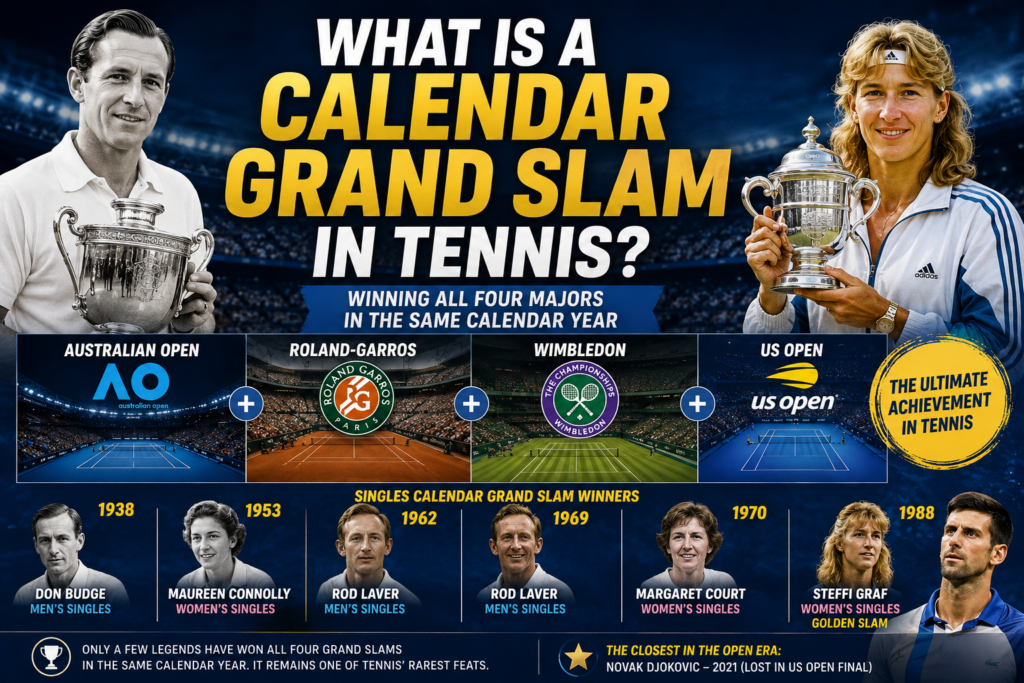
What Is a Calendar Grand Slam? Quick Answer
A Calendar Grand Slam means winning all four major singles championships during the same calendar year:
Australian Open
Roland-Garros
Wimbledon
US Open
A player must win all four in one season.
Winning the four tournaments across two different years does not count as a traditional Calendar Grand Slam.
Winning all four at different points during a career is instead called a:
Career Grand Slam.
If you’re unfamiliar with the four majors themselves, start with our guide explaining what a Grand Slam is in tennis.
Who Has Won a Calendar Grand Slam in Singles?
Only a handful of players have accomplished it.
| Year | Player | Singles |
|---|---|---|
| 1938 | Don Budge | Men’s |
| 1953 | Maureen Connolly | Women’s |
| 1962 | Rod Laver | Men’s |
| 1969 | Rod Laver | Men’s |
| 1970 | Margaret Court | Women’s |
| 1988 | Steffi Graf | Women’s |
There is one extraordinary detail in this table.
Rod Laver appears twice.
He is the only singles player to complete the traditional Calendar Grand Slam twice.
And his second came in 1969, during the Open Era.
How Does a Player Complete the Calendar Grand Slam?
The challenge begins at the Australian Open.
A player must win the season’s first major.
Then comes Roland-Garros.
Win again.
Then Wimbledon.
Win again.
At that point, the player arrives at the US Open with history on the line.
One tournament remains.
The sequence is:
1. Australian Open
Hard court
2. Roland-Garros
Clay
3. Wimbledon
Grass
4. US Open
Hard court
That surface transition is one of the reasons the achievement is so difficult.
A player must dominate on hard courts.
Then adapt to clay.
Then rapidly adjust to grass.
Then return to hard courts.
And all of it must happen within the same season.
Don Budge — 1938 Calendar Grand Slam
Don Budge became the first singles player to win all four major championships during the same calendar year.
He accomplished it in:
1938
Budge won:
Australian Championships
French Championships
Wimbledon
U.S. Championships
That historic sweep helped establish the concept of winning the four major championships as the ultimate tennis achievement.
Why Budge’s 1938 Season Matters
Budge did something nobody had previously achieved in singles.
He won every major available during the same year.
His accomplishment came decades before the Open Era began in 1968, but it remains an essential part of Grand Slam history.
Maureen Connolly — 1953 Calendar Grand Slam
Maureen Connolly became the first woman to complete the singles Calendar Grand Slam.
She achieved it in:
1953
Connolly won all four major championships while still extraordinarily young.
Her dominance earned her the nickname:
Little Mo
Her career, however, was tragically short.
A horseback-riding accident severely injured her leg and effectively ended her competitive tennis career.
Despite that, her place in tennis history was already secure.
She had completed one of the sport’s rarest achievements.
Rod Laver — 1962 Calendar Grand Slam
Rod Laver completed his first Calendar Grand Slam in:
1962
He won:
Australian Championships
French Championships
Wimbledon
U.S. Championships
But this accomplishment came before the beginning of the Open Era.
That distinction matters.
Professional players were still excluded from the traditional major championships.
Laver himself would soon turn professional.
And that decision temporarily removed him from Grand Slam competition.
Rod Laver Was Unable to Play the Majors for Years
After completing the 1962 Grand Slam, Laver turned professional.
Under the old tennis system, professional players were not allowed to compete at the traditional amateur Grand Slam tournaments.
That meant Laver missed several years of major competition during his prime.
Then everything changed.
In 1968, tennis entered the Open Era.
Professionals were finally permitted to compete alongside amateurs at major tournaments.
Our guide to what the Open Era means in tennis explains why that transformation was so important.
And once Laver returned to the majors, he did something remarkable.
He completed the Grand Slam again.
Rod Laver — 1969 Calendar Grand Slam
Rod Laver won all four majors again in:
1969
This time, he did it during the Open Era.
He won:
Australian Open
Roland-Garros
Wimbledon
US Open
It remains the most recent men’s singles Calendar Grand Slam.
More than half a century later, no man has repeated it.
Why Laver’s 1969 Grand Slam Is So Important
The 1969 achievement carries enormous historical weight because professionals were now permitted to compete at the majors.
Laver therefore won all four championships in the newly opened competitive environment.
He became:
the first man to complete an Open Era Calendar Grand Slam
and remains:
the only man to do so.
Margaret Court — 1970 Calendar Grand Slam
One year after Laver’s historic season, Margaret Court completed the women’s Calendar Grand Slam.
She achieved it in:
1970
Court won:
Australian Open
Roland-Garros
Wimbledon
US Open
That made 1969 and 1970 an extraordinary two-year period in tennis history.
A men’s Calendar Grand Slam was followed immediately by a women’s Calendar Grand Slam.
Steffi Graf — 1988 Calendar Grand Slam
Steffi Graf completed the Calendar Grand Slam in:
1988
She won:
Australian Open
Roland-Garros
Wimbledon
US Open
But Graf didn’t stop there.
1988 was also an Olympic year.
And Graf won:
Olympic singles gold in Seoul.
That created an achievement even greater than the traditional Calendar Grand Slam.
The:
Calendar Golden Slam.
Graf remains the only singles player to win all four majors and Olympic singles gold during the same calendar year.
Steffi Graf’s 1988 Golden Slam
Graf’s 1988 season deserves special attention because of its uniqueness.
Her five biggest victories were:
Australian Open
Champion
Roland-Garros
Champion
Wimbledon
Champion
US Open
Champion
Seoul Olympics
Gold medal
Four majors.
Olympic gold.
One season.
No other singles player has duplicated it.
We will examine this achievement in greater detail in our September 4 article about the Golden Slam.
Who Was the Last Man to Win a Calendar Grand Slam?
The answer is:
Rod Laver
Year:
1969
No male singles player has completed the Calendar Grand Slam since.
Several have come close.
But none has won all four majors during the same calendar year.
That makes Laver’s achievement increasingly remarkable as the decades pass.
Who Was the Last Woman to Win a Calendar Grand Slam?
The answer is:
Steffi Graf
Year:
1988
Graf didn’t merely win the four majors.
She added Olympic singles gold.
Her season therefore became the Calendar Golden Slam.
Why Is the Calendar Grand Slam So Difficult?
Winning one major is difficult enough.
To complete the Calendar Grand Slam, a player must effectively produce four championship runs in four different environments.
Several factors make it extraordinarily difficult.
Different Surfaces
The majors are played across three surfaces:
Hard
Clay
Grass
A player who dominates one surface may be less effective on another.
To complete the Calendar Grand Slam, there can be no major weakness.
Surface Transitions
The transition from Roland-Garros to Wimbledon is especially challenging.
Players move from slow clay courts to fast, low-bouncing grass.
And they have relatively little time to adapt.
A player can dominate Paris and still struggle in London.
Seven Matches Per Major
A singles champion normally needs to win seven matches at each Grand Slam.
Four championships therefore require approximately:
28 match victories
across the four tournaments.
One loss ends the attempt.
Injuries
Professional tennis is physically demanding.
A player can dominate the first half of the season and then suffer an injury before Wimbledon or the US Open.
The Calendar Grand Slam requires both excellence and durability.
Pressure
The closer a player gets, the greater the pressure becomes.
Winning the Australian Open alone does not create enormous Calendar Grand Slam expectations.
Winning Australia and Roland-Garros changes the conversation.
Winning Wimbledon as well changes everything.
By the US Open, every match becomes part of tennis history.
Few examples demonstrate that pressure better than Novak Djokovic’s 2021 season.
Novak Djokovic’s 2021 Calendar Grand Slam Attempt
Djokovic produced one of the closest men’s attempts since Laver.
He began 2021 by winning:
Australian Open
Then:
Roland-Garros
Then:
Wimbledon
Three majors.
Three victories.
One remained.
Djokovic arrived at the US Open with an opportunity to become the first man since Rod Laver to complete the Calendar Grand Slam.
He reached the final.
One match separated him from history.
Djokovic vs Medvedev — 2021 US Open Final
Djokovic faced:
Daniil Medvedev
in the final.
Had Djokovic won, he would have completed the Calendar Grand Slam.
Instead, Medvedev defeated him in straight sets.
Djokovic’s historic attempt ended at the final hurdle.
His 2021 Grand Slam season finished:
Australian Open — Champion
Roland-Garros — Champion
Wimbledon — Champion
US Open — Finalist
It was an extraordinary season.
But it was not a Calendar Grand Slam.
Did Roger Federer Ever Win a Calendar Grand Slam?
No.
Roger Federer won:
20 Grand Slam singles titles
and completed the Career Grand Slam.
But he never won all four majors during the same calendar year.
The biggest obstacle was often:
Roland-Garros
and more specifically:
Rafael Nadal.
Federer reached the Roland-Garros final in 2006, 2007 and 2008 but lost to Nadal each time.
He finally won Paris in 2009.
That completed his Career Grand Slam.
But he did not win the Australian Open, Roland-Garros, Wimbledon and US Open in one season.
For his complete career, visit our Roger Federer profile.
Did Rafael Nadal Ever Win a Calendar Grand Slam?
No.
Nadal won:
22 major singles titles
and completed the Career Grand Slam.
But he never won all four during the same calendar year.
Nadal’s Roland-Garros dominance was unmatched.
He also won multiple Australian Opens, Wimbledons and US Opens.
But the four never came together in one season.
Visit our Rafael Nadal profile for his complete career records.
Did Novak Djokovic Ever Win a Calendar Grand Slam?
No.
Djokovic owns:
24 men’s Grand Slam singles titles
and has won every major multiple times.
But he has never won all four during one calendar year.
His closest attempt came in:
2021
when he won the first three majors and reached the US Open final.
However, Djokovic has accomplished something closely related.
He once held all four Grand Slam titles simultaneously.
What Is a Non-Calendar Grand Slam?
A player completes a non-calendar Grand Slam by winning four consecutive majors across two calendar years.
The player therefore holds all four titles at the same time.
But because they were not won during one January-to-December season, it is not the traditional Calendar Grand Slam.
Novak Djokovic produced one of the most famous examples.
The Nole Slam
Djokovic won:
Wimbledon 2015
US Open 2015
Australian Open 2016
Roland-Garros 2016
Four consecutive majors.
He held every Grand Slam title simultaneously.
This achievement became popularly known as the:
Nole Slam
It was extraordinary.
But technically, it was not a Calendar Grand Slam because the four championships were split between 2015 and 2016.
Serena Williams and the Serena Slam
Serena Williams also won four consecutive majors across two calendar years.
The achievement became known as the:
Serena Slam
Like Djokovic’s Nole Slam, it demonstrates dominance across all four majors.
But it is distinct from winning all four within the same calendar year.
This distinction is important when discussing historical records.
Calendar Grand Slam vs Career Grand Slam
These two achievements are often confused.
Career Grand Slam
Win all four majors at least once during a career.
They can be won across many different seasons.
Calendar Grand Slam
Win all four majors during the same calendar year.
The second is far rarer.
A player can take 10 or 15 years to complete a Career Grand Slam.
A Calendar Grand Slam gives only one season.
Calendar Grand Slam vs Non-Calendar Grand Slam
Another important distinction:
| Achievement | Requirement |
|---|---|
| Calendar Grand Slam | Four majors in the same calendar year |
| Non-Calendar Grand Slam | Four consecutive majors spanning two calendar years |
| Career Grand Slam | All four majors at least once during a career |
All three are extraordinary.
But they should not be treated as identical achievements.
Calendar Grand Slam vs Golden Slam
A Calendar Grand Slam requires:
Australian Open
Roland-Garros
Wimbledon
US Open
A Calendar Golden Slam requires all four plus:
Olympic singles gold
during the same year.
Steffi Graf achieved that in 1988.
That makes her season unique in singles tennis history.
Has Anyone Won the Calendar Grand Slam Twice?
Yes.
Only one singles player:
Rod Laver
He completed it in:
1962
and:
1969
The first occurred before the Open Era.
The second occurred during the Open Era.
No other singles player has completed the traditional Calendar Grand Slam twice.
Has Anyone Won a Calendar Grand Slam in the Open Era?
Yes.
Three singles players have done it since the Open Era began in 1968:
Rod Laver
1969
Margaret Court
1970
Steffi Graf
1988
Graf’s achievement was also a Calendar Golden Slam.
No men’s singles player has completed it since Laver.
No women’s singles player has completed it since Graf.
Calendar Grand Slam Winners Before and During the Open Era
The historical list can therefore be divided like this:
Before the Open Era
Don Budge — 1938
Maureen Connolly — 1953
Rod Laver — 1962
Open Era
Rod Laver — 1969
Margaret Court — 1970
Steffi Graf — 1988
This distinction matters because tennis changed dramatically when professionals were permitted to compete at major tournaments beginning in 1968.
Why Didn’t Federer, Nadal and Djokovic Complete One?
This is one of the most interesting questions of the Big Three era.
Together, Federer, Nadal and Djokovic won an extraordinary number of Grand Slam titles.
Yet none completed a traditional Calendar Grand Slam.
Why?
Because winning all four requires near-perfect versatility and timing.
Federer’s greatest obstacle was often Nadal at Roland-Garros.
Nadal’s clay dominance was extraordinary, but sustaining the same level across the full sequence of majors proved difficult.
Djokovic came closest in 2021 but fell one match short.
Their failures actually demonstrate how difficult the accomplishment is.
Does a Calendar Grand Slam Make Someone the GOAT?
It is an enormous achievement.
But it does not automatically settle the tennis GOAT debate.
Consider:
Rod Laver completed two Calendar Grand Slams.
Djokovic has not completed one.
But Djokovic has accumulated far more Grand Slam titles in total and owns numerous other Open Era records.
How should those achievements be weighed?
There is no universally accepted formula.
The GOAT debate considers much more than one season.
Important factors include:
Grand Slam titles
weeks at World No. 1
career titles
Masters 1000 titles
ATP Finals titles
career match wins
winning percentage
head-to-head records
surface versatility
longevity
and
peak dominance
The Calendar Grand Slam is one powerful piece of evidence.
It is not the entire case.
Why Rod Laver’s Calendar Grand Slams Matter in GOAT Discussions
Laver presents a particularly difficult historical comparison.
He completed the Calendar Grand Slam twice.
He also lost several prime years of traditional Grand Slam eligibility after turning professional under the pre-Open Era system.
His raw major total therefore does not tell the entire story.
That is why comparing Laver directly with Djokovic, Nadal or Federer requires historical context.
Our guide explaining how the greatest tennis player of all time is determined explores why cross-era comparisons require more than simple title totals.
Calendar Grand Slam FAQ
What is a Calendar Grand Slam in tennis?
A Calendar Grand Slam means winning the Australian Open, Roland-Garros, Wimbledon and US Open during the same calendar year.
How many players have won a singles Calendar Grand Slam?
Five different singles players have achieved it: Don Budge, Maureen Connolly, Rod Laver, Margaret Court and Steffi Graf.
Rod Laver achieved it twice.
Who was the first player to win the Calendar Grand Slam?
Don Budge in 1938.
Who was the first woman to win a Calendar Grand Slam?
Maureen Connolly in 1953.
Who was the last man to win a Calendar Grand Slam?
Rod Laver in 1969.
Who was the last woman to win a Calendar Grand Slam?
Steffi Graf in 1988.
Who has won the Calendar Grand Slam twice?
Rod Laver.
He completed it in 1962 and 1969.
Who has won an Open Era Calendar Grand Slam?
Rod Laver in 1969, Margaret Court in 1970 and Steffi Graf in 1988.
Did Roger Federer win a Calendar Grand Slam?
No.
Federer completed the Career Grand Slam but never won all four majors during one calendar year.
Did Rafael Nadal win a Calendar Grand Slam?
No.
Nadal completed the Career Grand Slam but never won all four in the same year.
Did Novak Djokovic win a Calendar Grand Slam?
No.
He came extremely close in 2021, winning the Australian Open, Roland-Garros and Wimbledon before losing the US Open final.
How close did Djokovic get to a Calendar Grand Slam?
One match.
He reached the 2021 US Open final after winning the year’s first three majors.
Did Djokovic ever hold all four Grand Slam titles?
Yes.
He won four consecutive majors from Wimbledon 2015 through Roland-Garros 2016.
That is often called the Nole Slam.
Is holding all four majors the same as a Calendar Grand Slam?
Not necessarily.
If the four titles were won across two calendar years, it is a non-calendar Grand Slam rather than a traditional Calendar Grand Slam.
What is the difference between a Career Grand Slam and Calendar Grand Slam?
A Career Grand Slam requires winning every major at least once during a career.
A Calendar Grand Slam requires winning all four during the same year.
What is a Golden Slam?
A Golden Slam combines all four Grand Slam championships with Olympic singles gold.
Who won the Calendar Golden Slam?
Steffi Graf in 1988.
Has anyone won a men’s Calendar Grand Slam in the Open Era?
Yes.
Rod Laver did it in 1969.
He remains the only man to achieve it during the Open Era.
Has Serena Williams won a Calendar Grand Slam?
No.
Serena held all four Grand Slam titles simultaneously across two calendar years, an achievement commonly known as the Serena Slam.
How many matches does it take to win all four Grand Slams?
Under standard singles draws, a champion normally wins seven matches at each major.
Winning all four therefore generally requires 28 Grand Slam match victories.
Final Answer: What Is a Calendar Grand Slam?
A Calendar Grand Slam means winning all four major tennis championships during the same calendar year:
Australian Open
Roland-Garros
Wimbledon
US Open
Only five singles players have ever achieved it.
Don Budge — 1938
Maureen Connolly — 1953
Rod Laver — 1962
Rod Laver — 1969
Margaret Court — 1970
Steffi Graf — 1988
Rod Laver is the only singles player to do it twice.
His 1969 achievement remains the only men’s Calendar Grand Slam of the Open Era.
Graf is the most recent singles player to complete one.
And she went even further by adding Olympic singles gold in 1988 to complete the Calendar Golden Slam.
The Big Three never achieved it.
Federer never did.
Nadal never did.
Djokovic came within one match in 2021.
That tells us something important.
Winning 20 or more Grand Slam titles across a career is extraordinary.
But winning all four majors in one season requires a different kind of perfection.
Different surfaces.
Different continents.
Different opponents.
Months of physical and mental pressure.
Approximately 28 Grand Slam victories.
And no second chance.
That is why the Calendar Grand Slam remains one of the rarest and most prestigious achievements in tennis history.
Who Is Your Tennis GOAT?
Should Rod Laver’s two Calendar Grand Slams carry more weight in the GOAT debate?
Or should total career records matter more?
What about Djokovic’s 24 majors?
Nadal’s 14 Roland-Garros titles?
Federer’s eight Wimbledon championships?
Weeks at No. 1?
Head-to-head records?
Longevity?
Peak dominance?
The numbers tell different parts of the story.
VIEW THE LIVE TENNIS GOAT RANKING AND CAST YOUR VOTE
Compare the greatest players in tennis history and make your choice.
Tags: Australian Open, Big Three tennis, Calendar Golden Slam, Calendar Grand Slam, Calendar Grand Slam tennis, Career Grand Slam, Don Budge, four Grand Slams, French Open, Golden Slam, Grand Slam history, Grand Slam records, Grand Slam tennis, Grand Slam winners, greatest tennis player of all time, Margaret Court, Maureen Connolly, Nole Slam, non-calendar Grand Slam, Novak Djokovic, Open Era records, Open Era tennis, Rafael Nadal, Rod Laver, Rod Laver 1969, Roger Federer, Roland Garros, Serena Slam, Serena Williams, Steffi Graf, Steffi Graf 1988, tennis GOAT, tennis Grand Slam, Tennis History, tennis records, US Open, Wimbledon