
Last Updated: September 2026
If you are new to tennis, one phrase appears constantly:
Grand Slam.
Players are judged by how many Grand Slam titles they have won.
Historic seasons are defined by Grand Slam victories.
And debates about the greatest tennis player of all time almost always begin with the majors.
But what exactly is a Grand Slam in tennis?
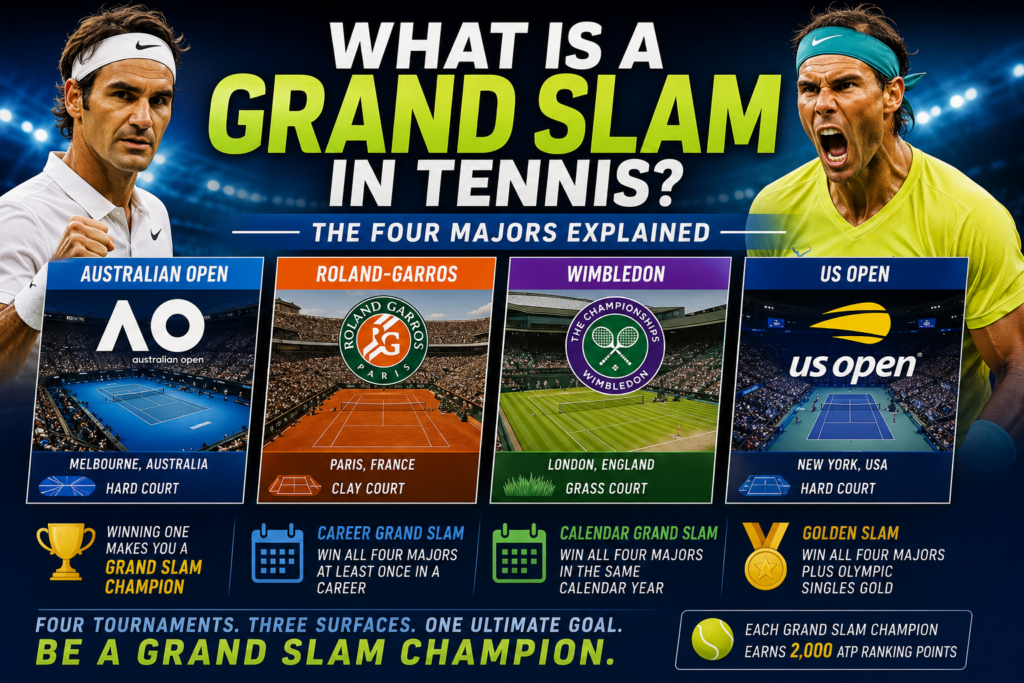
The four Grand Slam tournaments are:
Australian Open
Roland-Garros — also known as the French Open
Wimbledon
US Open
They are the four major championships in tennis and represent the biggest recurring individual prizes in the sport.
Each tournament has its own history, conditions and identity.
The Australian Open is played on hard courts in Melbourne.
Roland-Garros is played on clay in Paris.
Wimbledon is played on grass in London.
The US Open is played on hard courts in New York.
Winning even one can define a player’s career.
Winning all four at some point during a career creates another famous achievement:
the Career Grand Slam.
And winning all four during the same calendar year is one of the rarest accomplishments in tennis history.
This guide explains exactly what a Grand Slam is, how the four majors differ, what terms such as Career Grand Slam and Calendar Grand Slam mean, and why Grand Slam titles matter so much in the debate over the greatest tennis player of all time.
What Is a Grand Slam in Tennis? Quick Answer
The four Grand Slam tennis tournaments are:
| Grand Slam | Location | Current Surface |
|---|---|---|
| Australian Open | Melbourne, Australia | Hard |
| Roland-Garros | Paris, France | Clay |
| Wimbledon | London, England | Grass |
| US Open | New York, United States | Hard |
Together, these four events are commonly known as the majors.
Winning one means becoming a Grand Slam champion.
Winning all four at least once during a career means completing the Career Grand Slam.
Winning all four during the same calendar year means completing the Calendar Grand Slam.
Why Are They Called Grand Slam Tournaments?
The term “Grand Slam” has become associated with the four major championships of tennis.
But there is an important distinction.
A tournament such as Wimbledon is a Grand Slam tournament.
A player who wins Wimbledon has won a Grand Slam title.
But traditionally, winning the Grand Slam means winning all four major singles championships during the same calendar year.
In everyday tennis discussion, however, fans frequently use “Grand Slam” to refer to an individual major.
For example:
“Novak Djokovic has won 24 Grand Slams.”
That means he has won 24 Grand Slam singles titles, not 24 Calendar Grand Slams.
Understanding this distinction makes tennis terminology much easier.
What Are the Four Grand Slam Tournaments?
Each major presents a different challenge.
A player trying to win all four must succeed across different continents, climates, surfaces and stages of the season.
That is one reason Grand Slam versatility carries so much historical importance.
Australian Open
The Australian Open is traditionally the first Grand Slam tournament of the season.
It is played in:
Melbourne, Australia
on:
hard courts
The tournament normally takes place early in the calendar year.
Melbourne conditions can be physically demanding because of the Australian summer.
The men’s singles record belongs to:
Novak Djokovic — 10 titles
Djokovic’s success in Melbourne is one of the defining records of his career.
Roger Federer won six Australian Open championships.
Rafael Nadal won two.
Carlos Alcaraz won the tournament in 2026 and completed his Career Grand Slam.
For the complete historical leaderboard, read Who Has Won the Most Australian Open Titles?.
Roland-Garros
The second major of the traditional calendar is Roland-Garros.
It is played in:
Paris, France
on:
clay
Roland-Garros is also commonly called the French Open.
It is the only Grand Slam currently played on clay.
Clay changes tennis considerably.
The surface generally creates:
higher bounces
longer rallies
more sliding
and
greater physical demands
For nearly two decades, Roland-Garros was dominated by one player:
Rafael Nadal.
Nadal won the men’s singles championship:
14 times
That is the men’s record for the most titles at any single Grand Slam tournament.
His Paris dominance is one of the strongest arguments in his historical GOAT résumé.
Explore the full record in Who Has Won the Most French Open Titles?.
Wimbledon
Wimbledon is played at the All England Club in:
London, England
on:
grass
It is the only current Grand Slam tournament played on grass.
Wimbledon is also the oldest of the four majors.
Grass presents a completely different challenge from clay.
The ball generally stays lower.
Movement is different.
Strong serving becomes especially valuable.
Points can develop very quickly.
The men’s singles title record belongs to:
Roger Federer — 8
Novak Djokovic won seven.
Pete Sampras also won seven.
Federer’s Wimbledon achievements became one of the defining parts of his career.
See the complete leaderboard in Who Has Won the Most Wimbledon Titles?.
US Open
The US Open is traditionally the final Grand Slam of the season.
It is played in:
New York City
on:
hard courts
The tournament is famous for its atmosphere, large crowds and night sessions.
Unlike the Australian Open, French Open and Wimbledon, the men’s Open Era US Open title record is shared.
Jimmy Connors — 5
Pete Sampras — 5
Roger Federer — 5
Novak Djokovic won four.
Rafael Nadal also won four.
This makes New York one of the most evenly distributed Grand Slam battlegrounds among the Big Three.
For the full record book, visit Who Has Won the Most US Open Titles?.
Which Grand Slam Is Played First?
The normal seasonal order is:
1. Australian Open
Melbourne
Hard court
2. Roland-Garros
Paris
Clay
3. Wimbledon
London
Grass
4. US Open
New York
Hard court
That order matters when discussing achievements such as the Calendar Grand Slam.
A player attempting to win all four in one season must survive all four very different challenges.
Why Are Grand Slam Tournaments So Important?
Grand Slam championships occupy a unique place in tennis history.
They matter because they bring together several types of pressure at once.
Historical Importance
The majors contain much of the sport’s most celebrated history.
Winning one places a player’s name alongside generations of champions.
Strong Competition
The world’s best players target the majors.
Longer Format
Winning a men’s or women’s singles major requires surviving an entire draw across approximately two weeks.
Different Surfaces
The four majors collectively test hard-court, clay-court and grass-court ability.
Career Legacy
Grand Slam totals are one of the most commonly used measurements when comparing all-time greats.
That is why the difference between 24, 22 and 20 became so important during the Djokovic-Nadal-Federer era.
Who Has Won the Most Men’s Grand Slam Titles?
The men’s singles record belongs to:
Novak Djokovic — 24 titles
Behind him:
Rafael Nadal — 22
Roger Federer — 20
These three players transformed the men’s Grand Slam record book.
Before the Big Three era, Pete Sampras held the modern benchmark with 14 majors.
Federer passed him.
Nadal later passed Federer.
Djokovic ultimately moved ahead of both.
For the full historical list, visit Who Has Won the Most Grand Slam Tennis Titles?.
Djokovic’s Grand Slam Distribution
Novak Djokovic’s 24 major titles are distributed across all four tournaments:
| Tournament | Djokovic Titles |
|---|---|
| Australian Open | 10 |
| Roland-Garros | 3 |
| Wimbledon | 7 |
| US Open | 4 |
| Total | 24 |
One of the most impressive parts of this résumé is its balance.
Djokovic won every Grand Slam at least three times.
That demonstrates extraordinary versatility across surfaces and conditions.
For more of his records, visit our Novak Djokovic profile.
Nadal’s Grand Slam Distribution
Rafael Nadal finished with 22 major championships:
| Tournament | Nadal Titles |
|---|---|
| Australian Open | 2 |
| Roland-Garros | 14 |
| Wimbledon | 2 |
| US Open | 4 |
| Total | 22 |
The number that immediately stands out is:
14 Roland-Garros championships
Nadal’s clay-court dominance created one of the greatest single-tournament records in sports.
But he also won every other Grand Slam multiple times.
That is important because it demonstrates that Nadal was far more than a clay specialist.
Read our complete Rafael Nadal profile for the broader career picture.
Federer’s Grand Slam Distribution
Roger Federer won 20 major titles:
| Tournament | Federer Titles |
|---|---|
| Australian Open | 6 |
| Roland-Garros | 1 |
| Wimbledon | 8 |
| US Open | 5 |
| Total | 20 |
Federer’s signature major was Wimbledon.
His eight men’s singles titles remain the tournament record.
He also won five consecutive US Open championships and six Australian Opens.
His only Roland-Garros title came in 2009.
That victory was particularly significant because it completed his Career Grand Slam.
For more, visit our Roger Federer profile.
Djokovic vs Nadal vs Federer at the Four Grand Slams
The distribution of the Big Three’s titles shows their different strengths.
| Grand Slam | Djokovic | Nadal | Federer |
|---|---|---|---|
| Australian Open | 10 | 2 | 6 |
| Roland-Garros | 3 | 14 | 1 |
| Wimbledon | 7 | 2 | 8 |
| US Open | 4 | 4 | 5 |
| Total | 24 | 22 | 20 |
This table explains much of the modern GOAT debate.
Djokovic dominated Australia.
Nadal dominated Paris.
Federer owns the Wimbledon men’s record.
The US Open was far more evenly divided.
For a complete comparison beyond the majors, see Djokovic vs Nadal vs Federer: Who Is the Greatest?.
What Is a Career Grand Slam?
A Career Grand Slam means winning all four majors at least once during a player’s career.
A player does not have to win them during the same season.
For example, a player might win Wimbledon at 21, the US Open at 23, the Australian Open at 25 and finally Roland-Garros at 28.
Once the fourth different major is won, the Career Grand Slam is complete.
Modern men’s champions to achieve the feat include:
Andre Agassi
Roger Federer
Rafael Nadal
Novak Djokovic
Carlos Alcaraz
Alcaraz became the newest member when he won the 2026 Australian Open.
We have a full guide explaining the achievement and every player to complete it:
What Is a Career Grand Slam in Tennis?
What Is a Calendar Grand Slam?
A Calendar Grand Slam means winning:
Australian Open
Roland-Garros
Wimbledon
and
US Open
during the same calendar year.
This is significantly harder than the Career Grand Slam.
A player has no opportunity to wait for another season.
He or she must win all four majors consecutively within one year.
The achievement has occurred only rarely in singles tennis history.
Rod Laver famously completed the men’s Calendar Grand Slam in 1969 during the Open Era.
Steffi Graf completed the women’s Calendar Grand Slam in 1988.
And Graf went even further.
What Is a Golden Slam?
A Golden Slam adds Olympic singles gold to the Grand Slam collection.
The most famous example is:
Steffi Graf — 1988
Graf won:
Australian Open
Roland-Garros
Wimbledon
US Open
and:
Olympic singles gold
all during the same year.
That is known as the Calendar Golden Slam.
There is also a Career Golden Slam, where a player wins all four majors and Olympic singles gold at any point during his or her career.
Career Grand Slam vs Calendar Grand Slam vs Golden Slam
These terms are easy to confuse.
| Achievement | Requirement |
|---|---|
| Career Grand Slam | Win all four majors during a career |
| Calendar Grand Slam | Win all four majors in one calendar year |
| Career Golden Slam | Win all four majors plus Olympic singles gold during a career |
| Calendar Golden Slam | Win all four majors plus Olympic singles gold in one calendar year |
They are related.
But they are not interchangeable.
What Is a Non-Calendar Grand Slam?
There is another unusual achievement.
A player can win four consecutive majors without doing it within the same calendar year.
For example, Novak Djokovic won:
Wimbledon 2015
US Open 2015
Australian Open 2016
Roland-Garros 2016
He therefore held all four Grand Slam titles simultaneously.
But because the run crossed two calendar years, it was not a traditional Calendar Grand Slam.
The achievement became popularly known as the:
Nole Slam
Serena Williams also held all four major titles simultaneously across two calendar years, producing what became known as a:
Serena Slam
How Many Matches Does a Player Need to Win a Grand Slam?
A standard singles champion must work through the entire tournament draw.
For seeded stars, this means surviving round after round against increasingly dangerous opponents.
By the later stages, the pressure intensifies dramatically:
Quarterfinal
Semifinal
Final
Winning one Grand Slam requires sustained elite tennis across roughly two weeks.
That is why repeatedly winning majors becomes such an extraordinary measure of consistency.
Do Grand Slam Champions Get More Ranking Points?
Yes.
Grand Slams sit at the top of the normal tournament ranking-point hierarchy.
That gives them enormous importance not only historically but also in ranking battles.
Winning a major can have a major impact on the race for World No. 1.
This relationship between Grand Slam success and rankings is one reason the greatest players often dominate both categories.
For example, Djokovic leads the men’s major race and also holds the record for most weeks at World No. 1.
Grand Slams vs ATP Masters 1000
Grand Slams and ATP Masters 1000 events should not be confused.
Masters 1000 tournaments are major ATP Tour events.
But they are not Grand Slams.
The men’s Masters 1000 record belongs to:
Novak Djokovic — 40 titles
Rafael Nadal won 36.
Roger Federer won 28.
Masters success is important in GOAT comparisons because it measures repeated elite-level success throughout the regular tour.
But Grand Slam championships generally carry greater historical weight.
Read Who Has Won the Most ATP Masters 1000 Titles? for the complete record.
Grand Slams vs ATP Finals
The ATP Finals is another prestigious tournament.
But it is also not a Grand Slam.
The ATP Finals brings together the leading players of the season.
The tournament record belongs to:
Novak Djokovic — 7
Roger Federer won six.
Unlike a Grand Slam, the ATP Finals uses a small elite field and begins with round-robin competition.
The two tournaments therefore test players differently.
Grand Slams require surviving a large knockout draw.
The ATP Finals requires repeatedly beating the season’s elite players.
Our ATP Finals title record explains the distinction in more detail.
Why Grand Slam Titles Matter in the GOAT Debate
Grand Slam championships are not the only measure of greatness.
But they are one of the strongest.
Why?
Because a major victory tests several qualities at once.
Peak Performance
Players must perform at their highest level when the stakes are greatest.
Consistency
One bad match can eliminate a player.
Pressure
Major finals can define careers.
Surface Versatility
Winning majors across different surfaces demonstrates adaptability.
Longevity
Accumulating 15, 20 or more major titles requires years of elite performance.
That is why the Grand Slam race became central to the Federer-Nadal-Djokovic debate.
Are Grand Slam Titles Enough to Determine the GOAT?
No.
If Grand Slam totals were the only criterion, the GOAT debate would be extremely simple.
We could simply compare:
Djokovic — 24
Nadal — 22
Federer — 20
But tennis careers contain much more information.
Other important factors include:
weeks at World No. 1
year-end No. 1 finishes
Masters 1000 titles
ATP Finals titles
head-to-head results
career match wins
career win percentage
surface dominance
peak level
longevity
and
historical context
That is why our GOAT methodology considers more than one statistic.
Which Grand Slam Is the Hardest to Win?
There is no objective answer.
Each major creates a different challenge.
Australian Open
Hard court, early-season conditions and Melbourne heat.
Roland-Garros
Physical clay-court tennis and demanding movement.
Wimbledon
Unique grass conditions and limited annual grass preparation.
US Open
Late-season fatigue, hard courts and intense New York conditions.
Different players naturally perform better in different environments.
That is one reason completing the Career Grand Slam is so impressive.
Which Grand Slam Is the Most Prestigious?
This is subjective.
Wimbledon is often associated with tradition and tennis history.
But all four majors carry enormous sporting importance.
Modern players generally structure their seasons around competing at all four.
From a historical-record perspective, a Grand Slam singles championship counts as one major regardless of whether it was won in Melbourne, Paris, London or New York.
Which Player Dominated One Grand Slam the Most?
Among modern men’s tennis records, the most extraordinary single-major totals are:
Rafael Nadal
14 Roland-Garros titles
Novak Djokovic
10 Australian Open titles
Roger Federer
8 Wimbledon titles
These records reveal the different strengths of the Big Three.
Nadal owns the largest numerical total.
Djokovic owns Melbourne.
Federer owns the men’s Wimbledon title record.
Can Someone Win All Four Grand Slams More Than Once?
Yes.
A Career Grand Slam only requires one title at each tournament.
But some champions have won every major multiple times.
Novak Djokovic has won each major at least three times.
Rafael Nadal won every major at least twice.
That level of repeat success across all four majors demonstrates exceptional versatility.
Grand Slam Tennis FAQ
What are the four Grand Slam tournaments?
The four majors are the Australian Open, Roland-Garros, Wimbledon and US Open.
Is the French Open the same as Roland-Garros?
Yes.
Roland-Garros is the official tournament name, while French Open is commonly used in English.
Is Wimbledon a Grand Slam?
Yes.
Wimbledon is one of the four Grand Slam tournaments.
Is the Australian Open a Grand Slam?
Yes.
It is traditionally the first major of the season.
Is the US Open a Grand Slam?
Yes.
It is traditionally the final major of the season.
How many Grand Slams are there each year?
There are four Grand Slam tournaments in a normal tennis season.
Who has won the most men’s Grand Slam titles?
Novak Djokovic holds the men’s singles record with 24.
How many Grand Slams did Rafael Nadal win?
Nadal won 22 major singles titles.
How many Grand Slams did Roger Federer win?
Federer won 20.
What does Career Grand Slam mean?
It means winning all four major tournaments at least once during a career.
What does Calendar Grand Slam mean?
It means winning all four majors during the same calendar year.
What is a Golden Slam?
A Golden Slam combines Grand Slam success with Olympic singles gold.
Has anyone won all four majors in one year?
Yes.
The achievement is rare but has been completed in tennis history.
Rod Laver completed the men’s Calendar Grand Slam during the Open Era in 1969.
Steffi Graf completed the women’s Calendar Grand Slam in 1988.
Did Djokovic win a Calendar Grand Slam?
No.
Djokovic won four consecutive majors from Wimbledon 2015 through Roland-Garros 2016, but the run crossed two calendar years.
Has Federer completed the Career Grand Slam?
Yes.
Federer completed it by winning Roland-Garros in 2009.
Has Nadal completed the Career Grand Slam?
Yes.
Nadal completed it by winning the US Open in 2010.
Has Djokovic completed the Career Grand Slam?
Yes.
Djokovic completed it by winning Roland-Garros in 2016 and later won every major multiple times.
Has Carlos Alcaraz completed the Career Grand Slam?
Yes.
Alcaraz completed it by winning the Australian Open in 2026.
Are Masters 1000 tournaments Grand Slams?
No.
Masters 1000 events are prestigious ATP tournaments, but the four Grand Slams are separate.
Is the ATP Finals a Grand Slam?
No.
It is the elite season-ending ATP championship.
Final Answer: What Is a Grand Slam in Tennis?
The four Grand Slam tournaments are:
Australian Open
Roland-Garros
Wimbledon
US Open
They are the four major championships of tennis.
Each offers a different test.
Melbourne and New York use hard courts.
Paris uses clay.
Wimbledon uses grass.
Winning one makes a player a Grand Slam champion.
Winning all four during a career completes the Career Grand Slam.
Winning all four during the same calendar year completes the Calendar Grand Slam.
And winning all four plus Olympic singles gold in the same year creates the Golden Slam.
The majors also sit at the center of the tennis GOAT debate.
Djokovic owns 24 men’s major titles.
Nadal won 22.
Federer won 20.
But each built his résumé differently.
Djokovic dominated Melbourne.
Nadal dominated Paris.
Federer owns the Wimbledon men’s record.
That diversity is part of what makes Grand Slam tennis so fascinating.
Four tournaments.
Three major surfaces.
Different continents.
Different conditions.
And the same enormous objective:
Win seven matches and become a major champion.
Explore the Tennis GOAT Debate
Grand Slam titles provide some of the strongest evidence in the GOAT discussion.
But they are not the only evidence.
Rankings, Masters titles, head-to-head records, ATP Finals, longevity and surface versatility all matter.
So who built the greatest career?
VIEW THE LIVE TENNIS GOAT RANKING AND CAST YOUR VOTE
Compare the greatest players in tennis history and make your choice.
Tags: ATP Rankings, Australian Open, Big Three tennis, Calendar Grand Slam, Career Golden Slam, Career Grand Slam, Carlos Alcaraz, Djokovic records, Federer records, four Grand Slam tournaments, French Open, Golden Slam, Grand Slam champions, Grand Slam records, Grand Slam tennis, Grand Slam Titles, greatest tennis player of all time, Nadal records, Novak Djokovic, Pete Sampras, Rafael Nadal, Rod Laver, Roger Federer, Roland Garros, Serena Williams, Steffi Graf, tennis GOAT, tennis Grand Slams, Tennis History, tennis majors, tennis records, US Open, what is a Grand Slam in tennis, Wimbledon
Pingback: What Is a Calendar Grand Slam in Tennis? Complete History
Pingback: What Is a Golden Slam in Tennis? Complete History & Winners
Pingback: Most Consecutive Grand Slam Titles in Tennis History
Pingback: Who Has Won All Four Grand Slams? Career Grand Slam Winners
Pingback: Who Has Played the Most Grand Slam Matches? All-Time Records
Pingback: Who Has Played in the Most Grand Slam Tournaments? Records