
Statistics updated through Wimbledon 2026
Winning a Grand Slam attracts the headlines.
But there is another record that reveals something different about a tennis player’s greatness:
how often they were still standing when only four players remained.
Reaching one Grand Slam semifinal is a career-defining achievement for most professionals.
Roger Federer did it 46 times.
Rafael Nadal did it 38 times.
Jimmy Connors reached 31.
Novak Djokovic has gone further than all of them.
Through Wimbledon 2026, Djokovic has reached an extraordinary:
55 Grand Slam singles semifinals.
That is the men’s record — and it also places him beyond the women’s benchmark held by Chris Evert.
The number is remarkable because a semifinal appearance requires a player to win five matches at the same major before even getting the opportunity to play for a place in the final.
Do that once and you have had an exceptional tournament.
Do it dozens of times across different surfaces, opponents and generations, and the statistic becomes a measure of sustained greatness.
So who has reached the most Grand Slam semifinals?
Which legends converted those opportunities into titles most efficiently?
And what does this record add to the tennis GOAT debate?
Let’s examine the numbers.
Who Has Reached the Most Grand Slam Semifinals?
Novak Djokovic holds the men’s record with 55 Grand Slam semifinal appearances through Wimbledon 2026.
The leading men’s totals are:
| Rank | Player | Grand Slam Semifinals |
|---|---|---|
| 1 | Novak Djokovic | 55 |
| 2 | Roger Federer | 46 |
| 3 | Rafael Nadal | 38 |
| 4 | Jimmy Connors | 31 |
| 5 | Ivan Lendl | 28 |
| 6 | Andre Agassi | 26 |
| 7 | Pete Sampras | 23 |
| 8 | Andy Murray | 21 |
| 9 | John McEnroe | 19 |
| 10 | Björn Borg | 17 |
Djokovic’s advantage over Federer is:
9 semifinal appearances.
His advantage over Nadal is:
17.
Those gaps illustrate just how long Djokovic has remained capable of reaching the closing stages of majors.
Why Grand Slam Semifinals Are Such an Important Record
A title tells us who finished a tournament as champion.
A semifinal record answers another question:
How consistently did a player put himself in position to win?
To reach a major semifinal, a player normally needs five consecutive victories.
At four majors per season, opportunities are limited.
An early upset immediately ends that tournament’s chance.
Injury can remove another.
A difficult draw can place another elite player in the way.
And maintaining that standard over 10, 15 or 20 years requires far more than one exceptional peak.
That is why semifinal appearances are useful when evaluating:
longevity
consistency
all-surface performance
ability to avoid early defeats
and
repeated contention for the biggest titles.
They should not replace championships.
But they reveal something championships alone cannot.
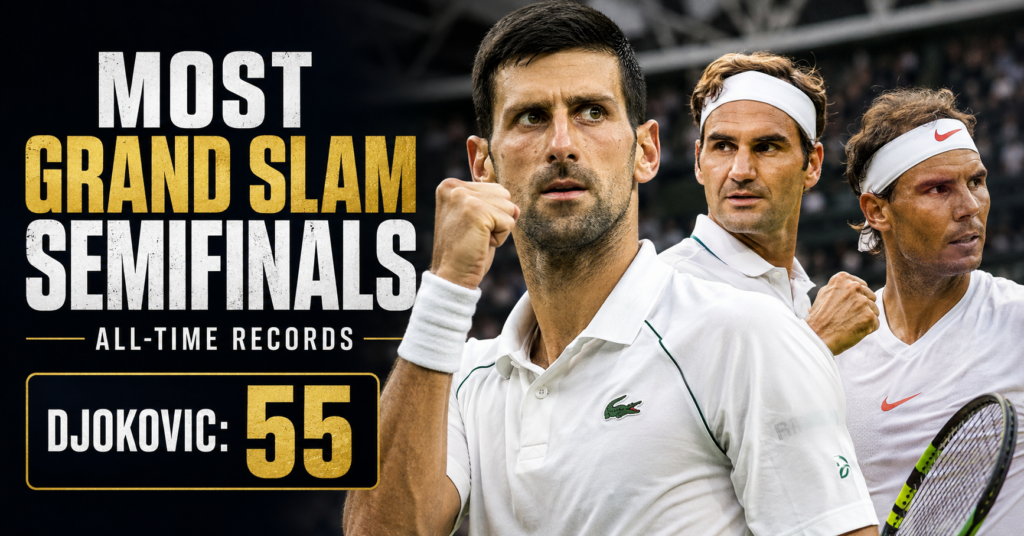
Novak Djokovic — 55 Grand Slam Semifinals
Djokovic now sits alone at the top of the men’s leaderboard.
His 55th major semifinal came at:
Wimbledon 2026.
By then, Djokovic was 39 years old.
That alone shows how unusual his career has become.
His first Grand Slam semifinal came almost two decades earlier.
Instead of producing one short period of dominance, he remained a major contender across multiple generations of opponents.
For the full résumé, see our Novak Djokovic career profile.
Djokovic’s Semifinal Record Is About More Than Longevity
Playing for a long time does not automatically create 55 semifinals.
A player has to keep reaching them.
Djokovic repeatedly advanced deep at:
Australian Open
Roland-Garros
Wimbledon
and
US Open.
That distribution matters.
His record was not created by dominating one tournament while struggling at the others.
It reflects deep runs across all four majors.
That fits with another important part of Djokovic’s résumé: he has won each of the four majors multiple times.
Djokovic Reaches His 55th Major Semifinal at Wimbledon
Djokovic reached another milestone at Wimbledon in 2026.
His quarterfinal victory put him into his:
55th Grand Slam semifinal
and:
15th Wimbledon semifinal.
The significance goes beyond one tournament.
At an age when virtually every all-time great has already retired from serious Grand Slam contention, Djokovic was still reaching the final four.
That combination of peak success and late-career longevity is a major reason his statistical résumé has become so difficult to match.
Roger Federer — 46 Grand Slam Semifinals
Before Djokovic moved ahead, Roger Federer set the standard for repeated deep runs at the majors.
Federer reached:
46 Grand Slam semifinals.
That remains an enormous total.
But one Federer record is even more striking than the overall number.
He once reached:
23 consecutive Grand Slam semifinals.
That streak stretched across several years.
Think about what that means.
Tournament after tournament, Federer avoided:
first-round defeats,
second-round shocks,
injury exits,
bad days in the middle rounds,
and quarterfinal losses.
For more on his career, visit our Roger Federer profile.
Federer’s 23 Consecutive Semifinals
Federer’s run began at Wimbledon in 2004.
For nearly six years, every Grand Slam he entered ended with Federer reaching at least the semifinal.
That level of reliability may be one of the strongest examples of sustained peak performance in tennis.
During the streak, a Grand Slam quarterfinal was not considered an exceptional result for Federer.
It was effectively the minimum.
That tells us how high the standard had become.
Rafael Nadal — 38 Grand Slam Semifinals
Rafael Nadal reached:
38 Grand Slam semifinals.
He ranks third among the leading men.
Naturally, many of his deepest runs came at Roland-Garros.
But reducing Nadal’s semifinal record to clay would badly misrepresent his career.
He also reached repeated semifinals at:
the Australian Open,
Wimbledon,
and
the US Open.
Nadal won every major at least twice, reinforcing the fact that his greatness extended far beyond Paris.
See the complete numbers in our Rafael Nadal career profile.
Nadal Turned Semifinal Runs Into Titles at an Exceptional Rate
Nadal reached fewer semifinals than Djokovic and Federer.
But when evaluating the statistic, quantity is not the only thing worth examining.
Nadal won:
22 Grand Slam titles
from:
38 semifinal appearances.
That means a very large percentage of Nadal’s final-four runs ultimately ended with him lifting the trophy.
His record therefore combines:
high consistency
with
exceptional conversion.
Jimmy Connors — 31 Grand Slam Semifinals
Jimmy Connors reached:
31 major semifinals.
His presence this high on the leaderboard is especially impressive considering how different the Grand Slam calendar was during much of his career.
Top players did not always compete in every major every year.
The Australian Open in particular did not consistently attract the complete elite field during parts of Connors’ era.
That makes direct numerical comparisons between generations imperfect.
Still, 31 semifinal appearances demonstrate the extraordinary longevity that defined Connors’ career.
Ivan Lendl — 28 Grand Slam Semifinals
Ivan Lendl reached:
28 Grand Slam semifinals.
Lendl’s consistency during the 1980s was remarkable.
He appeared deep in major tournaments season after season and ultimately won:
8 Grand Slam singles titles.
His one unresolved Grand Slam challenge was Wimbledon.
Lendl reached the Wimbledon final but never won the championship.
That missing trophy is often discussed when evaluating his place among the greatest players ever.
Yet 28 major semifinals demonstrate how regularly he remained part of the championship conversation.
Andre Agassi — 26 Grand Slam Semifinals
Andre Agassi reached:
26 Grand Slam semifinals.
His career was unusual because his success was not concentrated into one uninterrupted period.
Agassi experienced major highs, significant declines and one of tennis’s most famous career revivals.
Eventually, he won all four Grand Slam tournaments.
That versatility gives his semifinal total additional context.
Agassi did not merely accumulate deep runs at one favorite major.
He became a genuine contender across:
hard court,
clay,
and grass.
Pete Sampras — 23 Grand Slam Semifinals
Pete Sampras reached:
23 Grand Slam semifinals.
But his most impressive number may be what happened after reaching that stage.
Sampras won:
14 Grand Slam titles.
That means more than half of his major semifinal appearances ultimately became championships.
It is an extraordinarily efficient conversion rate.
Sampras was not as consistent across all four majors as Federer, Nadal or Djokovic.
Roland-Garros remained his greatest weakness.
But when Sampras reached the business end of a major on conditions that suited his game, he was exceptionally difficult to stop.
Andy Murray — 21 Grand Slam Semifinals
Andy Murray reached:
21 Grand Slam semifinals.
That number deserves more attention.
Murray played most of his prime during the era of:
Federer
Nadal
and
Djokovic.
He repeatedly reached the final stages of majors only to find one of those players waiting.
Murray still won:
3 Grand Slam titles
and reached:
11 major finals.
His 21 semifinals help explain why the term Big Four was regularly used during that period even though the Big Three ultimately finished with far larger Grand Slam title totals.
John McEnroe — 19 Grand Slam Semifinals
John McEnroe reached:
19 Grand Slam semifinals.
His seven major championships were concentrated at:
Wimbledon
and
the US Open.
McEnroe never won Roland-Garros or the Australian Open.
Still, during his peak he was one of the most difficult players in the world to beat, particularly on faster surfaces.
His semifinal record reflects a career that combined brilliant peaks with a shorter period of major dominance than several names above him.
Björn Borg — 17 Grand Slam Semifinals
Björn Borg’s total is:
17 Grand Slam semifinals.
At first glance, that looks relatively low compared with Djokovic’s 55 or Federer’s 46.
But this is where context becomes essential.
Borg’s elite career was comparatively short.
He also rarely played the Australian Open.
Yet from those 17 semifinal appearances, Borg won:
11 Grand Slam titles.
That is extraordinary efficiency.
It helps explain why raw totals should never be the only way historical players are compared.
Most Grand Slam Semifinals vs Most Grand Slam Titles
Now the comparison becomes more interesting.
| Player | Semifinals | Grand Slam Titles |
|---|---|---|
| Novak Djokovic | 55 | 24 |
| Roger Federer | 46 | 20 |
| Rafael Nadal | 38 | 22 |
| Jimmy Connors | 31 | 8 |
| Ivan Lendl | 28 | 8 |
| Andre Agassi | 26 | 8 |
| Pete Sampras | 23 | 14 |
| Andy Murray | 21 | 3 |
| John McEnroe | 19 | 7 |
| Björn Borg | 17 | 11 |
This table reveals why semifinal totals and title totals should be evaluated together.
Djokovic has the largest number of semifinal appearances.
Nadal reached fewer semifinals but converted an unusually high number into championships.
Sampras and Borg were especially efficient after making the final four.
Murray, meanwhile, reached 21 semifinals during one of the strongest periods of men’s tennis but converted only three into titles.
For the championship leaderboard itself, see Most Grand Slam Tennis Titles.
Which Player Converted Grand Slam Semifinals Into Titles Best?
A useful way to examine the record is:
Grand Slam titles ÷ Grand Slam semifinal appearances.
Among the leading men listed above:
| Player | Semifinals | Titles | Approx. Title Conversion |
|---|---|---|---|
| Björn Borg | 17 | 11 | 64.7% |
| Pete Sampras | 23 | 14 | 60.9% |
| Rafael Nadal | 38 | 22 | 57.9% |
| Novak Djokovic | 55 | 24 | 43.6% |
| Roger Federer | 46 | 20 | 43.5% |
| John McEnroe | 19 | 7 | 36.8% |
| Andre Agassi | 26 | 8 | 30.8% |
| Ivan Lendl | 28 | 8 | 28.6% |
| Jimmy Connors | 31 | 8 | 25.8% |
| Andy Murray | 21 | 3 | 14.3% |
This does not mean Borg was automatically greater than Djokovic because his percentage is higher.
Borg had far fewer opportunities and a shorter career.
Djokovic created 55 semifinal opportunities across an extraordinarily long span.
The statistics measure different qualities.
One measures efficiency.
The other helps measure sustained contention.
Djokovic vs Federer vs Nadal: Semifinal Comparison
The Big Three totals are:
Djokovic — 55
Federer — 46
Nadal — 38
The gap is substantial.
But the numbers tell different stories.
Djokovic
The strongest combination of:
volume + longevity + all-major consistency
Federer
An extraordinary peak of uninterrupted consistency, highlighted by:
23 consecutive Grand Slam semifinals
Nadal
Fewer semifinal appearances, but an exceptional ability to convert deep runs into:
22 championships
For a broader comparison of their careers, visit Djokovic vs Nadal vs Federer.
How Hard Is It to Reach a Grand Slam Semifinal?
A major singles draw normally begins with:
128 players.
After the first round:
64 remain.
Then:
32.
Then:
16.
Then:
8.
After the quarterfinals, only:
4 players remain.
Those are the semifinalists.
So reaching the last four usually requires:
five match victories.
And there are only four Grand Slam tournaments each season.
Even a player who reaches two semifinals in one year has produced an elite major season by normal professional standards.
The legends on this list did that repeatedly for years.
Why Semifinals Can Tell Us More Than Finals Alone
Suppose two players each reach 10 Grand Slam finals.
Player A also loses 15 semifinals.
Player B rarely gets beyond the quarterfinals when he does not reach the final.
Their number of finals is identical.
But their broader Grand Slam consistency is not.
Semifinal totals capture those additional deep runs.
This makes them particularly useful when studying:
career longevity
and
week-to-week consistency at the majors.
Why Titles Still Matter More
There is an important limit to this statistic.
Nobody enters Wimbledon dreaming of becoming a semifinalist.
The objective is:
the championship.
A player who reaches 25 semifinals and wins five titles has not achieved the same thing as someone who reaches 20 and wins 12.
That is why semifinal appearances should be treated as:
supporting evidence
rather than the ultimate GOAT statistic.
The most meaningful analysis combines:
titles,
finals,
semifinals,
match wins,
ranking dominance,
surface versatility,
and quality of competition.
That is also the philosophy behind our guide to how the greatest tennis player of all time is determined.
Who Holds the Women’s Grand Slam Semifinal Record?
Chris Evert reached:
52 Grand Slam singles semifinals.
For decades, that stood as one of the great consistency records in tennis.
Martina Navratilova reached:
44
while Serena Williams reached:
40.
Steffi Graf reached:
37.
That provides an interesting cross-tour comparison.
Through Wimbledon 2026:
Novak Djokovic — 55
Chris Evert — 52
Djokovic therefore owns the highest known Grand Slam singles semifinal total across men’s and women’s tennis.
Chris Evert’s 52 Semifinals Were Extraordinary
Evert’s record deserves context.
She did not reach 52 semifinals merely because she played for a long time.
She reached the late rounds of Grand Slam tournaments at an astonishing rate.
Early exits were unusually rare during her prime.
That is exactly what makes semifinal totals valuable.
They reward the ability to avoid the kind of off-day or upset that ends a major campaign before championship weekend.
Grand Slam Semifinals and Longevity
There are different ways to build a huge semifinal total.
One is peak dominance.
Another is exceptional longevity.
The biggest records generally require:
both.
Federer’s 23-semifinal streak shows what sustained peak dominance looks like.
Djokovic’s ability to reach major semifinals into his late 30s demonstrates something different:
the capacity to remain elite long after the normal physical decline of a tennis career begins.
When the two qualities are combined, the totals become enormous.
Can Djokovic’s 55 Grand Slam Semifinal Record Be Broken?
It is possible.
But the standard is intimidating.
Imagine a player reaching:
three Grand Slam semifinals every year.
At that rate, reaching 55 would still require more than:
18 seasons.
Even averaging all four semifinals per season would require nearly:
14 full years.
And real careers are not that clean.
Players suffer injuries.
They lose early.
They skip tournaments.
They have poor seasons.
New rivals emerge.
That is why 55 is such a formidable benchmark.
Could Carlos Alcaraz or Jannik Sinner Eventually Challenge It?
Carlos Alcaraz and Jannik Sinner have already established themselves as major champions and regular contenders.
But challenging 55 semifinals would require much more than accumulating Grand Slam titles early in their careers.
They would need:
exceptional health
long careers
consistent participation
and
deep runs season after season.
The difficult part of Djokovic’s record is not simply reaching semifinals while playing great tennis.
It is continuing to do so across an enormous portion of a career.
Grand Slam Semifinals vs Consecutive Grand Slam Semifinals
These are two different records.
Career Grand Slam semifinals
Counts every major semifinal reached during an entire career.
Djokovic leads this category with:
55 through Wimbledon 2026.
Consecutive Grand Slam semifinals
Counts how many majors in a row a player reached the final four without interruption.
Federer’s famous streak reached:
23 consecutive majors.
The first statistic rewards total career volume.
The second measures uninterrupted dominance.
Both tell us something valuable.
Does Reaching a Semifinal Count as a Grand Slam Result?
Yes.
When historical tennis results are listed, the usual progression is:
Champion
Runner-up
Semifinal
Quarterfinal
Fourth Round
and earlier rounds.
A semifinal appearance means a player reached the final four of the tournament but did not necessarily reach the championship match.
Is a Grand Slam Semifinal the Same as a Major Semifinal?
Yes.
In tennis, the terms:
Grand Slam
and
major
are commonly used interchangeably when referring to the four biggest tournaments:
Australian Open,
Roland-Garros,
Wimbledon,
and
US Open.
So:
55 Grand Slam semifinals
and
55 major semifinals
describe the same achievement.
How Many Matches Must a Player Win to Reach a Grand Slam Semifinal?
In a standard 128-player singles draw:
five matches.
A player advances through:
First Round
Second Round
Third Round
Fourth Round
Quarterfinal
Winning the quarterfinal places that player in the:
semifinal.
To win the entire tournament requires two additional victories:
the semifinal
and
the final.
Which Grand Slam Legend Was Most Efficient From the Semifinal Stage?
Among the major men’s champions in our comparison, Björn Borg and Pete Sampras stand out statistically.
Borg reached 17 semifinals and won 11 titles.
Sampras reached 23 and won 14.
Nadal also produced an exceptional ratio:
38 semifinals and 22 championships.
Djokovic and Federer reached far more semifinals overall, which tells a different story about sustained deep-run consistency.
There is no single perfect statistic.
That’s precisely why tennis history is so interesting to compare.
Grand Slam Semifinal Records FAQ
Who has reached the most Grand Slam semifinals in men’s tennis?
Novak Djokovic.
Through Wimbledon 2026, he has reached 55 Grand Slam singles semifinals.
How many Grand Slam semifinals did Roger Federer reach?
Federer reached 46.
How many Grand Slam semifinals did Rafael Nadal reach?
Nadal reached 38.
How many Grand Slam semifinals did Jimmy Connors reach?
Connors reached 31.
How many Grand Slam semifinals did Ivan Lendl reach?
Lendl reached 28.
How many Grand Slam semifinals did Andre Agassi reach?
Agassi reached 26.
How many Grand Slam semifinals did Pete Sampras reach?
Sampras reached 23.
How many Grand Slam semifinals did Andy Murray reach?
Murray reached 21.
How many Grand Slam semifinals did John McEnroe reach?
McEnroe reached 19.
How many Grand Slam semifinals did Björn Borg reach?
Borg reached 17.
Who has the most consecutive Grand Slam semifinal appearances?
Roger Federer reached 23 consecutive Grand Slam semifinals.
Who has reached the most women’s Grand Slam semifinals?
Chris Evert reached 52.
Did Djokovic pass Chris Evert’s semifinal total?
Yes.
Through Wimbledon 2026, Djokovic has reached 55 major semifinals compared with Evert’s 52.
How many matches do you need to win to reach a Grand Slam semifinal?
Normally five in a 128-player singles draw.
What are the four Grand Slam tournaments?
The Australian Open, Roland-Garros, Wimbledon and US Open.
Does a semifinal appearance count as a Grand Slam title?
No.
A player must win the semifinal and then the final to become champion.
Why are Grand Slam semifinal records important?
They measure repeated deep runs at the sport’s biggest tournaments and provide useful evidence of consistency and longevity.
Final Answer: Who Has Reached the Most Grand Slam Semifinals?
Through Wimbledon 2026, Novak Djokovic holds the record with 55 Grand Slam singles semifinal appearances.
The leading men’s totals are:
Novak Djokovic — 55
Roger Federer — 46
Rafael Nadal — 38
Jimmy Connors — 31
Ivan Lendl — 28
Djokovic’s record is impressive for more than its size.
His semifinals span multiple generations.
They came on different surfaces.
They stretch from his early years challenging Federer and Nadal to his late 30s competing against a new generation of major champions.
Federer’s 46 still represents one of the greatest records of sustained excellence, especially when combined with his extraordinary streak of 23 consecutive semifinals.
Nadal’s 38 came with a remarkably high conversion into 22 championships.
And players such as Borg and Sampras show why efficiency matters alongside volume.
A semifinal does not carry the same value as a trophy.
But reaching the final four again and again tells us something important:
the player kept giving himself a chance to win.
And across an entire career, nobody in men’s Grand Slam tennis has done that more often than Novak Djokovic.
What Does This Record Mean for the Tennis GOAT Debate?
Djokovic leads in total major semifinal appearances.
Federer owns one of the greatest uninterrupted semifinal streaks.
Nadal converted a huge percentage of his deep runs into championships.
Borg and Sampras were extraordinarily efficient when they reached the final four.
So which matters more:
frequency, efficiency, longevity or titles?
There is no serious GOAT analysis that should rely on only one number.
That’s why we compare the complete record.
VIEW THE LIVE TENNIS GOAT RANKING AND CAST YOUR VOTE
Compare the greatest players in tennis history and decide which achievements matter most.
Tags: Grand Slam records, Grand Slam Semifinals, Major Championships, Novak Djokovic, Rafael Nadal, Roger Federer, tennis GOAT, tennis records