
Last Updated: August 2026
Reaching World No. 1 is one of the greatest achievements in professional tennis.
Staying there is even harder.
Unlike winning a single tournament, holding the No. 1 ranking requires sustained excellence across an entire season. Players must consistently win matches, reach the later rounds of major tournaments and outperform the rest of the tour over an extended period.
So who has spent the most weeks at World No. 1 in men’s tennis?
The answer is Novak Djokovic.
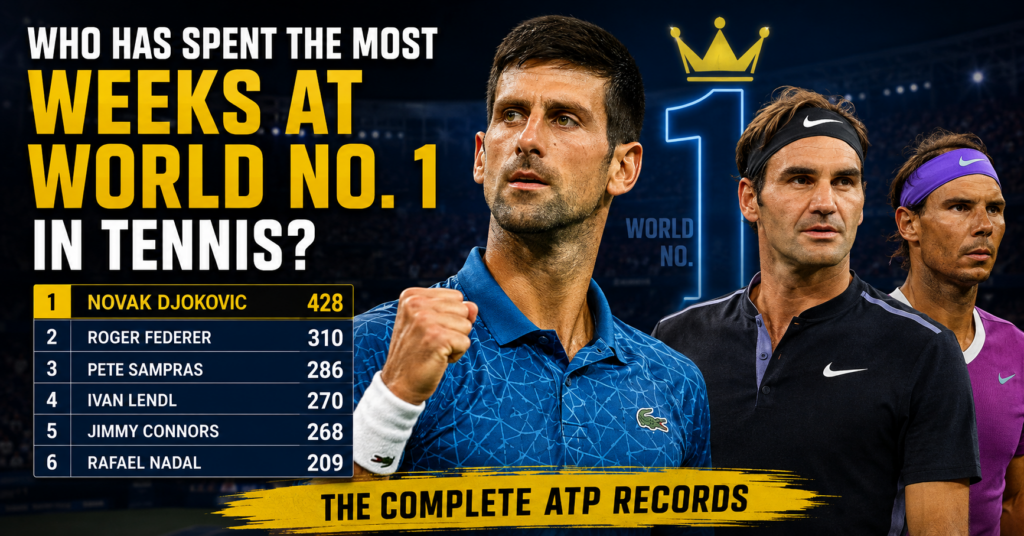
Djokovic holds the ATP record with an extraordinary 428 weeks as World No. 1.
That puts him well ahead of Roger Federer at 310 weeks, Pete Sampras at 286, Ivan Lendl at 270 and Jimmy Connors at 268.
The record is one of the strongest statistical arguments in Djokovic’s case to be considered the greatest tennis player of all time.
But the complete No. 1 story is about much more than one player.
Federer owns one of the most remarkable consecutive-week records in tennis history.
Sampras dominated the 1990s.
Nadal reached No. 1 during arguably the strongest era men’s tennis has ever seen.
And several generations of champions have demonstrated very different forms of ranking dominance.
Let’s examine the numbers.
Who Has the Most Weeks at World No. 1? Quick Answer
Novak Djokovic holds the men’s record with 428 total weeks at World No. 1.
The leading ATP totals are:
| Rank | Player | Weeks at No. 1 |
|---|---|---|
| 1 | Novak Djokovic | 428 |
| 2 | Roger Federer | 310 |
| 3 | Pete Sampras | 286 |
| 4 | Ivan Lendl | 270 |
| 5 | Jimmy Connors | 268 |
| 6 | Rafael Nadal | 209 |
| 7 | John McEnroe | 170 |
| 8 | Björn Borg | 109 |
| 9 | Andre Agassi | 101 |
| 10 | Lleyton Hewitt | 80 |
Djokovic is therefore the only man to have spent more than 400 weeks as the world’s top-ranked player.
His total of 428 weeks is:
118 weeks more than Federer
and
219 weeks more than Nadal.
That is more than eight cumulative years at the top of men’s tennis.
What Does World No. 1 Mean in Tennis?
The ATP ranking measures a player’s results across a rolling period of tournament competition.
Being ranked No. 1 means that, according to the ranking system, a player has accumulated the strongest body of eligible results on the men’s tour.
This makes the No. 1 ranking fundamentally different from winning a Grand Slam.
A Grand Slam title demonstrates that a player was the best competitor at one of tennis’s four biggest tournaments.
The No. 1 ranking measures something broader:
sustained performance over time.
To stay at No. 1, a player generally needs to perform consistently across multiple tournaments and surfaces while defending ranking points earned from previous results.
That is why weeks at No. 1 have become one of the most important statistics in the tennis GOAT debate.
Novak Djokovic — 428 Weeks at World No. 1
The All-Time Men’s Record
Novak Djokovic has spent 428 weeks as World No. 1, more than any man in ATP ranking history.
It is one of the defining achievements of his career.
Djokovic first reached No. 1 on July 4, 2011, after an extraordinary first half of the season that included victories at the Australian Open and Wimbledon.
But unlike some champions whose dominance was concentrated into one short period, Djokovic repeatedly returned to No. 1 across different stages of his career.
That longevity is what made the final total so extraordinary.
His No. 1 reign stretched across multiple generations of opponents.
He competed for the top position during the Federer and Nadal era.
He remained at the top during the rise of players such as Andy Murray.
And he continued reaching No. 1 as younger generations emerged.
For a broader examination of his career, visit our Novak Djokovic profile.
How Djokovic Broke Federer’s Weeks at No. 1 Record
For years, Roger Federer’s 310 weeks at No. 1 appeared to be one of the great modern tennis records.
Federer had surpassed Pete Sampras’s previous benchmark of 286 weeks.
Then Djokovic began closing the gap.
In March 2021, Djokovic surpassed Federer’s 310-week total and became the men’s record holder.
But he didn’t stop at 311.
He eventually extended the record all the way to:
428 weeks.
That changed the scale of the record completely.
The difference between Djokovic and Federer is now 118 weeks.
That’s more than two additional years accumulated as the world’s top-ranked player.
Roger Federer — 310 Weeks at World No. 1
Roger Federer ranks second with 310 total weeks at No. 1.
But one part of Federer’s ranking record remains particularly extraordinary.
Federer Spent 237 Consecutive Weeks at No. 1
Federer became World No. 1 for the first time in February 2004.
He then remained there continuously for 237 consecutive weeks.
From February 2004 until August 2008, no other player replaced Federer at the top of the ATP rankings.
That is more than four and a half uninterrupted years as World No. 1.
While Djokovic surpassed Federer in total weeks, Federer’s 237 consecutive weeks remain the men’s record for the longest uninterrupted reign.
This distinction is important.
Djokovic owns the total-weeks record.
Federer owns the consecutive-weeks record.
They represent two different forms of ranking dominance.
Read more about Federer’s records and career in our Roger Federer profile.
Pete Sampras — 286 Weeks at World No. 1
Before Federer and Djokovic, Pete Sampras held the men’s record.
Sampras accumulated 286 weeks at World No. 1.
His dominance defined much of men’s tennis during the 1990s.
But Sampras owns another remarkable ranking achievement.
Sampras Finished Six Consecutive Years at No. 1
From 1993 through 1998, Sampras finished every season as the year-end World No. 1.
Six consecutive seasons.
That demonstrated extraordinary consistency across an entire era.
Federer eventually passed Sampras in total weeks.
Djokovic eventually passed both men.
But Sampras remains one of the greatest No. 1 players in tennis history.
Ivan Lendl — 270 Weeks at World No. 1
Ivan Lendl spent 270 weeks at World No. 1.
That places him fourth on the men’s all-time list.
Lendl’s ranking dominance was built on relentless consistency.
He reached major finals repeatedly, accumulated tournament titles across the tour and maintained an extremely high level for years.
His 270 weeks illustrate why Grand Slam totals alone don’t tell the complete story of a player’s dominance.
Lendl won eight Grand Slam singles titles.
That is far below Djokovic’s 24, Nadal’s 22 and Federer’s 20.
Yet he spent more weeks at No. 1 than Nadal.
That comparison demonstrates why rankings and majors measure different aspects of greatness.
Jimmy Connors — 268 Weeks at World No. 1
Jimmy Connors accumulated 268 weeks at World No. 1.
He therefore sits just two weeks behind Ivan Lendl.
Connors was one of the defining players of the 1970s and early 1980s.
His career was characterized by extraordinary longevity, competitiveness and consistency.
Like Lendl, his ranking record demonstrates why historical comparisons require more than simply counting Grand Slam trophies.
Rafael Nadal — 209 Weeks at World No. 1
Rafael Nadal spent 209 weeks at World No. 1.
That places him behind Djokovic and Federer in the Big Three ranking comparison:
| Player | Weeks at No. 1 |
|---|---|
| Novak Djokovic | 428 |
| Roger Federer | 310 |
| Rafael Nadal | 209 |
At first glance, Nadal’s total is significantly lower.
But context matters.
Nadal competed for the No. 1 position during an era that included both Federer and Djokovic.
He first reached the top ranking in 2008, ending Federer’s record 237-week uninterrupted reign.
Nadal subsequently returned to No. 1 multiple times during his career.
His ability to reach the top during such intense competition strengthens the significance of those 209 weeks.
For Nadal’s complete career analysis, visit our Rafael Nadal profile.
Djokovic vs Federer vs Nadal: Weeks at No. 1
The ranking comparison between the Big Three is one of the clearest statistical differences among them.
| Player | Weeks at No. 1 | Grand Slam Titles |
|---|---|---|
| Novak Djokovic | 428 | 24 |
| Roger Federer | 310 | 20 |
| Rafael Nadal | 209 | 22 |
Djokovic leads both categories.
Federer ranks second in weeks at No. 1 but third in Grand Slam titles.
Nadal ranks second in Grand Slams but third among the Big Three in weeks at No. 1.
That difference is important.
It demonstrates why individual metrics can produce different rankings of the same players.
If Grand Slam titles are prioritized:
Djokovic → Nadal → Federer
If weeks at No. 1 are prioritized:
Djokovic → Federer → Nadal
For our complete comparison across Grand Slams, rankings, Masters titles, surfaces, head-to-head records, Olympics and longevity, see Djokovic vs Nadal vs Federer: Who Is the Greatest?.
Total Weeks at No. 1 vs Consecutive Weeks at No. 1
These two statistics should not be confused.
Total Weeks at No. 1
This counts every week a player has held the No. 1 ranking across his entire career.
A player can lose the ranking and regain it years later.
The men’s record:
Novak Djokovic — 428
Consecutive Weeks at No. 1
This counts the longest uninterrupted period a player remained No. 1 without losing the ranking.
The men’s record:
Roger Federer — 237
So Djokovic’s record represents extraordinary career-long ranking dominance.
Federer’s record represents extraordinary uninterrupted peak dominance.
Both are historically significant.
Roger Federer’s 237 Consecutive Weeks at No. 1
Federer’s consecutive record deserves special attention.
He became No. 1 on February 2, 2004.
He remained there until August 2008.
Think about what that means.
Every week for more than four and a half years, Federer was the world’s top-ranked men’s player.
During that period, opponents changed.
Seasons changed.
Surfaces changed.
Grand Slam tournaments came and went.
Yet the player at No. 1 did not.
Eventually, Rafael Nadal ended the streak.
But Federer’s 237 consecutive weeks remain one of the clearest examples of sustained peak dominance in tennis history.
Who Has the Most Year-End No. 1 Finishes?
Weeks at No. 1 are not the only important ranking statistic.
Finishing a season at No. 1 is another major achievement.
It means that after an entire year of competition, one player finishes above everyone else.
Among the leading men’s records:
Novak Djokovic — 8 year-end No. 1 finishes
Pete Sampras — 6
Roger Federer — 5
Djokovic therefore owns another major ranking record.
His eight year-end No. 1 finishes reinforce the same argument made by his 428 weeks:
his dominance was not confined to a single short period.
It extended across many different seasons.
Why Year-End No. 1 Is Different From Weeks at No. 1
A player can reach No. 1 during a season without finishing the year there.
Likewise, a player can lose and regain the top ranking several times.
The year-end No. 1 statistic asks a simple question:
Who finished the season on top?
That makes it particularly valuable when measuring season-long dominance.
Weeks at No. 1 measure accumulated time at the top.
Year-end No. 1 finishes measure how often a player completed an entire season as the leading player.
Both belong in a serious historical comparison.
Weeks at No. 1 vs Grand Slam Titles
Which matters more?
There is no objective answer.
They measure different things.
Grand Slam Titles Measure Peak Tournament Success
The majors are tennis’s biggest tournaments.
Winning one requires surviving an elite field under enormous pressure.
Winning repeatedly demonstrates an ability to perform when the stakes are highest.
The men’s major leaders include:
Novak Djokovic — 24
Rafael Nadal — 22
Roger Federer — 20
For the complete leaderboard, read Who Has Won the Most Grand Slam Tennis Titles?.
Weeks at No. 1 Measure Sustained Dominance
Becoming No. 1 requires results across the tour.
Staying there requires maintaining those results.
That’s why weeks at No. 1 can reveal something Grand Slam totals cannot:
how consistently a player dominated the overall tour over time.
Can a Player Be No. 1 Without Winning a Grand Slam?
Yes.
The ranking is based on accumulated results rather than simply counting Grand Slam championships.
A player can collect enough ranking points through consistently deep runs and tournament victories to reach No. 1 even without winning a major during that particular period.
This demonstrates an important difference between rankings and championships.
Being No. 1 is about the total body of ranking results.
Winning a Grand Slam is about winning one of the sport’s four most important individual tournaments.
Both achievements are valuable for different reasons.
Why Weeks at No. 1 Matter in the GOAT Debate
When discussing the greatest tennis player ever, Grand Slam titles usually receive the most attention.
But consider what No. 1 represents.
To become the world’s top-ranked player, you need sustained results.
To remain there for hundreds of weeks, you need something much rarer:
- Longevity
- Consistency
- Adaptability
- Health
- Motivation
- Performance across seasons
and the ability to repeatedly defend major ranking points.
That is why Djokovic’s 428 weeks have become such an important part of his statistical GOAT argument.
His case isn’t based only on 24 Grand Slam titles.
It combines major success with unprecedented time at No. 1.
For a broader explanation of the criteria that should matter, read How Is the Greatest Tennis Player of All Time Determined?.
The Big Three’s Battle for World No. 1
The ranking rivalry between Federer, Nadal and Djokovic tells much of the story of modern men’s tennis.
Federer established his dominance first.
He became No. 1 in 2004 and stayed there for 237 consecutive weeks.
Then Nadal broke through.
In 2008, Nadal ended Federer’s uninterrupted reign and became World No. 1.
Then Djokovic joined the battle.
His extraordinary 2011 season took him to No. 1 for the first time.
From there, the top ranking repeatedly became part of the struggle among three of the greatest players ever.
Their rivalry wasn’t simply about individual matches.
It was about control of the sport.
Head-to-Head Records and the No. 1 Battle
The Big Three frequently had to defeat one another to win the tournaments that determined who controlled the rankings.
Their final head-to-head records demonstrate just how competitive the era became.
Djokovic vs Nadal
Djokovic leads their completed rivalry 31–29.
Read our complete Novak Djokovic vs Rafael Nadal head-to-head.
Djokovic vs Federer
Djokovic leads 27–23.
Read our complete Novak Djokovic vs Roger Federer head-to-head.
Nadal vs Federer
Nadal leads 24–16.
Read our complete Rafael Nadal vs Roger Federer head-to-head.
These rivalries provide important context for their ranking achievements.
Each man had to accumulate many of his greatest results while competing directly against other all-time champions.
Who Was World No. 1 for the Longest Without Interruption?
The answer is Roger Federer.
Federer spent 237 consecutive weeks at No. 1.
This is different from Djokovic’s 428-week record.
Djokovic accumulated the most total weeks across multiple periods.
Federer produced the longest single uninterrupted reign.
The distinction gives both players a major ranking record:
Most total weeks — Novak Djokovic
Most consecutive weeks — Roger Federer
How Difficult Is It to Reach 400 Weeks at No. 1?
Extremely difficult.
Consider the scale of Djokovic’s 428-week record.
One calendar year contains approximately 52 weeks.
Four hundred and twenty-eight weeks therefore represents more than eight years of accumulated time as the world’s top-ranked player.
That doesn’t mean Djokovic spent eight consecutive years at No. 1.
He didn’t.
The record was accumulated across multiple reigns.
But the total demonstrates extraordinary longevity.
A future player trying to reach 428 would need to dominate not merely for one great season, but potentially across a decade or more.
Could Djokovic’s 428-Week Record Be Broken?
Yes.
Every sports record can eventually be challenged.
But this one sets an enormous standard.
A player averaging 40 weeks at No. 1 per season would need more than 10 seasons of that level of ranking dominance to pass 428.
A player averaging 50 weeks would still need almost nine seasons.
That requires more than talent.
It requires sustained health, consistency and dominance across multiple generations of opponents.
Future stars such as Carlos Alcaraz and Jannik Sinner may accumulate significant time at No. 1.
But reaching 428 would require an extraordinary career.
It is far too early to assume anyone will.
Does the No. 1 Record Make Djokovic the GOAT?
It strengthens his case enormously.
But one statistic should not determine the entire debate.
Djokovic holds the men’s record for weeks at No. 1 and the men’s record for Grand Slam singles titles.
Those achievements provide a powerful statistical foundation.
But other arguments remain relevant.
Nadal’s 14 Roland Garros championships represent unmatched single-tournament dominance.
Federer’s 237 consecutive weeks demonstrate a different form of ranking control.
Head-to-head results matter.
Masters titles matter.
ATP Finals matter.
Olympic achievements matter.
Surface versatility matters.
Longevity matters.
Peak dominance matters.
Historical context matters.
That is why the GOAT question remains more interesting than simply comparing one column of numbers.
Explore our complete Greatest Tennis Player of All Time analysis for the broader debate.
Most Weeks at World No. 1 FAQ
Who has spent the most weeks at World No. 1 in men’s tennis?
Novak Djokovic, with 428 weeks.
How many weeks was Novak Djokovic World No. 1?
Djokovic accumulated 428 weeks as the ATP World No. 1.
How many weeks was Roger Federer World No. 1?
Federer spent 310 total weeks at No. 1.
How many weeks was Rafael Nadal World No. 1?
Nadal spent 209 weeks at No. 1.
How many weeks was Pete Sampras World No. 1?
Sampras spent 286 weeks at No. 1.
Who has the most consecutive weeks at World No. 1?
Roger Federer holds the men’s record with 237 consecutive weeks.
Did Djokovic break Federer’s No. 1 record?
Yes.
Federer previously held the men’s total-weeks record with 310.
Djokovic surpassed that mark in 2021 and eventually extended his total to 428.
Who has more weeks at No. 1, Djokovic or Federer?
Djokovic.
Djokovic — 428
Federer — 310
The difference is 118 weeks.
Who has more weeks at No. 1, Federer or Nadal?
Federer.
Federer — 310
Nadal — 209
Who has more weeks at No. 1, Djokovic or Nadal?
Djokovic.
Djokovic — 428
Nadal — 209
Who has more weeks at No. 1, Nadal or Sampras?
Sampras.
Sampras — 286
Nadal — 209
Who finished the most seasons as World No. 1?
Novak Djokovic holds the men’s record with eight year-end No. 1 finishes.
Is being World No. 1 more important than winning a Grand Slam?
They measure different achievements.
Grand Slam titles represent success at the sport’s four biggest tournaments.
The No. 1 ranking represents sustained results across the tour.
Both are important when evaluating an all-time great.
Who Is the Greatest World No. 1 in Men’s Tennis History?
If the question is based purely on total weeks at No. 1, the answer is clear:
Novak Djokovic — 428 Weeks
But different ranking records reveal different types of greatness.
For total weeks:
Novak Djokovic — 428
For consecutive weeks:
Roger Federer — 237
For sustained dominance during the 1990s:
Pete Sampras — 286 total weeks and six consecutive year-end No. 1 finishes
Each record tells us something different.
But Djokovic’s combination of total weeks at No. 1, year-end No. 1 finishes and Grand Slam success gives him an exceptional statistical résumé.
Weeks at No. 1 and the Tennis GOAT Debate
The GOAT debate is often reduced to Grand Slam titles.
That is too simple.
Grand Slams tell us who repeatedly won the biggest tournaments.
Weeks at No. 1 tell us who repeatedly controlled the tour.
And the all-time men’s ranking leaderboard begins:
Novak Djokovic — 428
Roger Federer — 310
Pete Sampras — 286
Ivan Lendl — 270
Jimmy Connors — 268
Rafael Nadal — 209
The numbers show that dominance can take many forms.
Djokovic owns the total-weeks record.
Federer owns the consecutive-weeks record.
Sampras dominated an entire decade.
Nadal reached the summit repeatedly while competing against Federer and Djokovic.
That’s why ranking history deserves a major place in any serious discussion about tennis greatness.
Vote for the Greatest Tennis Player of All Time
Now the question becomes:
How much should the World No. 1 record matter?
Should Djokovic’s 428 weeks give him a decisive advantage?
Should Federer’s 237 consecutive weeks receive more weight than total weeks accumulated across separate reigns?
Should Grand Slam titles matter more than rankings?
Should peak dominance matter more than longevity?
There is no official formula.
That’s where the debate begins.
VIEW THE LIVE TENNIS GOAT RANKING AND CAST YOUR VOTE
Compare the candidates, see how fans are voting and decide which achievements matter most to you.
Final Answer: Who Has Spent the Most Weeks at World No. 1?
Novak Djokovic holds the men’s record with 428 weeks as World No. 1.
The leading totals are:
Novak Djokovic — 428
Roger Federer — 310
Pete Sampras — 286
Ivan Lendl — 270
Jimmy Connors — 268
Rafael Nadal — 209
Djokovic therefore leads Federer by 118 weeks and Nadal by 219.
Federer, however, still owns the men’s record for the longest uninterrupted reign at No. 1 with 237 consecutive weeks.
Together, these records illustrate two different forms of dominance.
Grand Slam championships measure greatness on tennis’s biggest individual stages.
World No. 1 records measure the ability to remain above the entire tour.
To understand the complete GOAT debate, we need both.
Tags: Andre Agassi, ATP Rankings, ATP World No. 1 records, Big Three tennis, Bjorn Borg, consecutive weeks at No. 1, Djokovic records, Federer records, greatest tennis player of all time, Ivan Lendl, Jimmy Connors, John McEnroe, Lleyton Hewitt, most weeks at World No. 1, Nadal records, Novak Djokovic, Pete Sampras, Rafael Nadal, Roger Federer, tennis GOAT, Tennis History, tennis records, World No. 1 tennis, year-end No. 1
Pingback: What Is a Grand Slam in Tennis? The Four Majors Explained