
Last Updated: August 2026
Wimbledon is the oldest and arguably the most famous tennis tournament in the world.
Played on the grass courts of the All England Club in London, The Championships have produced generations of legendary champions — from Rod Laver and Björn Borg to Pete Sampras, Roger Federer, Serena Williams, Novak Djokovic and today’s stars.
But who has won Wimbledon the most times?
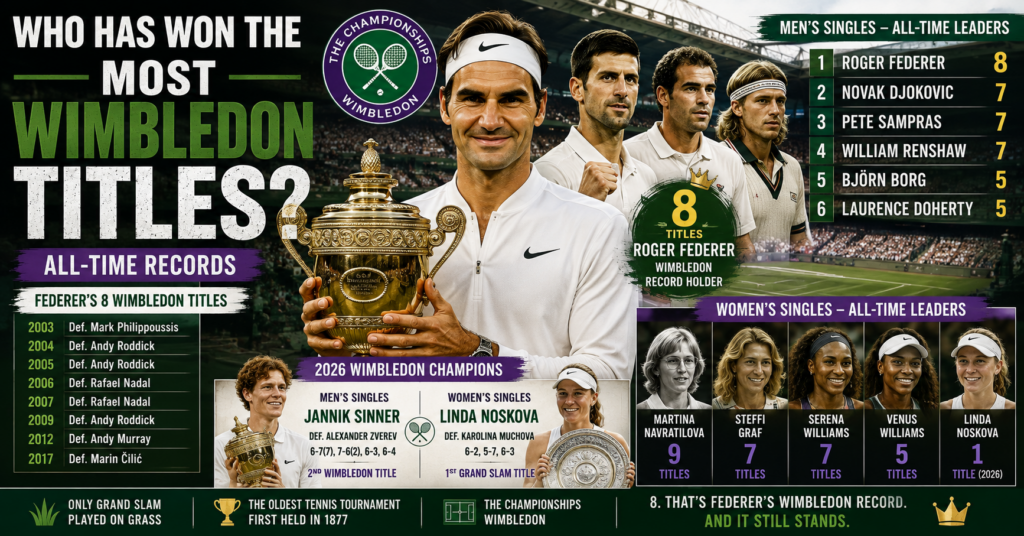
Roger Federer holds the men’s singles record with eight Wimbledon titles.
On the women’s side, Martina Navratilova holds the all-time singles record with nine championships.
Federer’s eight titles helped make Wimbledon the defining tournament of his career. But his record has faced serious challenges. Novak Djokovic reached seven championships, while Pete Sampras also won seven.
In the women’s game, Navratilova’s nine titles remain one of the greatest records in Grand Slam history.
Wimbledon therefore provides an important piece of the debate over the greatest tennis player of all time.
Let’s examine the complete record book.
Who Has Won the Most Wimbledon Titles? Quick Answer
The Wimbledon singles record holders are:
Men’s singles: Roger Federer — 8 titles
Women’s singles: Martina Navratilova — 9 titles
The leading men’s champions are:
| Rank | Player | Wimbledon Titles |
|---|---|---|
| 1 | Roger Federer | 8 |
| T-2 | Novak Djokovic | 7 |
| T-2 | Pete Sampras | 7 |
| T-2 | William Renshaw | 7 |
| T-5 | Björn Borg | 5 |
| T-5 | Laurence Doherty | 5 |
Federer therefore stands alone at the top of the men’s singles record book.
But Djokovic came extremely close to joining him.
Roger Federer — 8 Wimbledon Titles
The Men’s Wimbledon Record Holder
Roger Federer won Wimbledon eight times.
His championships came in:
2003
2004
2005
2006
2007
2009
2012
2017
His first Wimbledon championship in 2003 was also the first Grand Slam singles title of his career.
Fourteen years later, Federer won his eighth title.
That combination of dominance and longevity helped make Centre Court inseparable from Federer’s legacy.
For a broader look at his career, records and GOAT case, visit our Roger Federer profile.
Federer’s Eight Wimbledon Championships
Federer’s Wimbledon record was built across several distinct periods of his career.
2003 — Federer’s First Grand Slam
Federer entered Wimbledon in 2003 as one of the most talented young players in tennis.
He left as a Grand Slam champion.
Federer defeated Mark Philippoussis in the final to capture his first Wimbledon championship.
It was also his first major title.
Few could have predicted that he would eventually win Wimbledon seven more times.
2004 — Federer Successfully Defends His Title
Federer returned in 2004 and defeated Andy Roddick in the final.
The victory confirmed that 2003 had not been a one-time breakthrough.
Federer was becoming the dominant grass-court player of his generation.
2005 — Three Consecutive Wimbledon Titles
Federer defeated Roddick again in the 2005 final.
He had now won Wimbledon three consecutive times.
His combination of serving, movement, forehand aggression and comfort on grass made him exceptionally difficult to defeat.
2006 — Federer vs Nadal Begins at Wimbledon
Federer won his fourth consecutive championship in 2006.
This time, Rafael Nadal was waiting in the final.
Nadal had already established himself as the dominant player at Roland-Garros.
Federer was the dominant force at Wimbledon.
Their contrasting strengths created one of the defining rivalries of their era.
Federer won the 2006 final in four sets.
2007 — Five Consecutive Wimbledon Championships
Federer and Nadal met again in the 2007 final.
This time the match went five sets.
Federer eventually prevailed to win his fifth consecutive Wimbledon championship.
He had now matched Björn Borg’s Open Era record of five consecutive men’s singles titles.
But one year later, Nadal would stop the streak.
Federer vs Nadal: The 2008 Wimbledon Final
The 2008 Wimbledon men’s final became one of the most celebrated matches in tennis history.
Federer entered the tournament as the five-time defending champion.
Nadal had just won his fourth consecutive Roland-Garros title.
The final became a dramatic battle between the two leading players in the world.
Nadal eventually won in five sets.
The result ended Federer’s run of five consecutive Wimbledon championships and gave Nadal his first title at the All England Club.
The match remains one of the defining encounters in their rivalry.
For the complete rivalry numbers and major matches, read our Rafael Nadal vs Roger Federer head-to-head.
Federer Returns to the Top in 2009
Federer reclaimed Wimbledon in 2009.
He defeated Andy Roddick in a remarkable five-set final.
The fifth set ended:
16–14
The victory gave Federer his sixth Wimbledon championship.
It also carried enormous historical significance because it moved him to 15 Grand Slam singles titles at the time, taking him beyond Pete Sampras’s previous men’s record of 14.
Federer’s Wimbledon success had become central not only to his grass-court legacy but also to his pursuit of the overall Grand Slam record.
Federer Wins His Seventh Wimbledon in 2012
Federer returned to the Wimbledon final in 2012.
His opponent was Andy Murray.
Murray was attempting to become the first British man to win Wimbledon singles in generations.
Federer won in four sets.
The victory gave him his seventh Wimbledon championship, tying Pete Sampras and William Renshaw at the top of the men’s record book.
Federer was now one title away from standing alone.
Federer Makes History With His Eighth Wimbledon Title
That eighth championship finally arrived in 2017.
Federer defeated Marin Čilić in the final.
At 35 years old, Federer became Wimbledon champion once again.
More importantly, title number eight moved him beyond Sampras and Renshaw.
Roger Federer — 8 Wimbledon Titles
He was now the most successful men’s singles player in Wimbledon history.
The record still stands in 2026.
Federer Won Wimbledon Without Losing a Set in 2017
Federer’s final Wimbledon championship was particularly impressive.
He completed the entire 2017 tournament without dropping a set.
Winning a Grand Slam is difficult.
Winning Wimbledon at age 35 is extraordinary.
Doing it without losing a single set made Federer’s eighth championship one of the most remarkable achievements of his later career.
Novak Djokovic — 7 Wimbledon Titles
Novak Djokovic won Wimbledon seven times.
His championships came in:
2011
2014
2015
2018
2019
2021
2022
That puts Djokovic only one championship behind Federer’s men’s record.
Djokovic’s Wimbledon success is especially significant because grass was not initially considered the surface most naturally suited to his game.
Yet he developed into one of the greatest grass-court players in tennis history.
For the wider statistical picture of his career, visit our Novak Djokovic profile.
Djokovic Wins His First Wimbledon in 2011
Djokovic won his first Wimbledon championship in 2011.
He defeated Rafael Nadal in the final.
The victory came during one of the greatest seasons of Djokovic’s career.
It demonstrated that his game could dominate not only hard courts but grass as well.
Wimbledon would eventually become his second-most successful Grand Slam tournament after the Australian Open.
Djokovic vs Federer at Wimbledon
Federer and Djokovic played several enormously important Wimbledon matches.
None were bigger than their finals.
They met in the Wimbledon final in:
2014
2015
2019
Djokovic won all three.
Those victories played a major role in the historical relationship between their careers.
Federer remained the more decorated Wimbledon champion with eight titles.
But Djokovic repeatedly defeated Federer on Centre Court during the later phase of their rivalry.
For their complete career comparison, read our Novak Djokovic vs Roger Federer head-to-head.
The Historic 2019 Wimbledon Final
The 2019 Wimbledon final between Djokovic and Federer became one of the most dramatic championship matches in tournament history.
Federer had opportunities to win.
He held championship points on his own serve in the fifth set.
Djokovic survived.
The match ultimately reached a deciding tiebreak, with Djokovic winning the championship.
The victory gave Djokovic his fifth Wimbledon title.
For Federer, it became one of the most painful near-misses of his career.
The final also demonstrated something that statistics alone cannot fully capture:
The difference between winning and losing a Grand Slam can come down to only a handful of points.
Djokovic’s Four Consecutive Wimbledon Championships
Djokovic won Wimbledon in:
2018
2019
2021
2022
There was no Wimbledon tournament in 2020.
That means Djokovic won four consecutive editions of the men’s singles championship.
This run brought him within one title of Federer’s record.
By the end of 2022:
Federer — 8
Djokovic — 7
The possibility of Djokovic matching or breaking Federer’s record became one of Wimbledon’s biggest storylines.
Carlos Alcaraz Stops Djokovic in 2023
Djokovic reached the Wimbledon final again in 2023.
A victory would have tied Federer’s record of eight championships.
Instead, Carlos Alcaraz defeated Djokovic in a dramatic five-set final.
The victory gave Alcaraz his first Wimbledon championship.
It also prevented Djokovic from matching Federer’s record.
That result represented an important generational shift.
One of the greatest grass-court champions in history had been defeated by the leading young player of the emerging generation.
Carlos Alcaraz Wins Again in 2024
Alcaraz and Djokovic met again in the 2024 Wimbledon final.
This time, Alcaraz won in straight sets.
He had now won consecutive Wimbledon championships:
2023
2024
At that moment, Alcaraz appeared capable of establishing his own long period of grass-court dominance.
But another member of the new generation was about to intervene.
Jannik Sinner Wins Wimbledon in 2025
Jannik Sinner won his first Wimbledon championship in 2025.
He defeated Carlos Alcaraz in the final:
4–6, 6–4, 6–4, 6–4
The result ended Alcaraz’s two-year championship run.
It also gave Sinner another major title and established him as a Wimbledon champion for the first time.
More importantly, Sinner was not finished.
Jannik Sinner Wins Wimbledon Again in 2026
Sinner successfully defended his Wimbledon championship in 2026.
He faced Alexander Zverev in the final.
Zverev entered the match after winning Roland-Garros earlier in the season and was attempting to complete the French Open-Wimbledon double.
Zverev won the opening set.
Sinner responded.
The final score was:
6–7(7), 7–6(2), 6–3, 6–4
Sinner had won his second consecutive Wimbledon championship.
His Wimbledon record now stood at:
Jannik Sinner — 2 Titles
2025
2026
The victory also gave Sinner his fifth Grand Slam singles championship.
Sinner’s 2026 Wimbledon Run
Sinner entered Wimbledon as the defending champion and World No. 1.
His path was not completely straightforward.
But as the tournament progressed, he became increasingly difficult to stop.
One of his biggest tests came in the semifinal.
His opponent:
Novak Djokovic.
Sinner defeated the seven-time Wimbledon champion in straight sets:
6–4, 6–4, 6–4
The result ended Djokovic’s latest attempt to win an eighth Wimbledon championship and a record 25th Grand Slam title.
Sinner then defeated Zverev in the final.
Winning consecutive Wimbledon titles confirmed that Sinner’s 2025 championship was not an isolated breakthrough.
He had become the dominant men’s player at Wimbledon in the middle of the decade.
Pete Sampras — 7 Wimbledon Titles
Before Federer and Djokovic, Pete Sampras was the defining modern men’s Wimbledon champion.
Sampras won seven championships:
1993
1994
1995
1997
1998
1999
2000
His serve, athleticism, net play and aggressive style were exceptionally effective on the grass courts of his era.
During the 1990s, beating Sampras at Wimbledon was one of the most difficult challenges in men’s tennis.
Sampras Won Seven Wimbledon Titles in Eight Years
Sampras’s dominance becomes even more impressive when we look at the timeframe.
He won seven Wimbledon championships between 1993 and 2000.
The only year during that eight-year period in which he did not win was 1996.
That level of concentrated dominance made Wimbledon the defining tournament of Sampras’s career.
When Federer eventually won his seventh title in 2012, he tied Sampras.
Federer’s eighth championship in 2017 finally moved him ahead.
Björn Borg — 5 Wimbledon Titles
Björn Borg won Wimbledon five consecutive times:
1976
1977
1978
1979
1980
Borg’s achievement was remarkable because he was simultaneously one of the greatest clay-court players in history.
He won six Roland-Garros titles.
Yet he also mastered grass.
The contrast between those surfaces makes Borg’s career particularly impressive.
Clay rewards movement, patience and heavy baseline play.
Grass historically rewarded aggressive serving and net play.
Borg found a way to dominate both.
Borg vs McEnroe at Wimbledon
Borg’s Wimbledon reign eventually collided with John McEnroe.
Their 1980 final became one of the tournament’s most famous matches.
Borg survived an extraordinary fourth-set tiebreak and eventually won the fifth set.
He captured his fifth consecutive Wimbledon championship.
One year later, McEnroe defeated Borg in the 1981 final.
The result ended Borg’s Wimbledon championship streak.
It also represented a changing of the guard.
Rafael Nadal — 2 Wimbledon Titles
Rafael Nadal won Wimbledon twice:
2008
2010
Those championships are historically important because Nadal’s game was most strongly associated with clay.
Yet he proved he could also win the biggest tournament on grass.
His 2008 victory over Federer remains one of the defining moments of his career.
Nadal returned in 2010 and won Wimbledon again.
His grass-court success strengthened the argument that he was much more than a clay-court specialist.
For a complete look at his achievements across every surface, visit our Rafael Nadal profile.
Federer vs Djokovic vs Nadal at Wimbledon
The Big Three Wimbledon comparison is:
| Player | Wimbledon Titles |
|---|---|
| Roger Federer | 8 |
| Novak Djokovic | 7 |
| Rafael Nadal | 2 |
This is one of the few major statistical categories in which Federer remains ahead of Djokovic.
Federer leads Djokovic by one Wimbledon title.
Djokovic leads Nadal by five.
But the picture changes dramatically when we compare the other Grand Slam tournaments.
At the Australian Open:
Djokovic — 10
Federer — 6
Nadal — 2
At Roland-Garros:
Nadal — 14
Djokovic — 3
Federer — 1
Each member of the Big Three therefore built a distinctive Grand Slam legacy.
For the broader comparison, see Djokovic vs Nadal vs Federer: Who Is the Greatest?.
The Big Three’s Signature Grand Slam Records
One of the most remarkable aspects of the Big Three era is that each player became the most successful men’s champion at a different Grand Slam.
Rafael Nadal at Roland-Garros
14 titles
Novak Djokovic at the Australian Open
10 titles
Roger Federer at Wimbledon
8 titles
These are three of the greatest examples of tournament-specific dominance in tennis history.
Nadal’s 14 is the largest total.
Djokovic’s 10 represents the Australian Open men’s record.
Federer’s eight represents the Wimbledon men’s record.
Their different strengths are one reason the GOAT debate cannot be reduced to a single statistic.
Martina Navratilova — 9 Wimbledon Titles
The overall women’s singles record belongs to Martina Navratilova.
She won Wimbledon nine times:
1978
1979
1982
1983
1984
1985
1986
1987
1990
Her record is extraordinary for several reasons.
Navratilova dominated across different periods of her career.
She won her first Wimbledon title in 1978.
She won her ninth in 1990.
And between 1982 and 1987, she won six consecutive Wimbledon singles championships.
No woman has won more Wimbledon singles titles.
Navratilova’s Six Consecutive Wimbledon Titles
Navratilova’s greatest Wimbledon streak came from:
1982 through 1987
Six tournaments.
Six championships.
Grass rewarded many of Navratilova’s greatest strengths:
serve
volleys
movement
athleticism
aggression
and
comfort at the net
Her style was ideally suited to the surface.
The result was the greatest women’s Wimbledon singles résumé in history.
Steffi Graf — 7 Wimbledon Titles
Steffi Graf won Wimbledon seven times:
1988
1989
1991
1992
1993
1995
1996
Her first title in 1988 was part of one of the greatest seasons in tennis history.
Graf won all four Grand Slam tournaments that year and Olympic singles gold.
That achievement became known as the Golden Slam.
Graf’s seven Wimbledon titles tie Serena Williams for the second-highest women’s total in the Open Era.
Serena Williams — 7 Wimbledon Titles
Serena Williams also won Wimbledon seven times:
2002
2003
2009
2010
2012
2015
2016
Her championships span 14 years.
That longevity is extraordinary.
Serena’s power, serve and ability to dominate short points made her particularly dangerous on grass.
Her seven titles place her alongside Graf and behind only Navratilova among women’s Open Era champions.
Venus Williams — 5 Wimbledon Titles
Venus Williams won Wimbledon five times:
2000
2001
2005
2007
2008
Wimbledon was the most successful Grand Slam tournament of Venus’s career.
Her powerful serve, movement and aggressive game translated exceptionally well to grass.
The Williams sisters together won Wimbledon singles 12 times.
Their dominance became one of the defining stories of women’s tennis in the 2000s.
Women’s Wimbledon Singles Title Leaders
The leading women’s champions include:
| Player | Wimbledon Titles |
|---|---|
| Martina Navratilova | 9 |
| Helen Wills Moody | 8 |
| Steffi Graf | 7 |
| Serena Williams | 7 |
| Dorothea Lambert Chambers | 7 |
| Billie Jean King | 6 |
| Suzanne Lenglen | 6 |
| Venus Williams | 5 |
Navratilova remains alone at the top with nine.
Her record has survived challenges from Graf and Serena.
Linda Noskova Wins Wimbledon 2026
The 2026 women’s tournament produced a first-time Grand Slam champion.
Linda Noskova — 2026 Wimbledon Champion
Noskova faced fellow Czech player Karolina Muchova in the final.
Noskova won the opening set.
Muchova responded to take the second.
The championship was decided in the third.
Noskova prevailed:
6–2, 5–7, 6–3
At 21 years old, she had won her first Grand Slam singles championship.
An All-Czech 2026 Wimbledon Final
The 2026 women’s final was especially significant because both finalists represented the Czech Republic.
Linda Noskova
vs
Karolina Muchova
Noskova’s victory continued an extraordinary recent period of Czech success at Wimbledon.
Markéta Vondroušová won the women’s championship in 2023.
Barbora Krejčíková won in 2024.
Then Noskova became champion in 2026.
Three Czech women had now won Wimbledon within four editions.
The result reinforced the Czech Republic’s remarkable influence on modern women’s tennis.
Wimbledon Men’s Singles Records at a Glance
Most Men’s Singles Titles
Roger Federer — 8
Second-Most Men’s Singles Titles
Novak Djokovic — 7
Pete Sampras — 7
William Renshaw — 7
Most Men’s Singles Titles in the Open Era
Roger Federer — 8
Most Consecutive Men’s Titles in the Open Era
Roger Federer — 5
Björn Borg — 5
2026 Men’s Champion
Jannik Sinner
Most Wimbledon Men’s Match Wins
As of the 2026 tournament, Novak Djokovic moved to the top of the men’s Wimbledon match-win list, passing the previous benchmark during his run to the semifinals.
That record adds another layer to his extraordinary longevity at the All England Club.
Wimbledon Women’s Singles Records at a Glance
Most Women’s Singles Titles
Martina Navratilova — 9
Most Consecutive Women’s Singles Titles
Martina Navratilova — 6
Leading Open Era Champions
Martina Navratilova — 9
Steffi Graf — 7
Serena Williams — 7
2026 Women’s Champion
Linda Noskova
Wimbledon vs Australian Open Records
Two members of the Big Three hold the men’s title records at these tournaments.
Wimbledon
Roger Federer — 8
Australian Open
Novak Djokovic — 10
Djokovic won two more Australian Open championships than Federer won Wimbledon titles.
But both records demonstrate extraordinary long-term dominance at a single Grand Slam.
For the complete Melbourne record book, read Who Has Won the Most Australian Open Titles?.
Wimbledon vs French Open Records
Now compare Federer with Nadal.
Wimbledon
Roger Federer — 8
Roland-Garros
Rafael Nadal — 14
Nadal’s 14 championships represent the greater numerical total.
But both records became defining elements of their careers.
Federer became synonymous with Centre Court.
Nadal became synonymous with Court Philippe-Chatrier.
Our complete French Open title records page examines Nadal’s extraordinary Paris dominance in detail.
Wimbledon Titles and the Overall Grand Slam Race
Wimbledon played an enormous role in the careers of Federer, Djokovic and Nadal.
| Player | Wimbledon Titles | Grand Slam Titles |
|---|---|---|
| Novak Djokovic | 7 | 24 |
| Rafael Nadal | 2 | 22 |
| Roger Federer | 8 | 20 |
Federer leads the Wimbledon category.
Djokovic leads the overall Grand Slam category.
Nadal dominates Roland-Garros.
This is why evaluating tennis greatness requires looking beyond a single tournament.
For the complete major leaderboard, read Who Has Won the Most Grand Slam Tennis Titles?.
Why Is Wimbledon So Difficult to Win?
Wimbledon presents a unique challenge because it is the only Grand Slam played on grass.
Grass changes several aspects of tennis.
Lower Bounces
The ball generally stays lower than it does on clay.
Players have less time to adjust.
Movement
Moving on grass requires different footwork.
Players must remain balanced on a surface that can become slippery.
Serving
Strong serving has historically been particularly valuable at Wimbledon.
Free points can become extremely important.
Returning
Because serves can be especially dangerous on grass, elite returning becomes equally valuable.
This helps explain Djokovic’s success.
Fast Decisions
Points can develop quickly.
Players often have less time to construct rallies than they do on clay.
Success at Wimbledon therefore requires technical skill, movement, confidence and adaptability.
How Wimbledon Has Changed Over Time
Comparing Wimbledon champions across generations requires historical context.
The tournament began in 1877.
Tennis itself has changed enormously since then.
Racquet technology changed.
Training changed.
Fitness changed.
Court preparation evolved.
Professional tennis became global.
The Open Era began in 1968.
This is why records from players such as William Renshaw should be respected but also understood in the context of their time.
Modern players compete in a very different environment.
That doesn’t erase historical achievements.
It simply means direct comparisons require context.
Federer, Djokovic and Sampras: Who Was the Greatest Grass-Court Player?
Statistically, Federer has the strongest Wimbledon title argument.
Roger Federer
8 Wimbledon titles
Novak Djokovic
7 Wimbledon titles
Pete Sampras
7 Wimbledon titles
But titles are not the only consideration.
Djokovic defeated Federer in three Wimbledon finals.
Sampras won seven championships during an eight-year stretch.
Federer reached a record level of sustained success over an exceptionally long Wimbledon career.
There is therefore room for debate about peak level, competition and longevity.
But if the question is simply:
Who won the most Wimbledon men’s singles titles?
The answer remains:
Roger Federer.
Wimbledon and the Tennis GOAT Debate
Federer’s Wimbledon record remains one of the strongest parts of his GOAT case.
He owns:
8 Wimbledon titles
He also won:
20 Grand Slam singles championships
and spent:
310 weeks at World No. 1
Djokovic’s statistical résumé includes:
24 Grand Slam titles
7 Wimbledon titles
10 Australian Open titles
40 Masters 1000 titles
and
428 weeks at World No. 1
Nadal’s résumé includes:
22 Grand Slam titles
14 Roland-Garros championships
and
36 Masters 1000 titles
Different categories point toward different forms of greatness.
Federer owns the Wimbledon record.
Nadal owns perhaps the greatest single-tournament record.
Djokovic owns several of the largest overall career records.
That is why GOAT analysis should evaluate an entire career rather than choosing one statistic.
Our guide to how the greatest tennis player of all time is determined explains the major criteria in greater detail.
Does Federer’s Wimbledon Record Make Him the Greatest Grass-Court Player?
There is a strong statistical argument.
Federer won more Wimbledon men’s singles titles than anyone else.
He also reached the Wimbledon final 12 times.
His championships span from 2003 through 2017.
But Djokovic complicates the debate.
Djokovic won seven Wimbledon championships and defeated Federer in three finals.
Sampras also deserves consideration because of the concentration of his dominance during the 1990s.
Therefore, the answer depends on the criteria.
If the primary measure is Wimbledon championships:
Federer is No. 1.
If head-to-head meetings and peak performance are weighted differently, the discussion becomes more complicated.
Could Djokovic Still Break Federer’s Wimbledon Record?
As of August 2026, the standings remain:
Federer — 8
Djokovic — 7
Djokovic reached the 2026 semifinal at age 39 before losing to Jannik Sinner.
Mathematically, the record remains within reach if Djokovic continues competing.
But time has become the biggest challenge.
Winning another Wimbledon would tie Federer.
Winning two more would establish a new men’s singles record.
Whether Djokovic gets another opportunity is one of the remaining major questions of his career.
Could Sinner or Alcaraz Eventually Challenge the Record?
The new generation has already established itself at Wimbledon.
As of August 2026:
Carlos Alcaraz — 2 Wimbledon titles
Jannik Sinner — 2 Wimbledon titles
Alcaraz won in 2023 and 2024.
Sinner won in 2025 and 2026.
Both have therefore won consecutive Wimbledon championships.
But Federer’s eight remains a very long way away.
A player with two titles still needs six more just to tie the record.
That requires not merely peak ability but extraordinary longevity.
The next decade will reveal whether either player can turn an early Wimbledon breakthrough into historic long-term dominance.
Wimbledon Titles FAQ
Who has won the most Wimbledon men’s singles titles?
Roger Federer, with eight.
How many Wimbledon titles did Roger Federer win?
Federer won eight Wimbledon singles championships.
Which years did Federer win Wimbledon?
Federer won in:
2003, 2004, 2005, 2006, 2007, 2009, 2012 and 2017.
Who has won the most women’s Wimbledon singles titles?
Martina Navratilova, with nine.
How many Wimbledon titles did Novak Djokovic win?
As of August 2026, Djokovic has won seven Wimbledon singles titles.
How many Wimbledon titles did Pete Sampras win?
Sampras won seven.
How many Wimbledon titles did Björn Borg win?
Borg won five.
How many Wimbledon titles did Rafael Nadal win?
Nadal won two, in 2008 and 2010.
How many Wimbledon titles did Serena Williams win?
Serena won seven Wimbledon singles championships.
How many Wimbledon titles did Steffi Graf win?
Graf won seven.
How many Wimbledon titles did Venus Williams win?
Venus won five.
How many Wimbledon titles has Carlos Alcaraz won?
As of August 2026, Alcaraz has won two, in 2023 and 2024.
How many Wimbledon titles has Jannik Sinner won?
As of August 2026, Sinner has won two, in 2025 and 2026.
Who won Wimbledon in 2026?
Jannik Sinner won the 2026 men’s singles title.
Linda Noskova won the 2026 women’s singles title.
Who did Sinner beat in the 2026 Wimbledon final?
Sinner defeated Alexander Zverev:
6–7(7), 7–6(2), 6–3, 6–4
Who did Linda Noskova beat in the 2026 Wimbledon final?
Noskova defeated Karolina Muchova:
6–2, 5–7, 6–3
Was the 2026 Wimbledon title Noskova’s first Grand Slam?
Yes.
Linda Noskova won her first Grand Slam singles championship at Wimbledon in 2026.
Who did Sinner beat in the 2026 Wimbledon semifinal?
Sinner defeated Novak Djokovic in straight sets:
6–4, 6–4, 6–4
Who won Wimbledon five consecutive times?
In the men’s Open Era, Björn Borg and Roger Federer both won five consecutive Wimbledon championships.
Who won six consecutive women’s Wimbledon titles?
Martina Navratilova won six consecutive singles championships from 1982 through 1987.
What surface is Wimbledon played on?
Wimbledon is played on grass.
It is the only Grand Slam currently played on grass.
Where is Wimbledon played?
Wimbledon is played at the All England Lawn Tennis and Croquet Club in London, England.
When was the first Wimbledon tournament?
The first Wimbledon Championship was held in 1877.
Who Is the Greatest Wimbledon Player Ever?
For men’s singles, the title record belongs to:
Roger Federer
8 Wimbledon championships
Federer won his first title in 2003 and his eighth in 2017.
He combined peak dominance with extraordinary longevity.
Djokovic and Sampras sit immediately behind him with seven titles each.
For women’s singles, the record belongs to:
Martina Navratilova
9 Wimbledon championships
Her record includes six consecutive titles from 1982 through 1987.
Both players built careers that became deeply connected with Centre Court.
Wimbledon Records and the GOAT Debate
Wimbledon gives Roger Federer something that remains uniquely his among the Big Three:
The Men’s Wimbledon Singles Record — 8 Titles
Nadal has his signature record:
Roland-Garros — 14 Titles
Djokovic has his:
Australian Open — 10 Titles
These three records tell an extraordinary story.
The greatest men’s era in modern tennis produced three players who each became the record holder at a different Grand Slam tournament.
But overall career comparisons tell another story.
Djokovic leads the Big Three in total Grand Slam titles and weeks at World No. 1.
Nadal owns the most dominant single-Grand-Slam record.
Federer remains the men’s Wimbledon record holder.
There is no single statistic capable of capturing every aspect of tennis greatness.
That is why the Djokovic vs Nadal vs Federer comparison should consider majors, rankings, Masters titles, head-to-head results, longevity, surface versatility and peak dominance together.
Vote for the Greatest Tennis Player of All Time
Roger Federer owns the men’s Wimbledon record.
Rafael Nadal owns the men’s Roland-Garros record.
Novak Djokovic owns the men’s Australian Open record and leads several major overall career categories.
So which achievement should matter most?
Should Federer’s eight Wimbledon championships strengthen his claim to the top position?
Should Nadal’s 14 French Open titles carry more weight?
Or should Djokovic’s broader collection of career records decide the debate?
The numbers provide evidence.
Fans decide how much each achievement matters.
VIEW THE LIVE TENNIS GOAT RANKING AND CAST YOUR VOTE
Compare the candidates, see the live ranking and make your choice.
Final Answer: Who Has Won the Most Wimbledon Titles?
The Wimbledon singles record holders are:
Men’s Record
Roger Federer — 8 titles
Women’s Record
Martina Navratilova — 9 titles
The leading men’s champions are:
Roger Federer — 8
Novak Djokovic — 7
Pete Sampras — 7
William Renshaw — 7
Björn Borg — 5
Federer’s eight championships make him the most successful men’s singles player in Wimbledon history.
Djokovic came within one title of the record.
Sampras dominated the 1990s.
Borg won five consecutive championships.
And the new generation has already begun writing its own history.
Carlos Alcaraz won consecutive titles in 2023 and 2024.
Jannik Sinner answered with consecutive championships in 2025 and 2026.
But they remain far from the number at the top.
8.
That is Roger Federer’s Wimbledon record.
And until another man reaches nine, Federer remains alone at the top of the men’s Wimbledon singles record book.
Tags: Alcaraz records, Big Three tennis, Bjorn Borg, Carlos Alcaraz, Djokovic records, Federer records, Grand Slam records, grass court records, grass court tennis, greatest tennis player of all time, Jannik Sinner, Linda Noskova, Martina Navratilova, most Wimbledon titles, Novak Djokovic, Pete Sampras, Rafael Nadal, Roger Federer, Sampras records, Serena Williams, Sinner records, Steffi Graf, tennis GOAT, Tennis History, tennis records, Venus Williams, Wimbledon, Wimbledon champions, Wimbledon records, Wimbledon titles
Pingback: Wimbledon Ticket Prices: Centre Court, Grounds Pass & More
Pingback: Wimbledon Semifinal Tickets: Prices, Sessions & How to Buy