
Last Updated: September 2026
If you read about tennis records, you will constantly see one phrase:
Open Era.
Novak Djokovic holds certain Open Era records.
Rafael Nadal owns some of the greatest Open Era clay-court records.
Roger Federer, Jimmy Connors, Bjorn Borg, Pete Sampras and other legends are frequently compared through Open Era statistics.
But what exactly does Open Era mean in tennis?
The answer goes back to 1968.
Before then, tennis was divided between amateur and professional players.
The biggest traditional tournaments, including the Grand Slams, were largely reserved for amateurs. Players who turned professional could earn money from tennis, but doing so meant losing access to many of the sport’s most prestigious championships.
That changed in 1968.
Professional and amateur players were finally allowed to compete against each other at “open” tournaments.
The result was one of the biggest transformations in tennis history.
The modern era of professional tennis had begun.
Understanding this change is especially important when comparing the greatest tennis players of all time, because many modern record lists specifically measure achievements from the beginning of the Open Era.
What Is the Open Era in Tennis? Quick Answer
The Open Era is the period of tennis history beginning in 1968, when major tournaments began allowing professional players to compete alongside amateurs.
Before the Open Era:
Amateurs and professionals were largely separated.
After the Open Era began:
The best players could increasingly compete in the same major tournaments regardless of professional status.
The word “open” refers to tournaments being opened to both categories of players.
This change helped create modern professional tennis.
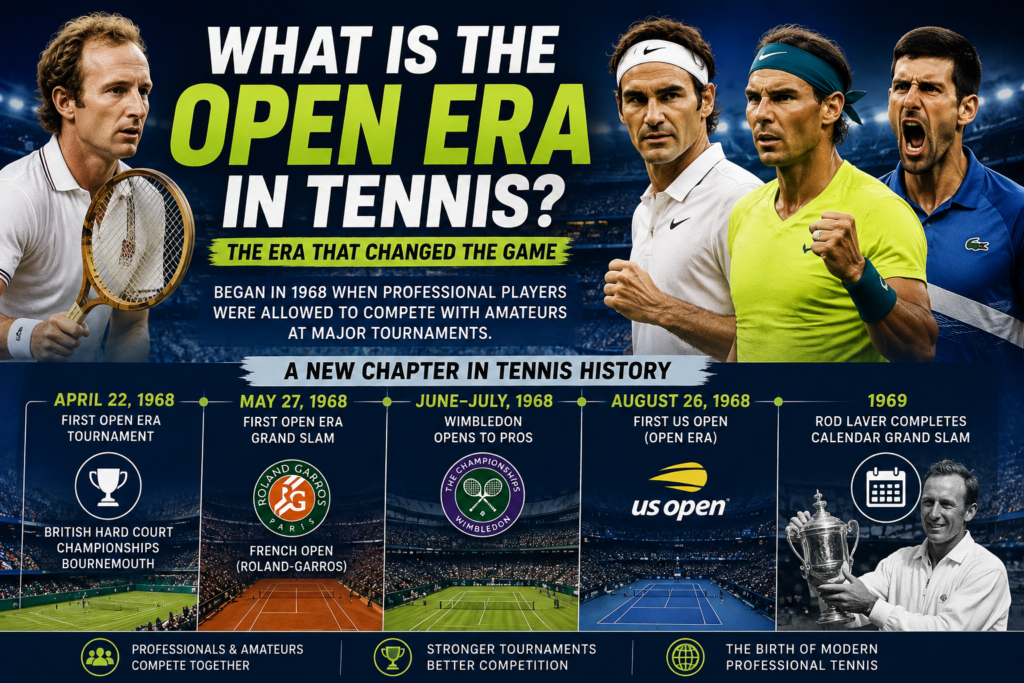
When Did the Open Era Begin?
The Open Era began in:
1968
The first Open Era tournament started on:
April 22, 1968
at the British Hard Court Championships in:
Bournemouth, England
For the first time at an officially recognized open tournament, amateurs and professionals competed in the same draw.
It was a historic moment.
But to understand why it mattered so much, we first need to understand what tennis looked like before 1968.
What Was Tennis Like Before the Open Era?
Modern fans are accustomed to the world’s best players competing at the biggest tournaments.
Before 1968, the situation was very different.
Tennis had a major divide between:
amateur players
and
professional players
That distinction affected which tournaments players could enter and whether they could officially earn money from the sport.
Amateur Tennis
The traditional major championships were built around amateur competition.
An amateur player was not supposed to earn a professional living from tournament prize money.
The most famous tournaments were therefore largely reserved for amateurs.
That included the events we now recognize as the four Grand Slams:
Australian Championships
French Championships
Wimbledon
U.S. National Championships
For an elite player, remaining amateur meant retaining access to these prestigious championships.
But it also meant operating under rules that restricted direct professional earnings.
Professional Tennis
Some of the best players eventually chose to turn professional.
They could earn money by competing in professional exhibitions, tours and events.
But there was a major cost.
Professional players could be excluded from the traditional amateur championships.
That meant some of the world’s strongest tennis players were unable to compete at tournaments such as Wimbledon or the French Championships during significant portions of their careers.
The sport therefore had two separate competitive worlds.
Why Was the Amateur vs Professional Divide a Problem?
Imagine if today’s best tennis players were split between two systems.
One group could compete at Wimbledon.
Another group contained some of the world’s best players but was not allowed to enter.
A tournament could therefore call itself one of the sport’s greatest championships without necessarily having all of the best players in the draw.
That was essentially one of the problems tennis faced before the Open Era.
The divide made historical comparisons complicated and prevented many direct matchups between elite players.
It also created a difficult financial system.
Eventually, pressure for change became impossible to ignore.
Why Did Tennis Become Open?
By the 1960s, the amateur-professional divide had become increasingly difficult to maintain.
Top players wanted the ability to earn money from their talent.
Tournament organizers wanted stronger fields.
Fans wanted to see the best players compete against each other.
And the distinction between amateur and professional tennis had become increasingly controversial.
The solution was relatively simple in principle:
Let them play together.
That is exactly what open tennis began to accomplish.
The First Open Era Tennis Tournament
The first recognized Open Era tournament was the:
British Hard Court Championships
It began on:
April 22, 1968
in:
Bournemouth, England
This was a historic event because amateur and professional players could compete together.
Who Won the First Open Era Tournament?
The men’s singles champion was:
Ken Rosewall
He defeated fellow Australian:
Rod Laver
in the final.
The women’s singles title was won by:
Virginia Wade
Those names therefore occupy a special place in tennis history.
They were champions at the tournament that helped launch the Open Era.
What Was the First Open Era Grand Slam?
The first Grand Slam tournament of the Open Era was:
1968 Roland-Garros
or the:
1968 French Open
It began in Paris on May 27, 1968.
Professional players were finally able to compete alongside amateurs at one of tennis’s traditional major championships.
Who Won the First Open Era Grand Slam?
The men’s singles champion was:
Ken Rosewall
The women’s singles champion was:
Nancy Richey
Rosewall therefore achieved something particularly significant.
He won both the first Open Era tournament in Bournemouth and the first Open Era men’s Grand Slam title at Roland-Garros.
Wimbledon Enters the Open Era
Wimbledon followed in 1968.
For the first time, professional players were permitted to compete alongside amateurs at the Championships.
The men’s singles champion was:
Rod Laver
The women’s singles champion was:
Billie Jean King
For Laver, this was only the beginning of an extraordinary period.
One year later, he would produce one of the greatest seasons in tennis history.
The First US Open
The tournament previously known as the U.S. National Championships became the:
US Open
in 1968.
The first Open Era men’s singles champion was:
Arthur Ashe
The women’s champion was:
Virginia Wade
The change in tournament name itself reflected the transformation occurring throughout tennis.
The sport was becoming genuinely “open.”
Why Is 1968 So Important in Tennis History?
1968 created a dividing line in tennis statistics.
You will often see records divided into:
All-time records
and
Open Era records
Why?
Because the competitive structure before 1968 was fundamentally different.
The strongest players were not always competing in the same tournaments.
Professional players could miss years of Grand Slam competition.
Tournament structures were different.
The tour itself was different.
And record keeping was less standardized than in modern professional tennis.
The Open Era therefore gives historians and fans a cleaner starting point for many comparisons.
What Does “Open Era Record” Mean?
When someone says:
“Open Era record”
they generally mean a record achieved from 1968 onward.
For example, Jimmy Connors holds the men’s Open Era record for career tour-level match victories.
He finished with:
1,274 wins
Roger Federer finished with:
1,251
Novak Djokovic is also among the very small group to surpass 1,000 victories.
These statistics belong to the Open Era record book.
For the complete leaderboard, see Who Has Won the Most Tennis Matches?.
Open Era Records vs All-Time Records
This distinction is extremely important.
An Open Era record counts achievements beginning in 1968.
An all-time record may include achievements from before and after 1968.
Those two lists can produce different results.
That does not mean one is automatically more valuable than the other.
It means they measure different historical periods.
Why Pre-1968 Records Are Harder to Compare
Before the Open Era, some elite players spent significant portions of their careers outside the Grand Slam system because they had turned professional.
That means simply counting traditional major championships can create an incomplete picture of their careers.
Players from different eras also faced:
different tournament structures
different eligibility rules
different travel conditions
different equipment
different surfaces
different ranking systems
and
different opportunities
This is why cross-era GOAT comparisons require context.
How the Open Era Changed Grand Slam Tennis
The Open Era fundamentally changed the majors.
Professional stars could return.
Tournament fields became stronger.
Prize money became an official part of elite competition.
And the majors increasingly became tournaments where the best available players could compete regardless of professional status.
That helped create the Grand Slam system modern fans recognize today.
If you are unfamiliar with how the majors work, read our guide to what a Grand Slam is in tennis.
How the Open Era Changed Tennis Careers
Before 1968, a great player could face a difficult choice:
Remain amateur and compete for traditional championships.
Or:
Turn professional and earn money but lose access to some of those championships.
The Open Era helped remove that fundamental conflict.
Elite players could increasingly pursue professional careers while competing at the sport’s biggest events.
This made it possible for tennis to develop into a global professional sport.
How the Open Era Changed Prize Money
One of the most important changes was financial.
Professional tennis players could officially compete for prize money at major events.
That might seem obvious today.
Modern stars earn prize money throughout the season.
But that was not always the structure of tennis.
Opening tournaments to professionals meant players could increasingly build careers around competing at the highest level.
This helped transform tennis from a sport built heavily around amateur traditions into a modern professional industry.
Did the ATP Exist When the Open Era Began?
No.
The Open Era began in:
1968
The Association of Tennis Professionals — ATP — was created later, in:
1972
The ATP was formed by professional players to represent their interests.
The modern ATP Tour therefore developed after the beginning of the Open Era.
This distinction matters.
Open Era does not mean ATP era.
The Open Era begins in 1968.
The ATP came later.
Why Are So Many Tennis Records Measured From the Open Era?
Because 1968 provides a useful historical dividing line.
From that point forward, professional and amateur competition increasingly merged.
The strongest players could compete at the same major tournaments.
Prize money became part of the official system.
And professional tennis gradually developed into the global tour structure we recognize today.
That makes Open Era statistics particularly useful for comparing modern careers.
Famous Open Era Tennis Records
Many of the records fans discuss today are Open Era records.
Some of the biggest include career titles, match victories, Grand Slam championships, weeks at World No. 1 and tournament-specific achievements.
Most Men’s Grand Slam Singles Titles
The men’s major record belongs to:
Novak Djokovic — 24
Behind him:
Rafael Nadal — 22
Roger Federer — 20
The Big Three completely transformed the men’s Grand Slam record book.
For the complete historical comparison, see Who Has Won the Most Grand Slam Tennis Titles?.
Most Men’s Open Era Career Titles
Jimmy Connors holds the men’s Open Era record with:
109 singles titles
Roger Federer finished with:
103
Novak Djokovic has also passed 100 career titles.
These numbers measure extraordinary longevity and repeated tournament success.
Read the full leaderboard in our guide to the most ATP career tennis titles.
Most Men’s Open Era Career Match Wins
Jimmy Connors also holds the men’s Open Era career-win record:
1,274 victories
Roger Federer is second:
1,251
Novak Djokovic remains among the leaders and, as an active player, can continue adding to his total.
This is one of the clearest examples of why the phrase “Open Era record” appears so frequently in tennis statistics.
Most Weeks at World No. 1
Novak Djokovic holds the men’s record with:
428 weeks at World No. 1
Roger Federer spent:
310 weeks
Rafael Nadal spent:
209 weeks
Ranking dominance provides another way to compare the greatest careers.
See the complete leaderboard in Who Has Spent the Most Weeks at World No. 1?.
Most ATP Masters 1000 Titles
Novak Djokovic holds the men’s record with:
40 Masters 1000 titles
Rafael Nadal won:
36
Roger Federer won:
28
Masters 1000 events did not exist in their current form at the beginning of the Open Era, which is another reminder that even within the Open Era, tournament structures have evolved.
See our ATP Masters 1000 titles record for the complete comparison.
The Open Era and the Big Three
The careers of Novak Djokovic, Rafael Nadal and Roger Federer took place entirely within the Open Era.
That makes many aspects of their statistical comparison relatively straightforward.
They competed within overlapping tour structures.
They played each other frequently.
They competed at the same four majors.
They fought for the same rankings.
And they spent many seasons directly competing for the biggest championships.
Their rivalry created one of the most statistically extraordinary periods in tennis history.
Novak Djokovic in the Open Era
Djokovic holds several major men’s records.
His achievements include:
24 Grand Slam singles titles
428 weeks at World No. 1
40 Masters 1000 titles
7 ATP Finals titles
and more than 1,000 career match victories.
His statistical breadth is one reason he sits at the center of the modern GOAT debate.
For a deeper look, visit our Novak Djokovic profile.
Rafael Nadal in the Open Era
Nadal finished with:
22 Grand Slam titles
14 Roland-Garros titles
36 Masters 1000 titles
209 weeks at World No. 1
and
1,080 career match wins
His clay-court records are among the most dominant achievements of the Open Era.
Visit our Rafael Nadal profile for the complete career picture.
Roger Federer in the Open Era
Federer finished with:
20 Grand Slam titles
103 career singles titles
310 weeks at World No. 1
1,251 career match victories
and a men’s record:
8 Wimbledon singles titles
His longevity and dominance helped redefine what appeared possible in men’s tennis before Nadal and Djokovic pushed many records even further.
Visit our Roger Federer profile for more.
What About Rod Laver?
Rod Laver is particularly interesting because his career crossed both sides of the historical divide.
He achieved major success before the Open Era.
He turned professional before 1968, which prevented him from competing in the traditional Grand Slam tournaments for several years.
Then the sport opened.
Laver returned to the majors.
And in 1969 he accomplished something extraordinary.
Rod Laver’s 1969 Calendar Grand Slam
In 1969, Laver won:
Australian Open
Roland-Garros
Wimbledon
US Open
during the same calendar year.
That completed the men’s Calendar Grand Slam.
His achievement remains one of the defining accomplishments of the Open Era.
Laver’s career also demonstrates why comparing pre-1968 and modern Grand Slam totals without context can be misleading.
He spent several prime years unable to compete at the traditional majors because he was a professional.
What About Ken Rosewall?
Ken Rosewall is another perfect example of the difficulty of cross-era comparisons.
Rosewall was already an elite champion before turning professional.
Once he became a professional, he was excluded from traditional Grand Slam tournaments for years.
When open tennis finally arrived in 1968, Rosewall immediately demonstrated his level.
He won the first Open Era tournament at Bournemouth.
Then he won the first Open Era Grand Slam men’s singles title at Roland-Garros.
His career is a reminder that historical greatness cannot always be measured by modern statistics alone.
Open Era vs Modern Era
These phrases should not automatically be treated as synonyms.
Open Era
Has a clear historical starting point:
1968
Modern Era
Is a much less precise expression.
Different people may use “modern era” to mean:
the ATP Tour era,
the 21st century,
the Big Three era,
or simply recent professional tennis.
For accurate statistics, Open Era is therefore the better-defined term.
Is Every Record Since 1968 an ATP Record?
No.
This is another important distinction.
The Open Era began before the ATP existed.
And some records involve competitions or periods that do not fit neatly into today’s ATP Tour structure.
So the following terms should not automatically be treated as identical:
Open Era record
ATP record
all-time record
They may overlap.
But they can describe different datasets.
Why the Open Era Matters in the Tennis GOAT Debate
The Open Era gives us a relatively consistent framework for comparing many of the greatest modern players.
But even then, context matters.
Bjorn Borg played a much shorter career than Jimmy Connors.
Pete Sampras competed in a different tournament environment from Djokovic.
Federer, Nadal and Djokovic experienced enormous overlap with each other.
Equipment evolved.
Court speeds changed.
Sports science improved.
Tournament schedules changed.
That is why statistics are extremely useful — but they must be interpreted carefully.
Can We Fairly Compare Pre-Open Era Players With Modern Players?
Yes, but not by simply comparing raw numbers.
Imagine comparing Rod Laver’s major total with Novak Djokovic’s without acknowledging that Laver was prohibited from playing the traditional majors during several prime years.
That would ignore a major historical difference.
Similarly, modern players benefit from developments that earlier champions never had:
better sports medicine,
advanced training,
modern equipment,
larger support teams,
and different travel conditions.
Earlier players faced challenges modern stars never experienced.
Cross-era comparisons therefore require context rather than simple arithmetic.
Open Era vs All-Time GOAT Debate
There are really two related questions.
Who Is the Greatest Player of the Open Era?
Here, players from 1968 onward can be compared within a more unified professional period.
Who Is the Greatest Tennis Player of All Time?
This question also includes legends whose careers occurred partly or entirely before 1968.
That makes the analysis significantly harder.
Players such as:
Rod Laver
Ken Rosewall
Pancho Gonzales
and other earlier champions cannot be evaluated fairly using only modern-style Grand Slam totals.
This is one reason our methodology for determining the greatest tennis player of all time considers multiple factors rather than one statistic.
Open Era Tennis Timeline
Here is a simple timeline of the transition:
| Year | Event |
|---|---|
| Before 1968 | Amateur and professional tennis largely separated |
| April 1968 | First Open Era tournament begins in Bournemouth |
| May 1968 | First Open Era Grand Slam held at Roland-Garros |
| June 1968 | First Open Era Wimbledon |
| 1968 | First US Open |
| 1969 | Rod Laver completes the Calendar Grand Slam |
| 1972 | ATP founded |
| 1973 | ATP computerized rankings introduced |
| 1990 | ATP Tour begins |
| Today | Global professional tennis operates within the Open Era |
The most important date is:
1968
That is the dividing line used for countless modern tennis records.
Open Era Tennis FAQ
What does Open Era mean in tennis?
The Open Era is the period beginning in 1968 when professional players were allowed to compete alongside amateurs at major tennis tournaments.
When did the Open Era begin?
The Open Era began in 1968.
Why is it called the Open Era?
Because tournaments were opened to both amateur and professional players.
What was the first Open Era tennis tournament?
The British Hard Court Championships in Bournemouth, England, beginning on April 22, 1968.
Who won the first Open Era men’s tournament?
Ken Rosewall.
What was the first Open Era Grand Slam?
The 1968 French Open at Roland-Garros.
Who won the first Open Era men’s Grand Slam?
Ken Rosewall won the 1968 French Open.
Who won the first Open Era women’s Grand Slam?
Nancy Richey won the women’s singles title at the 1968 French Open.
Who won the first Open Era Wimbledon?
Rod Laver won the men’s singles title and Billie Jean King won the women’s singles title in 1968.
Who won the first men’s US Open?
Arthur Ashe won the first US Open men’s singles championship in 1968.
What happened before the Open Era?
Amateur and professional tennis players largely competed separately, and professionals could be excluded from traditional Grand Slam tournaments.
Is the Open Era the same as the ATP era?
No.
The Open Era began in 1968.
The ATP was founded in 1972.
Does the Open Era include today’s tennis?
Yes.
We are still in the Open Era.
What does an Open Era record mean?
It means the record is measured from the beginning of the Open Era in 1968.
Are Open Era records the same as all-time records?
Not necessarily.
All-time records can include achievements from before 1968.
Why do tennis statistics often start in 1968?
Because 1968 marked the integration of professional and amateur competition and provides a useful dividing point for modern tennis records.
Was Rod Laver an Open Era player?
Yes, but part of his career occurred before the Open Era.
His career crossed both periods.
Did Rod Laver win a Calendar Grand Slam in the Open Era?
Yes.
He won all four majors in 1969.
Were professional players allowed at Wimbledon before 1968?
Not in the traditional Wimbledon Championships.
The 1968 tournament was the first Wimbledon of the Open Era.
Does Open Era mean professional tennis?
It refers to the era in which professional players were permitted to compete alongside amateurs at major open tournaments, eventually helping create the professional system familiar today.
Final Answer: What Is the Open Era in Tennis?
The Open Era began in:
1968
It marked one of the most important changes in tennis history.
Before 1968, amateur and professional players were largely separated.
Professional players could earn money from tennis but could be excluded from traditional Grand Slam tournaments.
Amateurs could compete at the majors but operated under rules restricting professional earnings.
The Open Era began breaking down that divide.
The first Open Era tournament started in Bournemouth on April 22, 1968.
The first Open Era Grand Slam was Roland-Garros later that year.
From that point forward, professional tennis began evolving toward the global sport we know today.
That is why 1968 appears so frequently in tennis statistics.
When you see:
Open Era Grand Slam record
Open Era career-title record
Open Era match-win record
or
Open Era tournament record
the statistic is generally measuring achievements from 1968 onward.
But the distinction also teaches us something important about tennis history.
Raw numbers never exist without context.
Players such as Rod Laver and Ken Rosewall lost opportunities to compete at traditional majors because of the old amateur-professional divide.
Modern champions competed under a very different system.
Understanding the Open Era therefore doesn’t just help us understand tennis records.
It helps us understand what those records actually mean.
Why the Open Era Matters to the GOAT Debate
Who is the greatest tennis player ever?
Novak Djokovic?
Rafael Nadal?
Roger Federer?
Rod Laver?
Pete Sampras?
Bjorn Borg?
Jimmy Connors?
The answer depends partly on how we compare different eras.
Modern statistics provide extraordinary detail.
Historical context explains what those numbers cannot.
That is why GOAT analysis should use both.
VIEW THE LIVE TENNIS GOAT RANKING AND CAST YOUR VOTE
Compare the greatest players in tennis history and make your choice.
Tags: 1968 French Open, 1968 tennis, amateur tennis, Arthur Ashe, ATP history, ATP records, Big Three tennis, Billie Jean King, Bjorn Borg, Bournemouth 1968, British Hard Court Championships, first Open Era Grand Slam, first Open Era tournament, Grand Slam history, greatest tennis player of all time, Jimmy Connors, Ken Rosewall, Novak Djokovic, Open Era Grand Slam records, Open Era history, Open Era records, Open Era tennis, Open Era tennis records, Pete Sampras, professional tennis, professional tennis history, Rafael Nadal, Rod Laver, Roger Federer, Roland Garros, tennis career records, tennis GOAT, Tennis History, tennis Open Era, US Open history, what is the Open Era in tennis, Wimbledon history
Pingback: Youngest Grand Slam Champions in Tennis History: All-Time Records
Pingback: Oldest Grand Slam Champions in Tennis History: Age Records