
Last Updated: September 2026
Winning a Grand Slam singles title places a tennis player among an elite group.
Winning every Grand Slam tournament is something else entirely.
To do it, a player must conquer the hard courts of the Australian Open, the clay of Roland-Garros, the grass of Wimbledon and the hard courts of the US Open.
That achievement is known as the:
Career Grand Slam.
Some of the greatest players in tennis history have completed it.
Novak Djokovic has won every major at least three times.
Rafael Nadal completed the collection at the US Open.
Roger Federer finally captured his missing Roland-Garros title in 2009.
Andre Agassi needed a dramatic comeback in Paris to complete his.
Rod Laver completed the four-major collection in an era with very different rules and circumstances.
But many legendary champions never managed to win all four.
So who has actually won every Grand Slam tournament?
What is the difference between a Career Grand Slam and a Calendar Grand Slam?
And which major most often prevented great champions from completing the set?
Let’s examine one of the most prestigious achievements in tennis.
What Is a Career Grand Slam? Quick Answer
A Career Grand Slam means winning all four major singles tournaments at least once during a player’s career:
Australian Open
Roland-Garros
Wimbledon
US Open
The tournaments do not have to be won during the same season.
A player might win one major at age 22 and complete the Career Grand Slam a decade later.
That is different from a Calendar Grand Slam, which requires winning all four during the same calendar year.
If you want a basic explanation of the majors themselves, start with our guide to what a Grand Slam is in tennis.
Which Men’s Players Have Won All Four Grand Slams?
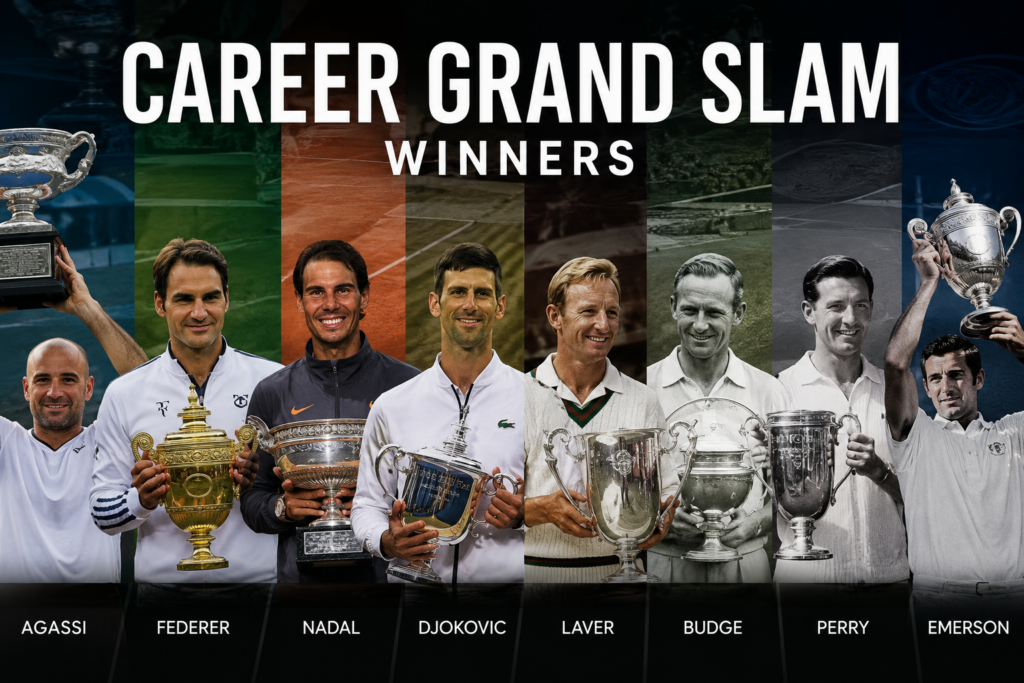
The list of men’s singles players who have completed the Career Grand Slam includes some of the biggest names in tennis history.
They include:
Fred Perry
Don Budge
Rod Laver
Roy Emerson
Andre Agassi
Roger Federer
Rafael Nadal
Novak Djokovic
These players competed across very different eras.
That matters.
Some achievements came before professional players were allowed to compete at the traditional major championships.
Others came during the modern Open Era.
Nevertheless, every player in this group accomplished the central requirement:
winning all four major singles championships.
Men’s Career Grand Slam Winners
| Player | Australian Open | Roland-Garros | Wimbledon | US Open |
|---|---|---|---|---|
| Fred Perry | ✓ | ✓ | ✓ | ✓ |
| Don Budge | ✓ | ✓ | ✓ | ✓ |
| Rod Laver | ✓ | ✓ | ✓ | ✓ |
| Roy Emerson | ✓ | ✓ | ✓ | ✓ |
| Andre Agassi | ✓ | ✓ | ✓ | ✓ |
| Roger Federer | ✓ | ✓ | ✓ | ✓ |
| Rafael Nadal | ✓ | ✓ | ✓ | ✓ |
| Novak Djokovic | ✓ | ✓ | ✓ | ✓ |
The table looks simple.
Achieving it was anything but simple.
Each player had to solve four very different Grand Slam challenges.
Why Is Winning All Four Grand Slams So Difficult?
The biggest problem is:
surface versatility.
The four majors are currently played on three surfaces.
Australian Open
Hard court
Roland-Garros
Clay
Wimbledon
Grass
US Open
Hard court
A player can be historically great on one surface without being equally dominant on another.
That is why the Career Grand Slam provides such valuable evidence of all-surface greatness.
Novak Djokovic and the Career Grand Slam
Novak Djokovic has one of the strongest all-surface Grand Slam records in men’s tennis history.
His major-title distribution is:
Australian Open — 10
Roland-Garros — 3
Wimbledon — 7
US Open — 4
That means Djokovic has not merely won every Grand Slam.
He has won:
each of the four at least three times.
That is a unique men’s achievement.
For his complete career records, visit our Novak Djokovic profile.
Which Grand Slam Did Djokovic Win Last to Complete His Career Grand Slam?
The missing tournament was:
Roland-Garros.
Djokovic had already won the Australian Open, Wimbledon and US Open.
But winning in Paris proved much more difficult.
One major reason was Rafael Nadal.
Nadal’s dominance at Roland-Garros created perhaps the greatest obstacle any generation of players has faced at a single major tournament.
Djokovic eventually broke through in:
2016
Djokovic Completes the Career Grand Slam at Roland-Garros 2016
Djokovic faced Andy Murray in the 2016 Roland-Garros final.
Murray won the opening set.
Djokovic responded.
He eventually won in four sets.
The victory gave Djokovic his first Roland-Garros championship.
It also completed his:
Career Grand Slam.
But there was something else remarkable about the victory.
Djokovic was now simultaneously holding:
Wimbledon 2015
US Open 2015
Australian Open 2016
Roland-Garros 2016
He held all four major titles at once.
The achievement became widely known as the:
Nole Slam.
Djokovic Eventually Won Every Major Three Times
Djokovic did not stop after completing the Career Grand Slam once.
He won Roland-Garros again in:
2021
Then again in:
2023
His third French Open title meant that he had won every Grand Slam tournament at least three times.
That level of distribution is one of the strongest arguments for Djokovic’s versatility.
Rafael Nadal and the Career Grand Slam
Rafael Nadal’s career will always be most closely associated with:
Roland-Garros.
He won the French Open an extraordinary:
14 times.
But describing Nadal only as a clay-court player ignores one of the most important parts of his résumé.
Nadal won every Grand Slam tournament.
His major distribution was:
Australian Open — 2
Roland-Garros — 14
Wimbledon — 2
US Open — 4
That made Nadal a multiple champion at every major.
For his complete records, visit our Rafael Nadal profile.
Which Major Did Nadal Need to Complete the Career Grand Slam?
Nadal’s final missing major was:
US Open.
Before winning in New York, he had already captured:
Roland-Garros,
Wimbledon,
and the Australian Open.
Then came:
2010.
Nadal Completes the Career Grand Slam at the 2010 US Open
Nadal reached the 2010 US Open final against:
Novak Djokovic.
He won the match in four sets.
That victory gave Nadal his first US Open championship.
More importantly for tennis history, it completed his:
Career Grand Slam.
Nadal was only:
24 years old.
He had now demonstrated championship-level tennis on clay, grass and hard courts.
Nadal Also Completed the Career Golden Slam
There was another layer to Nadal’s accomplishment.
He had already won:
Olympic singles gold at Beijing 2008.
When he completed the Career Grand Slam in 2010, Nadal therefore also possessed all four majors plus Olympic singles gold.
That made him a:
Career Golden Slam winner.
You can learn more about that achievement in our guide to the Golden Slam in tennis.
Roger Federer and the Career Grand Slam
Roger Federer won:
20 Grand Slam singles championships.
His distribution was:
Australian Open — 6
Roland-Garros — 1
Wimbledon — 8
US Open — 5
Three of the four tournaments brought Federer multiple championships.
One proved far more difficult.
Roland-Garros.
For Federer’s complete career records, visit our Roger Federer profile.
Why Was Roland-Garros So Difficult for Federer?
Federer was an excellent clay-court player.
He reached the Roland-Garros final repeatedly.
The problem was that his career overlapped with the greatest Roland-Garros champion in men’s tennis history:
Rafael Nadal.
Federer reached the final in:
2006
2007
2008
Nadal defeated him every time.
Federer’s inability to win Roland-Garros was therefore not evidence that he was a poor clay player.
It reflected the extraordinary obstacle Nadal presented.
Federer Completes the Career Grand Slam in 2009
The situation changed in:
2009.
Nadal lost to Robin Söderling before the final.
Federer eventually reached the championship match against:
Robin Söderling.
This time, Federer won.
After years of trying, Roland-Garros finally belonged to him.
The victory completed Federer’s:
Career Grand Slam.
It was one of the most important titles of his career.
Andre Agassi and the Career Grand Slam
Andre Agassi was the first man in the Open Era to complete the Career Grand Slam.
His four major championships came across very different surfaces and stages of his career.
Agassi won:
Wimbledon
US Open
Australian Open
and eventually:
Roland-Garros.
Paris was the final missing piece.
Agassi’s 1999 Roland-Garros Comeback
Agassi faced Andrei Medvedev in the:
1999 Roland-Garros final.
The match started badly for Agassi.
He lost the first two sets.
One more lost set would leave Roland-Garros missing from his résumé yet again.
Instead, Agassi recovered.
He won the next three sets and completed one of the most important comebacks of his career.
The victory gave him:
Roland-Garros
and completed his:
Career Grand Slam.
Agassi Also Completed the Career Golden Slam
Agassi had already won:
Olympic singles gold in Atlanta in 1996.
That meant his Roland-Garros victory did more than complete the Career Grand Slam.
It also gave Agassi the full collection required for the:
Career Golden Slam.
All four majors.
Olympic singles gold.
Another exceptionally rare accomplishment.
Rod Laver and the Career Grand Slam
Rod Laver belongs in almost every serious discussion about all-surface tennis greatness.
He won every major.
But Laver went much further.
He completed the traditional Calendar Grand Slam:
twice.
The first came in:
1962
The second:
1969
Winning all four majors during one year automatically completes the Career Grand Slam.
Laver therefore belongs to an even more exclusive historical category.
Why Rod Laver’s Career Requires Historical Context
Laver’s career crossed the dividing line between amateur-era tennis and the Open Era.
After turning professional, he was unable to compete in the traditional major tournaments for several years.
Then tennis changed.
The Open Era began in:
1968.
Professionals could compete at the majors.
One year later, Laver won all four.
Our guide to what the Open Era means in tennis explains why this context matters when comparing Laver with modern players.
Don Budge and the Career Grand Slam
Don Budge was another early member of the four-major club.
His place in history became even more important in:
1938.
Budge won all four major championships during the same season.
He became the first singles player to complete what became known as the:
Grand Slam.
That meant his Career Grand Slam was achieved in the strongest possible way:
all four championships in one calendar year.
Fred Perry and the Career Grand Slam
Fred Perry completed his collection during the 1930s.
He became one of the earliest men’s players to win all four major singles championships.
Perry’s achievements occurred long before the modern ATP Tour.
That makes direct statistical comparison with Djokovic, Nadal or Federer difficult.
But historically, his all-major accomplishment remains significant.
Roy Emerson and the Career Grand Slam
Roy Emerson also won all four major championships.
His career came primarily during the amateur era.
Emerson accumulated an extraordinary major record for his period and won every Grand Slam tournament.
Again, historical context matters because professional and amateur tennis were separated.
That system changed when the Open Era began in 1968.
Who Has Completed the Career Grand Slam in the Open Era?
Among men, the key Open Era Career Grand Slam achievers are:
Rod Laver
Andre Agassi
Roger Federer
Rafael Nadal
Novak Djokovic
Each reached the achievement differently.
Laver swept all four in one season.
Agassi completed his collection with Roland-Garros.
Federer did the same.
Nadal completed his at the US Open.
Djokovic completed his first Career Grand Slam at Roland-Garros and later won every major at least three times.
Djokovic vs Nadal vs Federer: Career Grand Slam Comparison
All three members of the Big Three completed the Career Grand Slam.
But their distributions are different.
| Major | Djokovic | Nadal | Federer |
|---|---|---|---|
| Australian Open | 10 | 2 | 6 |
| Roland-Garros | 3 | 14 | 1 |
| Wimbledon | 7 | 2 | 8 |
| US Open | 4 | 4 | 5 |
This table tells us much more than simply saying:
all three completed the Career Grand Slam.
Djokovic’s distribution is the most balanced at the highest level.
Nadal’s Roland-Garros dominance is unmatched.
Federer’s Wimbledon record remains one of his defining achievements.
For the complete statistical comparison, see Djokovic vs Nadal vs Federer.
Who Completed the Career Grand Slam the Most Times?
This question requires a precise definition.
If we define a multiple Career Grand Slam as winning each of the four majors multiple times, several legends stand out.
Among modern men’s players:
Novak Djokovic
Every major at least:
3 times
Rafael Nadal
Every major at least:
2 times
Federer won three majors many times but Roland-Garros only once.
Therefore, he completed the full four-major collection once in terms of minimum title counts at each tournament.
Djokovic’s Triple Career Grand Slam
Djokovic became the first man to win every Grand Slam tournament at least:
three times.
His minimum total at any one major is his three Roland-Garros championships.
This gives him what is often described as a:
Triple Career Grand Slam.
It is one of the strongest all-surface records in men’s tennis.
Nadal’s Double Career Grand Slam
Nadal won:
2 Australian Opens
14 Roland-Garros titles
2 Wimbledons
4 US Opens
That means he won every major at least twice.
This completed what is commonly called a:
Double Career Grand Slam.
It is an important counterpoint to the idea that Nadal’s greatness existed only on clay.
Did Pete Sampras Complete the Career Grand Slam?
No.
Pete Sampras won:
14 Grand Slam singles titles.
He was one of the dominant players of the 1990s and held the men’s major record when he retired.
But he never won:
Roland-Garros.
That prevented him from completing the Career Grand Slam.
Why Didn’t Sampras Win Roland-Garros?
Clay was the surface least suited to Sampras’s greatest strengths.
His attacking game and serve were extraordinarily effective on faster surfaces.
At Roland-Garros, the slower clay reduced some of those advantages.
Sampras’s best French Open result was a:
semifinal appearance in 1996.
He never reached the final.
His career demonstrates an important point:
You can be one of the greatest players in tennis history without completing the Career Grand Slam.
Did Björn Borg Complete the Career Grand Slam?
No.
Borg dominated two majors:
Roland-Garros
and
Wimbledon.
He won six French Open titles and five Wimbledon titles.
But he never won:
Australian Open
or:
US Open.
His US Open record is particularly notable because he reached the final four times without winning the championship.
Did John McEnroe Complete the Career Grand Slam?
No.
McEnroe won seven major singles titles.
His championships came at:
Wimbledon
and
US Open.
He never won the Australian Open or Roland-Garros.
His closest opportunity in Paris came in:
1984
when he reached the Roland-Garros final.
Ivan Lendl defeated him after McEnroe had led by two sets.
Did Ivan Lendl Complete the Career Grand Slam?
No.
Lendl won:
Australian Open
Roland-Garros
and
US Open.
One tournament remained missing:
Wimbledon.
Lendl reached the Wimbledon final twice.
He never won it.
For one of the greatest baseline players of his generation, grass remained the final unsolved Grand Slam challenge.
Did Andy Murray Complete the Career Grand Slam?
No.
Andy Murray won:
Wimbledon twice
and:
US Open once.
He reached the Australian Open final five times but never won the championship.
He also reached the Roland-Garros final in 2016.
Murray therefore demonstrated elite performance at all four majors without completing the Career Grand Slam.
Great Players Who Never Completed the Career Grand Slam
This list demonstrates how difficult the achievement is.
| Player | Missing Major(s) |
|---|---|
| Pete Sampras | Roland-Garros |
| Björn Borg | Australian Open, US Open |
| John McEnroe | Australian Open, Roland-Garros |
| Ivan Lendl | Wimbledon |
| Andy Murray | Australian Open, Roland-Garros |
These players won numerous major championships.
Some dominated entire eras.
Yet winning all four remained beyond them.
Career Grand Slam vs Calendar Grand Slam
These terms are frequently confused.
Career Grand Slam
Win each of the four majors at least once during an entire career.
Calendar Grand Slam
Win all four majors during the same calendar year.
The Calendar Grand Slam is substantially rarer.
A player has many seasons to complete a Career Grand Slam.
A Calendar Grand Slam must be completed within one year.
For the complete history, read our guide to the Calendar Grand Slam in tennis.
Career Grand Slam vs Golden Slam
A Career Grand Slam requires:
four major championships.
A Career Golden Slam adds:
Olympic singles gold.
So a Career Golden Slam requires victories at:
Australian Open,
Roland-Garros,
Wimbledon,
US Open,
and the Olympic singles event.
Among modern men’s champions, Andre Agassi, Rafael Nadal and Novak Djokovic have completed that collection.
Career Grand Slam vs Holding All Four Majors at Once
These are also different.
A Career Grand Slam does not require the titles to overlap.
Federer took years to assemble his four-major collection.
But a player who holds all four championships simultaneously has won four consecutive majors.
Djokovic achieved that across:
2015–2016.
Laver achieved an even more demanding version by winning all four within 1969.
The distinction matters when comparing peak dominance.
Which Grand Slam Is Hardest to Complete?
There is no universal answer.
It depends on the player.
For Federer:
Roland-Garros
For Djokovic:
Roland-Garros
For Nadal:
US Open
For Agassi:
Roland-Garros
For Sampras, the missing major throughout his career was:
Roland-Garros.
For Lendl:
Wimbledon.
The hardest major is often the tournament played on the surface least suited to a player’s natural strengths.
Why Roland-Garros Has Blocked So Many Career Grand Slams
Clay tennis requires specific skills.
Movement is different.
Points often last longer.
Heavy topspin becomes more influential.
Defending can be more effective.
Serving dominance can be reduced.
And during the Big Three era, another problem existed:
Rafael Nadal.
Federer and Djokovic were both outstanding clay players.
But Nadal’s unprecedented dominance in Paris made their path much harder.
Federer eventually broke through in 2009.
Djokovic eventually broke through in 2016.
Sampras never did.
Why Wimbledon Can Be the Missing Major
The opposite problem exists on grass.
Players have less time each season to adapt to it.
The bounce is lower.
Movement is different.
The surface rewards different patterns.
Ivan Lendl’s career is one of the clearest examples.
He won eight majors.
He reached the Wimbledon final twice.
But the trophy remained missing.
Does a Career Grand Slam Matter in the GOAT Debate?
Yes.
It demonstrates:
surface versatility.
A player cannot complete the Career Grand Slam by dominating only one environment.
He must find a way to win everywhere.
That is one reason Djokovic, Nadal, Federer, Agassi and Laver receive additional historical credit for completing it.
But it should not decide the GOAT debate by itself.
Pete Sampras did not complete the Career Grand Slam.
That does not erase his 14 major championships or six consecutive year-end No. 1 finishes.
Borg did not complete it.
That does not erase his extraordinary Roland-Garros and Wimbledon dominance.
Every statistic needs context.
Career Grand Slam and All-Surface Greatness
One of the most interesting uses of the Career Grand Slam is comparing specialists with all-surface champions.
Nadal owns the greatest clay résumé in men’s tennis.
Federer owns the Open Era men’s Wimbledon title record.
Djokovic owns the men’s Australian Open title record.
Yet all three also won every other major.
That is why the Big Three were so unusual.
They combined specialization with versatility.
Each had a tournament or surface where he was historically exceptional.
Yet none was confined to that environment.
Career Grand Slam FAQ
What is a Career Grand Slam?
A Career Grand Slam means winning the Australian Open, Roland-Garros, Wimbledon and US Open at least once during a player’s career.
Do the four Grand Slams have to be won in the same year?
No.
If all four are won during the same year, that is a Calendar Grand Slam.
Did Novak Djokovic complete the Career Grand Slam?
Yes.
Djokovic completed his first Career Grand Slam by winning Roland-Garros in 2016.
How many times has Djokovic won every Grand Slam?
Djokovic has won each of the four majors at least three times.
Did Rafael Nadal complete the Career Grand Slam?
Yes.
Nadal completed it by winning the US Open in 2010.
Did Roger Federer complete the Career Grand Slam?
Yes.
Federer completed it by winning Roland-Garros in 2009.
Did Andre Agassi complete the Career Grand Slam?
Yes.
Agassi completed it by winning Roland-Garros in 1999.
Did Rod Laver complete the Career Grand Slam?
Yes.
Laver also completed the Calendar Grand Slam twice, in 1962 and 1969.
Did Pete Sampras complete the Career Grand Slam?
No.
Sampras never won Roland-Garros.
Did Björn Borg complete the Career Grand Slam?
No.
Borg never won the Australian Open or US Open.
Did Ivan Lendl complete the Career Grand Slam?
No.
Wimbledon was the missing major.
Did Andy Murray complete the Career Grand Slam?
No.
Murray won Wimbledon and the US Open but never won the Australian Open or Roland-Garros.
What was Federer’s last missing Grand Slam?
Roland-Garros.
He won it in 2009.
What was Djokovic’s last missing Grand Slam?
Roland-Garros.
He first won it in 2016.
What was Nadal’s last missing Grand Slam?
US Open.
He first won it in 2010.
Who has won every Grand Slam at least three times?
Novak Djokovic is the first man to achieve the feat.
Has Nadal won every Grand Slam more than once?
Yes.
Nadal won each major at least twice.
Is a Career Grand Slam the same as a Golden Slam?
No.
A Golden Slam also requires Olympic singles gold.
Is a Career Grand Slam the same as a Calendar Grand Slam?
No.
A Career Grand Slam can be completed across multiple years.
A Calendar Grand Slam requires all four majors during one calendar year.
Final Answer: Who Has Won All Four Grand Slams?
Only a select group of men’s singles champions has won all four major tournaments.
The historical Career Grand Slam winners include:
Fred Perry
Don Budge
Rod Laver
Roy Emerson
Andre Agassi
Roger Federer
Rafael Nadal
Novak Djokovic
In the modern men’s game, the Big Three all completed it.
Federer finally won Roland-Garros in 2009.
Nadal completed his collection at the US Open in 2010.
Djokovic won his missing Roland-Garros title in 2016.
Djokovic later went even further, becoming the first man to win every Grand Slam tournament at least three times.
Nadal won every major at least twice.
And several other legends demonstrate just how difficult the accomplishment is.
Sampras never won Roland-Garros.
Lendl never won Wimbledon.
Borg never won the US Open.
McEnroe never won Roland-Garros or the Australian Open.
Winning many majors demonstrates greatness.
Winning every major demonstrates something more specific:
versatility.
Hard court.
Clay.
Grass.
Different conditions.
Different opponents.
Different challenges.
One champion capable of solving all four.
That is why the Career Grand Slam remains one of tennis’s defining all-surface achievements.
How Important Is the Career Grand Slam to Tennis Greatness?
Djokovic won every major at least three times.
Nadal won every major at least twice.
Federer won three of the four majors multiple times and finally conquered Roland-Garros.
Laver swept all four in the same year twice.
Agassi combined the Career Grand Slam with Olympic singles gold.
Which accomplishment should carry the most weight?
And how much should versatility matter compared with total titles, peak dominance or longevity?
VIEW THE LIVE TENNIS GOAT RANKING AND CAST YOUR VOTE
Compare the greatest players in tennis history and make your choice.
Tags: Andre Agassi, Career Grand Slam, Grand Slam winners, Novak Djokovic, Rafael Nadal, Rod Laver, Roger Federer, tennis records