
Statistics updated through Wimbledon 2026
A Grand Slam career can be measured in trophies.
It can also be measured in how many times a player walked onto court at the Australian Open, Roland-Garros, Wimbledon or US Open and competed in a main-draw singles match.
By that measure, one player has travelled further than anyone else in men’s tennis history.
Novak Djokovic has played 467 Grand Slam singles matches through Wimbledon 2026.
That places him ahead of:
Roger Federer — 429
and
Rafael Nadal — 358.
The number is different from the record for most Grand Slam match wins.
Djokovic leads that category too, but matches played count both sides of a career record:
wins + losses.
That makes this statistic particularly useful for examining longevity.
It rewards players who kept qualifying for majors, survived into the later rounds and remained competitive across many seasons.
And the leaderboard contains some interesting surprises.
Andy Murray has played more Grand Slam matches than Pete Sampras.
Stan Wawrinka appears among the leaders despite winning only three majors.
Andre Agassi and Ivan Lendl sit remarkably close together.
Let’s examine who has played the most matches on tennis’s biggest stages — and what those numbers actually tell us.
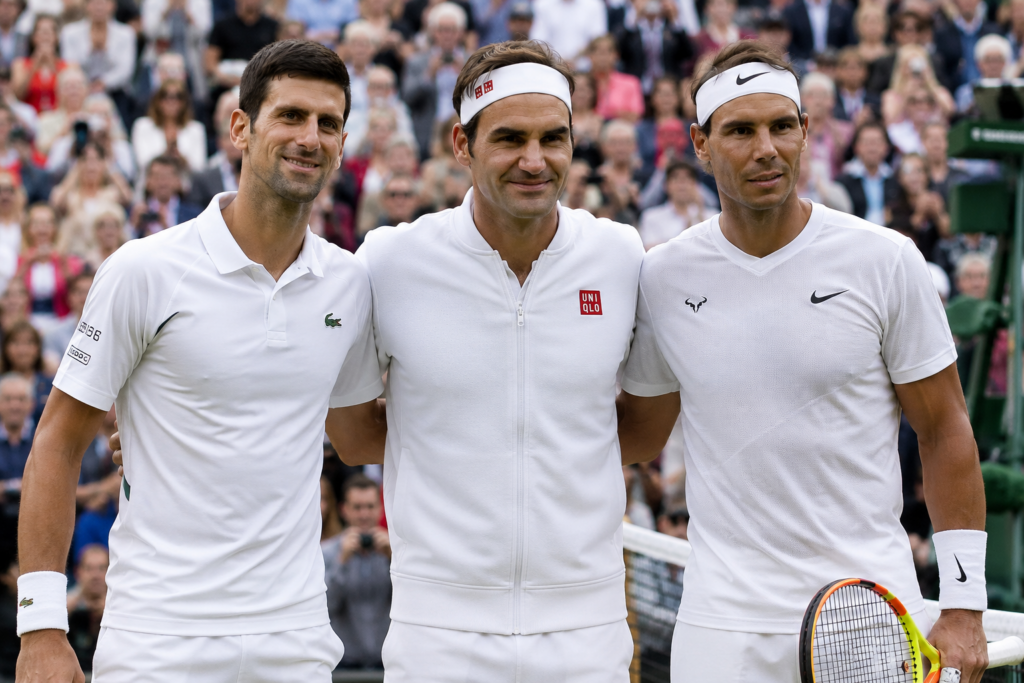
Who Has Played the Most Grand Slam Matches?
Novak Djokovic holds the men’s record with 467 Grand Slam singles matches played through Wimbledon 2026.
The leading totals are:
| Rank | Player | Wins | Losses | Grand Slam Matches |
|---|---|---|---|---|
| 1 | Novak Djokovic | 409 | 58 | 467 |
| 2 | Roger Federer | 369 | 60 | 429 |
| 3 | Rafael Nadal | 314 | 44 | 358 |
| 4 | Jimmy Connors | 233 | 49 | 282 |
| 5 | Andre Agassi | 224 | 53 | 277 |
| 6 | Ivan Lendl | 222 | 49 | 271 |
| 7 | Andy Murray | 200 | 57 | 257 |
| 8 | Pete Sampras | 203 | 38 | 241 |
| 9 | Stan Wawrinka | 160 | 74 | 234 |
| 10 | Stefan Edberg | 178 | 47 | 225 |
Djokovic has played:
38 more Grand Slam matches than Federer
and:
109 more than Nadal.
Reaching 467 is not simply a story about playing for a long time.
A player also has to keep winning enough matches to remain in tournament draws.
What Does “Grand Slam Matches Played” Mean?
For this article, a Grand Slam match is a men’s singles match at one of the four majors:
Australian Open
Roland-Garros
Wimbledon
US Open
The total can be calculated from a player’s Grand Slam win-loss record.
For example:
Djokovic: 409 wins + 58 losses = 467 matches
Federer: 369 + 60 = 429
Nadal: 314 + 44 = 358
If you’re new to the structure of the majors, our guide to what a Grand Slam is in tennis explains the four tournaments and why they carry so much historical importance.
Why Matches Played Is Different From Matches Won
This distinction matters.
Our article on the most Grand Slam match wins answers:
Who won the most matches at majors?
This article answers:
Who actually played the most matches at majors?
Those leaderboards are similar near the top, but they are not identical.
Consider:
Andy Murray — 257 matches, 200 wins
Pete Sampras — 241 matches, 203 wins
Murray played more Grand Slam matches.
Sampras won more of them.
Sampras also won far more Grand Slam titles:
14 compared with Murray’s 3.
One statistic reflects total exposure and longevity.
Another measures victories.
Championship totals measure something else again.
That difference gives each leaderboard its own value.
Novak Djokovic — 467 Grand Slam Matches
Novak Djokovic’s total is unprecedented in men’s tennis.
Through Wimbledon 2026:
467 major singles matches
409 victories
58 defeats
24 Grand Slam titles
His Grand Slam career began in 2005.
More than two decades later, Djokovic was still reaching the latter stages of the biggest tournaments.
That is why the 467 figure is so remarkable.
It combines an extremely long career with extraordinarily few early exits.
Explore the rest of his records in our Novak Djokovic career profile.
Djokovic’s Record Requires Both Longevity and Winning
Simply entering many Grand Slam tournaments isn’t enough.
Imagine two players each compete at majors for 20 years.
One repeatedly loses in the first or second round.
The other regularly reaches:
quarterfinals,
semifinals,
and
finals.
The second player will accumulate far more matches.
Djokovic belongs to the extreme version of that second category.
His record is built not merely on showing up.
It is built on staying in the draw.
More Than 400 of Djokovic’s Matches Were Victories
Perhaps the most striking number inside the 467 total is:
409 wins.
Djokovic became the first man to reach 400 Grand Slam singles victories at the 2026 Australian Open.
By the end of Wimbledon, he had added nine more.
That means nearly nine out of every ten major matches in his career ended with Djokovic advancing to another round.
Roger Federer — 429 Grand Slam Matches
Roger Federer occupies second place with:
429 Grand Slam matches.
His record:
369–60
The Swiss champion combined a long career with some of the most remarkable streaks of major consistency tennis has seen.
Federer rarely disappeared early from Grand Slam draws during his prime.
For years, making the second week was almost automatic.
See his complete achievements in our Roger Federer profile.
Federer Built His Total Through Extraordinary Streaks
One statistic explains much of Federer’s 429-match total:
23 consecutive Grand Slam semifinals.
He also reached:
36 consecutive Grand Slam quarterfinals.
Every deep run adds five, six or seven matches to a player’s career total.
Stack those runs together for years and the numbers grow rapidly.
Federer’s longevity mattered.
His consistency mattered even more.
Rafael Nadal — 358 Grand Slam Matches
Rafael Nadal played:
358 Grand Slam singles matches.
His record was:
314 wins
44 losses
That gives Nadal one of the strongest winning percentages of any player with such a large sample of major matches.
For his full career statistics, visit our Rafael Nadal profile.
Nadal Played Fewer Matches but Lost Remarkably Rarely
Nadal sits well behind Djokovic and Federer in total matches.
Part of the reason is injury.
Throughout his career, physical problems caused Nadal to miss tournaments or end seasons early.
Yet when he did compete at the majors, eliminating him was exceptionally difficult.
His record of:
314–44
produces a winning percentage of approximately:
87.7%.
That is slightly higher than Djokovic’s 409–58 mark through Wimbledon 2026.
Roland-Garros Changed Nadal’s Numbers
No discussion of Nadal’s Grand Slam career is complete without Paris.
At Roland-Garros he recorded:
112 victories
and only:
4 defeats.
Those matches formed a huge part of his overall major record.
But Nadal also won multiple championships at the other three majors.
His 358 matches therefore represent much more than clay-court dominance.
Jimmy Connors — 282 Grand Slam Matches
Jimmy Connors played:
282 major singles matches.
Record:
233–49
Connors’ presence in fourth place is another testament to his extraordinary career length.
And unlike modern players, he competed during a period when participating in all four majors every season was less routine.
The Australian Open did not always draw the same elite international field that it does today.
That historical context makes his 282 matches especially impressive.
Andre Agassi — 277 Grand Slam Matches
Andre Agassi finished only five matches behind Connors:
277 matches
His record was:
224–53.
Agassi’s career path was anything but straightforward.
He rose to the top.
He fell dramatically in the rankings.
Then he rebuilt his career and returned to championship level.
Through all those phases, he continued accumulating Grand Slam matches.
Agassi’s 277 Matches Came Across Every Surface
Agassi won all four majors:
Australian Open,
Roland-Garros,
Wimbledon,
and
US Open.
That matters when interpreting his longevity.
His deep runs were not confined to one particular surface.
He found ways to succeed on:
hard courts,
clay,
and
grass.
Ivan Lendl — 271 Grand Slam Matches
Ivan Lendl played:
271 Grand Slam matches.
Career major record:
222–49.
His total sits only six matches behind Agassi.
Lendl was an almost permanent presence in the later rounds of majors during much of the 1980s.
He won eight championships and reached many additional finals.
One tournament remained unconquered:
Wimbledon.
Yet even without that trophy, Lendl’s overall Grand Slam record demonstrates remarkable consistency.
Andy Murray — 257 Grand Slam Matches
Andy Murray is where this leaderboard becomes particularly interesting.
Murray played:
257 major matches
and won:
200.
That places him ahead of Pete Sampras in total matches played.
But Sampras won more matches and many more championships.
Murray vs Sampras Shows Why These Statistics Should Not Be Confused
Compare:
| Player | Matches | Wins | Titles |
|---|---|---|---|
| Andy Murray | 257 | 200 | 3 |
| Pete Sampras | 241 | 203 | 14 |
Murray played:
16 more Grand Slam matches.
Sampras won:
3 more matches.
And Sampras won:
11 more major titles.
How?
Sampras converted his deep runs into championships far more frequently.
Murray lost considerably more Grand Slam matches because he made repeated deep runs without ultimately winning the tournament.
The comparison shows exactly why matches played should be treated as a measure of:
career volume and sustained contention
rather than as a direct ranking of greatness.
Pete Sampras — 241 Grand Slam Matches
Pete Sampras played:
241 major singles matches.
His record:
203–38
That loss total is remarkably low.
Sampras won:
14 Grand Slam championships
with his greatest success coming at:
Wimbledon
and
US Open.
His career was more concentrated than those of Djokovic or Federer.
But his efficiency was outstanding.
Sampras Played Fewer Matches Than Murray but Won More Titles
This is one of the best examples of why tennis statistics need context.
Murray had:
257 matches
Sampras:
241.
If matches played were treated as a GOAT ranking, Murray would come out ahead.
Few serious tennis historians would argue that this fact alone gives Murray the stronger Grand Slam career.
Titles matter.
Finals matter.
Win percentage matters.
Era matters.
Matches played provide one part of the picture.
Stan Wawrinka — 234 Grand Slam Matches
Stan Wawrinka reaches the top 10 when we rank by total matches rather than victories.
Through Wimbledon 2026, his major record stood at:
160–74.
Total:
234 matches.
Wawrinka is a fascinating player to find on this leaderboard.
He did not dominate majors season after season like the Big Three.
Yet his longevity allowed him to build an enormous body of Grand Slam tennis.
Why Wawrinka Appears Here but Not Among the Top Match-Win Leaders
Wawrinka’s:
74 Grand Slam defeats
increase his total matches played.
That may sound obvious, but it illustrates the mathematical difference between the two statistics.
A match-played leaderboard counts:
victories and defeats.
A win leaderboard counts only:
victories.
Wawrinka therefore gains ground when the focus changes from winning matches to playing them.
His three Grand Slam championships remain the defining achievements of his major career, but his 234 matches also demonstrate exceptional longevity.
Stefan Edberg — 225 Grand Slam Matches
Stefan Edberg played:
225 major matches.
His record:
178–47
Edberg won six Grand Slam singles titles and reached the championship match at three different majors.
His elegant serve-and-volley tennis was especially effective on faster surfaces.
He never won Roland-Garros, though he did reach the final there.
With 225 matches, Edberg completes this leading group of men’s Grand Slam workhorses.
The Big Three Were in a Different Volume Category
The gap becomes obvious when we isolate Djokovic, Federer and Nadal.
| Player | Matches Played | Wins | Losses |
|---|---|---|---|
| Novak Djokovic | 467 | 409 | 58 |
| Roger Federer | 429 | 369 | 60 |
| Rafael Nadal | 358 | 314 | 44 |
Then compare the next player:
Jimmy Connors — 282.
Nadal played:
76 more major matches than Connors.
Federer played:
147 more.
Djokovic played:
185 more.
The scale of the Big Three’s Grand Slam careers is one reason so many historical records were rewritten during their era.
For a direct comparison of the three, see Djokovic vs Nadal vs Federer.
Who Played the Most Grand Slam Matches Without Winning Many Titles?
This is where Andy Murray and Stan Wawrinka become particularly interesting.
Andy Murray
257 matches
3 titles
Stan Wawrinka
234 matches
3 titles
Both played enormous numbers of major matches.
Both also competed during the Big Three era.
But their careers developed differently.
Murray was more consistently present in semifinals and finals.
Wawrinka produced fewer elite-level runs, but when his game peaked, he famously converted three of them into Grand Slam championships.
Matches Played vs Winning Percentage
Playing more matches is not always better.
A player can increase his match count through longevity while simultaneously lowering his career winning percentage.
That is why it is useful to place volume next to efficiency.
| Player | Matches | Win Rate |
|---|---|---|
| Novak Djokovic | 467 | 87.6% |
| Roger Federer | 429 | 86.0% |
| Rafael Nadal | 358 | 87.7% |
| Jimmy Connors | 282 | 82.6% |
| Andre Agassi | 277 | 80.9% |
| Ivan Lendl | 271 | 81.9% |
| Andy Murray | 257 | 77.8% |
| Pete Sampras | 241 | 84.2% |
| Stan Wawrinka | 234 | 68.4% |
| Stefan Edberg | 225 | 79.1% |
This is one reason Djokovic’s number stands out.
The remarkable part is not simply:
467 matches.
It is playing 467 while winning approximately:
87.6% of them.
Who Was More Efficient: Nadal or Djokovic?
By winning percentage, their records are extremely close.
Nadal
314–44
87.7%
Djokovic
409–58
87.6%
Nadal has the marginal percentage advantage.
Djokovic has played:
109 more matches.
This creates two different forms of statistical excellence.
Nadal’s number emphasizes efficiency.
Djokovic’s emphasizes maintaining almost the same efficiency across a much larger number of matches.
Neither statistic should be considered in isolation.
How Many Matches Does a Grand Slam Champion Play?
In a standard 128-player men’s singles draw, the champion normally wins:
7 matches.
Those rounds are:
First Round
Second Round
Third Round
Fourth Round
Quarterfinal
Semifinal
Final
So one complete championship run adds seven match victories to a player’s career record.
How Quickly Could Someone Reach 400 Grand Slam Matches?
Suppose a player averaged:
20 major matches per season.
That would mean regular deep runs across the four majors.
At that pace, reaching:
400 matches
would require:
20 seasons.
Even at:
24 matches per year
a player would need nearly:
17 seasons.
This explains why the top of the leaderboard is dominated by players with exceptional longevity.
Why Playing Four Majors Every Year Matters
Modern players normally have four opportunities each season:
Australian Open
Roland-Garros
Wimbledon
US Open
But historical careers cannot always be compared directly.
Travel was different.
Professional and amateur tennis were once separated.
Major participation patterns varied.
The Australian Open was not always a routine destination for every leading European and American player.
These differences matter when comparing modern totals with older champions.
Our guide to the Open Era in tennis explains why 1968 is such an important dividing line in tennis history.
Matches Played and Grand Slam Semifinals
There is a strong relationship between playing many matches and reaching the later rounds.
A semifinalist normally plays:
6 matches if including the semifinal itself, with five wins required to arrive there.
A finalist plays:
7 matches including the final.
A champion also plays seven and wins all seven.
Players who repeatedly reach the last four therefore accumulate major matches much faster than players who regularly lose in the opening rounds.
That is why Djokovic, Federer and Nadal also dominate the conversation around most Grand Slam semifinal appearances.
Matches Played and Grand Slam Titles
Titles remain the ultimate result.
The championship totals among several leaders demonstrate why:
| Player | Matches | Grand Slam Titles |
|---|---|---|
| Novak Djokovic | 467 | 24 |
| Roger Federer | 429 | 20 |
| Rafael Nadal | 358 | 22 |
| Jimmy Connors | 282 | 8 |
| Andre Agassi | 277 | 8 |
| Ivan Lendl | 271 | 8 |
| Andy Murray | 257 | 3 |
| Pete Sampras | 241 | 14 |
| Stan Wawrinka | 234 | 3 |
| Stefan Edberg | 225 | 6 |
Sampras is the obvious outlier.
He played considerably fewer matches than Connors, Agassi, Lendl and Murray.
Yet his:
14 championships
far exceed their totals.
For the complete championship leaderboard, visit Most Grand Slam Tennis Titles.
Does Playing More Grand Slam Matches Mean Greater Longevity?
Usually, but not perfectly.
A large total generally requires:
many years on tour
frequent Grand Slam participation
few missed tournaments
and
enough victories to make deep runs.
But two players with careers of equal length can produce very different match totals.
The player regularly reaching quarterfinals will accumulate far more matches than the player repeatedly losing in Round 1.
So the statistic is best understood as:
longevity multiplied by consistency.
Djokovic’s 467 Matches Put His Career in Perspective
Consider the scale.
Djokovic has played:
467 Grand Slam singles matches.
A player who competed in all four majors for:
20 seasons
would have entered:
80 tournaments.
To reach Djokovic’s number across those 80 majors, that player would need to average almost:
six matches per tournament.
That essentially means living in the latter rounds of Grand Slam draws for two decades.
It demonstrates why this record is much harder than simply remaining professionally active for a long time.
Could Carlos Alcaraz or Jannik Sinner Reach 467?
Young champions such as Carlos Alcaraz and Jannik Sinner have already accumulated major victories at impressive rates.
But this particular record cannot be attacked quickly.
It requires time.
A player could win numerous majors before age 25 and still be hundreds of matches short.
To challenge Djokovic’s mark would likely require:
15–20+ years of Grand Slam participation
combined with:
exceptional consistency
good health
and
deep runs almost every season.
That is why longevity records often cannot be properly evaluated until late in a player’s career.
What This Record Adds to the GOAT Debate
Grand Slam matches played should never be the first statistic used to determine the greatest player ever.
Winning matters more than merely playing.
But the record does answer an important question:
Who sustained elite Grand Slam tennis for the largest body of matches?
Djokovic’s answer is remarkable because his volume comes with:
24 titles,
409 victories,
55 semifinals through Wimbledon 2026,
and an approximately 87.6% win rate.
The number therefore supports a larger résumé rather than standing alone.
That is how statistics should be used in serious historical comparisons.
For our complete framework, read How Is the Greatest Tennis Player of All Time Determined?.
Most Grand Slam Matches Played FAQ
Who has played the most Grand Slam matches in men’s tennis?
Novak Djokovic.
Through Wimbledon 2026, he has played 467 Grand Slam singles matches.
How many Grand Slam matches has Djokovic played?
467 through Wimbledon 2026, based on a record of 409 wins and 58 losses.
How many Grand Slam matches did Roger Federer play?
Federer played 429, with a 369–60 record.
How many Grand Slam matches did Rafael Nadal play?
Nadal played 358, finishing 314–44.
How many major matches did Jimmy Connors play?
Connors played 282.
How many Grand Slam matches did Andre Agassi play?
Agassi played 277.
How many Grand Slam matches did Ivan Lendl play?
Lendl played 271.
How many Grand Slam matches did Andy Murray play?
Murray played 257.
How many Grand Slam matches did Pete Sampras play?
Sampras played 241.
How many Grand Slam matches has Stan Wawrinka played?
Through Wimbledon 2026, Wawrinka’s 160–74 record gives him 234 matches.
Who played more Grand Slam matches, Federer or Nadal?
Federer.
Federer played 429 compared with Nadal’s 358.
Who played more Grand Slam matches, Murray or Sampras?
Murray played more: 257 compared with Sampras’s 241.
Sampras, however, won more matches and considerably more Grand Slam titles.
Is matches played the same as matches won?
No.
Matches played includes both wins and losses.
How many matches does a Grand Slam champion usually play?
Seven in a standard 128-player singles draw.
Which four tournaments count as Grand Slams?
Australian Open, Roland-Garros, Wimbledon and US Open.
Do Masters 1000 matches count?
No.
This record covers Grand Slam singles competition only.
Why is the matches-played record important?
It helps measure longevity and sustained deep-run consistency at the four biggest tournaments in tennis.
Final Answer: Who Has Played the Most Grand Slam Matches?
Novak Djokovic holds the men’s record with 467 Grand Slam singles matches played through Wimbledon 2026.
The leading totals are:
Novak Djokovic — 467
Roger Federer — 429
Rafael Nadal — 358
Jimmy Connors — 282
Andre Agassi — 277
Ivan Lendl — 271
Andy Murray — 257
Pete Sampras — 241
Stan Wawrinka — 234
Stefan Edberg — 225
The leaderboard is useful precisely because it is not identical to the match-wins ranking.
Murray played more major matches than Sampras, yet Sampras won more and collected 14 championships.
Wawrinka climbs into the top 10 because his long career produced 234 major matches despite a lower winning percentage.
Nadal played 109 fewer matches than Djokovic but finished with a marginally higher major winning percentage.
And Djokovic combines the largest volume with one of the highest success rates ever recorded.
That is what separates simply playing for a long time from remaining a Grand Slam contender for a long time.
467 matches.
409 victories.
More than two decades of major competition.
The record is ultimately another way of showing just how much elite-level tennis Djokovic has produced on the sport’s biggest stages.
Is Longevity as Important as Peak Dominance?
Djokovic leads in total matches played.
Nadal produced extraordinary efficiency.
Federer’s 429 matches included one of the most consistent peaks tennis has seen.
Sampras played fewer matches but converted his opportunities into 14 championships.
So what should matter most?
Longevity?
Win percentage?
Titles?
Peak dominance?
The best GOAT comparisons consider all of them.
VIEW THE LIVE TENNIS GOAT RANKING AND CAST YOUR VOTE
Compare the careers, statistics and achievements of tennis’s greatest players and decide which résumé you value most.
Tags: Grand Slam Matches Played, Grand Slam records, Major Championships, Novak Djokovic, Rafael Nadal, Roger Federer, tennis GOAT, tennis records