
Statistics verified through Wimbledon 2026
A fifth set is where a tennis match stops being only about technique.
After three or four hours, serving motions become heavier.
Legs lose their explosiveness.
Decision-making becomes harder.
Every missed opportunity feels more expensive because there may not be another one.
And yet some players have repeatedly found their best tennis precisely when a match reached its final possible set.
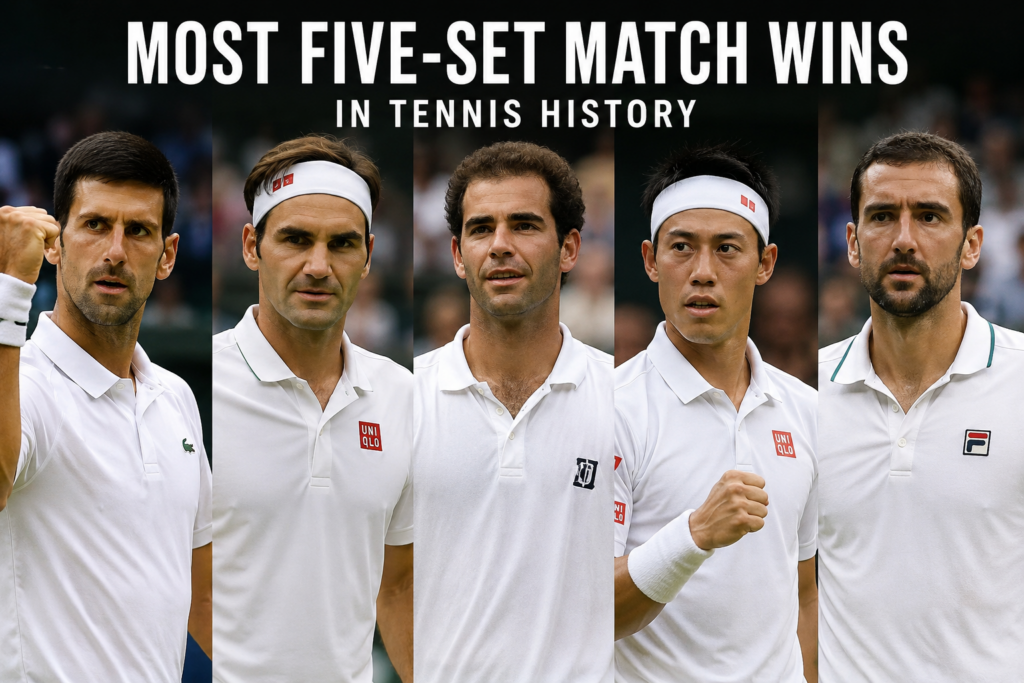
Among the men’s career records tracked by the ATP, one player has won more fifth sets than anyone else on the leading list:
Novak Djokovic — 41 fifth-set victories.
His career record through Wimbledon 2026 stands at:
41 wins and 12 losses.
But Djokovic is not alone among tennis’s great deciding-set specialists.
Marin Cilic has won 34 fifth sets.
Pete Sampras and Roger Federer each won 33.
Lleyton Hewitt won 32.
Stan Wawrinka has reached 31.
And Kei Nishikori’s 29–8 record gives him one of the strongest fifth-set winning percentages among players with a large sample.
These numbers reveal a part of tennis greatness that trophy counts do not fully capture.
What happens when there is no comfortable victory?
What happens when four sets have solved nothing?
Who keeps making the right decisions when the entire match has been reduced to one final set?
That is what the fifth-set record measures.
Who Has Won the Most Five-Set Matches?
Using the ATP’s official career fifth-set records, Novak Djokovic leads this group of men’s players with:
41 fifth-set wins.
The leading verified records include:
| Player | Fifth-Set Wins | Fifth-Set Losses | Win Rate |
|---|---|---|---|
| Novak Djokovic | 41 | 12 | 77.4% |
| Marin Cilic | 34 | 20 | 63.0% |
| Pete Sampras | 33 | 15 | 68.8% |
| Roger Federer | 33 | 23 | 58.9% |
| Lleyton Hewitt | 32 | 25 | 56.1% |
| Stan Wawrinka | 31 | 27 | 53.4% |
| Kei Nishikori | 29 | 8 | 78.4% |
| Andy Murray | 28 | 14 | 66.7% |
| Jimmy Connors | 27 | 17 | 61.4% |
| Andre Agassi | 27 | 22 | 55.1% |
Djokovic owns the largest victory total among these ATP-recorded leaders.
Nishikori, however, has an even higher winning percentage from a smaller number of fifth-set matches.
That distinction immediately makes the record more interesting:
volume and efficiency are not the same thing.
What Is a Five-Set Match?
Men’s Grand Slam singles use a:
best-of-five-set format.
The first player to win three sets wins the match.
A contest can therefore finish:
3–0
3–1
or:
3–2.
Only the final score requires a fifth set.
So when we discuss a player’s fifth-set record, we are examining matches that reached:
two sets each
before being decided.
Why a Fifth Set Is Different From Any Other Set
A fifth set begins with the match effectively reset.
The previous four sets may have lasted hours.
One player may have controlled the opening stages.
The other may have fought back.
But at two sets apiece, both players suddenly need the same thing:
one more set.
There is no sixth.
There is no opportunity to repair another poor stretch.
The next decisive run of games can end the entire tournament.
That creates a unique combination of:
physical fatigue,
tactical adjustment,
mental pressure,
and scoreboard tension.
Novak Djokovic — 41 Fifth-Set Victories
Djokovic’s official ATP record through Wimbledon 2026 is:
41–12.
That translates to an approximate winning percentage of:
77.4%.
The volume is extraordinary.
Djokovic has played more than 50 matches that reached a fifth set and won more than three-quarters of them.
For a player whose career is already filled with longevity records, the statistic adds another dimension:
survival under maximum match pressure.
For his complete career résumé, visit our Novak Djokovic profile.
Djokovic’s Five-Set Reputation Was Built on Huge Matches
The raw total matters.
But so do some of the matches behind it.
Djokovic’s fifth-set victories include championship matches, semifinals and contests where he came extremely close to elimination.
Several have become part of modern tennis history.
Djokovic vs Nadal — Australian Open 2012
Few matches demonstrate fifth-set endurance better than the:
2012 Australian Open final.
Djokovic faced:
Rafael Nadal.
The match lasted:
5 hours and 53 minutes.
Nadal won the first set.
Djokovic took the next two.
Nadal forced a fifth.
Then both players continued fighting long after normal levels of physical comfort had disappeared.
Djokovic eventually won:
7–5 in the fifth set.
It remains one of the defining matches of their rivalry.
Read the full rivalry record at Novak Djokovic vs Rafael Nadal head-to-head.
Djokovic vs Federer — Wimbledon 2019
Another fifth set produced one of the most dramatic championship finishes in tennis history.
Djokovic faced:
Roger Federer
in the 2019 Wimbledon final.
Federer held championship points.
Djokovic survived both.
The match ultimately reached Wimbledon’s deciding-set tiebreak.
Djokovic won after:
4 hours and 57 minutes.
The victory delivered another Wimbledon championship and became one of the signature examples of Djokovic’s ability to remain composed while extremely close to defeat.
Their complete rivalry is covered in Novak Djokovic vs Roger Federer head-to-head.
Djokovic vs Sinner — Australian Open 2026
Djokovic’s fifth-set record continued growing deep into his career.
At the 2026 Australian Open, he defeated Jannik Sinner in a five-set semifinal to reach another Melbourne final.
What makes victories such as this particularly notable is age.
Djokovic was no longer relying on the physical advantages of a player in his mid-20s.
He was attempting to survive marathon Grand Slam tennis against players more than a decade younger.
Djokovic vs Auger-Aliassime — Wimbledon 2026
At Wimbledon 2026, Djokovic again needed five sets.
This time the opponent was:
Felix Auger-Aliassime.
Djokovic eventually prevailed in a deciding-set tiebreak to reach another Wimbledon semifinal.
That victory pushed his ATP fifth-set career total to:
41.
It is an important reminder that his record has not simply remained frozen from the Big Three era.
He continued adding to it in his late 30s.
Marin Cilic — 34 Fifth-Set Victories
Marin Cilic holds one of the largest fifth-set victory totals in the ATP records:
34 wins
against:
20 losses.
His approximate success rate is:
63.0%.
Cilic’s presence near the top makes sense when we consider his career.
He played Grand Slam tennis across many seasons.
He reached finals at:
the US Open,
Wimbledon,
and
Australian Open.
And his powerful game frequently placed him in extended battles against elite opponents.
Roger Federer — 33 Fifth-Set Wins
Roger Federer’s ATP career fifth-set record is:
33–23.
That gives him:
56 fifth-set matches
in the official record.
The number reflects both sides of Federer’s extraordinary longevity.
He won many deciding sets.
He also experienced some of the most painful five-set defeats of his career.
Federer Experienced Both Sides of Fifth-Set History
Federer’s greatest matches include spectacular five-set victories.
But several of his most famous losses also went the distance.
The 2008 Wimbledon final against Rafael Nadal.
The 2009 US Open final against Juan Martín del Potro.
The 2019 Wimbledon final against Djokovic.
Fifth-set statistics therefore tell a different story from title records.
They include:
triumphs,
missed chances,
comebacks,
and defeats that could easily have gone the other way.
Visit our Roger Federer profile for his complete career record.
Pete Sampras — 33–15 in Fifth Sets
Pete Sampras also won:
33 fifth sets.
But his loss total was considerably lower:
15.
That gives Sampras an approximate fifth-set success rate of:
68.8%.
Sampras was known for serving extremely well under pressure.
That ability becomes especially valuable late in a match.
Holding serve can prevent a physically exhausted player from facing constant defensive pressure.
And one strong return game can suddenly decide the contest.
Federer vs Sampras: Same Wins, Different Efficiency
Both men won:
33 fifth sets.
But their overall records were:
Pete Sampras
33–15
Roger Federer
33–23
That gives Sampras a clear percentage advantage.
Federer played more fifth sets.
Sampras lost fewer.
This is a useful example of why the number of victories and the winning percentage should be displayed together.
Lleyton Hewitt — 32 Fifth-Set Wins
Lleyton Hewitt’s ATP fifth-set record is:
32–25.
Few statistics fit Hewitt’s reputation better.
He was never the biggest server.
He was rarely the most powerful ball-striker on court.
But he built his career around:
movement,
counterpunching,
competitive intensity,
and refusing to concede points easily.
Those qualities become extremely valuable in a fifth set.
Stan Wawrinka — 31 Fifth-Set Victories
Stan Wawrinka’s verified ATP record through the current data is:
31–27.
The percentage is not as spectacular as Djokovic’s or Nishikori’s.
But 31 victories demonstrate how many major battles Wawrinka has survived.
His career is filled with long Grand Slam contests against elite opposition.
And unlike many players with impressive deciding-set records, Wawrinka converted several of his biggest runs into:
Grand Slam championships.
Kei Nishikori — The Efficiency Standout
Kei Nishikori’s record is particularly striking:
29 wins
8 losses.
Approximate success rate:
78.4%.
That percentage is even higher than Djokovic’s 77.4%, although Djokovic has won 12 more fifth sets.
Nishikori therefore provides the perfect example of two different record categories.
Most fifth-set wins
Djokovic.
Exceptional fifth-set efficiency
Nishikori.
Why Nishikori Was So Effective Late in Matches
Nishikori’s game was built around:
elite return positioning,
clean ball striking,
quick movement,
and the ability to redirect pace.
Those skills can remain effective late in matches even when serving power begins to decline.
A fifth set often rewards players who can continue:
returning accurately,
extending rallies,
and making opponents play one more difficult ball.
Nishikori’s record suggests he did that exceptionally well.
Andy Murray — 28 Fifth-Set Wins
Andy Murray finished with an ATP fifth-set record of:
28–14.
Winning percentage:
66.7%.
Murray’s 28 victories become more impressive when we remember the era in which he accumulated them.
Many of his deepest Grand Slam runs eventually placed him against:
Federer,
Nadal,
Djokovic,
or another elite champion.
Yet Murray repeatedly survived long matches on the way to:
11 Grand Slam finals
and
3 major championships.
Jimmy Connors — 27 Fifth-Set Victories
Jimmy Connors’ ATP record is:
27–17.
Approximate success rate:
61.4%.
Connors was one of the greatest competitors of his generation.
His ability to remain dangerous late into his career became part of his legend.
His famous 1991 US Open run at age 39 is one of tennis’s greatest examples of an older player feeding off the energy of long, emotional matches.
Andre Agassi — 27 Fifth-Set Wins
Andre Agassi also won:
27 fifth sets.
His official ATP record:
27–22.
Agassi’s career contained an unusual combination of:
early success,
major decline,
physical transformation,
and late-career revival.
Those phases gave him enormous experience in difficult matches across different surfaces and generations.
Rafael Nadal — 26–13 in Fifth Sets
Rafael Nadal’s ATP career fifth-set record is:
26–13.
That produces an approximate win rate of:
66.7%.
Nadal does not rank as high in raw fifth-set wins as Djokovic, Federer or several longevity leaders.
But the statistic requires context.
Nadal won many Grand Slam matches without needing a fifth set at all — particularly during his overwhelming years at Roland-Garros.
For his broader career statistics, visit our Rafael Nadal profile.
Why Winning More Fifth Sets Does Not Automatically Mean Being Better
A strange thing happens with this statistic.
Dominating too efficiently can actually reduce a player’s opportunities to build the record.
Suppose Player A repeatedly wins matches:
3–0
or:
3–1.
Player B regularly needs five sets.
Player B may accumulate more fifth-set victories even if Player A is the stronger overall player.
That’s why this is not a GOAT ranking by itself.
It measures what happens:
when matches become extremely close.
Fifth-Set Wins vs Grand Slam Match Wins
These are very different records.
Our most Grand Slam match wins leaderboard counts every victory at the four majors.
A first-round straight-sets win counts.
So does a five-hour final.
For this article, only matches that actually reach the fifth set matter.
That makes the fifth-set record a much narrower measure of:
deciding-set performance under prolonged pressure.
Fifth-Set Wins vs Longest Tennis Matches
A match does not have to be one of the longest ever to reach five sets.
And some extremely long historical matches became enormous because of an extended final set.
The best-known example is:
John Isner vs Nicolas Mahut at Wimbledon 2010.
Their match lasted:
11 hours and 5 minutes
and ended with a fifth set of:
70–68.
You can read the complete story in What Is the Longest Tennis Match Ever?.
Fifth-Set Wins vs Comebacks From Two Sets Down
These statistics are also easy to confuse.
A player can win a fifth-set match without ever trailing by two sets.
For example:
Player A wins Set 1.
Player B wins Set 2.
Player A wins Set 3.
Player B wins Set 4.
Player A wins Set 5.
The winner was never two sets behind.
So:
every comeback from two sets down that reaches completion involves a fifth set, but not every fifth-set victory is a comeback from two sets down.
That difference is important when comparing endurance records.
Who Has the Best Fifth-Set Winning Percentage?
This depends heavily on minimum-match requirements.
A player who goes:
3–0
technically has a perfect percentage.
But that tiny sample tells us much less than a player who has contested 40 or 50 fifth sets.
Among the high-volume players in our table, Kei Nishikori stands out:
29–8 — 78.4%
followed closely by:
Novak Djokovic — 41–12 — 77.4%.
The difference in sample size is significant.
Djokovic has played:
53 fifth sets
compared with Nishikori’s:
37.
Fifth-Set Record: Wins or Percentage?
Which is more impressive?
There is no universal answer.
Total wins reward:
longevity,
frequency of close matches,
and repeated survival.
Winning percentage rewards:
efficiency when matches reach the deciding set.
Djokovic leads in volume.
Nishikori has an extraordinary percentage.
Sampras combines a high total with strong efficiency.
Each tells a slightly different story.
What Makes a Great Fifth-Set Player?
There is no single playing style required.
But several qualities appear repeatedly among strong deciding-set competitors.
Physical Endurance
The obvious one.
By a fifth set, players may have already been on court for:
three,
four,
or five hours.
Movement must remain efficient even when fatigue increases.
Serving Under Pressure
A late service break can be decisive.
Players who continue serving effectively can protect themselves from long return games and save physical energy.
This was a major advantage for players such as:
Sampras,
Federer,
and Cilic.
Returning Under Fatigue
A great returner creates pressure even when the opponent is trying to survive through serve alone.
Djokovic, Murray and Nishikori all built careers around elite returning.
Late in a match, that skill can become decisive.
Emotional Control
The fifth set is full of moments that can destabilize a player.
A missed break point.
A double fault.
A disputed call.
A lost lead.
The strongest competitors reset quickly.
One bad point cannot be allowed to become three bad games.
Tactical Adaptation
After four sets, players know each other’s patterns.
The fifth is often about:
who adjusts first,
who finds a new serve location,
who attacks a vulnerable wing,
or who recognizes fatigue in the opponent.
At that stage, intelligence can matter as much as power.
Why Best-of-Five Tennis Is So Important to Grand Slam History
Best-of-five creates space for a match to transform.
A player can dominate for an hour and still lose.
Momentum can change several times.
Physical conditioning becomes more important.
Mental resilience becomes visible.
And championship matches can become stories rather than simple results.
That is why five-set classics occupy such an important place in men’s Grand Slam history.
Are All Men’s Tennis Matches Best-of-Five?
No.
Modern ATP Tour events generally use:
best-of-three sets.
The major exception in men’s singles is:
Grand Slam competition, where matches remain best-of-five.
Historically, best-of-five formats also appeared in other competitions and finals.
That is why career fifth-set databases extend across several different eras and competitive formats.
Why Five-Set Tennis Has Become Rarer
Modern professional tennis has largely moved toward:
best-of-three
outside the Grand Slams.
That means today’s players have fewer opportunities to contest fifth sets than players from periods when best-of-five formats were used more widely.
Historical comparisons therefore require some caution.
A player cannot win a fifth set if the tournament format does not allow one.
The Fifth Set and the Tennis GOAT Debate
Should fifth-set performance matter when comparing the greatest players ever?
Yes — but as supporting evidence.
It can reveal:
mental resilience,
physical durability,
pressure performance,
and ability to survive when a match becomes extremely close.
Djokovic’s 41–12 record fits naturally alongside his:
Grand Slam titles,
major match wins,
semifinal record,
World No. 1 achievements,
and longevity.
Sampras’s 33–15 record supports his reputation as an elite pressure player.
Nadal’s 26–13 adds another piece to his competitive résumé.
Federer’s 33–23 shows both his enormous volume and the painful deciding-set losses contained inside a long career.
For our complete GOAT framework, read How Is the Greatest Tennis Player of All Time Determined?.
Most Five-Set Wins FAQ
Who has won the most five-set matches in men’s tennis?
Among the leading men’s career fifth-set records tracked by the ATP, Novak Djokovic leads with 41 victories through Wimbledon 2026.
What is Djokovic’s career fifth-set record?
41–12 through Wimbledon 2026.
How many fifth-set matches has Djokovic played?
53 according to the ATP record: 41 wins and 12 losses.
How many fifth sets did Roger Federer win?
Federer won 33, finishing 33–23.
How many fifth sets did Pete Sampras win?
Sampras won 33, finishing 33–15.
How many fifth sets has Marin Cilic won?
Cilic’s ATP record shows 34 victories and 20 defeats.
How many fifth sets did Lleyton Hewitt win?
Hewitt won 32.
What is Stan Wawrinka’s fifth-set record?
Through the current verified ATP data, 31–27.
What is Kei Nishikori’s fifth-set record?
29–8.
What is Andy Murray’s fifth-set record?
28–14.
What was Rafael Nadal’s fifth-set record?
26–13.
Who has a better fifth-set winning percentage, Djokovic or Federer?
Djokovic.
Djokovic’s 41–12 record is approximately 77.4%, while Federer’s 33–23 record is approximately 58.9%.
Who has a better fifth-set winning percentage, Djokovic or Nishikori?
Nishikori’s 29–8 record produces a slightly higher percentage, although Djokovic has substantially more victories and more fifth-set matches played.
Is a fifth-set win the same as coming back from two sets down?
No.
A match can reach a fifth set without either player ever trailing 0–2.
Are fifth sets used in every ATP match?
No.
Modern regular ATP Tour singles events generally use best-of-three. Men’s Grand Slam singles are best-of-five.
Why are fifth-set matches considered special?
They combine maximum scoreboard pressure with accumulated physical and mental fatigue, making them a useful measure of performance in close, extended matches.
Final Answer: Who Has Won the Most Five-Set Matches?
Among the leading men’s fifth-set records in the ATP database, Novak Djokovic has the largest verified victory total through Wimbledon 2026:
41 wins — 12 losses
Behind him among the prominent leaders are:
Marin Cilic — 34–20
Pete Sampras — 33–15
Roger Federer — 33–23
Lleyton Hewitt — 32–25
Stan Wawrinka — 31–27
Kei Nishikori — 29–8
Andy Murray — 28–14
Jimmy Connors — 27–17
Andre Agassi — 27–22
Djokovic leads in total victories.
Nishikori stands out for efficiency.
Sampras combined a large number of wins with an excellent success rate.
Federer’s 56 fifth-set matches show just how often his long career reached the most dramatic possible conclusion.
But perhaps the most important lesson is that a fifth-set record is not simply another way of counting greatness.
A dominant player sometimes avoids fifth sets entirely.
This statistic measures something more specific:
what happens when domination disappears.
When two players have each won two sets.
When fatigue is unavoidable.
When the next set decides everything.
And across an enormous career sample, Djokovic has survived that situation more often than anyone else among the ATP-recorded leaders examined here.
Which Player Would You Trust Most in a Fifth Set?
Djokovic owns the largest victory total.
Nishikori’s winning percentage is remarkable.
Sampras was exceptionally efficient.
Nadal built his reputation around refusing to surrender.
Federer played some of the most famous fifth sets tennis has ever seen.
Who would you choose if one final set decided the championship?
VIEW THE LIVE TENNIS GOAT RANKING AND CAST YOUR VOTE
Compare the careers, pressure records and achievements of tennis’s greatest players and make your choice.
Tags: Deciding Set, Five-Set Matches, Grand Slam records, Kei Nishikori, Novak Djokovic, Pete Sampras, Roger Federer, tennis records