
Last Updated: September 2026
Winning one Grand Slam singles title is difficult.
Winning two in succession is exceptional.
Winning three means a player has dominated most of the biggest tournaments in tennis.
But what happens when a player keeps winning?
Some of the greatest champions in tennis history have put together extraordinary streaks across the Australian Open, Roland-Garros, Wimbledon and US Open.
Novak Djokovic once held all four men’s Grand Slam titles simultaneously.
Rod Laver won all four majors during the 1969 season.
Roger Federer produced stretches in which he seemed almost unbeatable at the majors.
And in women’s tennis, Martina Navratilova produced an even longer sequence.
So who has won the most consecutive Grand Slam singles titles?
The answer depends on exactly what we are measuring.
There are two records that are frequently confused:
consecutive titles across all four Grand Slam tournaments
and
consecutive titles at the same Grand Slam tournament.
This guide explains both, with a particular focus on consecutive major championships across the Grand Slam calendar.
What Are Consecutive Grand Slam Titles?
A player wins consecutive Grand Slam titles when they win one major and then win the next major played.
The four annual Grand Slam tournaments are normally played in this order:
Australian Open
Roland-Garros
Wimbledon
US Open
If a player wins Wimbledon and then the US Open, that is two consecutive major titles.
If that player then wins the following Australian Open, the streak becomes three.
Win Roland-Garros next and the player has captured:
four consecutive Grand Slam titles.
That means holding all four major singles championships simultaneously.
If you first want to understand the major tournaments themselves, see our guide to what a Grand Slam is in tennis.
Who Has Won the Most Consecutive Grand Slam Singles Titles?
In women’s singles, several historic streaks reached six consecutive major championships.
One of the most famous belongs to:
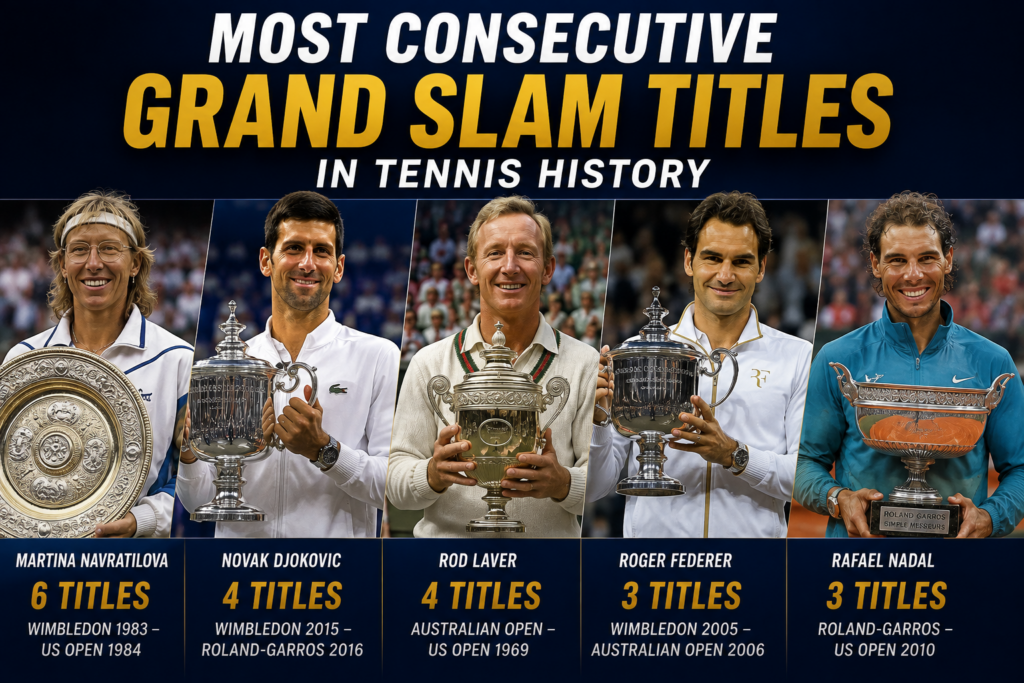
Martina Navratilova — 6 consecutive Grand Slam singles titles
Her sequence ran from:
Wimbledon 1983
through:
US Open 1984
In men’s tennis, winning four consecutive majors represents one of the sport’s defining achievements.
Several legendary players have accomplished versions of this feat, including:
Don Budge
Rod Laver
and
Novak Djokovic
But the circumstances were not identical.
Some won the traditional Calendar Grand Slam.
Djokovic’s four-title sequence crossed two calendar years.
That distinction is crucial.
Martina Navratilova — Six Consecutive Grand Slam Titles
One of the greatest sustained runs in Grand Slam history belongs to:
Martina Navratilova
Her streak began at:
Wimbledon 1983
and continued through:
US Open 1984
She captured six consecutive major singles championships.
The run demonstrated a remarkable ability to dominate on different surfaces and in different conditions.
Navratilova’s Six-Major Sequence
Her run included:
Wimbledon 1983 — Champion
US Open 1983 — Champion
Australian Open 1983 — Champion
Roland-Garros 1984 — Champion
Wimbledon 1984 — Champion
US Open 1984 — Champion
Six consecutive majors played.
Six championships.
The unusual tournament chronology reflects the Grand Slam calendar of that period, when the Australian Open was played late in the year rather than in its current January position.
Why Navratilova’s Streak Was Not a Calendar Grand Slam
This is where tennis terminology becomes important.
Navratilova won six consecutive majors.
But she did not win all four majors within the same January-to-December calendar year during that sequence.
Therefore, the run was not the traditional:
Calendar Grand Slam.
It was instead an extraordinary sequence of consecutive Grand Slam victories spanning more than one calendar year.
This distinction is similar to Novak Djokovic’s famous run more than three decades later.
Novak Djokovic — Four Consecutive Grand Slam Titles
Novak Djokovic produced one of the greatest men’s Grand Slam sequences of the Open Era.
He won:
Wimbledon 2015
US Open 2015
Australian Open 2016
Roland-Garros 2016
Four consecutive majors.
Four different tournaments.
Three different surfaces.
And all four major trophies belonged to Djokovic simultaneously.
The achievement became popularly known as the:
Nole Slam.
How Djokovic Completed the Nole Slam
Djokovic’s run began on the grass of Wimbledon.
Wimbledon 2015
Djokovic defeated Roger Federer in the final.
That gave him the first title in what would become a historic sequence.
US Open 2015
Djokovic again faced Federer in the final.
He won.
Two consecutive majors.
Australian Open 2016
Djokovic reached the final against Andy Murray.
He won in straight sets.
Three consecutive majors.
Now only Roland-Garros remained.
Roland-Garros 2016
The French Open had long been the missing major in Djokovic’s career.
He had reached the final multiple times without winning the title.
In 2016, he returned to the championship match.
His opponent was Andy Murray.
Djokovic lost the first set but recovered to win the match in four.
With that victory, he completed his:
Career Grand Slam
and simultaneously became the holder of:
all four major singles titles.
For more about Djokovic’s overall record, visit our Novak Djokovic profile.
Why Djokovic’s Four Majors Were Not a Calendar Grand Slam
Djokovic won four majors consecutively.
But the victories occurred across:
2015
and
2016
A traditional Calendar Grand Slam requires all four championships to be won within the same calendar year.
Djokovic therefore held all four titles simultaneously without completing the traditional Calendar Grand Slam.
For the full distinction, see What Is a Calendar Grand Slam in Tennis?.
Rod Laver — Four Majors in 1969
Rod Laver accomplished something even more historically significant in:
1969
He won:
Australian Open
Roland-Garros
Wimbledon
US Open
Because all four victories came during the same calendar year, Laver completed the:
Calendar Grand Slam.
That automatically means he also won four consecutive major championships.
More than half a century later, Laver remains the last man to complete the traditional Calendar Grand Slam.
Rod Laver Also Did It in 1962
Remarkably, 1969 was not Laver’s first four-major sweep.
He also won all four major championships in:
1962
That occurred before the Open Era.
Laver therefore completed the Calendar Grand Slam twice:
1962
and
1969
His second is especially important in modern tennis history because it came after professional players had been permitted to compete at the major championships.
To understand why 1968 changed the sport so dramatically, read What Is the Open Era in Tennis?.
Don Budge — Four Consecutive Majors and Beyond
Don Budge was the first singles player to complete the traditional Grand Slam.
He won all four major championships in:
1938
His dominance actually stretched beyond a single season.
Budge’s run remains one of the defining achievements of pre-Open Era tennis.
His success helped establish the idea of sweeping the four major championships as the ultimate tennis accomplishment.
What About Roger Federer?
Roger Federer never held all four Grand Slam titles simultaneously.
But he came remarkably close to creating his own four-major sequence.
During his peak years, Federer repeatedly won:
Wimbledon
US Open
and
Australian Open
before running into one enormous obstacle at Roland-Garros:
Rafael Nadal.
That prevented Federer from completing a four-major sweep.
Federer’s 2005–2006 Grand Slam Run
Federer won:
Wimbledon 2005
US Open 2005
Australian Open 2006
He then reached the:
2006 Roland-Garros final
Had Federer won that match, he would have held all four major titles simultaneously.
But Nadal defeated him.
Federer’s run ended at three consecutive Grand Slam championships.
Federer Did It Again in 2006–2007
Remarkably, Federer created another three-major sequence almost immediately.
He won:
Wimbledon 2006
US Open 2006
Australian Open 2007
Then he reached the Roland-Garros final again.
And again:
Rafael Nadal defeated him.
Federer therefore twice came within one Roland-Garros final of holding all four majors simultaneously.
For the full picture of his career, visit our Roger Federer profile.
Rafael Nadal and Consecutive Grand Slam Titles
Rafael Nadal’s Grand Slam dominance followed a different pattern.
Rather than repeatedly sweeping consecutive majors across the calendar, Nadal’s greatest concentration of dominance occurred at one tournament:
Roland-Garros.
His 14 French Open championships remain one of the most extraordinary records in tennis.
But Nadal also produced multi-major seasons and proved he could win on every major surface.
Nadal’s 2010 Grand Slam Run
Nadal produced one of his greatest stretches in:
2010
He won:
Roland-Garros
then:
Wimbledon
then:
US Open
Three consecutive Grand Slam tournaments.
The US Open victory also completed Nadal’s Career Grand Slam.
However, he did not win the next Australian Open.
The consecutive-title run therefore ended at:
three majors.
For more about his career records, visit our Rafael Nadal profile.
Djokovic vs Federer vs Nadal: Consecutive Major Titles
Among the Big Three, their best consecutive Grand Slam title sequences show an interesting difference:
| Player | Best Consecutive Major-Title Run | Sequence |
|---|---|---|
| Novak Djokovic | 4 | Wimbledon 2015 – Roland-Garros 2016 |
| Roger Federer | 3 | Achieved in multiple runs |
| Rafael Nadal | 3 | Roland-Garros – US Open 2010 |
Djokovic is the only member of the Big Three to win:
four consecutive Grand Slam tournaments.
That meant he held all four major titles simultaneously.
Why Four Consecutive Grand Slam Titles Are So Difficult
Winning four consecutive majors requires far more than being dominant at one tournament.
The player must succeed across the entire Grand Slam landscape.
Three Different Surfaces
The majors currently use:
hard court
clay
grass
A player must adapt to all three.
A game perfectly suited to clay may be less effective on grass.
A dominant hard-court player may struggle with clay movement.
There is nowhere to hide.
Different Conditions
Melbourne is not Paris.
Paris is not Wimbledon.
Wimbledon is not New York.
The weather changes.
The balls can differ.
Court movement changes.
Crowd environments change.
The rhythm of play changes.
Winning everywhere requires adaptability.
Seven Matches Per Tournament
A singles Grand Slam champion normally wins:
seven matches
Four consecutive championships therefore generally require:
28 consecutive Grand Slam match victories
within those four title runs.
One loss ends the title streak.
Consecutive Grand Slam Titles vs Consecutive Grand Slam Match Wins
These are different records.
A title streak counts:
championships won consecutively.
A match-winning streak counts:
individual Grand Slam matches won consecutively.
A player can have a long major match-winning streak without winning every tournament involved.
Likewise, the length of a match streak can extend beyond the exact tournaments in a title sequence.
For example, Djokovic’s famous mid-2010s run reached 30 consecutive Grand Slam match victories before Sam Querrey defeated him at Wimbledon in 2016.
So we should not use the two statistics interchangeably.
Consecutive Majors vs Consecutive Titles at One Grand Slam
This is another major source of confusion.
Suppose a player wins Wimbledon five years in a row.
That means:
five consecutive Wimbledon titles.
It does NOT mean:
five consecutive Grand Slam titles.
Between those Wimbledon victories, many other majors were played.
The two records measure very different forms of dominance.
Roger Federer’s Five Consecutive US Open Titles
Federer produced one of the greatest single-tournament streaks of the Open Era at the US Open.
He won in:
2004
2005
2006
2007
2008
Five consecutive US Open championships.
He remains the only player, male or female, to win five consecutive US Open singles titles in the Open Era.
That is a phenomenal record.
But it should not be confused with winning five consecutive majors.
Federer’s Five Consecutive Wimbledon Titles
Federer also won Wimbledon five consecutive times:
2003
2004
2005
2006
2007
His run ended in the famous 2008 final against Rafael Nadal.
Federer later won Wimbledon three more times, bringing his men’s record to:
8 singles titles
His Wimbledon success and US Open streak demonstrate extraordinary tournament-specific dominance.
Rafael Nadal’s Roland-Garros Title Streaks
Nadal’s Roland-Garros record is even more remarkable.
He won the tournament:
14 times
His championships came in several enormous streaks.
One run lasted from:
2005 through 2008
Another lasted from:
2010 through 2014
And another from:
2017 through 2020
The five-title sequence from 2010 through 2014 is particularly notable.
But again, these are consecutive championships at one tournament, not consecutive titles across all Grand Slam events.
Martina Navratilova’s Wimbledon Dominance
Navratilova’s Grand Slam dominance was particularly visible at Wimbledon.
She won a record:
9 women’s singles titles
including:
6 consecutive championships from 1982 through 1987.
That is one of the greatest tournament-specific streaks in tennis history.
It is separate from her six-consecutive-major run across different Grand Slam tournaments.
Remarkably, Navratilova therefore features prominently in both categories.
Consecutive Grand Slam Titles vs Calendar Grand Slam
A player who wins all four majors in the normal order during one year automatically wins:
four consecutive Grand Slam titles
and completes the:
Calendar Grand Slam.
But the reverse is not necessarily true.
Djokovic won four consecutive majors.
Because the sequence crossed from 2015 into 2016, it was not a Calendar Grand Slam.
That’s the key distinction.
Consecutive Grand Slam Titles vs Career Grand Slam
A Career Grand Slam requires winning each of the four majors at least once during a career.
They do not need to be consecutive.
For example, a player could win:
Wimbledon at age 21,
US Open at 23,
Australian Open at 25,
and Roland-Garros at 29.
That would still complete the Career Grand Slam.
Winning four consecutive majors is much more concentrated.
It requires winning every major that appears on the schedule until all four have been captured.
Consecutive Grand Slam Titles vs Golden Slam
The Golden Slam introduces another achievement:
Olympic singles gold.
A Career Golden Slam requires all four majors plus Olympic singles gold at some point during a career.
A Calendar Golden Slam requires all five achievements during one calendar year.
Steffi Graf remains the only singles player to complete the Calendar Golden Slam, doing so in 1988.
For the complete explanation, see What Is a Golden Slam in Tennis?.
What Is the Most Impressive Consecutive Grand Slam Run?
There is no completely objective answer.
Different streaks have different strengths.
Martina Navratilova
Six consecutive major titles represent an extraordinary sustained run.
Rod Laver
Four majors in the same calendar year in 1969 created the Open Era Calendar Grand Slam.
Novak Djokovic
Four consecutive majors across 2015–2016 made him the first man since Laver to hold all four major singles titles simultaneously.
Roger Federer
Three consecutive majors on multiple occasions demonstrated extraordinary dominance, while Nadal repeatedly stopped the fourth title at Roland-Garros.
Rafael Nadal
Three consecutive majors in 2010 demonstrated that his greatness extended far beyond clay.
Each tells us something different about dominance.
Does Winning Consecutive Grand Slams Matter in the GOAT Debate?
Absolutely.
Total Grand Slam titles measure career accumulation.
Consecutive Grand Slam titles measure something different:
concentrated dominance.
A player who wins four consecutive majors has effectively defeated the entire Grand Slam field across every major environment without surrendering a championship between them.
That says something important about peak level.
Djokovic’s four-major run is therefore a major part of his GOAT case.
Laver’s Calendar Grand Slams are fundamental to his historical standing.
Navratilova’s six-major sequence demonstrates the extraordinary height of her dominance.
Federer’s repeated three-major runs show how close he came to joining the four-major group.
Nadal’s 2010 sequence illustrates one of the strongest all-surface periods of his career.
Peak Dominance vs Career Longevity
This record also raises an important GOAT question.
Which matters more?
A player who wins many majors over 15 years?
Or a player who produces an almost unbeatable two-year peak?
The strongest GOAT cases usually contain both:
longevity
and
peak dominance.
That is why consecutive-title streaks should be considered alongside:
total Grand Slam titles
weeks at World No. 1
year-end No. 1 finishes
career titles
Masters 1000 titles
ATP Finals titles
head-to-head records
and
career winning percentage.
Our guide to how the greatest tennis player of all time is determined explains why no single statistic should decide the debate.
Most Consecutive Grand Slam Titles FAQ
What are consecutive Grand Slam titles?
They are major championships won one after another without another player winning a Grand Slam between them.
Who won six consecutive Grand Slam singles titles?
Martina Navratilova won six consecutive major singles titles from Wimbledon 1983 through the 1984 US Open.
Did Novak Djokovic win four consecutive Grand Slams?
Yes.
Djokovic won Wimbledon 2015, US Open 2015, Australian Open 2016 and Roland-Garros 2016.
What is the Nole Slam?
The Nole Slam refers to Djokovic winning four consecutive Grand Slam tournaments across 2015 and 2016 and holding all four major titles simultaneously.
Was the Nole Slam a Calendar Grand Slam?
No.
The four championships were split across two calendar years.
Did Rod Laver win four consecutive majors?
Yes.
Laver won all four majors during both 1962 and 1969, completing the Calendar Grand Slam twice.
Did Federer ever win four consecutive Grand Slam titles?
No.
Federer won three consecutive majors multiple times but did not complete a four-major sequence.
What stopped Federer from winning four in a row?
Rafael Nadal defeated Federer in the Roland-Garros final during two of Federer’s most important three-major sequences.
How many consecutive Grand Slam titles did Nadal win?
Nadal won three consecutive majors in 2010: Roland-Garros, Wimbledon and the US Open.
What is the difference between consecutive Grand Slam titles and consecutive titles at one major?
Consecutive Grand Slam titles are won across the major schedule.
Consecutive titles at one major refer to winning the same tournament in successive years.
How many consecutive US Opens did Federer win?
Five, from 2004 through 2008.
How many consecutive Wimbledons did Federer win?
Five, from 2003 through 2007.
How many consecutive Wimbledon titles did Navratilova win?
Six, from 1982 through 1987.
Did Djokovic ever hold all four Grand Slam titles at once?
Yes.
After winning Roland-Garros in 2016, Djokovic simultaneously held the Australian Open, Roland-Garros, Wimbledon and US Open titles.
Is holding all four majors the same as a Calendar Grand Slam?
Not always.
If the four titles are won across two calendar years, the player holds all four but has not completed the traditional Calendar Grand Slam.
How many matches are needed to win four consecutive majors?
Under standard singles draws, four major titles normally require 28 tournament victories.
Why are consecutive major titles important?
They measure concentrated dominance and the ability to win repeatedly across different surfaces, tournaments and conditions.
Final Answer: Who Has Won the Most Consecutive Grand Slam Titles?
Winning consecutive Grand Slam titles is one of the clearest demonstrations of peak dominance in tennis.
In women’s singles, Martina Navratilova produced a famous run of:
6 consecutive major championships
from Wimbledon 1983 through the 1984 US Open.
In men’s tennis, four consecutive majors represents one of the sport’s defining achievements.
Rod Laver won all four during the 1969 season.
And decades later, Novak Djokovic won:
Wimbledon 2015
US Open 2015
Australian Open 2016
Roland-Garros 2016
That made Djokovic the first man since Laver to hold all four major titles simultaneously.
Roger Federer twice came within one Roland-Garros final of achieving a four-major sequence.
Rafael Nadal won three consecutive majors in 2010.
But these streaks should not be confused with winning the same Grand Slam repeatedly.
Federer’s five consecutive US Opens and five consecutive Wimbledons are tournament-specific streaks.
Navratilova’s six consecutive Wimbledon titles are another.
Nadal’s Roland-Garros runs belong to the same category.
All are extraordinary.
But winning consecutive majors across the Grand Slam calendar tests something different:
the ability to keep winning as the tournament, surface, conditions and opposition change.
That is why the greatest Grand Slam streaks remain such powerful evidence of peak tennis dominance.
Which Grand Slam Streak Impresses You Most?
Is it Navratilova’s six consecutive majors?
Laver’s 1969 Calendar Grand Slam?
Djokovic holding all four majors simultaneously?
Federer’s five straight US Opens?
Or Nadal’s extraordinary Roland-Garros dominance?
These records measure different forms of greatness.
And that’s exactly why the GOAT debate cannot be reduced to a single number.
VIEW THE LIVE TENNIS GOAT RANKING AND CAST YOUR VOTE
Compare the greatest players in tennis history and make your choice.
Tags: Consecutive Grand Slam Titles, Grand Slam records, Martina Navratilova, Novak Djokovic, Rafael Nadal, Rod Laver, Roger Federer, tennis records
Pingback: What Is the Longest Grand Slam Winning Streak? All-Time Records