
Updated for 2026
Winning seven matches in a row at a Grand Slam is enough to become champion.
Novak Djokovic once kept winning long after one tournament was over.
He won at Wimbledon.
Then he won every match at the US Open.
Then every match at the Australian Open.
Then every match at Roland-Garros.
And when Wimbledon arrived again, he won two more matches before somebody finally stopped him.
The result was:
30 consecutive Grand Slam match victories.
That is the men’s record.
It is one of the clearest examples of sustained dominance tennis has ever produced because these were not victories accumulated at smaller events or on one favorite surface.
They came across four majors, three surfaces and almost an entire year of Grand Slam competition.
Rod Laver came extraordinarily close with 29 consecutive major victories.
Roger Federer twice reached 27.
Djokovic himself produced another 27-match streak earlier in his career.
So how did Djokovic reach 30?
Why did Federer’s greatest runs keep stopping at Roland-Garros?
And how is a Grand Slam winning streak different from winning consecutive Grand Slam titles?
Here is the complete story.
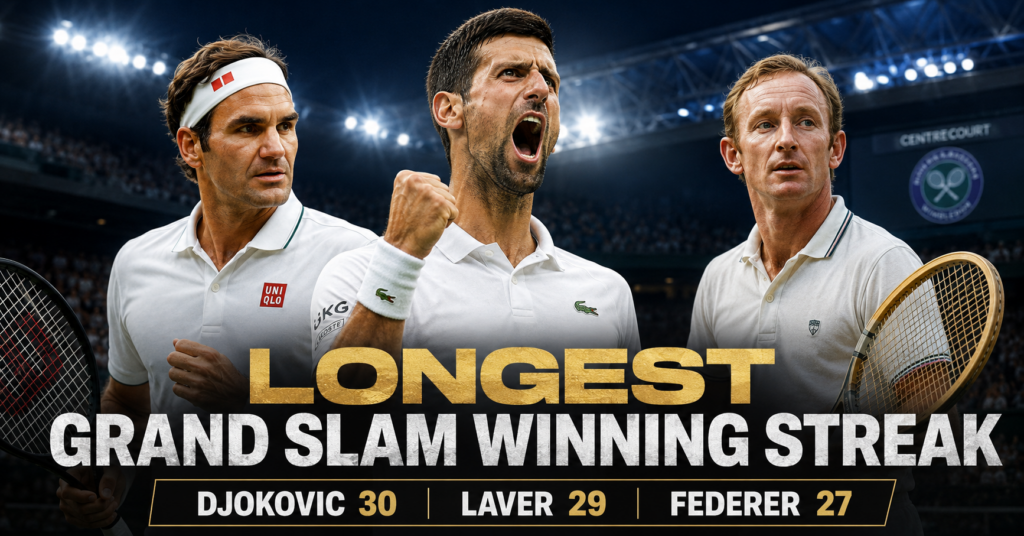
What Is the Longest Grand Slam Winning Streak?
The men’s record belongs to:
Novak Djokovic — 30 consecutive Grand Slam match wins
His streak began at:
Wimbledon 2015
and ended at:
Wimbledon 2016.
The leading men’s streaks are:
| Rank | Player | Consecutive Grand Slam Wins | Streak |
|---|---|---|---|
| 1 | Novak Djokovic | 30 | Wimbledon 2015 – Wimbledon 2016 |
| 2 | Rod Laver | 29 | Australian Open 1969 – Wimbledon 1970 |
| =3 | Roger Federer | 27 | Wimbledon 2005 – Roland-Garros 2006 |
| =3 | Roger Federer | 27 | Wimbledon 2006 – Roland-Garros 2007 |
| =3 | Novak Djokovic | 27 | Wimbledon 2011 – Roland-Garros 2012 |
Three players appear on the leading list.
But Djokovic is the only man to reach:
30.
What Does a Grand Slam Winning Streak Actually Count?
This record counts consecutive singles matches won at Grand Slam tournaments.
The four majors are:
Australian Open
Roland-Garros
Wimbledon
US Open
Matches played at Masters 1000 tournaments, ATP 500 events, ATP Finals, Olympics or other tour events do not affect the streak.
If a player wins six matches at Wimbledon but loses the final, the Grand Slam winning streak ends with that final defeat.
If he wins Wimbledon and then wins seven more matches at the US Open, the streak continues from one major to the next.
That distinction is essential.
Novak Djokovic’s Record: 30 Straight Grand Slam Wins
Djokovic’s record run began during the summer of:
2015.
By that stage, he was already one of the greatest players of his generation.
What followed elevated his dominance to another level.
Across four consecutive majors, Djokovic did something extraordinarily rare:
he did not lose once.
For more on his complete career, visit our Novak Djokovic profile.
Wimbledon 2015: Where the Streak Began
Djokovic entered Wimbledon as the defending champion.
The tournament included several demanding moments, including a fourth-round battle with Kevin Anderson.
Djokovic eventually reached the final.
Waiting there was:
Roger Federer.
Federer had already won Wimbledon seven times and had defeated Andy Murray impressively in the semifinal.
But Djokovic controlled the championship match and won in four sets.
Seven victories.
One major championship.
The streak had begun.
Nobody yet knew how far it would go.
US Open 2015: Djokovic Beats Federer Again
Two months later, Djokovic arrived in New York.
Once again he moved through the draw.
Once again Federer stood across the net in the final.
And once again Djokovic won.
The US Open championship added another:
7 consecutive Grand Slam victories.
His running total was now:
14.
More importantly, Djokovic had won the final two majors of 2015.
Australian Open 2016: Dominance Continues
Melbourne was already one of Djokovic’s strongest tournaments.
The 2016 Australian Open reinforced that reputation.
He survived a five-set fourth-round match against Gilles Simon and later produced an extraordinary performance against Federer in the semifinal.
In the final, Djokovic defeated:
Andy Murray.
Another championship.
Another seven victories.
The Grand Slam streak had reached:
21 straight matches.
But the most difficult challenge was still ahead.
Roland-Garros 2016: The Missing Trophy
Roland-Garros had repeatedly frustrated Djokovic.
He had already won the other three majors.
He had reached the French Open final.
But Paris remained missing from his collection.
That changed in:
2016.
Djokovic advanced through the tournament and reached another final against Andy Murray.
Murray won the opening set.
Djokovic responded by taking control of the match.
He eventually won:
3–6, 6–1, 6–2, 6–4.
Roland-Garros was finally his.
Four Grand Slam Titles at the Same Time
Djokovic’s victory in Paris was bigger than one tournament.
He now held:
Wimbledon 2015
US Open 2015
Australian Open 2016
Roland-Garros 2016
simultaneously.
Four consecutive major championships.
The achievement became widely known as the:
Nole Slam.
His Grand Slam winning streak had reached:
28 consecutive matches.
You can compare this accomplishment with other streaks in our article on the most consecutive Grand Slam titles.
Wimbledon 2016: Djokovic Reaches 30
Djokovic returned to Wimbledon as holder of all four major trophies.
He won his first-round match.
29 consecutive Grand Slam wins.
He won again in the second round.
30.
Nobody in the men’s record books had produced a longer run.
Then came:
Sam Querrey.
Sam Querrey Ends the Record Streak
Djokovic faced American Sam Querrey in the third round.
Querrey won the first two sets.
Rain interrupted the contest.
Djokovic fought back by taking the third set.
But Querrey refused to surrender the advantage.
He won the fourth-set tiebreak and completed one of the biggest Grand Slam upsets of the decade.
Final score:
7–6, 6–1, 3–6, 7–6
The streak was over.
Djokovic had won:
30 consecutive Grand Slam matches.
One more victory would never come.
And that is exactly what makes records like this so difficult.
What Did Djokovic Accomplish During Those 30 Wins?
The streak contained:
4 consecutive Grand Slam titles
across:
3 different surfaces.
Grass
Wimbledon 2015
Hard court
US Open 2015
Australian Open 2016
Clay
Roland-Garros 2016
Then came two additional Wimbledon victories in 2016.
This matters because the streak was not created by repeatedly playing in identical conditions.
Djokovic had to move from:
grass,
to hard court,
to another hard-court major,
to clay,
and back to grass.
That versatility is one of the defining characteristics of the record.
Rod Laver — 29 Consecutive Grand Slam Wins
Djokovic narrowly surpassed one of tennis’s most historically significant champions:
Rod Laver.
Laver won:
29 consecutive Grand Slam matches.
His run began during:
1969.
And 1969 was not an ordinary season.
Laver won:
all four majors.
Laver’s 1969 Calendar Grand Slam
Laver captured:
Australian Open
Roland-Garros
Wimbledon
US Open
during the same calendar year.
That is the traditional:
Calendar Grand Slam.
No man has repeated the achievement in the Open Era.
For the complete history, see our Calendar Grand Slam in tennis guide.
Why Laver’s 29-Match Streak Is Different
Laver’s streak occurred in a very different period of tennis history.
Tournament draws differed.
Participation patterns differed.
Travel was different.
The professional game itself had only recently entered the Open Era.
Directly comparing raw numbers across generations therefore requires context.
But one thing is clear:
Laver was almost impossible to beat at the majors during that period.
He came within one victory of the modern record listed by the ATP.
Roger Federer — 27 Straight Grand Slam Wins
Roger Federer reached:
27 consecutive Grand Slam victories
not once, but:
twice.
That is one of the more remarkable details on the leaderboard.
For Federer’s wider record, visit our Roger Federer profile.
Federer’s First 27-Match Run
The first began at:
Wimbledon 2005.
Federer won the championship.
Then he won:
US Open 2005.
Then:
Australian Open 2006.
Three consecutive majors.
By the time Roland-Garros arrived, Federer was chasing a fourth.
He reached the final.
And there he met the opponent who would repeatedly disrupt his attempt to dominate all four majors:
Rafael Nadal.
Nadal Stops Federer in Paris
Federer won the first set of the 2006 Roland-Garros final.
Nadal responded.
The Spaniard eventually won in four sets.
Federer’s Grand Slam winning streak ended at:
27 matches.
He had reached the final match required to extend it further.
But Roland-Garros and Nadal stood in the way.
Federer’s Second 27-Match Run
Remarkably, Federer immediately started another one.
He won:
Wimbledon 2006
then:
US Open 2006
then:
Australian Open 2007.
Once again:
three consecutive majors.
Once again:
27 consecutive victories by the time the French Open final arrived.
And once again, the opponent was:
Rafael Nadal.
History Repeats Itself at Roland-Garros 2007
Federer had another opportunity to complete four consecutive majors.
Nadal stopped him again.
The 2007 French Open final ended Federer’s second:
27-match Grand Slam winning streak.
So Federer produced two enormous streaks with almost identical endings.
Both started at Wimbledon.
Both included three straight major championships.
Both ended against Nadal in the Roland-Garros final.
Novak Djokovic’s Earlier 27-Match Streak
Before Djokovic set the record of 30, he had already reached:
27 consecutive major victories.
This run began at:
Wimbledon 2011.
Djokovic won Wimbledon.
Then:
US Open 2011.
Then:
Australian Open 2012.
Three consecutive majors.
Next came Roland-Garros.
Nadal Again Becomes the Barrier in Paris
Djokovic reached the:
2012 Roland-Garros final.
His opponent:
Rafael Nadal.
Had Djokovic won, he would have held all four Grand Slam titles simultaneously.
But Nadal won the match.
Djokovic’s streak stopped at:
27.
Four years later, he returned to Paris and finished the job.
The Curious Role of Rafael Nadal
Look closely at the leading streaks.
Federer’s first 27-match streak:
ended against Nadal at Roland-Garros.
Federer’s second 27-match streak:
ended against Nadal at Roland-Garros.
Djokovic’s 27-match streak:
ended against Nadal at Roland-Garros.
Three enormous Grand Slam winning streaks.
The same opponent ended all three.
That fact captures just how difficult Nadal made Roland-Garros for the other great players of his generation.
Explore Nadal’s wider career record in our Rafael Nadal profile.
Djokovic Finally Solved the Roland-Garros Problem
The difference during Djokovic’s record 30-match streak was:
he got through Paris.
In 2016, Nadal withdrew from Roland-Garros because of injury before a potential meeting with Djokovic.
Djokovic continued through the draw and defeated Murray in the final.
That victory allowed him to move beyond the 27-match barrier that had stopped him in 2012.
He eventually reached 30 at Wimbledon.
Longest Grand Slam Winning Streak vs Consecutive Grand Slam Titles
These two records sound similar but measure different things.
Consecutive Grand Slam match wins
Count every uninterrupted match victory at the majors.
Djokovic’s record:
30 matches.
Consecutive Grand Slam titles
Count championships won one after another.
Djokovic won:
4 consecutive majors
from Wimbledon 2015 through Roland-Garros 2016.
The first statistic counts matches.
The second counts tournaments.
That is why the two topics deserve separate pages.
Winning Four Majors in a Row vs a Calendar Grand Slam
Another distinction matters.
Djokovic held all four major titles after Roland-Garros 2016.
But he did not complete the traditional Calendar Grand Slam.
Why?
Because his four titles spanned:
two calendar years.
He won:
Wimbledon 2015
US Open 2015
Australian Open 2016
Roland-Garros 2016
A Calendar Grand Slam requires all four to be won during:
the same calendar year.
Rod Laver achieved that in 1969.
How Many Consecutive Matches Does It Take to Win Four Majors?
Under the standard modern 128-player singles draw:
one major title generally requires:
7 victories.
Four titles would therefore normally require:
28 consecutive match wins.
Djokovic reached exactly that number when he completed Roland-Garros 2016.
He then won two more matches at Wimbledon.
That extended the record to:
30.
Why 30 Straight Grand Slam Wins Is So Difficult
There are ordinary winning streaks.
Then there are Grand Slam winning streaks.
The difference is the level of opposition and the cost of one bad match.
There Is No Safety Net
A league season can survive one defeat.
A Grand Slam streak cannot.
Lose once:
the streak ends immediately.
A bad serving day can end it.
An injury can end it.
An inspired opponent can end it.
A five-set thriller can end it.
Thirty straight victories require the player to escape every one of those possibilities.
Different Surfaces Keep Changing the Test
The majors are not played under identical conditions.
Players move between:
hard court,
clay,
and
grass.
A game that is almost perfect for one tournament can be less effective at another.
A long major streak therefore demands adaptation.
Djokovic’s record run crossed all three surfaces.
Every Round Brings a Different Problem
A champion may face:
a huge server,
a defensive counterpuncher,
a clay specialist,
an aggressive returner,
a young player with nothing to lose,
or another all-time champion.
Staying undefeated across 30 major matches requires solving problem after problem.
Is Djokovic’s 30-Match Streak More Impressive Than Four Straight Titles?
They describe the same historic period from different angles.
Four consecutive major championships highlight:
the trophies.
Thirty consecutive major victories highlight:
the uninterrupted path through the draws.
The match streak also includes Djokovic’s first two victories at Wimbledon 2016.
So it stretches slightly beyond the four-title sequence.
Both statistics are useful.
But they answer different questions.
Federer vs Djokovic: Grand Slam Winning Streaks
Their best streaks:
| Player | Best Streak | Second Notable Streak |
|---|---|---|
| Novak Djokovic | 30 | 27 |
| Roger Federer | 27 | 27 |
Federer’s achievement has a remarkable consistency of its own.
He reached 27 twice.
Djokovic reached 27 once and later pushed the record three matches further.
The comparison reflects how closely their periods of major dominance resemble each other in some statistical categories.
For the complete rivalry, visit Novak Djokovic vs Roger Federer head-to-head.
Why Nadal Does Not Appear in the Top Five
This may seem surprising.
Nadal won:
22 Grand Slam titles
and produced the greatest single-major dominance in men’s tennis history at Roland-Garros.
But long cross-major winning streaks reward a slightly different type of dominance.
Nadal’s greatest strength was extraordinarily concentrated in Paris.
Djokovic and Federer produced periods in which they won several majors consecutively across different surfaces.
That creates longer uninterrupted Grand Slam match streaks.
It doesn’t make Nadal’s major résumé weaker.
It simply demonstrates that different records reward different forms of greatness.
Winning Streaks and Grand Slam Match Wins
Career match wins measure accumulated success.
A streak measures:
uninterrupted success.
Djokovic owns both types of record.
Through Wimbledon 2026, he leads the men’s career Grand Slam match-win standings.
You can see the complete leaderboard in our most Grand Slam match wins analysis.
The difference is important.
A player can accumulate hundreds of victories while losing regularly between deep runs.
To create a 30-match streak, there can be:
no Grand Slam loss at all
until the streak finally ends.
Winning Streaks and Grand Slam Semifinals
The same principle applies to semifinal records.
Repeated semifinals measure how often a player reached the final four.
A winning streak measures whether he continued winning from one major to another without interruption.
Djokovic also leads the men’s semifinal leaderboard.
See our most Grand Slam semifinals article for that comparison.
Together, these records show different dimensions of sustained major performance.
Could Anyone Break Djokovic’s 30-Match Record?
Yes.
Unlike some longevity records that require decades, this one can theoretically be broken within roughly one year.
But “theoretically” is doing a lot of work.
To reach 31 consecutive Grand Slam victories under a standard draw, a player would need something like:
four straight major championships plus additional victories at the next major
or another combination of uninterrupted deep runs around the calendar.
That means surviving more than:
four complete Grand Slam tournaments
without losing.
In modern men’s tennis, that is extraordinarily difficult.
What Would a 31-Match Grand Slam Streak Look Like?
Imagine a player wins:
Australian Open — 7 matches
Roland-Garros — 7
Wimbledon — 7
US Open — 7
That is:
28 consecutive victories.
He would then need to win:
three more matches
at the following Australian Open.
Only then would he reach:
31
and surpass Djokovic.
The mathematics sound simple.
Tennis history shows that the execution is anything but.
Could Carlos Alcaraz or Jannik Sinner Challenge the Record?
A player does not need a 20-year career to attack this particular mark.
He needs an extraordinary period of concentrated dominance.
Carlos Alcaraz and Jannik Sinner have already demonstrated the ability to win multiple majors.
That gives future generations realistic candidates.
But 30 straight victories requires something more than winning often.
It requires temporarily eliminating:
all Grand Slam defeats.
One early-round upset resets the count to zero.
That is what makes streak records so unforgiving.
Does an Injury or Withdrawal End a Winning Streak?
Statistical treatment can depend on whether an official match is recorded.
A withdrawal before a match does not always function the same way as an on-court defeat.
That is why official record sources should be used when comparing historical streaks rather than simply counting calendar appearances.
For this leaderboard, we follow the ATP’s published Grand Slam winning-streak records.
What Makes Djokovic’s 2015–16 Run Historically Important?
The 30 wins are impressive on their own.
But the streak also produced:
Wimbledon champion
US Open champion
Australian Open champion
Roland-Garros champion
At the end of Roland-Garros, Djokovic simultaneously possessed every men’s major singles trophy.
That placed his run alongside some of the rarest achievements in tennis history.
It wasn’t simply a collection of early-round victories.
Almost the entire streak was spent:
winning championships.
Longest Grand Slam Winning Streak FAQ
Who has the longest Grand Slam winning streak in men’s tennis?
Novak Djokovic holds the record with 30 consecutive Grand Slam match wins.
When did Djokovic’s streak happen?
From Wimbledon 2015 through the third round of Wimbledon 2016.
Who ended Djokovic’s 30-match streak?
Sam Querrey at Wimbledon in 2016.
What was the score when Querrey beat Djokovic?
Querrey won 7–6, 6–1, 3–6, 7–6.
Who has the second-longest Grand Slam winning streak?
Rod Laver, with 29 consecutive wins.
What is Roger Federer’s longest Grand Slam winning streak?
27 matches.
Federer achieved that number twice.
Did Djokovic also have a 27-match Grand Slam streak?
Yes.
His earlier run stretched from Wimbledon 2011 through the 2012 Roland-Garros final.
Who ended Djokovic’s 27-match streak?
Rafael Nadal in the 2012 Roland-Garros final.
Who ended Federer’s Grand Slam streaks?
Rafael Nadal ended both of Federer’s 27-match streaks in Roland-Garros finals.
How many matches must a player win to win one Grand Slam?
Normally seven in a 128-player singles draw.
How many matches are needed to win four consecutive majors?
Normally 28.
Did Djokovic win four consecutive Grand Slam titles?
Yes.
He won Wimbledon 2015, US Open 2015, Australian Open 2016 and Roland-Garros 2016.
Is that a Calendar Grand Slam?
No.
The four titles were split across two calendar years.
Who completed the men’s Calendar Grand Slam in the Open Era?
Rod Laver in 1969.
Is a Grand Slam winning streak the same as consecutive Grand Slam titles?
No.
A winning streak counts consecutive matches won.
A title streak counts consecutive tournaments won.
Why did Djokovic’s streak reach 30 instead of 28?
After winning four consecutive majors, he won his first two matches at Wimbledon 2016 before losing in the third round.
Final Answer: What Is the Longest Grand Slam Winning Streak?
The men’s record is:
30 consecutive Grand Slam match victories
by:
Novak Djokovic.
His run stretched from:
Wimbledon 2015
to:
Wimbledon 2016.
During the streak, Djokovic won:
Wimbledon 2015
US Open 2015
Australian Open 2016
Roland-Garros 2016
He therefore won:
28 straight matches while collecting four consecutive majors
before adding two more victories at Wimbledon 2016.
Sam Querrey finally stopped him in the third round.
Behind Djokovic:
Rod Laver — 29
Roger Federer — 27
Roger Federer — 27
Novak Djokovic — 27
The leaderboard contains an intriguing historical pattern.
Laver’s run was built around his 1969 Calendar Grand Slam.
Federer’s two great streaks both died against Rafael Nadal in Roland-Garros finals.
Djokovic’s earlier 27-match run suffered the same fate.
Then, in 2016, Djokovic finally made it through Paris.
That breakthrough transformed an already extraordinary run into the longest Grand Slam winning streak in men’s tennis history.
Which Streak Is More Impressive?
Djokovic won 30 straight major matches.
Laver won all four majors in the same calendar year.
Federer produced two separate 27-match streaks.
Nadal repeatedly stopped historically long streaks at Roland-Garros.
Each achievement says something different about dominance.
The question is how much those peaks should matter when comparing complete careers.
VIEW THE LIVE TENNIS GOAT RANKING AND CAST YOUR VOTE
Compare the records, peaks and careers of tennis’s greatest players and decide which achievements matter most.
Tags: Consecutive Wins, Grand Slam records, Grand Slam Winning Streak, Novak Djokovic, Rod Laver, Roger Federer, tennis GOAT, tennis records