
Last Updated: August 2026
Novak Djokovic, Rafael Nadal and Roger Federer didn’t simply dominate men’s tennis.
They dominated while repeatedly having to beat each other.
That is what makes the Big Three era so extraordinary.
Together, Djokovic, Nadal and Federer won 66 Grand Slam singles titles:
Novak Djokovic — 24
Rafael Nadal — 22
Roger Federer — 20
But what happened when the three greatest players of their generation actually faced one another?
Who has the best head-to-head record?
The answer is fascinating.
Novak Djokovic leads Rafael Nadal 31–29.
Novak Djokovic leads Roger Federer 27–23.
Rafael Nadal leads Roger Federer 24–16.
That means Djokovic finished his rivalries with winning records against both Nadal and Federer.
Nadal finished with a winning record against Federer but a losing record against Djokovic.
Federer finished with losing records against both.
However, those numbers alone do not tell the entire story.
Clay dramatically influenced Nadal’s rivalry with Federer.
Djokovic and Nadal played an extraordinary 60 matches.
Djokovic and Federer produced legendary battles on hard courts and at Wimbledon.
And Grand Slam matches sometimes tell a different story from the overall head-to-head.
So who really had the best record among the Big Three?
Let’s break down the numbers.
Djokovic vs Nadal vs Federer Head-to-Head: Quick Answer
Here are the final overall rivalry records:
| Rivalry | Head-to-Head |
|---|---|
| Novak Djokovic vs Rafael Nadal | 31–29 Djokovic |
| Novak Djokovic vs Roger Federer | 27–23 Djokovic |
| Rafael Nadal vs Roger Federer | 24–16 Nadal |
Now combine each player’s matches against the other two:
| Player | Wins | Losses | Win Rate |
|---|---|---|---|
| Rafael Nadal | 53 | 47 | 53.0% |
| Novak Djokovic | 58 | 52 | 52.7% |
| Roger Federer | 39 | 51 | 43.3% |
There is an interesting distinction here.
Most Big Three Head-to-Head Wins
Novak Djokovic — 58
Best Combined Big Three Winning Percentage
Rafael Nadal — 53.0%
Nadal’s percentage is fractionally higher because he played fewer total matches against Federer and Djokovic.
But Djokovic holds arguably the more significant distinction:
Djokovic is the only member of the Big Three with winning head-to-head records against both of the other two.
That gives Djokovic an exceptionally powerful head-to-head argument in the Djokovic vs Nadal vs Federer GOAT debate.
Novak Djokovic vs Rafael Nadal Head-to-Head
Djokovic Leads Nadal 31–29
The final official record is:
Novak Djokovic — 31 wins
Rafael Nadal — 29 wins
Total Meetings — 60
Only two matches separated them.
That is remarkable considering the rivalry lasted nearly two decades.
Djokovic and Nadal first met at Roland-Garros in 2006.
Their final official meeting came at the 2024 Paris Olympics.
Djokovic won that final encounter.
The rivalry therefore finished:
31–29 Djokovic
Their 60 meetings make Djokovic vs Nadal the most-played men’s rivalry of the Open Era.
For the match-by-match story, visit our complete Novak Djokovic vs Rafael Nadal head-to-head analysis.
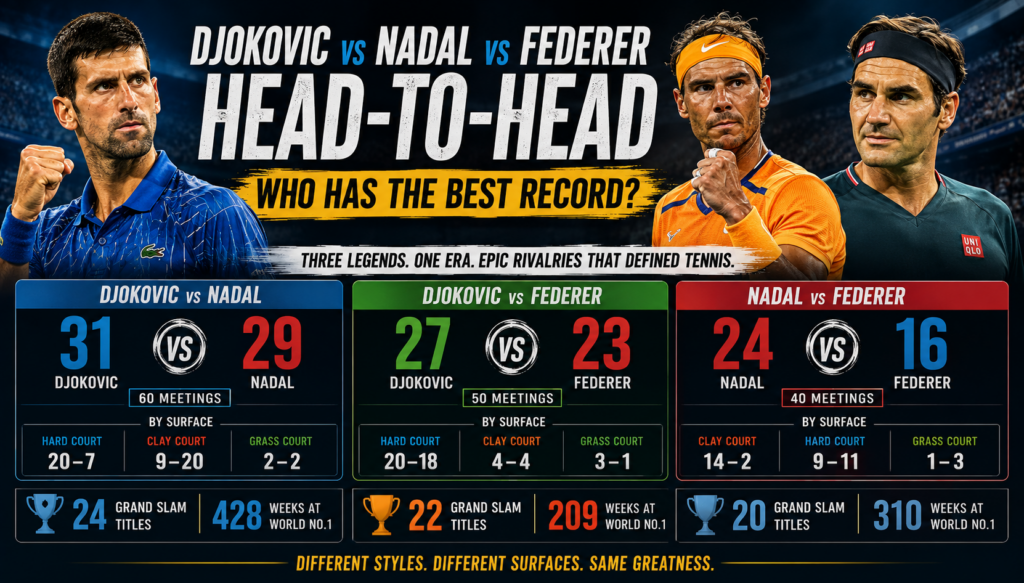
Djokovic vs Nadal by Surface
Surface is essential when understanding this rivalry.
Hard Court
Djokovic leads 20–7
Clay
Nadal leads 20–9
Grass
Djokovic leads 2–2?
Their grass rivalry was much smaller than their hard-court and clay rivalry, with the overall balance far closer than on the two primary surfaces.
The larger pattern is obvious:
Hard court strongly favored Djokovic.
Clay strongly favored Nadal.
That contrast defined much of their rivalry.
Why Djokovic Dominated Nadal More on Hard Courts
Hard courts suited many of Djokovic’s greatest strengths.
His return of serve is among the greatest in tennis history.
His movement allowed him to defend without surrendering court position.
His backhand could absorb Nadal’s heavy left-handed forehand.
And his ability to redirect the ball down the line prevented Nadal from controlling rallies as easily as he could against many other opponents.
Djokovic’s 20–7 hard-court advantage represents one of the strongest parts of his rivalry résumé.
Why Nadal Dominated Djokovic on Clay
Then everything changed on clay.
Nadal leads their clay rivalry:
20–9
Roland-Garros was especially important.
Nadal’s movement, heavy topspin, physical endurance and extraordinary defensive ability made him historically difficult to defeat on clay.
Even Djokovic — arguably Nadal’s greatest overall rival — struggled to overcome him consistently on the surface.
That should not be surprising.
Nadal won Roland-Garros 14 times.
No man has dominated one Grand Slam tournament to the same extent.
Djokovic vs Nadal at Grand Slams
Djokovic and Nadal met 18 times at Grand Slam tournaments.
Nadal leads their major head-to-head:
Nadal — 11
Djokovic — 7
This is an important counterpoint to Djokovic’s 31–29 overall advantage.
Across all tournaments:
Djokovic leads.
At the Grand Slams:
Nadal leads.
But once again, surface matters enormously.
A large portion of those major encounters took place at Roland-Garros, Nadal’s strongest tournament.
Djokovic vs Nadal in Grand Slam Finals
Djokovic and Nadal played nine Grand Slam finals against each other.
Their championship rivalry included finals at all four majors.
Australian Open
Djokovic defeated Nadal in the legendary 2012 final.
Roland-Garros
Nadal defeated Djokovic in multiple championship matches.
Wimbledon
Djokovic defeated Nadal in the 2011 final.
US Open
They played three finals, with Nadal winning two and Djokovic one.
Few rivalries in tennis history have been contested at such a high level across every Grand Slam.
The 2012 Australian Open Final
Perhaps the greatest Djokovic-Nadal battle came in Melbourne.
The 2012 Australian Open final lasted:
5 hours and 53 minutes
Djokovic eventually won:
5–7, 6–4, 6–2, 6–7, 7–5
It became the longest Grand Slam singles final in history.
Both players were physically exhausted.
Neither surrendered.
The match became a symbol of what made the Djokovic-Nadal rivalry different:
defense
endurance
mental strength
physicality
and
extraordinary baseline consistency
Djokovic Defeats Nadal at Roland-Garros
Defeating Nadal at Roland-Garros became one of the most difficult achievements in tennis.
Djokovic managed to do it twice.
He defeated Nadal in Paris in:
2015
and
2021
The 2021 semifinal was particularly significant because Nadal entered as the defending champion and had dominated the tournament throughout his career.
Djokovic defeated him in four sets and went on to win the championship.
Very few players ever solved Nadal on Court Philippe-Chatrier.
Djokovic did it more than once.
Novak Djokovic vs Roger Federer Head-to-Head
Djokovic Leads Federer 27–23
Djokovic and Federer played 50 official matches.
Their final record:
Novak Djokovic — 27
Roger Federer — 23
This rivalry was even closer than the final number might suggest.
Federer won many of their early encounters.
As Djokovic entered his prime, the balance gradually shifted.
Their final match came at the 2020 Australian Open, where Djokovic defeated Federer in the semifinal.
For the full rivalry history, see our Novak Djokovic vs Roger Federer head-to-head page.
Djokovic vs Federer by Surface
Their rivalry was unusually competitive across surfaces.
Hard Court
Djokovic leads 20–18
Clay
Tied 4–4
Grass
Djokovic leads 3–1
The clay statistic is particularly interesting.
Unlike Nadal’s rivalries, there was no enormous surface advantage separating Djokovic and Federer.
Their clay rivalry ended exactly even.
Djokovic vs Federer at Grand Slams
They met 17 times at Grand Slam tournaments.
Djokovic leads:
11–6
This is one of the most important numbers in their rivalry.
Federer was extraordinarily successful against Djokovic early in Djokovic’s career.
But as the rivalry developed, Djokovic increasingly won their biggest matches.
That included several Grand Slam finals.
Djokovic vs Federer in Grand Slam Finals
They met in five Grand Slam finals.
Djokovic won four.
Federer won one.
Their championship meetings included:
2007 US Open
Federer won
2014 Wimbledon
Djokovic won
2015 Wimbledon
Djokovic won
2015 US Open
Djokovic won
2019 Wimbledon
Djokovic won
That 4–1 final record is one of Djokovic’s strongest head-to-head statistics against Federer.
The 2019 Wimbledon Final
No discussion of Djokovic vs Federer is complete without the 2019 Wimbledon final.
Federer was attempting to win his ninth Wimbledon title.
Djokovic was defending his championship.
The match lasted nearly five hours.
Federer eventually held two championship points on his own serve.
He was one point away from defeating Djokovic and becoming Wimbledon champion at age 37.
Djokovic saved both.
The match continued.
Djokovic eventually won the deciding tiebreak.
Final score:
7–6, 1–6, 7–6, 4–6, 13–12
The statistics made the result even more remarkable.
Federer won more total points.
Federer won more games.
Federer hit more winners.
But Djokovic won the points that ultimately decided the championship.
It remains one of the clearest examples of Djokovic’s extraordinary ability to perform under pressure.
Federer Stopped Djokovic’s 2011 Winning Streak
Federer also produced one of the most important victories of the rivalry.
Djokovic entered the 2011 Roland-Garros semifinal undefeated for the season.
Federer stopped him.
He defeated Djokovic in four sets.
The victory ended Djokovic’s extraordinary winning streak and sent Federer into the French Open final against Nadal.
It remains one of Federer’s finest victories over Djokovic.
Rafael Nadal vs Roger Federer Head-to-Head
Nadal Leads Federer 24–16
Nadal and Federer played 40 official matches.
Their final record:
Rafael Nadal — 24
Roger Federer — 16
Nadal therefore won 60% of their encounters.
Their rivalry was the defining matchup of men’s tennis before Djokovic fully established himself alongside them.
Their contrasting personalities and playing styles helped make Federer-Nadal one of the most famous rivalries in sports.
For the complete breakdown, read Rafael Nadal vs Roger Federer head-to-head.
Nadal vs Federer by Surface
This is where the rivalry becomes especially interesting.
Clay
Nadal leads 14–2
Hard Court
Federer leads 11–9
Grass
Federer leads 3–1
Nadal’s overall 24–16 advantage was therefore heavily influenced by clay.
Remove clay, and Federer leads their rivalry:
Federer 14–10
That does NOT mean clay matches should be ignored.
Clay is a major part of professional tennis.
Roland-Garros is one of the four most important tournaments in the sport.
But it demonstrates why raw head-to-head numbers require context.
Why Nadal Was Such a Difficult Matchup for Federer
Nadal’s game created a specific tactical problem for Federer.
Nadal is left-handed.
His heavy topspin forehand repeatedly attacked Federer’s one-handed backhand.
On clay, the higher bounce made that pattern even more difficult for Federer.
Nadal could repeatedly push Federer high and wide on the backhand side before attacking the open court.
That tactical matchup contributed significantly to Nadal’s dominance on clay.
Federer Adjusted Late in the Rivalry
Interestingly, Federer became much more successful against Nadal later in their careers.
Federer won six of their final seven meetings.
One important change was Federer’s willingness to take the backhand earlier and play more aggressively.
Instead of allowing Nadal’s forehand to push him far behind the baseline, Federer increasingly attacked the ball.
The adjustment came relatively late in their rivalry, but it produced some of Federer’s best results against Nadal.
Nadal vs Federer at Grand Slams
Nadal and Federer met 14 times at Grand Slam tournaments.
Nadal leads:
10–4
Again, Roland-Garros played a major role.
Nadal repeatedly defeated Federer in Paris.
But their rivalry also produced legendary matches elsewhere.
Nadal vs Federer in Grand Slam Finals
They met in nine Grand Slam finals.
Nadal won six.
Federer won three.
Those finals included some of the most important matches of their careers.
Their 2008 Wimbledon final became one of the most famous matches ever played.
Their 2009 Australian Open final produced another emotional Nadal victory.
Then, years later, Federer defeated Nadal in the 2017 Australian Open final.
The 2008 Wimbledon Final
Federer entered Wimbledon in 2008 as the five-time defending champion.
Nadal had just won Roland-Garros for the fourth consecutive year.
They met in the final.
Nadal won the first two sets.
Federer fought back.
He won the next two.
The fifth set stretched deep into the evening.
Eventually:
Nadal won 9–7 in the fifth.
The victory gave Nadal his first Wimbledon championship.
It also ended Federer’s five-year reign at the tournament.
The match became one of the defining moments of the Big Three era.
The 2017 Australian Open Final
Nearly nine years after their famous Wimbledon battle, Federer and Nadal met in another major final.
Both had dealt with injuries.
Both were attempting to return to the top of men’s tennis.
The 2017 Australian Open final went five sets.
Nadal led by a break in the fifth.
Federer responded.
He won five consecutive games to capture the championship.
It was Federer’s 18th Grand Slam title and one of the most celebrated victories of his career.
Big Three Head-to-Head Comparison
Now put all three rivalries together.
| Player | vs Djokovic | vs Nadal | vs Federer | Combined |
|---|---|---|---|---|
| Novak Djokovic | — | 31–29 | 27–23 | 58–52 |
| Rafael Nadal | 29–31 | — | 24–16 | 53–47 |
| Roger Federer | 23–27 | 16–24 | — | 39–51 |
There are several ways to interpret this.
Djokovic
Winning record against Nadal.
Winning record against Federer.
Most total Big Three H2H wins.
Nadal
Losing record against Djokovic by only two matches.
Strong 24–16 advantage over Federer.
Slightly higher combined Big Three winning percentage than Djokovic.
Federer
Losing overall records against both.
But positive non-clay record against Nadal and an extremely competitive rivalry with Djokovic.
Who Has the Best Big Three Head-to-Head Record?
If the question is:
Who is the only Big Three player with winning records against both rivals?
The answer is:
Novak Djokovic
Djokovic leads Nadal:
31–29
Djokovic leads Federer:
27–23
That is extremely difficult to ignore.
He competed against both of his greatest rivals dozens of times and finished ahead of each.
If we instead ask:
Who has the highest combined win percentage?
The answer is narrowly:
Rafael Nadal
Nadal’s combined record:
53–47 — 53.0%
Djokovic:
58–52 — 52.7%
The difference is tiny.
And Djokovic played ten more Big Three matches.
So the fairest conclusion is:
Djokovic has the strongest overall pairwise head-to-head position because he leads both rivals.
Nadal has the highest combined winning percentage by a fraction.
Big Three Grand Slam Head-to-Head
Grand Slam matches deserve separate attention because these were the most important tournaments.
Across their individual rivalries:
Djokovic vs Nadal
Nadal leads 11–7
Djokovic vs Federer
Djokovic leads 11–6
Nadal vs Federer
Nadal leads 10–4
Now combine them:
| Player | Big Three Grand Slam H2H |
|---|---|
| Rafael Nadal | 21–11 |
| Novak Djokovic | 18–17 |
| Roger Federer | 10–21 |
This is where Nadal’s case becomes much stronger.
His Grand Slam head-to-head record against Federer and Djokovic combined is extraordinary.
But once again, Roland-Garros is an important part of the explanation.
Nadal’s dominance in Paris heavily influenced those numbers.
Why Surface Matters in Head-to-Head Records
A head-to-head record without surface context can be misleading.
Consider Nadal vs Federer.
Overall:
Nadal 24–16
That appears decisive.
But by surface:
Clay — Nadal 14–2
Hard — Federer 11–9
Grass — Federer 3–1
The rivalry tells two different stories.
On clay:
Nadal dominated.
Away from clay:
Federer led.
Neither fact should be ignored.
The complete record requires both.
Djokovic vs Nadal Shows the Same Surface Effect
The same phenomenon appears in Djokovic vs Nadal.
Hard Court
Djokovic 20–7
Clay
Nadal 20–9
Their rivalry was almost a mirror image depending on surface.
This is one reason they created such a fascinating matchup.
Each player had an environment where he held a significant advantage.
But each was also good enough to defeat the other on his preferred surface.
Which Big Three Player Was Best on Each Surface?
Head-to-head records are only part of this question, but their career achievements give us a clear general picture.
Hard Courts — Novak Djokovic
Djokovic owns the men’s Australian Open record with 10 titles and produced extraordinary results throughout his career on hard courts.
Clay — Rafael Nadal
This is the clearest category.
Nadal won Roland-Garros 14 times.
His clay-court dominance is unmatched.
Grass — Roger Federer or Novak Djokovic
Federer owns the men’s Wimbledon record:
8 titles
Djokovic won:
7 titles
But Djokovic leads their direct grass rivalry 3–1 and defeated Federer in three Wimbledon finals.
This makes the grass GOAT discussion more complicated than simply counting championships.
Who Won the Most Grand Slams?
Head-to-head is only one GOAT criterion.
The overall Grand Slam totals are:
| Player | Grand Slam Titles |
|---|---|
| Novak Djokovic | 24 |
| Rafael Nadal | 22 |
| Roger Federer | 20 |
Djokovic leads.
Nadal is second.
Federer is third.
For the complete major breakdown, see Who Has Won the Most Grand Slam Tennis Titles?.
Who Spent the Most Weeks at World No. 1?
The ranking comparison also favors Djokovic.
Novak Djokovic — 428 weeks
Roger Federer — 310 weeks
Rafael Nadal — 209 weeks
Djokovic’s advantage here is substantial.
Federer also owns one particularly famous ranking record:
237 consecutive weeks at No. 1.
Our complete weeks at World No. 1 rankings provide the full historical leaderboard.
Who Won the Most Masters 1000 Titles?
Another important measure is success below Grand Slam level.
Among the Big Three:
Novak Djokovic — 40
Rafael Nadal — 36
Roger Federer — 28
Again, Djokovic leads.
These results matter because Masters tournaments consistently feature the strongest players in the world.
Big Three Signature Grand Slam Records
Each player also owns a remarkable tournament-specific legacy.
Novak Djokovic
Australian Open — 10 titles
Rafael Nadal
Roland-Garros — 14 titles
Roger Federer
Wimbledon — 8 titles
Nadal’s 14 French Open championships represent the greatest numerical single-major dominance of the three.
Djokovic’s Australian Open dominance is extraordinary.
Federer’s eight Wimbledon titles remain the men’s record.
This is another reminder that greatness can appear in different forms.
Who Had the Toughest Matchup?
This is subjective, but the head-to-head records provide clues.
Federer struggled most with Nadal.
Nadal’s left-handed forehand into Federer’s one-handed backhand created a difficult tactical pattern, particularly on clay.
Nadal struggled most with Djokovic on hard courts.
Djokovic’s return, backhand and ability to absorb Nadal’s topspin allowed him to control rallies differently from most players.
Djokovic’s rivalry with Federer was more balanced by surface.
Their clay record was tied, their hard-court rivalry was close, and their grass meetings were relatively limited.
The Big Three therefore created something like a complex tactical triangle rather than a simple hierarchy.
Did Age Differences Affect the Big Three Head-to-Head?
Yes, and this deserves consideration.
Federer was born in 1981.
Nadal was born in 1986.
Djokovic was born in 1987.
Federer is almost five years older than Nadal and nearly six years older than Djokovic.
That meant their career peaks did not align perfectly.
Federer was already dominating men’s tennis before Nadal and Djokovic reached their primes.
Later, Federer continued competing deep into his thirties while facing younger versions of his two rivals.
That does not invalidate the head-to-head results.
But historical analysis should acknowledge the age difference.
Did Clay Inflate Nadal’s Head-to-Head Advantage Over Federer?
“Inflate” is probably the wrong word.
Clay matches count exactly like matches on every other official surface.
Nadal earned those victories.
But clay clearly explains much of his overall advantage.
Nadal leads Federer:
14–2 on clay
Federer leads Nadal:
14–10 away from clay
So if someone uses only the 24–16 overall number without mentioning surface distribution, important context is missing.
The correct conclusion is not that Nadal’s clay victories matter less.
It is that:
Nadal was overwhelmingly superior in their clay matchup.
Federer held the advantage on other surfaces combined.
Both are true.
Did Djokovic Have a Matchup Advantage Over Nadal?
On hard courts, absolutely.
Djokovic’s 20–7 record demonstrates a significant advantage.
But Nadal countered with a 20–9 advantage on clay.
Overall:
Djokovic 31–29 Nadal
That is about as close as a 60-match rivalry can realistically become.
A difference of only two matches after nearly two decades suggests neither player consistently dominated the other across all conditions.
Who Was Best in Big Matches?
There is no perfect definition of a “big match.”
Grand Slam finals?
All Grand Slam matches?
Masters finals?
Matches for No. 1?
Olympic matches?
Different definitions produce different answers.
But two statistics stand out.
Nadal leads Djokovic in Grand Slam matches.
11–7
Djokovic leads Federer in Grand Slam matches.
11–6
Nadal leads Federer in Grand Slam matches.
10–4
This gives Nadal a particularly strong Grand Slam head-to-head argument.
Djokovic, however, owns winning overall records against both.
That tension is exactly why head-to-head comparisons are so interesting.
Does Head-to-Head Decide the Tennis GOAT?
No.
It matters.
But it should not decide the question by itself.
Imagine evaluating entire careers using only direct meetings.
That would ignore:
Grand Slam titles
weeks at No. 1
year-end No. 1 finishes
Masters titles
ATP Finals
Olympic results
longevity
surface versatility
consistency
and
performance against the rest of the tour
Head-to-head is evidence.
It is not the entire case.
Our guide to how the greatest tennis player of all time is determined explains why multiple criteria need to be considered together.
Djokovic’s Head-to-Head GOAT Argument
Djokovic’s argument is simple and powerful.
He leads Federer:
27–23
He leads Nadal:
31–29
He also leads the Big Three in:
Grand Slam titles
weeks at World No. 1
Masters 1000 titles
Those categories reinforce one another.
Head-to-head therefore isn’t an isolated Djokovic statistic.
It fits into a broader statistical résumé.
Nadal’s Head-to-Head GOAT Argument
Nadal’s case is also strong.
He leads Federer:
24–16
He trails Djokovic by only two matches:
29–31
And he owns the best combined Big Three Grand Slam head-to-head record.
Then there is Roland-Garros:
14 championships
Nadal’s peak surface dominance is unmatched among the Big Three.
For supporters of Nadal’s GOAT case, his results against Federer and his Grand Slam H2H performance provide important evidence.
Federer’s Head-to-Head GOAT Argument
Federer’s overall head-to-head numbers are the weakest of the three.
He trails Nadal:
16–24
He trails Djokovic:
23–27
But context matters.
Federer was the oldest member of the trio.
He also leads Nadal outside clay.
He remained highly competitive against Djokovic even as he moved deep into his thirties.
And Federer’s career achievements remain extraordinary:
20 Grand Slam titles
8 Wimbledon titles
310 weeks at No. 1
His GOAT argument therefore depends more heavily on his entire career résumé than on direct head-to-head numbers.
Djokovic vs Nadal vs Federer: Complete GOAT Snapshot
| Category | Djokovic | Nadal | Federer |
|---|---|---|---|
| Grand Slam Titles | 24 | 22 | 20 |
| Weeks at No. 1 | 428 | 209 | 310 |
| Masters 1000 Titles | 40 | 36 | 28 |
| vs Djokovic | — | 29–31 | 23–27 |
| vs Nadal | 31–29 | — | 16–24 |
| vs Federer | 27–23 | 24–16 | — |
| Australian Open Titles | 10 | 2 | 6 |
| Roland-Garros Titles | 3 | 14 | 1 |
| Wimbledon Titles | 7 | 2 | 8 |
| US Open Titles | 4 | 4 | 5 |
No single row explains everything.
But taken together, the table shows why these three players dominated the GOAT conversation for so long.
Djokovic vs Nadal vs Federer Head-to-Head FAQ
What is the Djokovic vs Nadal head-to-head record?
Djokovic leads Nadal 31–29.
They played 60 official matches.
What is the Djokovic vs Federer head-to-head record?
Djokovic leads Federer 27–23.
They played 50 official matches.
What is the Nadal vs Federer head-to-head record?
Nadal leads Federer 24–16.
They played 40 official matches.
Who has the best head-to-head record among Djokovic, Nadal and Federer?
Djokovic is the only member of the Big Three with winning individual head-to-head records against both of the others.
He leads Nadal 31–29 and Federer 27–23.
Who has the most wins against the other Big Three players?
Djokovic, with 58 combined wins against Nadal and Federer.
Who has the highest combined Big Three win percentage?
Nadal, very narrowly.
His combined record is 53–47, a 53.0% winning percentage.
Djokovic is 58–52, or approximately 52.7%.
Who leads Djokovic vs Nadal at Grand Slams?
Nadal leads 11–7.
Who leads Djokovic vs Federer at Grand Slams?
Djokovic leads 11–6.
Who leads Nadal vs Federer at Grand Slams?
Nadal leads 10–4.
Who played each other the most: Djokovic, Nadal or Federer?
Djokovic and Nadal.
They played 60 official matches, the most prolific men’s rivalry of the Open Era.
Who was better between Federer and Nadal on clay?
Nadal.
He leads their clay-court head-to-head 14–2.
Who leads Federer vs Nadal outside clay?
Federer leads 14–10 outside clay.
Who leads Djokovic vs Nadal on hard courts?
Djokovic leads 20–7.
Who leads Djokovic vs Nadal on clay?
Nadal leads 20–9.
Who leads Djokovic vs Federer on hard courts?
Djokovic leads 20–18.
Who leads Djokovic vs Federer on clay?
They finished tied 4–4.
Did Djokovic beat Federer in Wimbledon finals?
Yes.
Djokovic defeated Federer in the Wimbledon finals of 2014, 2015 and 2019.
Did Nadal beat Federer in a Wimbledon final?
Yes.
Nadal defeated Federer in the famous 2008 Wimbledon final.
Did Djokovic beat Nadal at Roland-Garros?
Yes.
Djokovic defeated Nadal at Roland-Garros in 2015 and 2021.
Who won more Grand Slams: Djokovic, Nadal or Federer?
Djokovic leads with 24, followed by Nadal with 22 and Federer with 20.
Should head-to-head decide who the GOAT is?
No.
Head-to-head is an important measure, but Grand Slam titles, rankings, Masters titles, longevity, versatility, peak performance and other career achievements should also be considered.
What the Big Three Head-to-Head Really Tells Us
The most interesting conclusion isn’t simply that one player beat another more often.
It’s how differently the rivalries developed.
Djokovic vs Nadal
Almost perfectly balanced overall.
But dramatically divided by surface.
Djokovic vs Federer
Extremely competitive, with Djokovic increasingly taking control of their biggest matches later in the rivalry.
Nadal vs Federer
A major overall Nadal advantage driven heavily by extraordinary clay dominance, while Federer held the edge away from clay.
These differences help explain why the Big Three era was so compelling.
There was no simple matchup.
Surface mattered.
Age mattered.
Tournament mattered.
Form mattered.
And pressure mattered.
Final Answer: Who Has the Best Head-to-Head Record — Djokovic, Nadal or Federer?
The final individual head-to-head records are:
Novak Djokovic vs Rafael Nadal
Djokovic leads 31–29
Novak Djokovic vs Roger Federer
Djokovic leads 27–23
Rafael Nadal vs Roger Federer
Nadal leads 24–16
If we ask who holds the strongest overall head-to-head position among the Big Three, the answer is:
Novak Djokovic
He is the only one who finished with winning records against both of his principal rivals.
Djokovic defeated Nadal 31 times.
He defeated Federer 27 times.
That gives him 58 victories against the other two members of the Big Three.
But Nadal has an important counterargument.
His combined 53–47 record gives him a fractionally higher winning percentage, and his Grand Slam head-to-head results are exceptionally strong.
Federer’s overall head-to-head numbers are weaker, but surface distribution and the age gap provide important context.
Ultimately, head-to-head tells us something extremely valuable:
These three legends didn’t build their records in isolation.
They built them while repeatedly standing in one another’s way.
That is what makes their combined achievements so extraordinary.
Who Is Your Tennis GOAT?
Djokovic leads both Nadal and Federer head-to-head.
Nadal dominated Federer overall and owns an extraordinary Grand Slam H2H record.
Federer owns the men’s Wimbledon title record and helped define the era before his younger rivals reached their peaks.
So how much should head-to-head matter?
Should Djokovic’s winning records against both rivals settle the argument?
Should Nadal’s Grand Slam H2H and unmatched clay dominance carry more weight?
Or should the complete career résumé matter more than direct matchups?
VIEW THE LIVE TENNIS GOAT RANKING AND CAST YOUR VOTE
Compare the greatest players, see how tennis fans are voting and make your choice.
Tags: ATP records, Australian Open rivalry, Big Three head to head, Big Three tennis, Djokovic head to head, Djokovic Nadal Federer, Djokovic Nadal Federer head to head, Djokovic records, Djokovic vs Federer, Djokovic vs Nadal, Federer head to head, Federer records, French Open rivalry, GOAT Debate, Grand Slam head to head, Grand Slam records, greatest tennis player of all time, greatest tennis rivalries, Nadal head to head, Nadal records, Nadal vs Federer, Novak Djokovic, Rafael Nadal, Roger Federer, tennis GOAT, tennis head to head, Tennis History, tennis records, tennis rivalries, US Open rivalry, Wimbledon rivalry