
Last Updated: August 2026
The ATP Finals is unlike almost any other tournament in men’s tennis.
There is no field of 128 players.
There are no easy early rounds.
Only the best players of the season qualify.
That means winning the ATP Finals requires defeating elite opposition repeatedly — often five matches against some of the best players in the world.
So who has won the ATP Finals the most times?
The answer is:
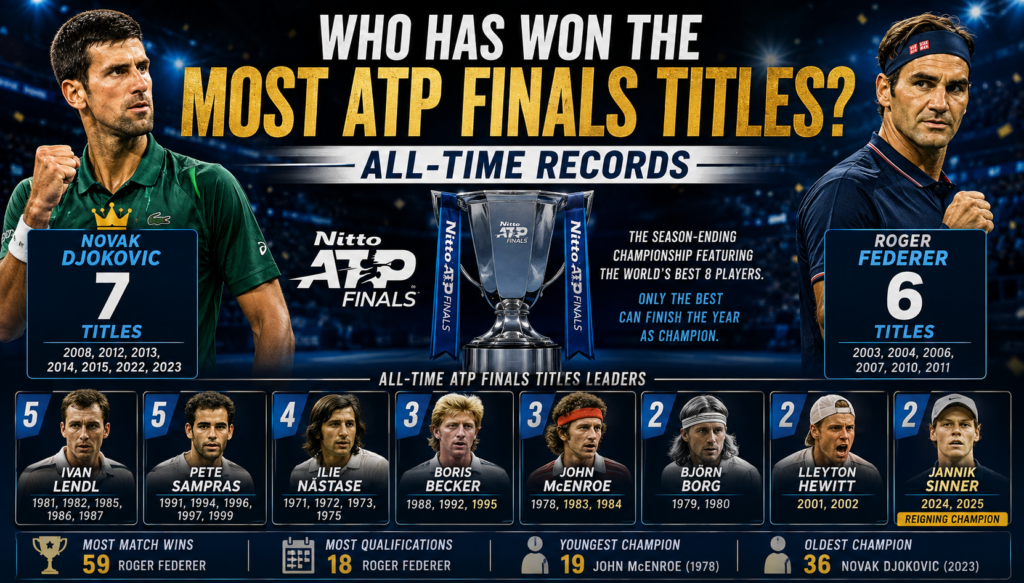
Novak Djokovic — 7 titles
Djokovic holds the all-time record with seven ATP Finals singles championships.
He moved ahead of Roger Federer, who won six.
Behind them are two more legends:
Ivan Lendl — 5
Pete Sampras — 5
The ATP Finals record is particularly important when comparing the greatest men’s tennis players because the tournament brings together the season’s leading performers.
And there is one fascinating Big Three statistic:
Djokovic — 7
Federer — 6
Nadal — 0
Rafael Nadal won 22 Grand Slam titles and 36 Masters 1000 titles, but he never won the ATP Finals.
That makes this tournament an especially interesting part of the tennis GOAT debate.
Let’s examine the complete record.
Who Has Won the Most ATP Finals Titles? Quick Answer
Novak Djokovic holds the men’s record with:
7 ATP Finals titles
Roger Federer is second with:
6 titles
The leading champions are:
| Player | ATP Finals Titles |
|---|---|
| Novak Djokovic | 7 |
| Roger Federer | 6 |
| Ivan Lendl | 5 |
| Pete Sampras | 5 |
| Ilie Năstase | 4 |
| Boris Becker | 3 |
| John McEnroe | 3 |
| Björn Borg | 2 |
| Lleyton Hewitt | 2 |
| Jannik Sinner | 2 |
Several other champions have won the tournament once.
But Djokovic stands alone at the top.
What Is the ATP Finals?
The ATP Finals is the prestigious season-ending championship of men’s professional tennis.
Unlike a Grand Slam or Masters 1000 tournament, qualification is extremely limited.
The singles event features the season’s leading players based primarily on their performance in the ATP Race.
That creates an unusual tournament.
At a Grand Slam, a top player may face lower-ranked opponents during the opening rounds.
At the ATP Finals, there is nowhere to hide.
Elite opponents appear immediately.
How Does the ATP Finals Format Work?
The singles tournament begins with eight players divided into two groups.
Each player competes in a round-robin format.
The best performers from each group advance to the semifinals.
The semifinal winners then meet in the championship match.
This means a player can sometimes lose one match during the group stage and still win the tournament.
It also creates something rare in professional tennis:
Two players can potentially face each other twice during the same event.
Why Is the ATP Finals So Difficult to Win?
The answer is simple:
Quality of opposition.
Only the season’s elite players qualify.
A champion may need to defeat several Top 10 opponents during one tournament.
There are no conventional first or second rounds against a large field.
Every match matters.
That is one reason ATP Finals championships deserve consideration when evaluating the greatest tennis player of all time.
Novak Djokovic — Record 7 ATP Finals Titles
Novak Djokovic has won the ATP Finals seven times.
His championships came in:
2008
2012
2013
2014
2015
2022
2023
That gives Djokovic the most ATP Finals titles in men’s tennis history.
His record is particularly impressive because his championships span 15 years.
His first came in 2008.
His seventh came in 2023.
That combination of peak dominance and longevity is difficult to match.
Djokovic Wins His First ATP Finals Title in 2008
Djokovic’s first season-ending championship came in 2008.
The tournament was then known as the Tennis Masters Cup and was played in Shanghai.
Djokovic defeated Nikolay Davydenko in the final.
He was still early in his career.
Earlier that year, Djokovic had won his first Grand Slam title at the Australian Open.
Winning the season finale gave another indication of what was coming.
Djokovic’s Four Consecutive ATP Finals Titles
Djokovic later produced one of the greatest periods of dominance in tournament history.
He won four consecutive ATP Finals championships:
2012
2013
2014
2015
Four years.
Four championships.
And because the tournament included the world’s leading players each season, maintaining that streak was extraordinary.
During this period Djokovic was also becoming the dominant player in men’s tennis.
Djokovic Defeats Federer in the 2012 Final
Djokovic’s second ATP Finals title came against Roger Federer.
Federer entered as the two-time defending champion.
Djokovic defeated him in straight sets:
7–6, 7–5
It was a significant result.
Federer was already the greatest ATP Finals champion in history at the time.
Djokovic was beginning to challenge his dominance.
Djokovic Defeats Nadal in the 2013 Final
One year later, Djokovic faced Rafael Nadal in the championship match.
Djokovic won:
6–3, 6–4
For Nadal, it represented another missed opportunity to capture one of the few major trophies absent from his résumé.
For Djokovic, it was his third ATP Finals championship.
Djokovic Wins Again in 2014
Djokovic returned to the final in 2014.
He was scheduled to face Roger Federer.
But Federer withdrew before the championship match because of a back injury.
Djokovic therefore received a walkover and was awarded the title.
It became his third consecutive ATP Finals championship.
Djokovic vs Federer in the 2015 ATP Finals
The 2015 tournament produced another Djokovic-Federer showdown.
Interestingly, Federer defeated Djokovic during the round-robin stage.
But both players advanced.
They met again in the final.
This time Djokovic won:
6–3, 6–4
That gave him his fourth consecutive ATP Finals title.
It also demonstrated one of the unusual characteristics of the tournament:
A player can lose to an opponent in the group stage and then defeat the same opponent for the championship.
Djokovic Returns to the Top in 2022
After his 2015 championship, Djokovic went several years without winning the ATP Finals.
Then came 2022.
Djokovic defeated Casper Ruud in the final:
7–5, 6–3
That gave him his sixth championship.
And it tied Roger Federer’s all-time record.
The leaderboard now read:
Djokovic — 6
Federer — 6
One more championship would put Djokovic alone at the top.
He needed only one year.
Djokovic Breaks Federer’s Record in 2023
Djokovic returned to Turin in 2023.
He reached the final against Jannik Sinner.
Sinner had actually defeated Djokovic during the round-robin stage.
But Djokovic survived the group and advanced.
In the final, the result was completely different.
Djokovic defeated Sinner:
6–3, 6–3
And history was made.
Novak Djokovic — 7 ATP Finals titles
Roger Federer — 6
For the first time, Djokovic held the record outright.
It became another major statistic in his extraordinary career résumé.
Read our complete Novak Djokovic profile for more of his records.
Roger Federer — 6 ATP Finals Titles
Before Djokovic broke the record, Roger Federer stood alone with six championships.
Federer won in:
2003
2004
2006
2007
2010
2011
His six titles came during one of the most successful periods of his career.
Federer was particularly effective in indoor conditions, where his serve, attacking tennis and ability to take the ball early made him extremely difficult to beat.
Federer Wins Back-to-Back Titles in 2003 and 2004
Federer’s first ATP Finals championship came in 2003.
He successfully defended it in 2004.
Those victories occurred during the beginning of his rise to complete dominance of men’s tennis.
By the end of 2004, Federer had established himself as the clear World No. 1.
The ATP Finals became another tournament where his all-court game excelled.
Federer Wins Again in 2006 and 2007
Federer added consecutive championships in:
2006
and
2007
That gave him four ATP Finals titles by age 26.
His success at the tournament mirrored his dominance elsewhere.
During those seasons Federer was simultaneously collecting Grand Slam titles and spending uninterrupted years at World No. 1.
Federer Beats Nadal in 2010
Federer won his fifth ATP Finals championship in 2010.
His opponent in the final was Rafael Nadal.
Federer won:
6–3, 3–6, 6–1
Nadal had enjoyed an extraordinary season that included victories at Roland-Garros, Wimbledon and the US Open.
But Federer stopped him at the season finale.
For Nadal, it remains one of the closest opportunities he had to winning the ATP Finals.
Federer Wins His Sixth Title in 2011
Federer successfully defended the championship in 2011.
He defeated Jo-Wilfried Tsonga in the final.
That gave Federer:
6 ATP Finals titles
At the time, it was the outright record.
Federer would never win the championship again.
But his record stood until Djokovic tied it in 2022 and broke it in 2023.
For more on Federer’s career, visit our Roger Federer profile.
Federer Still Holds the ATP Finals Match-Wins Record
Djokovic has the most championships.
But Federer still owns another enormous ATP Finals record.
Roger Federer — 59 match wins
Federer competed in the tournament across an extraordinary span of his career and accumulated more match victories than anyone else.
That distinction demonstrates why tournament records should not always be reduced to titles alone.
Djokovic owns the championship record.
Federer owns the match-win record.
Both are remarkable.
Ivan Lendl — 5 ATP Finals Titles
Ivan Lendl won the season-ending championship five times.
His titles came in:
1981
1982
1985
1986
1987
Lendl was one of the dominant players of the 1980s.
His consistency at the season finale was extraordinary.
He did not simply win five championships.
He repeatedly reached the final.
That made Lendl one of the greatest performers in the history of the event long before Federer and Djokovic arrived.
Lendl Wins Three Consecutive Titles
Lendl won three consecutive championships from:
1985 through 1987
That streak demonstrated the level of control he held over men’s tennis during the middle of the decade.
Before Djokovic’s four-title run, Lendl’s consecutive success represented one of the standards of ATP Finals dominance.
Pete Sampras — 5 ATP Finals Titles
Pete Sampras also won five ATP Finals championships.
His titles came in:
1991
1994
1996
1997
1999
Sampras was the dominant men’s player of the 1990s.
His ATP Finals success complemented a career that included:
14 Grand Slam titles
six consecutive year-end No. 1 finishes
and
seven Wimbledon championships
His five season-ending titles reinforced his ability to defeat the strongest players in the world.
Sampras Wins His Fifth Title in 1999
Sampras captured his fifth and final ATP Finals championship in 1999.
He defeated Andre Agassi in the final.
The victory added another chapter to one of the defining American rivalries of the era.
It also left Sampras tied with Lendl on five championships.
For years, those five titles represented the benchmark behind Federer’s eventual record.
Ilie Năstase — 4 ATP Finals Titles
Ilie Năstase won four championships:
1971
1972
1973
1975
He was one of the first great champions of the event.
Năstase won the tournament three consecutive times from 1971 through 1973.
He added another title in 1975.
His success established the season-ending championship as a major part of his career legacy.
Boris Becker — 3 ATP Finals Titles
Boris Becker won three season-ending championships.
His victories came in:
1988
1992
1995
Becker’s powerful serve and attacking style translated extremely well to indoor conditions.
He also reached additional finals during his career.
That places him among the most successful players in tournament history.
John McEnroe — 3 ATP Finals Titles
John McEnroe also won three titles.
His championships came in:
1978
1983
1984
McEnroe won his first title as a teenager.
His attacking tennis and exceptional net play made him extremely dangerous in the conditions used by the tournament during his era.
Jannik Sinner — 2 ATP Finals Titles
Jannik Sinner has rapidly entered the tournament’s record books.
As of August 2026, Sinner has won the ATP Finals twice:
2024
2025
His progression at the event has been remarkable.
2023 — Finalist
2024 — Champion
2025 — Champion
That means Sinner reached the championship match in three consecutive editions.
Sinner Loses to Djokovic in 2023
Sinner reached his first ATP Finals championship match in 2023.
He faced Novak Djokovic.
Sinner had defeated Djokovic earlier in the tournament during the group stage.
But the final was different.
Djokovic won in straight sets.
For Sinner, the defeat became part of his development into one of the world’s leading players.
One year later, he returned.
And this time he won.
Sinner Wins the 2024 ATP Finals
Sinner produced a dominant tournament in 2024.
He reached the final against Taylor Fritz.
Sinner won:
6–4, 6–4
The victory gave him his first ATP Finals championship.
And because the tournament was held in Turin, Sinner became a home champion in Italy.
It was one of the defining victories of his breakthrough period at the top of men’s tennis.
Sinner Successfully Defends His Title in 2025
Sinner returned in 2025 and won again.
That gave him:
2 ATP Finals titles
His back-to-back championships moved him alongside other multiple champions such as Björn Borg and Lleyton Hewitt.
More importantly, Sinner demonstrated that his 2024 victory was not an isolated achievement.
He had become a consistent force at the season-ending championship.
As of August 2026, the next ATP Finals have not yet been played.
So Sinner remains the defending champion.
Rafael Nadal — The Great Champion Who Never Won the ATP Finals
Perhaps the most surprising name in ATP Finals history is a player who does not appear among the champions.
Rafael Nadal
Nadal won:
22 Grand Slam titles
36 Masters 1000 titles
Olympic singles gold
and spent 209 weeks at World No. 1.
But:
Nadal never won the ATP Finals.
It is one of the few major achievements missing from his extraordinary résumé.
How Close Did Nadal Come?
Nadal reached the ATP Finals championship match twice.
2010
Lost to Roger Federer.
2013
Lost to Novak Djokovic.
Those two opponents are now the two most successful players in ATP Finals history.
Nadal therefore reached the final twice but encountered two of the tournament’s greatest champions.
Why Didn’t Nadal Win the ATP Finals?
There is no single explanation.
But several factors likely contributed.
Indoor Hard Courts
The ATP Finals has traditionally been played indoors on hard courts during Nadal’s era.
That was not his strongest environment.
Nadal’s greatest dominance came on outdoor clay.
Timing
The ATP Finals takes place at the end of a long season.
Nadal’s physically demanding style and injury history sometimes made late-season competition more difficult.
Opposition
Federer and Djokovic were exceptional indoor hard-court players.
Nadal repeatedly had to compete against them and other elite players.
None of this diminishes Nadal’s career.
But it does make the ATP Finals one of the clearest differences between his résumé and those of Djokovic and Federer.
Djokovic vs Federer vs Nadal at the ATP Finals
The Big Three comparison is striking:
| Player | ATP Finals Titles |
|---|---|
| Novak Djokovic | 7 |
| Roger Federer | 6 |
| Rafael Nadal | 0 |
This is one of the largest gaps between the three players in any major career category.
Compare it with Grand Slam titles:
Djokovic — 24
Nadal — 22
Federer — 20
Or Masters 1000 titles:
Djokovic — 40
Nadal — 36
Federer — 28
At the ATP Finals:
Djokovic — 7
Federer — 6
Nadal — 0
The difference is impossible to ignore when comparing their complete careers.
For the broader statistical battle, see Djokovic vs Nadal vs Federer: Who Is the Greatest?.
Djokovic vs Federer at the ATP Finals
Djokovic and Federer produced several important matches at the season finale.
Their ATP Finals rivalry included championship matches in:
2012
Djokovic defeated Federer.
2015
Djokovic defeated Federer.
They were also scheduled to play the 2014 final, but Federer withdrew because of injury.
Their battles at the tournament became another chapter in the larger Novak Djokovic vs Roger Federer head-to-head rivalry.
Djokovic vs Nadal at the ATP Finals
Djokovic and Nadal also met in important matches at the event.
The biggest came in the:
2013 final
Djokovic won in straight sets.
The result prevented Nadal from capturing his first ATP Finals championship.
Their rivalry ultimately became the most-played men’s rivalry of the Open Era.
You can explore the full record in our Novak Djokovic vs Rafael Nadal head-to-head analysis.
Federer vs Nadal at the ATP Finals
Federer and Nadal also produced memorable season-ending encounters.
The most important was the:
2010 final
Federer defeated Nadal in three sets.
That gave Federer his fifth championship.
For Nadal, it represented his first appearance in the ATP Finals title match.
Their contrasting results at the tournament also reflect the broader surface dynamics of their rivalry.
See our complete Rafael Nadal vs Roger Federer head-to-head breakdown.
ATP Finals vs Grand Slams
The ATP Finals is prestigious.
But it is not a Grand Slam tournament.
The four Grand Slams are:
Australian Open
Roland-Garros
Wimbledon
US Open
Grand Slams use a much larger draw and require the champion to win seven matches.
The ATP Finals uses an eight-player field and a round-robin system.
So the tournaments test players differently.
Grand Slam titles remain the most prominent championships in tennis.
But the ATP Finals provides a unique test:
Can you repeatedly beat the best players of that particular season?
That makes it a valuable additional measure of greatness.
ATP Finals vs Masters 1000
The ATP Finals should also not be confused with an ATP Masters 1000 tournament.
Masters 1000 events take place throughout the season.
The ATP Finals occurs at the end of the season and requires qualification.
There are multiple Masters 1000 tournaments in a normal season.
There is only:
One ATP Finals.
That scarcity increases the significance of every championship.
Djokovic’s seven titles therefore represent seven separate seasons in which he finished the year by winning the elite season finale.
For the Masters leaderboard, read Who Has Won the Most ATP Masters 1000 Titles?.
ATP Finals and the World No. 1 Ranking
The ATP Finals can also play an important role in battles for the year-end No. 1 ranking.
Because only elite players qualify and significant ranking points are available, results at the tournament can influence the final standings.
One of the clearest examples came in 2016.
Andy Murray and Novak Djokovic entered the season finale fighting for year-end No. 1.
They ultimately met in the final.
Murray won.
He secured the ATP Finals championship and finished the season as World No. 1.
It was one of the most important victories of Murray’s career.
For the broader ranking record, read Who Has Spent the Most Weeks at World No. 1 in Tennis?.
Andy Murray Wins the 2016 ATP Finals
Murray’s only ATP Finals title came in 2016.
But its timing made it especially significant.
Murray had climbed to World No. 1 late in the season.
Djokovic still had an opportunity to finish the year on top.
Then the two met in the championship match.
Murray defeated Djokovic:
6–3, 6–4
The victory gave Murray both the ATP Finals trophy and the year-end No. 1 ranking.
It was a remarkable conclusion to the best season of his career.
Other ATP Finals Champions
The tournament’s champions list contains many of the greatest players in men’s tennis history.
One-time champions include players such as:
Jimmy Connors
Stefan Edberg
Andre Agassi
Gustavo Kuerten
David Nalbandian
Nikolay Davydenko
Daniil Medvedev
Alexander Zverev has won the event multiple times and is another major champion of the modern tournament era.
The diversity of champions demonstrates how difficult it is to dominate the tournament repeatedly.
Winning once is difficult.
Winning six or seven times is extraordinary.
Most ATP Finals Titles: Big Three vs Other Legends
| Player | ATP Finals Titles | Grand Slam Titles |
|---|---|---|
| Novak Djokovic | 7 | 24 |
| Roger Federer | 6 | 20 |
| Pete Sampras | 5 | 14 |
| Ivan Lendl | 5 | 8 |
| Rafael Nadal | 0 | 22 |
The Nadal comparison immediately stands out.
He has more Grand Slam titles than Federer, Sampras or Lendl.
Yet all three won the ATP Finals repeatedly.
This shows why different statistics measure different types of greatness.
Who Has the Most ATP Finals Match Wins?
Roger Federer holds the record.
Roger Federer — 59 wins
Federer’s longevity at the tournament was exceptional.
He qualified repeatedly and consistently advanced deep into the event.
Djokovic is the title leader, but Federer remains the match-win leader.
That gives Federer another important place in the tournament’s history even after Djokovic surpassed his championship record.
Who Qualified for the ATP Finals the Most Times?
Roger Federer also holds the qualification record.
He qualified for the season-ending championship:
18 times
That level of consistency is remarkable.
Qualification requires an elite season.
Doing it repeatedly across almost two decades demonstrates Federer’s extraordinary longevity.
Djokovic and Nadal also qualified many times, but Federer remains the historical leader in this category.
Who Is the Youngest ATP Finals Champion?
John McEnroe became champion at age:
19
He won the 1978 tournament.
That remains an extraordinary achievement.
The ATP Finals requires a young player not only to reach an elite ranking but also to defeat the world’s leading players once he gets there.
McEnroe managed both as a teenager.
Who Is the Oldest ATP Finals Champion?
Novak Djokovic became the oldest champion when he won in:
2023
He was:
36 years old
That record is particularly interesting when compared with McEnroe’s.
The tournament’s youngest and oldest champions demonstrate how differently greatness can develop.
McEnroe won as a teenager.
Djokovic won at 36.
Djokovic’s ATP Finals Longevity
Consider the gap between Djokovic’s first and final championship:
First title — 2008
Seventh title — 2023
That’s a span of:
15 years
Very few athletes remain capable of winning an elite season-ending championship across such a long period.
Djokovic first won while Federer and Nadal were central figures on the tour.
He won his seventh while a younger generation led by Jannik Sinner was emerging.
That longevity is one of the defining features of Djokovic’s career.
Sinner’s Opportunity to Climb the Record List
As of August 2026:
Jannik Sinner — 2 ATP Finals titles
He is still far behind:
Djokovic — 7
Federer — 6
Lendl — 5
Sampras — 5
But Sinner has something those retired legends no longer have:
Time.
His back-to-back championships in 2024 and 2025 give him an opportunity to continue climbing the leaderboard.
A third consecutive title would move him into another historical tier.
But reaching Djokovic’s seven remains a massive challenge.
Why ATP Finals Titles Matter in the GOAT Debate
No single statistic determines the greatest tennis player ever.
But ATP Finals titles are useful because of the tournament’s unique structure.
A champion must compete against the best players of the season.
That tests:
quality against elite opposition
indoor hard-court ability
late-season fitness
mental strength
consistency
and
performance under pressure
Djokovic’s seven titles strengthen his GOAT résumé.
Federer’s six strengthen his.
Nadal’s absence from the champions list is a weakness relative to his two biggest rivals.
But it should be considered alongside all of their other achievements.
Djokovic vs Nadal vs Federer: Major Career Records
| Category | Djokovic | Nadal | Federer |
|---|---|---|---|
| Grand Slam Titles | 24 | 22 | 20 |
| ATP Finals Titles | 7 | 0 | 6 |
| Masters 1000 Titles | 40 | 36 | 28 |
| Weeks at World No. 1 | 428 | 209 | 310 |
| Australian Open Titles | 10 | 2 | 6 |
| Roland-Garros Titles | 3 | 14 | 1 |
| Wimbledon Titles | 7 | 2 | 8 |
| US Open Titles | 4 | 4 | 5 |
The table highlights the different strengths of each player.
Nadal owns the greatest single-tournament dominance.
Federer owns the men’s Wimbledon title record.
Djokovic leads several major overall statistical categories.
And the ATP Finals is one of those categories.
Does Djokovic’s ATP Finals Record Strengthen His GOAT Case?
Yes.
But it is not because seven is dramatically larger than Federer’s six.
The broader significance comes from how the statistic fits with Djokovic’s other records.
He owns:
24 Grand Slam titles
7 ATP Finals titles
40 Masters 1000 titles
and
428 weeks at World No. 1
He also completed the Career Grand Slam multiple times.
The ATP Finals record therefore supports an already exceptionally complete statistical résumé.
Does Nadal’s Zero ATP Finals Titles Hurt His GOAT Case?
It is a legitimate weakness in Nadal’s résumé compared with Djokovic and Federer.
There is no reason to pretend otherwise.
But context matters.
Nadal’s achievements elsewhere include:
22 Grand Slam titles
14 Roland-Garros titles
36 Masters 1000 titles
Olympic singles gold
and a Career Grand Slam.
So failing to win the ATP Finals does not erase his other accomplishments.
Instead, it demonstrates something important about GOAT analysis:
No career is perfect.
Every player has categories where another legend performed better.
Does Federer Still Have an ATP Finals GOAT Argument?
Absolutely.
Djokovic owns the title record:
7–6
But Federer owns the match-win record:
59 victories
Federer also qualified a record 18 times and reached the final repeatedly.
So Djokovic has the strongest championship argument.
Federer has an extraordinary combination of titles, wins, finals and longevity.
Both belong at the very top of ATP Finals history.
ATP Finals Titles FAQ
Who has won the most ATP Finals titles?
Novak Djokovic holds the record with seven ATP Finals singles titles.
How many ATP Finals titles did Novak Djokovic win?
Djokovic won seven.
His championships came in 2008, 2012, 2013, 2014, 2015, 2022 and 2023.
How many ATP Finals titles did Roger Federer win?
Federer won six.
He held the all-time record until Djokovic tied him in 2022 and surpassed him in 2023.
How many ATP Finals titles did Rafael Nadal win?
Nadal won zero ATP Finals titles.
He reached the final in 2010 and 2013.
How many ATP Finals titles did Pete Sampras win?
Sampras won five.
How many ATP Finals titles did Ivan Lendl win?
Lendl won five.
How many ATP Finals titles did John McEnroe win?
McEnroe won three.
How many ATP Finals titles did Boris Becker win?
Becker won three.
How many ATP Finals titles has Jannik Sinner won?
As of August 2026, Sinner has won two, in 2024 and 2025.
Who won the 2025 ATP Finals?
Jannik Sinner won the 2025 ATP Finals.
It was his second consecutive championship.
Who holds the ATP Finals match-win record?
Roger Federer, with 59 match victories.
Who is the youngest ATP Finals champion?
John McEnroe, who won the tournament at age 19 in 1978.
Who is the oldest ATP Finals champion?
Novak Djokovic, who won at age 36 in 2023.
Did Djokovic break Federer’s ATP Finals record?
Yes.
Federer held the record with six titles.
Djokovic tied him in 2022 and won his seventh championship in 2023.
Did Nadal ever reach the ATP Finals final?
Yes.
Nadal reached the final twice:
2010
and
2013
He lost to Federer in 2010 and Djokovic in 2013.
Is the ATP Finals a Grand Slam?
No.
The four Grand Slam tournaments are the Australian Open, Roland-Garros, Wimbledon and US Open.
The ATP Finals is the elite season-ending ATP championship.
Is the ATP Finals a Masters 1000 tournament?
No.
It is a separate season-ending championship featuring the season’s leading players.
Can you lose a match and still win the ATP Finals?
Yes.
Because the opening stage uses a round-robin format, a player can lose one group match and still qualify for the semifinals and eventually win the championship.
Who has more ATP Finals titles: Djokovic or Federer?
Djokovic.
Djokovic — 7
Federer — 6
Who has more ATP Finals titles: Federer or Nadal?
Federer by a large margin.
Federer — 6
Nadal — 0
Who Is the Greatest ATP Finals Player Ever?
There are two obvious candidates:
Novak Djokovic
and
Roger Federer
Djokovic owns the most important record:
Most titles — 7
Federer owns another enormous record:
Most match wins — 59
Federer also qualified more times than anyone else.
But if championships are the primary measure, Djokovic has the strongest claim.
He won seven titles across a 15-year span.
He won four consecutively.
And in 2023 he finally moved ahead of Federer.
So by championship count:
Novak Djokovic is the most successful ATP Finals player in history.
ATP Finals and the Tennis GOAT Debate
The ATP Finals provides another piece of the Big Three puzzle.
Novak Djokovic
7 titles
Roger Federer
6 titles
Rafael Nadal
0 titles
But those numbers should not be viewed alone.
Djokovic also leads in Grand Slam titles, Masters 1000 championships and weeks at World No. 1.
Nadal owns 14 Roland-Garros titles and one of the greatest single-surface records ever.
Federer owns eight Wimbledon championships and spent 237 consecutive weeks at World No. 1.
The ATP Finals therefore adds evidence.
It does not end the debate.
For our complete methodology, read How Is the Greatest Tennis Player of All Time Determined?.
Vote for the Greatest Tennis Player of All Time
Djokovic leads the ATP Finals record with seven titles.
Federer won six and still owns the tournament’s match-win record.
Nadal never won the event but dominated Roland-Garros like no player before him.
How much should the ATP Finals matter when deciding the tennis GOAT?
Should Djokovic’s dominance across Grand Slams, Masters 1000s, ATP Finals and rankings make the difference?
Should Nadal’s unmatched clay dominance carry more weight?
Should Federer’s Wimbledon records, longevity and influence remain central to the discussion?
The statistics provide the evidence.
You make the decision.
VIEW THE LIVE TENNIS GOAT RANKING AND CAST YOUR VOTE
Compare the greatest players in tennis history and cast your vote.
Final Answer: Who Has Won the Most ATP Finals Titles?
The answer is:
Novak Djokovic — 7 titles
He won the ATP Finals in:
2008
2012
2013
2014
2015
2022
2023
The all-time leaders are:
Novak Djokovic — 7
Roger Federer — 6
Ivan Lendl — 5
Pete Sampras — 5
Ilie Năstase — 4
Boris Becker — 3
John McEnroe — 3
Djokovic broke Federer’s record in 2023 and remains the all-time title leader as of August 2026.
Jannik Sinner is the leading active champion from the new generation, having won consecutive ATP Finals titles in 2024 and 2025.
But reaching Djokovic’s record of seven will require years of elite performance.
That is what makes the record so impressive.
The ATP Finals does not ask a champion to beat an enormous field.
It asks something different:
Beat the best.
Again and again.
At the end of the season.
When everyone left in the tournament belongs among the world’s elite.
Djokovic did that often enough to win the trophy seven times.
For now, that is the standard everyone else is chasing.
Tags: Andy Murray, ATP Finals, ATP Finals champions, ATP Finals records, ATP Finals titles, ATP records, ATP Tour Finals, Big Three tennis, Bjorn Borg, Boris Becker, Djokovic records, Djokovic vs Federer, Djokovic vs Nadal, Federer records, Grand Slam records, greatest tennis player of all time, Ilie Nastase, Ivan Lendl, Jannik Sinner, John McEnroe, Masters 1000 titles, most ATP Finals titles, Nadal records, Novak Djokovic, Pete Sampras, Rafael Nadal, Roger Federer, season-ending championships, Sinner records, tennis GOAT, Tennis History, tennis records, year-end championships
Pingback: Who Has Won the Most Tennis Matches? ATP All-Time Records